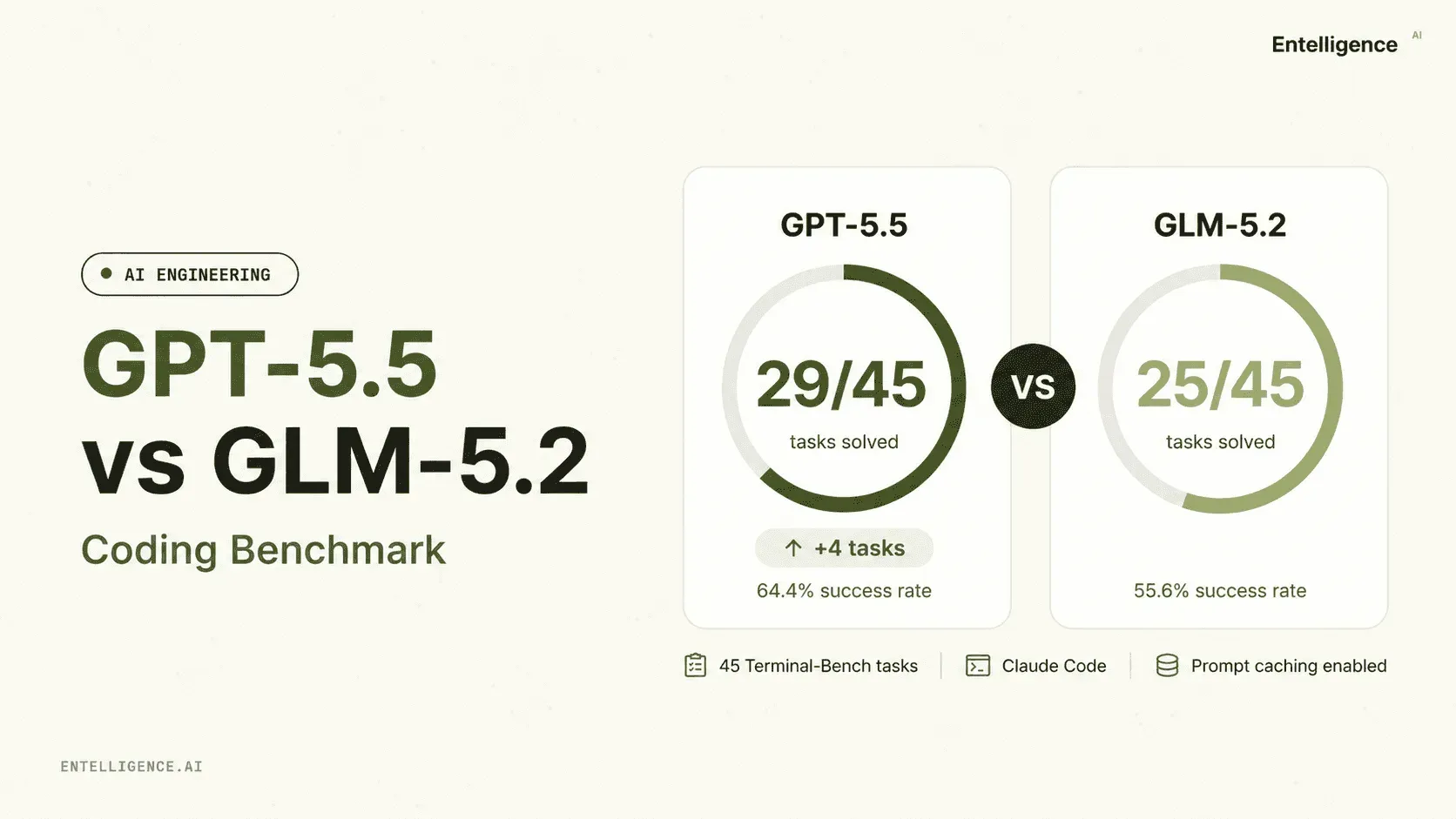
GPT-5.5 solves more tasks than GLM-5.2 on a real coding-agent benchmark but it also costs 70% more to get there. The one-sentence result: GPT-5.5 completes 4 more tasks out of 45, for roughly $10 more per full benchmark run. Whether that trade is worth it depends entirely on what you're optimizing for.
To compare them under real-world conditions, we evaluated both models inside the same coding agent using Terminal-Bench. Every variable except the underlying model remained identical, allowing us to measure differences in coding performance, agent efficiency, and inference cost.
Benchmark Setup
All evaluations were performed using Terminal-Bench, a benchmark designed to evaluate agentic software engineering tasks under hidden test evaluation.
To ensure a fair comparison, every variable except the model remained identical:
- Benchmark: Terminal-Bench (45 tasks)
- Coding Agent: Claude Code
- GPT Model: GPT-5.5 (Medium Reasoning)
- GLM Model: GLM-5.2
- Identical prompts
- Identical tool access
- Same hidden evaluation tests
- Same execution environment
- Same turn budget
The benchmark measures complete task execution rather than isolated code generation, making it representative of how coding agents behave in production environments.
Evaluation Tasks
Both models were evaluated on the exact same 45-task subset of Terminal-Bench under identical conditions.
The workload spans a broad range of real software engineering tasks, including:
- Python debugging
- Multi-file repository modifications
- Backend implementation
- Dependency management
- Package installation
- Command-line tooling
- Asynchronous programming
- Data transformation
- Performance profiling
- Parsing and automation
- Infrastructure debugging
- Algorithmic reasoning
Representative tasks include broken-python, csv-to-parquet, cancel-async-tasks, classifier-debug, fix-pandas-version, fibonacci-server, cprofiling-python, dna-assembly, crack-7z-hash, and hydra-debug-slurm-mode.
Because every task, prompt, tool, execution environment, and evaluation script remained identical, the benchmark isolates model capability rather than differences in workload.
Benchmark Results
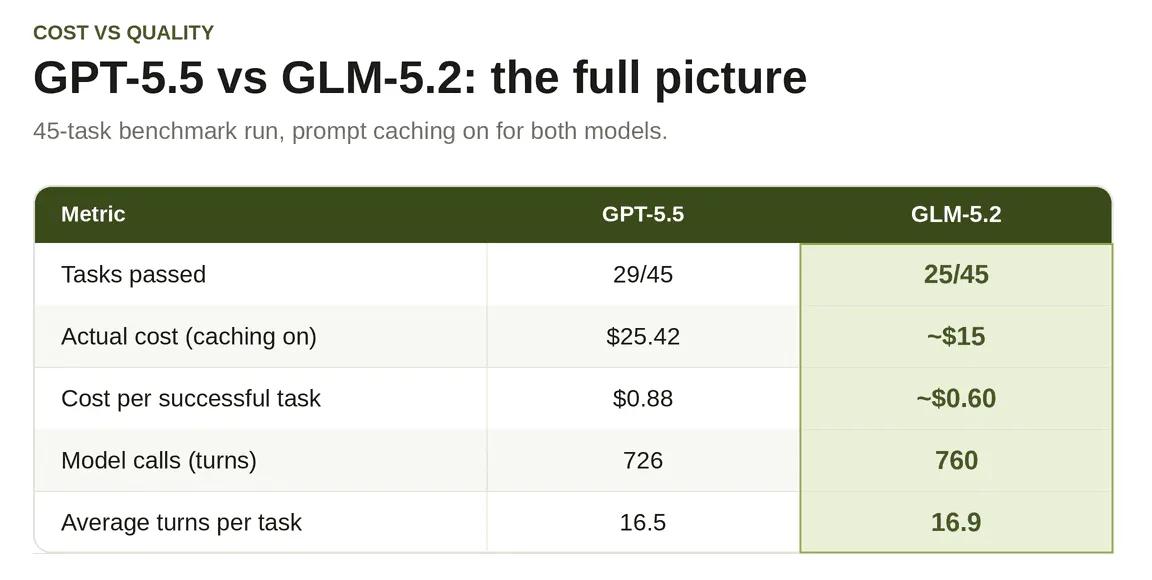
GPT-5.5 achieved the highest overall task completion rate, solving 29 of 45 tasks compared to 25 of 45 for GLM-5.2. It also completed the benchmark with fewer model calls, indicating more efficient execution across the same workload.
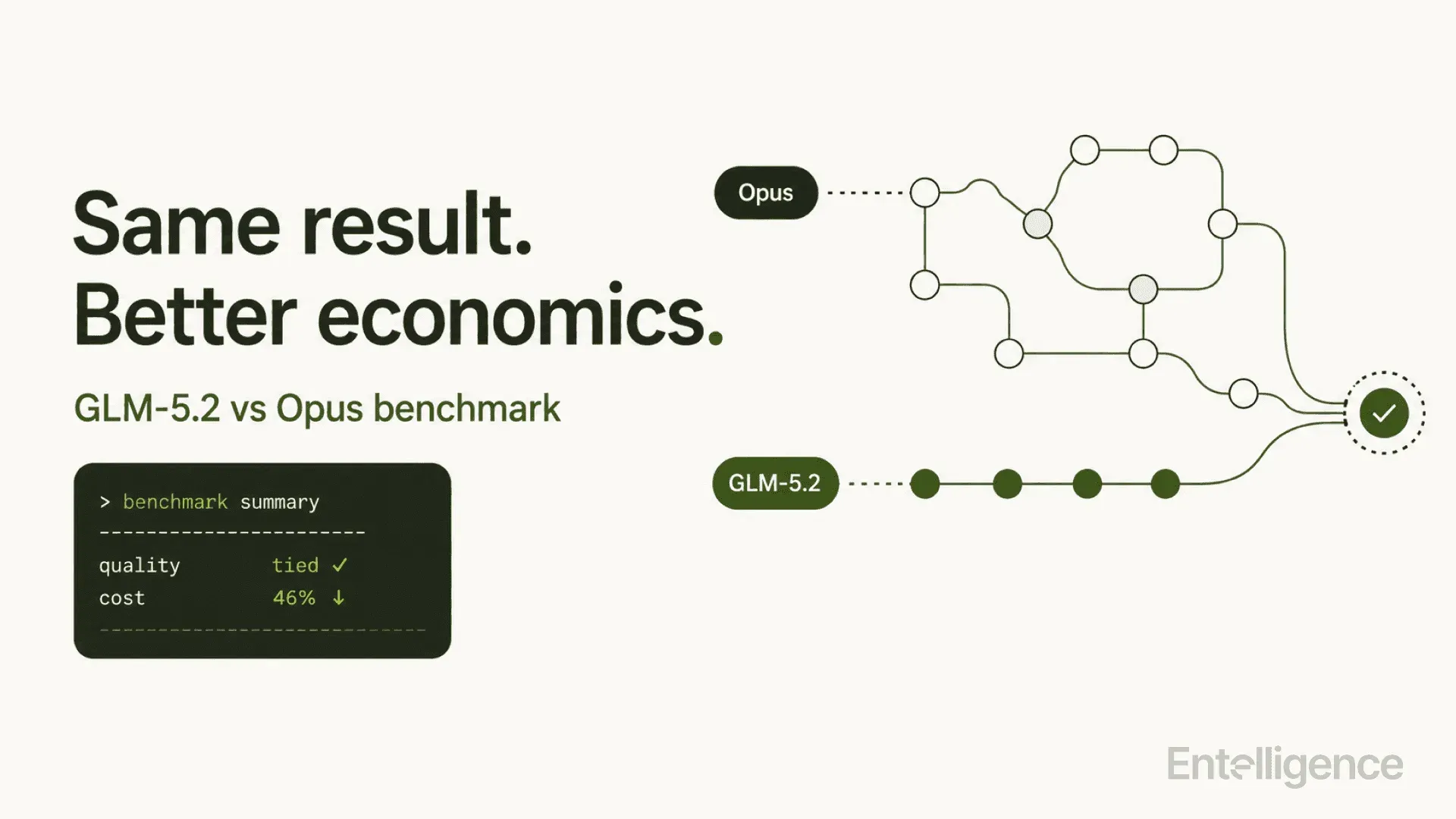
GLM-5.2 remained highly competitive while reducing inference cost by roughly 40% when prompt caching was enabled.
Cost Comparison
One of GLM-5.2's biggest strengths is pricing.
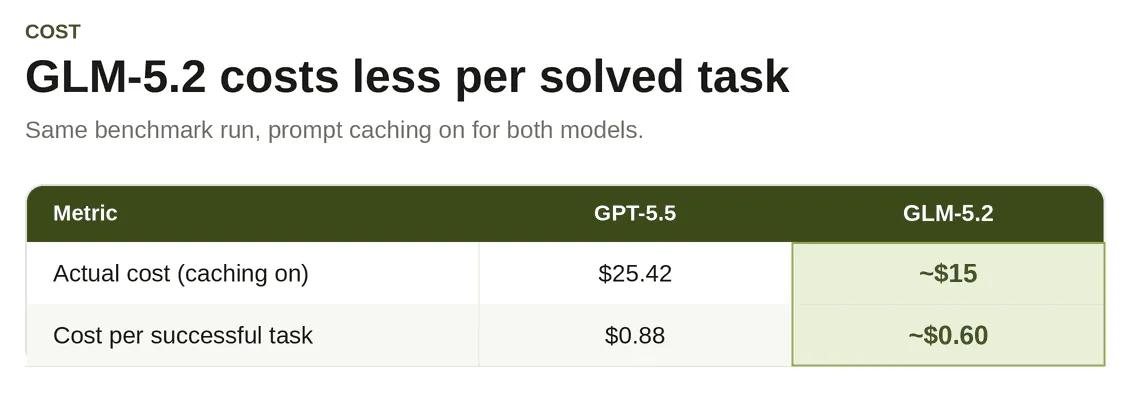
Although GPT-5.5 achieved better benchmark performance, GLM-5.2 completed the same evaluation for approximately $15, compared to $25.42 for GPT-5.5 using identical workloads.
For organizations running thousands of coding-agent sessions each day, this difference compounds into substantial infrastructure savings while maintaining competitive coding performance.
Agent Efficiency
Task completion tells only part of the story.
We also measured how efficiently each model navigated the benchmark.
GPT-5.5 required 726 model calls across the benchmark, averaging 16.5 calls per task. GLM-5.2 completed the same workload in 760 model calls, averaging 16.9 calls per task.
The difference is relatively small, but GPT-5.5 consistently reached successful solutions with fewer overall interactions, resulting in shorter execution paths and higher task completion.
What This Benchmark Shows
These results highlight two different optimization strategies.
GPT-5.5 prioritizes maximum coding capability, solving more software engineering tasks while requiring fewer model interactions.
GLM-5.2 prioritizes price-performance, delivering competitive coding results at substantially lower inference cost, particularly when prompt caching is enabled.
Because both models were evaluated using the same coding agent, prompts, tools, hidden evaluation tests, execution environment, and turn budget, the comparison reflects differences in model capability rather than benchmark configuration.
Like any benchmark, these results represent one evaluation setup. Performance may vary across different coding agents, workloads, reasoning settings, or future model versions.
Key Takeaways
- GPT-5.5 achieved the highest overall task completion rate (29/45).
- GLM-5.2 remained competitive while reducing inference cost by roughly 40%.
- GPT-5.5 required fewer overall model calls, indicating more efficient execution.
- GLM-5.2 offers one of the strongest price-to-performance ratios for autonomous coding agents.
- The best choice depends on whether maximum coding performance or infrastructure cost is the primary objective.
Final Verdict
GPT-5.5 delivered the strongest overall performance in our Terminal-Bench evaluation, solving more software engineering tasks while requiring fewer model interactions. For teams where reliability and maximum task success are the priority, it remains the stronger choice.
GLM-5.2, however, delivers exceptional value. Despite solving slightly fewer tasks, it achieves competitive coding performance at roughly 40% lower inference cost with prompt caching, making it an excellent option for large-scale coding agents and cost-sensitive deployments.
If your priority is maximum coding capability, GPT-5.5 is the better model. If your priority is price-to-performance at scale, GLM-5.2 is one of the most compelling options currently available.