


Case study
BeFreed : More Code, Fewer Fixes Needed
BeFreed
How Entelligence went from a handful of reviews to the default check on every PR BeFreed ships
Background
BeFreed builds a personalized AI learning platform. It turns books, research papers, and expert talks into personalized audio lessons, podcasts, and flashcards that adapt to each learner's goals and pace, and more than 500,000 people use it. The product ships across a broad stack: a core backend, a React Native mobile app, a React web client, and a set of internal and growth tools.
Shipping a consumer product at that pace, across that many surfaces, means a constant stream of pull requests. Review has to keep up with every one of them, on every repo, without becoming the thing that slows the team down. That's the bar.
The problem
A fast-growing team shipping across a multi-repo, multi-language codebase can't scale human review linearly with PR volume. Coverage gets uneven, and the pushes that get skimmed are where regressions slip in. What BeFreed needed was a reviewer that read every pull request at the same bar, on every repo, and kept doing it as the team and the codebase grew.
Wired into every repo
Entelligence started on a single repo and became BeFreed's default reviewer fast. Code review volume climbed from about 50 runs in January to nearly 3,000 a month by early summer, spreading from the backend out to the mobile app, the web client, internal tooling, and a growth dashboard onboarded as recently as this summer. Today Entelligence runs across eight repos, from the busiest backend service to the newest tool.
What the trend shows
Two things stand out.
The first is consistency. In the last three months alone, Entelligence ran 7,500+ reviews across 2,900+ PRs, which on the active repos means effectively every pull request got a read. Not the marquee changes only, all of them.
The second is more telling. As the codebase grew, it got quieter. Even as monthly review volume more than doubled from winter to summer, the number of comments Entelligence needed to leave per review fell by more than half. A team shipping faster, with fewer things to flag each time, which is exactly the direction a reviewer is supposed to move a codebase.
The numbers
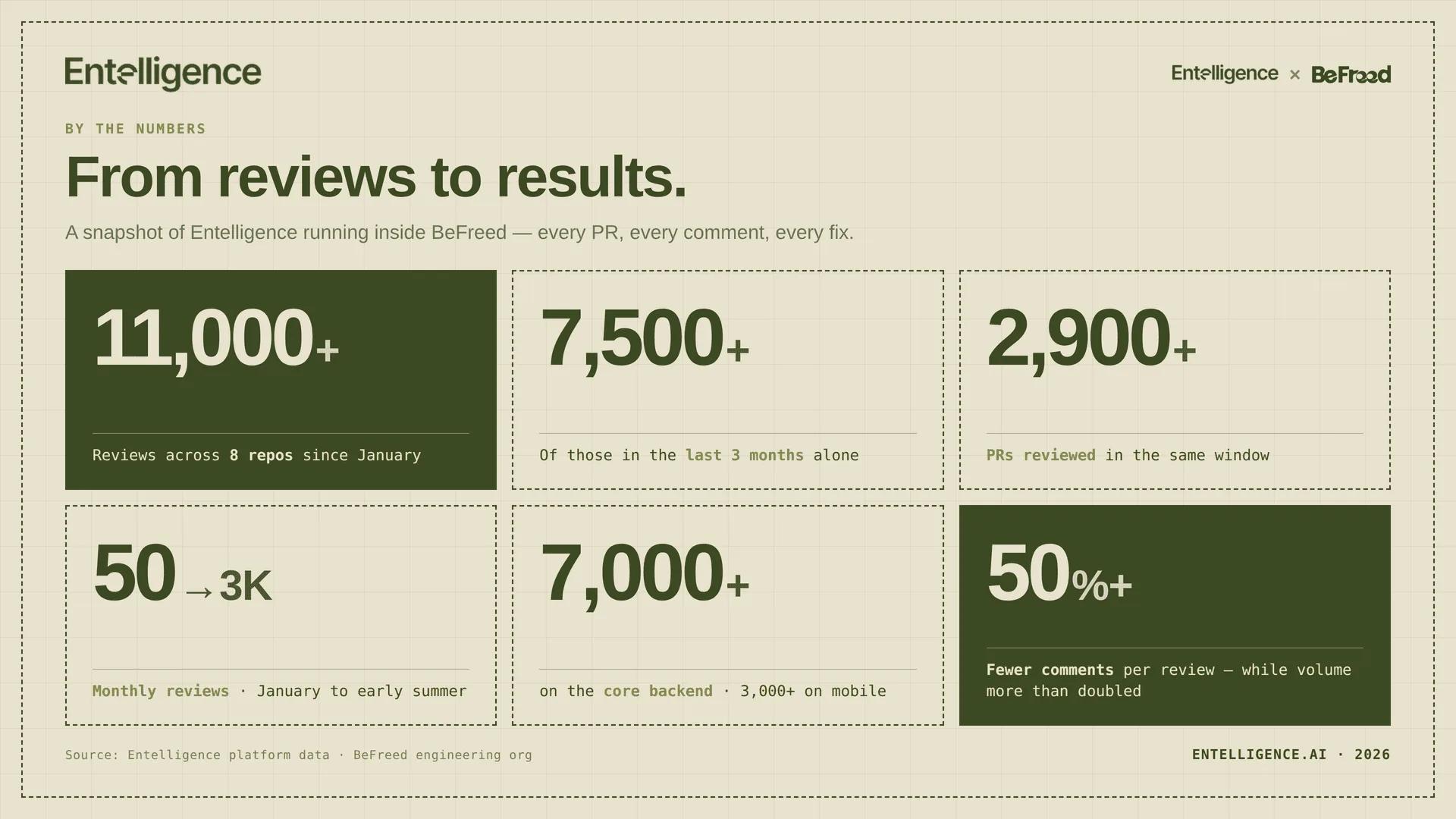
11,000+ reviews run across eight repos since January
- 7,500+ of them in the last three months, across 2,900+ PRs
- monthly volume climbed from about 50 reviews in January to nearly 3,000 by early summer
- 7,000+ reviews on the core backend and 3,000+ on the mobile app
- comments needed per review fell by more than half as volume more than doubled
The bottom line
BeFreed didn't point a reviewer at one repo and leave it there. It made Entelligence the default check on every push, across its entire stack, and that coverage scaled as the product and team grew. The clearest signal is the one in the trend: more code, shipped faster, needing fewer fixes each time.