


One request, one decision#
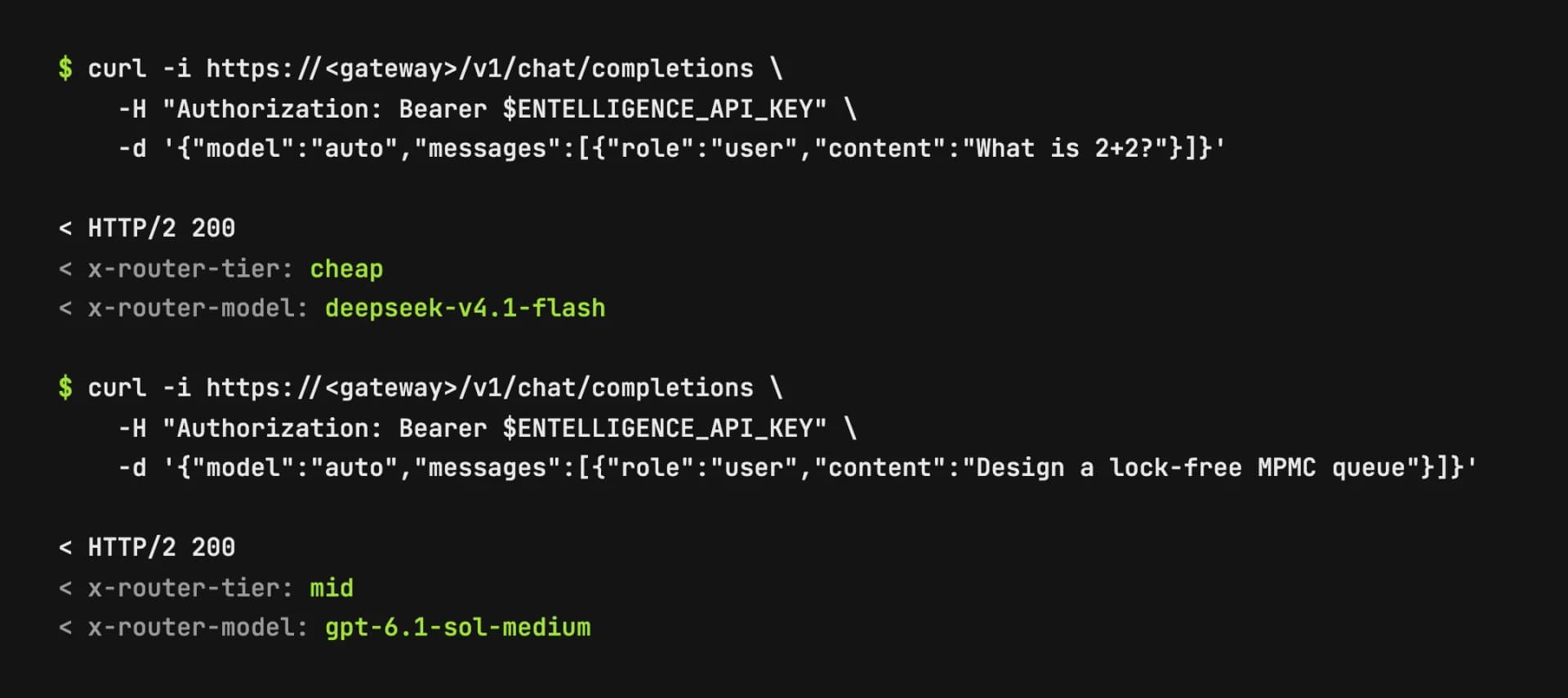
Coding agents keep a session: switching models mid-task throws away the prompt cache, so the router holds a session to its model until the work gets hard. An API caller has different needs. With "auto" (or "entelligence/auto"), each request gets its own decision, classified on its latest user message, and leaves no session state behind.
It works on both /v1/chat/completions and /v1/messages. Any other model name keeps the agent behaviour exactly as before.
The answer says where it ran#
Every response carries x-router-model with the model that served it and a new x-router-tier header with its tier. Failover, billing, bring-your-own-key and per-org policy run the same pipeline in both modes.
A curated catalog, weighted to the cheapest capable model#
The catalog keeps the latest two versions of each model line and retires the rest, which took out 100 registrations. What remains is 30 cheap, 23 mid and 32 frontier models, and tier weighting now favours the cheapest model that is capable of the request. Retired models still resolve for billing history and pinned sessions.
Benchmarks refreshed every hour#
Artificial Analysis metrics now load hourly, and the router added the 14 models and effort levels from the Artificial Analysis top 40 that it was missing, plus cost-per-task figures seeded from their model pages.
Improvements#
- Model RouterMembers see their own sessions, savings and model quality.
- Model RouterModel usage and cost are listed with pagination.
- Model RouterThe usage percentage explains that it counts tokens.
- Model RouterSeptember models added with verified routing.
Fixes#
- Model RouterAn inert bring-your-own-key fallback toggle is gone, and settings links point to the right pages.
- Model RouterThe member view stays up when a panel fails, and savings show only what was measured.
- Model RouterRole copy on the router settings matches who can change them.