
How to Implement a Secure Software Development Life Cycle in 2026 

Dec 12, 2025

Dec 12, 2025

Security issues rarely come from dramatic zero-day attacks; most originate quietly during everyday development. Design oversights, outdated dependencies, missing tests, and overlooked code paths accumulate until one release leads to a costly breach.

The global average cost of a data breach reached around US$4.44 million in 2025

Teams know they need to “shift left,” but the real challenge is execution, not awareness. Modern engineering involves microservices, CI/CD pipelines, IaC, AI-generated code, and distributed teams. Without a structured and measurable security process, every phase becomes another opportunity for vulnerabilities to slip through.

Most organizations don’t struggle because they ignore security; they struggle because they lack a framework that makes security continuous, repeatable, and visible across engineering roles.

In this article, you’ll learn how to build and implement a secure software development life cycle (SSDLC) that matches today’s engineering reality, complete with phase-by-phase controls, KPIs, CI/CD gate examples, supply-chain safeguards, IaC security, and AI-aware development practices.

Key Takeaways

  • A Secure SDLC (SSDLC) strengthens software by embedding security checks into every phase, design, coding, build, testing, deployment, and post-release monitoring.

  • Modern SSDLCs rely on CI/CD security gates, policy-as-code, SBOMs, artifact signing, and continuous visibility to prevent vulnerabilities before they reach production.

  • Supply-chain risks and AI-generated code introduce new validation points, making secure dependency management and code authenticity essential parts of today’s SSDLC.

  • Tracking SSDLC KPIs, such as defect density, time-to-remediate, coverage of security controls, and compliance drift, keeps security continuous rather than a one-off activity.

What Is a Secure Software Development Life Cycle?

A Secure Software Development Life Cycle (SSDLC) is an approach in which security practices are integrated into every phase of software development, including planning, design, coding, testing, deployment, and ongoing maintenance. Instead of treating security as a final checkpoint, SSDLC ensures vulnerabilities are identified and addressed early, when fixes are faster, cheaper, and more reliable.

SSDLC is grounded in well-established industry frameworks that guide how secure software should be built:

Microsoft SDL (Security Development Lifecycle)

A set of engineering practices that include threat modeling, secure coding requirements, static and dynamic analysis, credential management, and a final security review before release.

NIST SSDF (Secure Software Development Framework)

A standardized framework (NIST SP 800-218) outlining secure build environments, dependency integrity, verifiable provenance, and auditable security controls. It is increasingly used by regulated industries and federal suppliers in the United States.

Together, these frameworks provide the baseline for a modern, high-assurance SSDLC.

SSDLC vs SDLC vs DevSecOps

Concept

Primary Focus

Security Positioning

Who Owns It

Common Practices

SDLC

Delivering functional software through structured phases

Security added late (testing or post-release)

Product + Engineering

QA testing, project management, and version control

SSDLC

Embedding security into every SDLC phase

Security is built in early and continuously

Security + Engineering

Threat modeling, secure design, SAST/DAST, SBOMs, dependency scanning

DevSecOps

Automating security inside CI/CD pipelines

Security integrated into automation and runtime environments

DevOps + Security

CI/CD security gates, policy-as-code, secrets scanning, runtime monitoring

These three terms are often used interchangeably, but they solve different problems.

  • SDLC defines how software is delivered.

  • SSDLC strengthens the process by embedding security at every step.

  • DevSecOps ensures those security activities scale through automation in CI/CD.

Understanding the differences helps you design a workflow where security is continuous, measurable, and aligned with how modern engineering teams ship software.

The 6 Phases of a Modern Secure Software Development Life Cycle

A modern SSDLC enhances the software development workflow by integrating security into the decisions you’re already making, including requirements, design, coding, testing, and deployment.

Instead of overwhelming teams with new steps, it enhances the existing process with the right checks at the right time.

Below is a practical, engineering-friendly breakdown of each phase.

1. Requirements & Planning

Goal: Set the security expectations for the feature before development begins.

What teams should do:

  • Define security requirements alongside functional requirements.

  • Classify the data that the feature will process (PII, payment data, secrets, internal).

  • List misuse/abuse cases and convert them into acceptance criteria.

  • Identify compliance hooks early (SOC 2, ISO 27001, GDPR, HIPAA).

  • Document authentication, authorization, logging, and rate-limiting needs.

Checks / Gates:

  • Every epic includes a “Security Requirements” section.

  • High-risk stories must include at least one security acceptance criterion.

  • Sensitive data flows must be approved before design begins.

Typical Owners: Product Manager + Engineering Lead, with review from Security/Compliance.

2. Design & Architecture

Goal: Remove structural weaknesses before they reach coding.

What teams should do:

  • Run threat modeling sessions for new or high-impact components.

  • Review architecture diagrams, trust boundaries, and data flows.

  • Validate API integrations, external services, and privilege boundaries.

  • Choose secure patterns for identity, secrets handling, storage, and logging.

  • Document design decisions that impact security.

Checks / Gates:

  • Architecture review checklist completed.

  • Threat model logged for features touching sensitive data.

  • Third-party components evaluated for risk.

Typical Owners: Staff/Principal Engineers, Security Architects.

3. Development (Coding)

Goal: Ensure code entering the repository follows secure patterns and avoids common pitfalls.

What teams should do:

  • Follow secure coding guidelines for the language/framework.

  • Scan code in IDE: SAST + secrets scanning + linting.

  • Use dependency scanning for all imports/packages.

  • Write tests that confirm secure behavior (auth failures, rate limits, errors).

  • Avoid insecure patterns such as wildcard permissions, weak crypto, or unchecked input.

Checks / Gates:

  • SAST, SCA, and secret-scanning must pass pre-merge.

  • PR must reference relevant security acceptance criteria.

  • No new high-severity vulnerabilities allowed into main.

Typical Owners: Developers + Security Champions.
https://entelligence.ai/code-quality

4. Build & Integration

Goal: Ensure every artifact is trustworthy, tamper-proof, and consistent with IaC expectations.

What teams should do:

  • Generate an SBOM for each build.

  • Sign containers/binaries using cosign or equivalent.

  • Scan containers and IaC templates for misconfigurations.

  • Lock dependency versions and enforce trusted registries.

  • Harden CI runners and restrict access to build secrets.

Checks / Gates:

  • Build must include an SBOM + signature + provenance metadata.

  • IaC checks must pass (Terraform, Kubernetes, Helm).

  • Only signed, verified artifacts move to staging or production.

Typical Owners: DevOps/Platform Engineering + Security Engineering.

5. Testing & Verification

Goal: Validate that the system behaves safely under real-world and adversarial conditions.

What teams should do:

  • Run DAST against staging or ephemeral environments.

  • Perform API tests, fuzz testing, and negative-path testing.

  • Run container/image scans again post-build.

  • Execute security regression tests for high-risk flows.

  • Validate permission boundaries, rate limits, and auth flows.

Checks / Gates:

  • No critical or high-severity findings in DAST.

  • All security regression tests must pass.

  • API responses validated for safe error handling and no sensitive leaks.

Typical Owners: QA + Security Testing Teams + DevOps for staging orchestration.

6. Deployment & Continuous Monitoring

Goal: Ensure the deployed system remains secure as environments evolve.

What teams should do:

  • Monitor runtime for anomalies, drift, and unexpected configuration changes.

  • Track new CVEs in deployed dependencies.

  • Enforce runtime policies (e.g., block unsigned images).

  • Maintain actionable logs for auth failures, privilege escalation, and API misuse.

  • Run periodic incident response drills and post-incident reviews.

Checks / Gates:

  • Drift detection alerts surfaced and were triaged.

  • Runtime protection rules active (PSPs, admission controls, WAF).

  • Patching SLAs are enforced based on criticality.

Typical Owners: Platform Team + Security Operations + Engineering Managers.

Together, these phases create a predictable, repeatable SSDLC where every stage contributes concrete checks, clear ownership, and measurable improvements to software integrity.

Why Is the SSDLC Important for Engineering Teams?

A Secure Software Development Life Cycle (SSDLC) provides engineering teams with a structured approach to building secure, reliable software without slowing down delivery. Instead of reacting to vulnerabilities after they reach production, teams identify risks early, enforce consistent controls, and create predictable workflows that improve both security posture and product velocity.
Why Is the SSDLC Important for Engineering Teams?

SSDLC isn’t just a compliance requirement or a security checklist; it’s an operational model that reduces rework, strengthens reliability, and keeps engineering output aligned with organizational risk expectations.

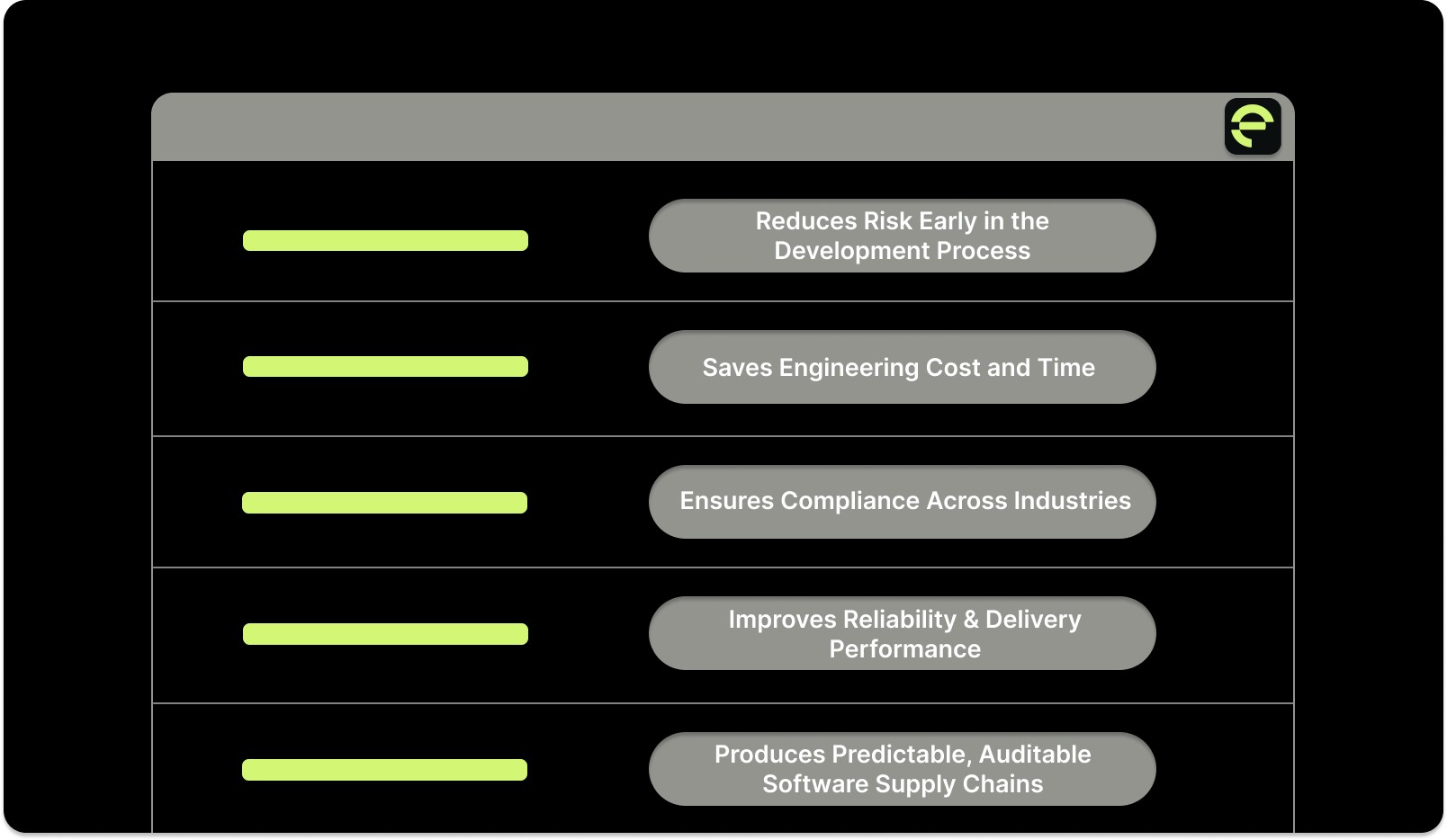
1. Reduces Risk Early in the Development Process

Catching security issues during design, coding, or build stages prevents them from becoming expensive, high-severity problems in production. Early detection also reduces back-and-forth during PR reviews and simplifies architecture decisions since the team works with secure patterns from the start.

2. Saves Engineering Cost and Time

When vulnerabilities surface late in the cycle, they trigger rework across engineering, product, QA, and DevOps. SSDLC shifts the effort earlier, where fixes are cheaper, faster, and more predictable. This reduces context-switching and slows the accumulation of security-related technical debt.

3. Ensures Compliance Across Industries (SOC 2, ISO 27001, GDPR, FedRAMP)

Most compliance frameworks require documented secure development practices, code integrity controls, access restrictions, and auditable workflows. SSDLC provides the structure needed for:

  • SOC 2 CC8: Change Management

  • ISO 27001 Annex A.14: Secure System Acquisition & Development

  • GDPR Article 25: Security by Design

  • NIST 800-218 & FedRAMP security baselines

By having a repeatable SSDLC, engineering teams can pass audits without last-minute retroactive documentation.

4. Improves Reliability and Delivery Performance

Teams that embed security checks earlier in the cycle naturally strengthen DORA outcomes:

  • Lower Change Failure Rate (CFR), secure code reduces production incidents

  • Faster MTTR, better visibility, improved recovery

  • Shorter Lead Time, fewer unplanned fixes slow the pipeline

  • Higher Deployment Frequency, stable code moves through CI faster

SSDLC makes security a multiplier for engineering velocity, not a blocker.

5. Produces Predictable, Auditable Software Supply Chains

Modern software relies on open-source packages, AI-generated code, third-party services, and distributed CI/CD pipelines. SSDLC controls such as SBOMs, dependency scanning, and artifact signing create a verifiable chain of custody from code to production.

This improves trust, reduces supply-chain risk, and ensures engineering teams can demonstrate provenance during audits or incident investigations.

Practical View: Risks, Controls, and the Resulting Impact

Risk

SSDLC Control

Impact on Engineering Teams

Vulnerabilities introduced during coding

SAST, secure coding standards, PR security checks

Fewer bugs, reduced rework, higher PR quality

Compromised dependencies

Dependency scanning, SBOM generation

Lower supply-chain risk, predictable upgrades

Architecture flaws

Threat modeling, secure design reviews

Early risk visibility, fewer costly redesigns

Unverified builds

Artifact signing, trusted CI/CD pipelines

Stronger integrity, audit-ready builds

Inconsistent processes

Policy-as-code, automated CI gates

Repeatability, compliance readiness, and faster delivery

Also Read: Entelligence AI: State-of-the-Art PR Reviews

Advanced SSDLC Components

Modern engineering teams work in an environment shaped by fast release cycles, distributed systems, AI-generated code, and a constantly shifting dependency ecosystem. A mature SSDLC must account for these realities, strengthening security across code, infrastructure, pipelines, and the software supply chain.

Below are the advanced components that help teams build a resilient, verifiable, and continuously secure development lifecycle.

Supply Chain Security (SBOM, SLSA, and Provenance Attestation)

Supply chain attacks usually don’t start in code; they originate in third-party libraries, build tooling, or tampered artifacts. Strengthening supply chain security ensures every dependency, image, and build artifact is traceable and trustworthy.

What’s Inside an SBOM

A Software Bill of Materials provides a detailed inventory of:

• Dependencies and sub-dependencies

• Versions and licenses

• Hashes or checksums

• Known vulnerabilities associated with each component

This allows engineering teams to identify outdated or risky libraries early.

Why SLSA Matters

The Supply-chain Levels for Software Artifacts (SLSA) framework defines how trustworthy a build pipeline is. It focuses on:

• Build reproducibility

• Isolation of build environments

• Verification of source integrity

• Tamper-evident provenance

SLSA ensures the build process itself cannot be manipulated.

Signing & Verifying Packages

Artifact signing (e.g., with cosign) ensures that only authenticated, untampered images and binaries are deployed.

• Sign images as part of CI

• Store signatures in transparent logs

• Verify signatures during deployment

• Block unsigned or unverified artifacts

Enforcing Provenance in CI

Build systems must attach metadata that answers:

• What source was used?

• Who triggered the build?

• Which tools ran?

• Was the workflow modified?

Deployments should only accept artifacts that carry valid attestations.

Dependency-Reduction Strategies

Reducing dependency risk includes:

• Removing unused libraries

• Choosing well-maintained packages with active security advisories

• Pinning versions

• Restricting installations to trusted registries

Industry analyses consistently find that most security issues arise from indirect, deep-chain dependencies rather than direct imports, which is why reducing unnecessary packages is one of the most effective risk controls.

Also Read: How Entelligence AI is Redefining the Developer Experience

Cloud & IaC Security Integration

Infrastructure is now part of the codebase, which means SSDLC must cover Terraform, Kubernetes manifests, Helm charts, and cloud configuration. Security must shift left into these definitions, not wait for runtime detection.

Terraform & Kubernetes Checks Pre-Merge

Automated scanning validates:

• Public buckets

• Overly permissive IAM roles

• Insecure security groups

• Unsafe container settings (e.g., privileged mode)

• Missing resource limits

These issues should block merges until they are resolved.

Drift Detection

Environments evolve quickly. Drift detection ensures that what is deployed continues to match the IaC source of truth. Any deviation from manual edits, overlooked patches, or unsafe ad-hoc configs is surfaced and remediated.

Admission Controllers

Kubernetes admission controllers enforce rules before workloads run, such as:

• Blocking unsigned images

• Enforcing pod security standards

• Restricting hostPath mounts

• Requiring resource limits

They act as runtime gatekeepers at the cluster level.

Policy-as-Code (OPA/Rego)

Validation logic embedded directly into CI/CD ensures:

• No privilege escalation in deployments

• No public ingress unless approved

• Consistent tagging, logging, and encryption

• Compliance with organizational baselines

Policy-as-code turns security guidelines into enforceable automation.

AI-Assisted Development Risks & Controls

AI accelerates development, but it also introduces unique risks. A modern SSDLC must include guardrails for AI-generated or AI-suggested code.
AI-Assisted Development Risks & Controls

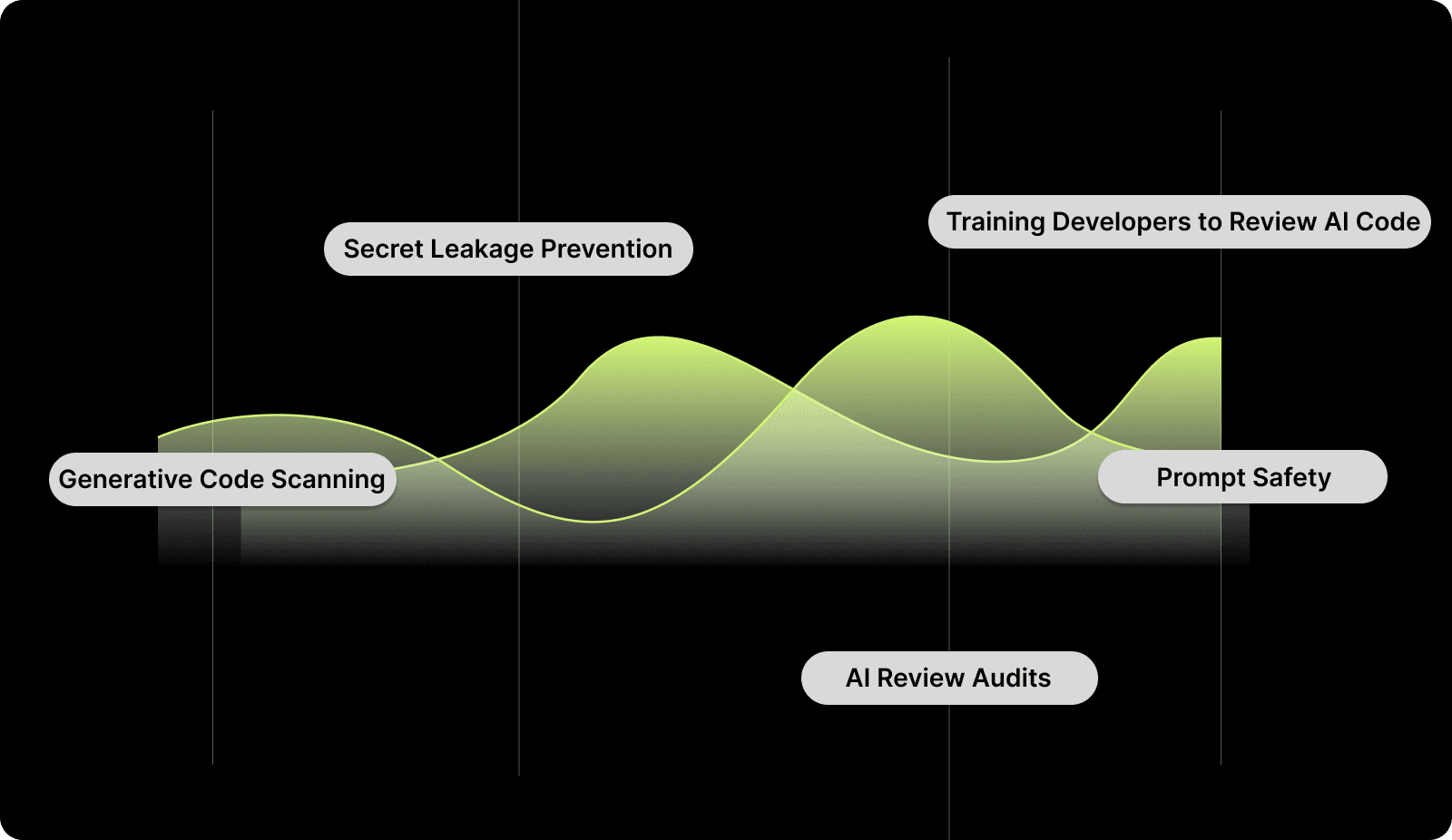
Generative Code Scanning

AI-generated code should be scanned for:

• Insecure defaults

• Outdated libraries

• Unsafe patterns copied from training data

• Missing input validation or error handling

Automated scanning helps reduce AI-introduced vulnerabilities.

Secret Leakage Prevention

LLMs may accidentally produce:

• Dummy secrets that resemble real ones

• Hard-coded credentials

• Keys embedded in example snippets

Secrets scanners must run on every PR, regardless of origin.

Training Developers to Review AI Code

Teams must:

• Validate logic paths

• Check edge cases

• Ensure architectural consistency

• Confirm the code aligns with internal standards

AI suggestions still require deliberate human oversight.

Prompt Safety

Prompts should avoid leaking:

• Internal architecture details

• Proprietary code

• Production secrets

• Credential patterns

A secure prompting policy mitigates exposure.

AI Review Audits

Periodic audits of AI-generated code ensure the long-term impact of AI assistance remains manageable and secure.

Metrics & Dashboards for SSDLC

Measuring SSDLC performance helps teams identify patterns, track improvements, and maintain long-term security consistency. Clear visibility makes the lifecycle operational—not theoretical.

Key metrics include:

  1. Vulnerability SLA Compliance: Tracks how quickly vulnerabilities are remediated based on severity.

  2. SAST/SCA Pass Rate: Indicates whether secure coding practices are consistent across sprints.

  3. IaC Policy Pass Rate: Shows how well teams adhere to cloud and infrastructure guardrails.

  4. PR Review Quality with Security Context: Evaluates whether reviews include security considerations, not just functionality or readability.

  5. Signed Artifact Coverage: Measures how many build artifacts, images, or releases are cryptographically verified.

  6. Team-Level Trends:

• Dependency health

• Security-related rework

• Architecture drift

• Change failure rates influenced by security issues

These metrics transform SSDLC from a checklist into an accountable, data-driven engineering discipline.

Also Read: Introducing Entelligence Engineering Leaderboard: a real-time scoreboard for developers

Common SSDLC Challenges and How to Overcome Them

Even teams with strong intentions struggle to maintain a consistent SSDLC. The challenges rarely come from a lack of tooling; they come from fragmented processes, unclear ownership, and the growing complexity of modern software systems. Addressing these issues requires a mix of cultural alignment and technical guardrails.

Data Fragmentation Across Tools and Pipelines

Security signals often live in different systems — SAST dashboards, dependency reports, Jira tickets, cloud alerts, and runtime findings. Teams lose context, fixes get delayed, and risk visibility becomes inconsistent.

How to Solve It

• Consolidate findings from code, dependencies, IaC, and runtime tools

• Normalize severity and prioritization across systems

• Use version-controlled policies to ensure consistent evaluation

• Maintain a unified audit trail for compliance and incident reviews

A central source of truth reduces confusion and speeds up remediation.

Developer Resistance to Security Work

Developers often view security tasks as blockers that slow down feature delivery. Without the right approach, SSDLC steps feel like friction instead of part of the workflow.

How to Solve It

• Keep checks inside existing developer tools and CI flows

• Add lightweight security acceptance criteria to stories

• Provide reusable, secure patterns and code examples

• Introduce a security champion model to distribute expertise

When security feels integrated, not bolted on, teams adopt it naturally.

High Noise and False Positives

SAST, SCA, and IaC scanners often flood teams with findings, many of which are low-impact or irrelevant. Noise overwhelms developers, leading to alert fatigue.

How to Solve It

• Tune scanners to ignore low-risk or duplicate findings

• Use risk-based prioritization tied to exploitability and exposure

• Autofix or autoflag common patterns using templates

• Suppress findings that meet internal policy thresholds

Lower noise produces higher trust in security signals.

Cloud and Infrastructure Complexity

Modern architectures introduce multiple layers of risk — Kubernetes, Terraform, serverless components, service meshes, and distributed secrets. Without IaC visibility, misconfigurations slip into production.

How to Solve It

• Scan Terraform, Kubernetes manifests, and Helm charts in PRs

• Enforce policy-as-code for guardrails such as encryption, IAM, and networking

• Enable drift detection to identify deviations from IaC baselines

• Block deployments of workloads that violate security baselines

Securing IaC early prevents misconfigurations from turning into incidents.

Lack of Clear Security Ownership

Security responsibilities often fall between engineering, QA, DevOps, and platform teams. Without clarity, SSDLC adoption becomes inconsistent.

How to Solve It

• Define RACI ownership across phases (design, coding, build, release, runtime)

• Add SSDLC responsibilities to engineering onboarding

• Use platform-level enforcement so controls apply automatically

• Integrate security KPIs into sprint and release metrics

Clear ownership ensures SSDLC is practiced, not assumed.

Modern Answers That Strengthen SSDLC Adoption

A mature SSDLC relies on automation, clarity, and shared responsibility.

Policy-as-Code: Moves security guidelines into reusable, enforceable rules that run inside CI, gating unsafe changes before they merge.

Security Champions: Creates a distributed model where knowledgeable developers guide secure design and help review PRs within their teams.

Platform-Level Enforcement: Ensures that certain controls, signing, provenance, dependency policies, and IaC checks cannot be bypassed, regardless of individual habits or team maturity.

These modern approaches keep SSDLC lightweight, consistent, and scalable.
https://app.entelligence.ai/signup

How Entelligence AI Strengthens the Secure Software Development Life Cycle

Modern engineering teams rely on multiple tools across code scanning, dependency management, IaC validation, and runtime monitoring. But when findings are scattered, PR reviews vary in quality, and teams lack a unified view of security and code health, gaps appear across the lifecycle.

These gaps slow delivery, increase incident risk, and make it difficult for engineering leaders to understand where vulnerabilities originate or how fast they are resolved.

Entelligence AI addresses this by acting as a single intelligence layer across the SDLC, bringing together security signals, code quality insights, developer productivity patterns, and workflow automation.

Instead of jumping between dashboards, teams get one place where reviews, findings, and engineering patterns are connected with full context.

What Entelligence AI Adds to Your SSDLC

  • Context-rich PR reviews that highlight insecure patterns, risky dependencies, missing checks, or architecture inconsistencies early in the cycle.

  • Real-time dashboards that unify code quality, security findings, and dependency health across repositories and teams.

  • AI-based IDE review that guides developers before they even open a pull request, reducing rework and improving consistency.

  • Automatic documentation for SBOMs, dependency summaries, design notes, and security-relevant artifacts created throughout the lifecycle.

  • Sprint and team-level insights that surface recurring issues, risk hotspots, and trends that influence long-term reliability.

  • Process consistency across the organization, ensuring security gates, coding standards, and review patterns are applied uniformly without additional overhead.

Together, these capabilities create a development environment where secure practices are embedded naturally into the workflow, making every release more predictable, auditable, and aligned with engineering expectations.

Conclusion

A secure software development life cycle isn’t built through scattered checks or last-minute fixes. It emerges when teams apply measurable controls, strengthen supply-chain visibility, add guardrails for AI-generated code, and enforce consistent security gates across design, coding, build, deployment, and runtime.

With the right structure, SSDLC becomes a predictable, repeatable, and confidence-driven way to ship software.

Entelligence AI

supports this approach by bringing code quality, security findings, dependency health, and engineering visibility together in one place. Instead of navigating multiple tools, teams work from a single source of truth that makes secure development clearer, faster, and easier to maintain.

Start your free trial with Entelligence AI and see how seamless, secure development becomes when clarity is built into every step.

FAQs

1. What is the difference between SDLC, SSDLC, and DevSecOps?

SDLC defines the phases of building and releasing software. SSDLC strengthens this process by embedding security activities, threat modeling, SAST, SBOMs, and policy checks into every phase. DevSecOps focuses on automating those security activities inside CI/CD pipelines, ensuring they run continuously and at scale.

2. How do I measure if my SSDLC is working?

An effective SSDLC shows improvement across measurable indicators like SAST/SCA pass rates, vulnerability SLAs, mean time to remediate, IaC policy compliance, and artifact-signing coverage. Over time, you should see fewer late-cycle defects, fewer emergency fixes, and more predictable releases. Consistent metrics make progress visible across teams.

3. What tools support an SSDLC pipeline?

SSDLC pipelines typically use a mix of SAST/SCA scanners, IaC analyzers, secrets scanners, SBOM generators, artifact-signing tools, and policy-as-code engines. CI/CD systems like GitHub Actions, GitLab CI, and Jenkins enforce gates, while platforms such as Entelligence provide unified visibility across code quality, security issues, and team performance.

4. How does SSDLC handle cloud and IaC risks?

SSDLC incorporates IaC scanning, drift detection, and admission controls to catch misconfigurations before deployment. Policy-as-code ensures Terraform, Kubernetes, and cloud templates follow organizational security rules. By shifting these checks earlier, teams prevent risky cloud changes from reaching production.

5. How do SBOMs and SLSA improve supply-chain security?

SBOMs list every dependency and component in an application, giving teams visibility into vulnerable or outdated packages. SLSA adds integrity controls like provenance, build isolation, and artifact signing to ensure code hasn’t been tampered with. Together, they strengthen trust in the software supply chain and simplify audits.

Security issues rarely come from dramatic zero-day attacks; most originate quietly during everyday development. Design oversights, outdated dependencies, missing tests, and overlooked code paths accumulate until one release leads to a costly breach.

The global average cost of a data breach reached around US$4.44 million in 2025

Teams know they need to “shift left,” but the real challenge is execution, not awareness. Modern engineering involves microservices, CI/CD pipelines, IaC, AI-generated code, and distributed teams. Without a structured and measurable security process, every phase becomes another opportunity for vulnerabilities to slip through.

Most organizations don’t struggle because they ignore security; they struggle because they lack a framework that makes security continuous, repeatable, and visible across engineering roles.

In this article, you’ll learn how to build and implement a secure software development life cycle (SSDLC) that matches today’s engineering reality, complete with phase-by-phase controls, KPIs, CI/CD gate examples, supply-chain safeguards, IaC security, and AI-aware development practices.

Key Takeaways

  • A Secure SDLC (SSDLC) strengthens software by embedding security checks into every phase, design, coding, build, testing, deployment, and post-release monitoring.

  • Modern SSDLCs rely on CI/CD security gates, policy-as-code, SBOMs, artifact signing, and continuous visibility to prevent vulnerabilities before they reach production.

  • Supply-chain risks and AI-generated code introduce new validation points, making secure dependency management and code authenticity essential parts of today’s SSDLC.

  • Tracking SSDLC KPIs, such as defect density, time-to-remediate, coverage of security controls, and compliance drift, keeps security continuous rather than a one-off activity.

What Is a Secure Software Development Life Cycle?

A Secure Software Development Life Cycle (SSDLC) is an approach in which security practices are integrated into every phase of software development, including planning, design, coding, testing, deployment, and ongoing maintenance. Instead of treating security as a final checkpoint, SSDLC ensures vulnerabilities are identified and addressed early, when fixes are faster, cheaper, and more reliable.

SSDLC is grounded in well-established industry frameworks that guide how secure software should be built:

Microsoft SDL (Security Development Lifecycle)

A set of engineering practices that include threat modeling, secure coding requirements, static and dynamic analysis, credential management, and a final security review before release.

NIST SSDF (Secure Software Development Framework)

A standardized framework (NIST SP 800-218) outlining secure build environments, dependency integrity, verifiable provenance, and auditable security controls. It is increasingly used by regulated industries and federal suppliers in the United States.

Together, these frameworks provide the baseline for a modern, high-assurance SSDLC.

SSDLC vs SDLC vs DevSecOps

Concept

Primary Focus

Security Positioning

Who Owns It

Common Practices

SDLC

Delivering functional software through structured phases

Security added late (testing or post-release)

Product + Engineering

QA testing, project management, and version control

SSDLC

Embedding security into every SDLC phase

Security is built in early and continuously

Security + Engineering

Threat modeling, secure design, SAST/DAST, SBOMs, dependency scanning

DevSecOps

Automating security inside CI/CD pipelines

Security integrated into automation and runtime environments

DevOps + Security

CI/CD security gates, policy-as-code, secrets scanning, runtime monitoring

These three terms are often used interchangeably, but they solve different problems.

  • SDLC defines how software is delivered.

  • SSDLC strengthens the process by embedding security at every step.

  • DevSecOps ensures those security activities scale through automation in CI/CD.

Understanding the differences helps you design a workflow where security is continuous, measurable, and aligned with how modern engineering teams ship software.

The 6 Phases of a Modern Secure Software Development Life Cycle

A modern SSDLC enhances the software development workflow by integrating security into the decisions you’re already making, including requirements, design, coding, testing, and deployment.

Instead of overwhelming teams with new steps, it enhances the existing process with the right checks at the right time.

Below is a practical, engineering-friendly breakdown of each phase.

1. Requirements & Planning

Goal: Set the security expectations for the feature before development begins.

What teams should do:

  • Define security requirements alongside functional requirements.

  • Classify the data that the feature will process (PII, payment data, secrets, internal).

  • List misuse/abuse cases and convert them into acceptance criteria.

  • Identify compliance hooks early (SOC 2, ISO 27001, GDPR, HIPAA).

  • Document authentication, authorization, logging, and rate-limiting needs.

Checks / Gates:

  • Every epic includes a “Security Requirements” section.

  • High-risk stories must include at least one security acceptance criterion.

  • Sensitive data flows must be approved before design begins.

Typical Owners: Product Manager + Engineering Lead, with review from Security/Compliance.

2. Design & Architecture

Goal: Remove structural weaknesses before they reach coding.

What teams should do:

  • Run threat modeling sessions for new or high-impact components.

  • Review architecture diagrams, trust boundaries, and data flows.

  • Validate API integrations, external services, and privilege boundaries.

  • Choose secure patterns for identity, secrets handling, storage, and logging.

  • Document design decisions that impact security.

Checks / Gates:

  • Architecture review checklist completed.

  • Threat model logged for features touching sensitive data.

  • Third-party components evaluated for risk.

Typical Owners: Staff/Principal Engineers, Security Architects.

3. Development (Coding)

Goal: Ensure code entering the repository follows secure patterns and avoids common pitfalls.

What teams should do:

  • Follow secure coding guidelines for the language/framework.

  • Scan code in IDE: SAST + secrets scanning + linting.

  • Use dependency scanning for all imports/packages.

  • Write tests that confirm secure behavior (auth failures, rate limits, errors).

  • Avoid insecure patterns such as wildcard permissions, weak crypto, or unchecked input.

Checks / Gates:

  • SAST, SCA, and secret-scanning must pass pre-merge.

  • PR must reference relevant security acceptance criteria.

  • No new high-severity vulnerabilities allowed into main.

Typical Owners: Developers + Security Champions.

https://entelligence.ai/code-quality

4. Build & Integration

Goal: Ensure every artifact is trustworthy, tamper-proof, and consistent with IaC expectations.

What teams should do:

  • Generate an SBOM for each build.

  • Sign containers/binaries using cosign or equivalent.

  • Scan containers and IaC templates for misconfigurations.

  • Lock dependency versions and enforce trusted registries.

  • Harden CI runners and restrict access to build secrets.

Checks / Gates:

  • Build must include an SBOM + signature + provenance metadata.

  • IaC checks must pass (Terraform, Kubernetes, Helm).

  • Only signed, verified artifacts move to staging or production.

Typical Owners: DevOps/Platform Engineering + Security Engineering.

5. Testing & Verification

Goal: Validate that the system behaves safely under real-world and adversarial conditions.

What teams should do:

  • Run DAST against staging or ephemeral environments.

  • Perform API tests, fuzz testing, and negative-path testing.

  • Run container/image scans again post-build.

  • Execute security regression tests for high-risk flows.

  • Validate permission boundaries, rate limits, and auth flows.

Checks / Gates:

  • No critical or high-severity findings in DAST.

  • All security regression tests must pass.

  • API responses validated for safe error handling and no sensitive leaks.

Typical Owners: QA + Security Testing Teams + DevOps for staging orchestration.

6. Deployment & Continuous Monitoring

Goal: Ensure the deployed system remains secure as environments evolve.

What teams should do:

  • Monitor runtime for anomalies, drift, and unexpected configuration changes.

  • Track new CVEs in deployed dependencies.

  • Enforce runtime policies (e.g., block unsigned images).

  • Maintain actionable logs for auth failures, privilege escalation, and API misuse.

  • Run periodic incident response drills and post-incident reviews.

Checks / Gates:

  • Drift detection alerts surfaced and were triaged.

  • Runtime protection rules active (PSPs, admission controls, WAF).

  • Patching SLAs are enforced based on criticality.

Typical Owners: Platform Team + Security Operations + Engineering Managers.

Together, these phases create a predictable, repeatable SSDLC where every stage contributes concrete checks, clear ownership, and measurable improvements to software integrity.

Why Is the SSDLC Important for Engineering Teams?

A Secure Software Development Life Cycle (SSDLC) provides engineering teams with a structured approach to building secure, reliable software without slowing down delivery. Instead of reacting to vulnerabilities after they reach production, teams identify risks early, enforce consistent controls, and create predictable workflows that improve both security posture and product velocity.

Why Is the SSDLC Important for Engineering Teams?

SSDLC isn’t just a compliance requirement or a security checklist; it’s an operational model that reduces rework, strengthens reliability, and keeps engineering output aligned with organizational risk expectations.

1. Reduces Risk Early in the Development Process

Catching security issues during design, coding, or build stages prevents them from becoming expensive, high-severity problems in production. Early detection also reduces back-and-forth during PR reviews and simplifies architecture decisions since the team works with secure patterns from the start.

2. Saves Engineering Cost and Time

When vulnerabilities surface late in the cycle, they trigger rework across engineering, product, QA, and DevOps. SSDLC shifts the effort earlier, where fixes are cheaper, faster, and more predictable. This reduces context-switching and slows the accumulation of security-related technical debt.

3. Ensures Compliance Across Industries (SOC 2, ISO 27001, GDPR, FedRAMP)

Most compliance frameworks require documented secure development practices, code integrity controls, access restrictions, and auditable workflows. SSDLC provides the structure needed for:

  • SOC 2 CC8: Change Management

  • ISO 27001 Annex A.14: Secure System Acquisition & Development

  • GDPR Article 25: Security by Design

  • NIST 800-218 & FedRAMP security baselines

By having a repeatable SSDLC, engineering teams can pass audits without last-minute retroactive documentation.

4. Improves Reliability and Delivery Performance

Teams that embed security checks earlier in the cycle naturally strengthen DORA outcomes:

  • Lower Change Failure Rate (CFR), secure code reduces production incidents

  • Faster MTTR, better visibility, improved recovery

  • Shorter Lead Time, fewer unplanned fixes slow the pipeline

  • Higher Deployment Frequency, stable code moves through CI faster

SSDLC makes security a multiplier for engineering velocity, not a blocker.

5. Produces Predictable, Auditable Software Supply Chains

Modern software relies on open-source packages, AI-generated code, third-party services, and distributed CI/CD pipelines. SSDLC controls such as SBOMs, dependency scanning, and artifact signing create a verifiable chain of custody from code to production.

This improves trust, reduces supply-chain risk, and ensures engineering teams can demonstrate provenance during audits or incident investigations.

Practical View: Risks, Controls, and the Resulting Impact

Risk

SSDLC Control

Impact on Engineering Teams

Vulnerabilities introduced during coding

SAST, secure coding standards, PR security checks

Fewer bugs, reduced rework, higher PR quality

Compromised dependencies

Dependency scanning, SBOM generation

Lower supply-chain risk, predictable upgrades

Architecture flaws

Threat modeling, secure design reviews

Early risk visibility, fewer costly redesigns

Unverified builds

Artifact signing, trusted CI/CD pipelines

Stronger integrity, audit-ready builds

Inconsistent processes

Policy-as-code, automated CI gates

Repeatability, compliance readiness, and faster delivery

Also Read: Entelligence AI: State-of-the-Art PR Reviews

Advanced SSDLC Components

Modern engineering teams work in an environment shaped by fast release cycles, distributed systems, AI-generated code, and a constantly shifting dependency ecosystem. A mature SSDLC must account for these realities, strengthening security across code, infrastructure, pipelines, and the software supply chain.

Below are the advanced components that help teams build a resilient, verifiable, and continuously secure development lifecycle.

Supply Chain Security (SBOM, SLSA, and Provenance Attestation)

Supply chain attacks usually don’t start in code; they originate in third-party libraries, build tooling, or tampered artifacts. Strengthening supply chain security ensures every dependency, image, and build artifact is traceable and trustworthy.

What’s Inside an SBOM

A Software Bill of Materials provides a detailed inventory of:

• Dependencies and sub-dependencies

• Versions and licenses

• Hashes or checksums

• Known vulnerabilities associated with each component

This allows engineering teams to identify outdated or risky libraries early.

Why SLSA Matters

The Supply-chain Levels for Software Artifacts (SLSA) framework defines how trustworthy a build pipeline is. It focuses on:

• Build reproducibility

• Isolation of build environments

• Verification of source integrity

• Tamper-evident provenance

SLSA ensures the build process itself cannot be manipulated.

Signing & Verifying Packages

Artifact signing (e.g., with cosign) ensures that only authenticated, untampered images and binaries are deployed.

• Sign images as part of CI

• Store signatures in transparent logs

• Verify signatures during deployment

• Block unsigned or unverified artifacts

Enforcing Provenance in CI

Build systems must attach metadata that answers:

• What source was used?

• Who triggered the build?

• Which tools ran?

• Was the workflow modified?

Deployments should only accept artifacts that carry valid attestations.

Dependency-Reduction Strategies

Reducing dependency risk includes:

• Removing unused libraries

• Choosing well-maintained packages with active security advisories

• Pinning versions

• Restricting installations to trusted registries

Industry analyses consistently find that most security issues arise from indirect, deep-chain dependencies rather than direct imports, which is why reducing unnecessary packages is one of the most effective risk controls.

Also Read: How Entelligence AI is Redefining the Developer Experience

Cloud & IaC Security Integration

Infrastructure is now part of the codebase, which means SSDLC must cover Terraform, Kubernetes manifests, Helm charts, and cloud configuration. Security must shift left into these definitions, not wait for runtime detection.

Terraform & Kubernetes Checks Pre-Merge

Automated scanning validates:

• Public buckets

• Overly permissive IAM roles

• Insecure security groups

• Unsafe container settings (e.g., privileged mode)

• Missing resource limits

These issues should block merges until they are resolved.

Drift Detection

Environments evolve quickly. Drift detection ensures that what is deployed continues to match the IaC source of truth. Any deviation from manual edits, overlooked patches, or unsafe ad-hoc configs is surfaced and remediated.

Admission Controllers

Kubernetes admission controllers enforce rules before workloads run, such as:

• Blocking unsigned images

• Enforcing pod security standards

• Restricting hostPath mounts

• Requiring resource limits

They act as runtime gatekeepers at the cluster level.

Policy-as-Code (OPA/Rego)

Validation logic embedded directly into CI/CD ensures:

• No privilege escalation in deployments

• No public ingress unless approved

• Consistent tagging, logging, and encryption

• Compliance with organizational baselines

Policy-as-code turns security guidelines into enforceable automation.

AI-Assisted Development Risks & Controls

AI accelerates development, but it also introduces unique risks. A modern SSDLC must include guardrails for AI-generated or AI-suggested code.

AI-Assisted Development Risks & Controls

Generative Code Scanning

AI-generated code should be scanned for:

• Insecure defaults

• Outdated libraries

• Unsafe patterns copied from training data

• Missing input validation or error handling

Automated scanning helps reduce AI-introduced vulnerabilities.

Secret Leakage Prevention

LLMs may accidentally produce:

• Dummy secrets that resemble real ones

• Hard-coded credentials

• Keys embedded in example snippets

Secrets scanners must run on every PR, regardless of origin.

Training Developers to Review AI Code

Teams must:

• Validate logic paths

• Check edge cases

• Ensure architectural consistency

• Confirm the code aligns with internal standards

AI suggestions still require deliberate human oversight.

Prompt Safety

Prompts should avoid leaking:

• Internal architecture details

• Proprietary code

• Production secrets

• Credential patterns

A secure prompting policy mitigates exposure.

AI Review Audits

Periodic audits of AI-generated code ensure the long-term impact of AI assistance remains manageable and secure.

Metrics & Dashboards for SSDLC

Measuring SSDLC performance helps teams identify patterns, track improvements, and maintain long-term security consistency. Clear visibility makes the lifecycle operational—not theoretical.

Key metrics include:

  1. Vulnerability SLA Compliance: Tracks how quickly vulnerabilities are remediated based on severity.

  2. SAST/SCA Pass Rate: Indicates whether secure coding practices are consistent across sprints.

  3. IaC Policy Pass Rate: Shows how well teams adhere to cloud and infrastructure guardrails.

  4. PR Review Quality with Security Context: Evaluates whether reviews include security considerations, not just functionality or readability.

  5. Signed Artifact Coverage: Measures how many build artifacts, images, or releases are cryptographically verified.

  6. Team-Level Trends:

• Dependency health

• Security-related rework

• Architecture drift

• Change failure rates influenced by security issues

These metrics transform SSDLC from a checklist into an accountable, data-driven engineering discipline.

Also Read: Introducing Entelligence Engineering Leaderboard: a real-time scoreboard for developers

Common SSDLC Challenges and How to Overcome Them

Even teams with strong intentions struggle to maintain a consistent SSDLC. The challenges rarely come from a lack of tooling; they come from fragmented processes, unclear ownership, and the growing complexity of modern software systems. Addressing these issues requires a mix of cultural alignment and technical guardrails.

Data Fragmentation Across Tools and Pipelines

Security signals often live in different systems — SAST dashboards, dependency reports, Jira tickets, cloud alerts, and runtime findings. Teams lose context, fixes get delayed, and risk visibility becomes inconsistent.

How to Solve It

• Consolidate findings from code, dependencies, IaC, and runtime tools

• Normalize severity and prioritization across systems

• Use version-controlled policies to ensure consistent evaluation

• Maintain a unified audit trail for compliance and incident reviews

A central source of truth reduces confusion and speeds up remediation.

Developer Resistance to Security Work

Developers often view security tasks as blockers that slow down feature delivery. Without the right approach, SSDLC steps feel like friction instead of part of the workflow.

How to Solve It

• Keep checks inside existing developer tools and CI flows

• Add lightweight security acceptance criteria to stories

• Provide reusable, secure patterns and code examples

• Introduce a security champion model to distribute expertise

When security feels integrated, not bolted on, teams adopt it naturally.

High Noise and False Positives

SAST, SCA, and IaC scanners often flood teams with findings, many of which are low-impact or irrelevant. Noise overwhelms developers, leading to alert fatigue.

How to Solve It

• Tune scanners to ignore low-risk or duplicate findings

• Use risk-based prioritization tied to exploitability and exposure

• Autofix or autoflag common patterns using templates

• Suppress findings that meet internal policy thresholds

Lower noise produces higher trust in security signals.

Cloud and Infrastructure Complexity

Modern architectures introduce multiple layers of risk — Kubernetes, Terraform, serverless components, service meshes, and distributed secrets. Without IaC visibility, misconfigurations slip into production.

How to Solve It

• Scan Terraform, Kubernetes manifests, and Helm charts in PRs

• Enforce policy-as-code for guardrails such as encryption, IAM, and networking

• Enable drift detection to identify deviations from IaC baselines

• Block deployments of workloads that violate security baselines

Securing IaC early prevents misconfigurations from turning into incidents.

Lack of Clear Security Ownership

Security responsibilities often fall between engineering, QA, DevOps, and platform teams. Without clarity, SSDLC adoption becomes inconsistent.

How to Solve It

• Define RACI ownership across phases (design, coding, build, release, runtime)

• Add SSDLC responsibilities to engineering onboarding

• Use platform-level enforcement so controls apply automatically

• Integrate security KPIs into sprint and release metrics

Clear ownership ensures SSDLC is practiced, not assumed.

Modern Answers That Strengthen SSDLC Adoption

A mature SSDLC relies on automation, clarity, and shared responsibility.

Policy-as-Code: Moves security guidelines into reusable, enforceable rules that run inside CI, gating unsafe changes before they merge.

Security Champions: Creates a distributed model where knowledgeable developers guide secure design and help review PRs within their teams.

Platform-Level Enforcement: Ensures that certain controls, signing, provenance, dependency policies, and IaC checks cannot be bypassed, regardless of individual habits or team maturity.

These modern approaches keep SSDLC lightweight, consistent, and scalable.

https://app.entelligence.ai/signup

How Entelligence AI Strengthens the Secure Software Development Life Cycle

Modern engineering teams rely on multiple tools across code scanning, dependency management, IaC validation, and runtime monitoring. But when findings are scattered, PR reviews vary in quality, and teams lack a unified view of security and code health, gaps appear across the lifecycle.

These gaps slow delivery, increase incident risk, and make it difficult for engineering leaders to understand where vulnerabilities originate or how fast they are resolved.

Entelligence AI addresses this by acting as a single intelligence layer across the SDLC, bringing together security signals, code quality insights, developer productivity patterns, and workflow automation.

Instead of jumping between dashboards, teams get one place where reviews, findings, and engineering patterns are connected with full context.

What Entelligence AI Adds to Your SSDLC

  • Context-rich PR reviews that highlight insecure patterns, risky dependencies, missing checks, or architecture inconsistencies early in the cycle.

  • Real-time dashboards that unify code quality, security findings, and dependency health across repositories and teams.

  • AI-based IDE review that guides developers before they even open a pull request, reducing rework and improving consistency.

  • Automatic documentation for SBOMs, dependency summaries, design notes, and security-relevant artifacts created throughout the lifecycle.

  • Sprint and team-level insights that surface recurring issues, risk hotspots, and trends that influence long-term reliability.

  • Process consistency across the organization, ensuring security gates, coding standards, and review patterns are applied uniformly without additional overhead.

Together, these capabilities create a development environment where secure practices are embedded naturally into the workflow, making every release more predictable, auditable, and aligned with engineering expectations.

Conclusion

A secure software development life cycle isn’t built through scattered checks or last-minute fixes. It emerges when teams apply measurable controls, strengthen supply-chain visibility, add guardrails for AI-generated code, and enforce consistent security gates across design, coding, build, deployment, and runtime.

With the right structure, SSDLC becomes a predictable, repeatable, and confidence-driven way to ship software.

Entelligence AI

supports this approach by bringing code quality, security findings, dependency health, and engineering visibility together in one place. Instead of navigating multiple tools, teams work from a single source of truth that makes secure development clearer, faster, and easier to maintain.

Start your free trial with Entelligence AI and see how seamless, secure development becomes when clarity is built into every step.

FAQs

1. What is the difference between SDLC, SSDLC, and DevSecOps?

SDLC defines the phases of building and releasing software. SSDLC strengthens this process by embedding security activities, threat modeling, SAST, SBOMs, and policy checks into every phase. DevSecOps focuses on automating those security activities inside CI/CD pipelines, ensuring they run continuously and at scale.

2. How do I measure if my SSDLC is working?

An effective SSDLC shows improvement across measurable indicators like SAST/SCA pass rates, vulnerability SLAs, mean time to remediate, IaC policy compliance, and artifact-signing coverage. Over time, you should see fewer late-cycle defects, fewer emergency fixes, and more predictable releases. Consistent metrics make progress visible across teams.

3. What tools support an SSDLC pipeline?

SSDLC pipelines typically use a mix of SAST/SCA scanners, IaC analyzers, secrets scanners, SBOM generators, artifact-signing tools, and policy-as-code engines. CI/CD systems like GitHub Actions, GitLab CI, and Jenkins enforce gates, while platforms such as Entelligence provide unified visibility across code quality, security issues, and team performance.

4. How does SSDLC handle cloud and IaC risks?

SSDLC incorporates IaC scanning, drift detection, and admission controls to catch misconfigurations before deployment. Policy-as-code ensures Terraform, Kubernetes, and cloud templates follow organizational security rules. By shifting these checks earlier, teams prevent risky cloud changes from reaching production.

5. How do SBOMs and SLSA improve supply-chain security?

SBOMs list every dependency and component in an application, giving teams visibility into vulnerable or outdated packages. SLSA adds integrity controls like provenance, build isolation, and artifact signing to ensure code hasn’t been tampered with. Together, they strengthen trust in the software supply chain and simplify audits.

Your questions,

Your questions,

Decoded

Decoded

What makes Entelligence different?

Unlike tools that just flag issues, Entelligence understands context — detecting, explaining, and fixing problems while aligning with product goals and team standards.

Does it replace human reviewers?

No. It amplifies them. Entelligence handles repetitive checks so engineers can focus on architecture, logic, and innovation.

What tools does it integrate with?

It fits right into your workflow — GitHub, GitLab, Jira, Linear, Slack, and more. No setup friction, no context switching.

How secure is my code?

Your code never leaves your environment. Entelligence uses encrypted processing and complies with top industry standards like SOC 2 and HIPAA.

Who is it built for?

Fast-growing engineering teams that want to scale quality, security, and velocity without adding more manual reviews or overhead.

What makes Entelligence different?
Does it replace human reviewers?
What tools does it integrate with?
How secure is my code?
Who is it built for?

Drop your details

We’ll reach out before your next deploy hits production.

We’ll reach out before your next deploy hits production.