

20 Proven DevOps Engineer OKR Examples
Dec 12, 2025
Dec 12, 2025
You spend hours optimizing CI/CD pipelines and infrastructure, yet production incidents can still spike and strategic goals feel disconnected from daily work. This friction between engineering effort and business outcomes leads to wasted effort and missed deadlines.
However, the value of bridging this gap is clear: 87% of companies say DevOps positively impacted customer satisfaction. The challenge is systematically achieving this impact. Objectives and Key Results (OKRs) provide the framework to bridge this execution gap.
They create clear alignment between technical work and business objectives while providing measurable evidence of progress. A well-structured DevOps engineer OKR transforms abstract goals like "improve reliability" into specific, measurable outcomes that drive actual performance improvement.
In this article, we will break down actionable frameworks and provide a comprehensive list of DevOps engineer OKR examples to help your team build better and ship faster.
Quick Look
Focus on Outcomes, Not Outputs: Good OKRs measure the reliability and speed of the system, not just the number of scripts written.
Balance Speed with Stability: If you increase deployment frequency but also increase failure rates, you have missed the mark.
DORA Metrics are Essential: Use Deployment Frequency, Lead Time for Changes, Change Failure Rate, and Time to Restore Service as foundational metrics.
Security is a Shared Responsibility: Integrate security checks early in the pipeline and track them via OKRs.
Automation Drives Efficiency: Set specific goals to reduce manual intervention in testing, deployment, and documentation.
What Are DevOps Engineer OKRs?
DevOps Engineer OKRs (Objectives and Key Results) are goal-setting frameworks that bridge the gap between IT operations and software development. The Objective defines a clear, ambitious goal (the "what"), while the Key Results are specific, measurable milestones used to track achievement (the "how").
Unlike standard KPIs, which track ongoing performance, OKRs drive significant improvements and strategic alignment across the engineering organization.
Understanding what OKRs are is just the beginning; the real value comes from applying them to drive measurable change.
How DevOps OKRs Improve Performance
DevOps OKRs create a direct connection between engineering effort and organizational success. They provide clarity and focus that help teams prioritize high-impact work while avoiding distraction by trivial tasks.
When implemented consistently, this framework transforms how engineering teams work and deliver value.
1. Enhanced Cross-Team Alignment
DevOps OKRs break down silos by creating shared objectives across development, operations, and quality assurance teams. Everyone understands how their individual contributions support broader business goals. This alignment reduces friction in deployment processes and accelerates feature delivery.
2. Data-Driven Performance Measurement
Instead of relying on anecdotal evidence or subjective assessments, OKRs provide quantitative evidence of progress. Teams can precisely track metrics like deployment frequency, mean time to recovery, and infrastructure cost per transaction. This data reveals improvement opportunities and validates process changes.
3. Strategic Focus And Prioritization
With clear OKRs, teams can quickly identify which initiatives support strategic objectives and which represent distractions. This focus prevents scope creep and ensures engineering effort delivers maximum business value. Teams learn to say no to low-impact activities.
4. Continuous Improvement Culture
Regular OKR check-ins create natural reflection points for assessing processes and identifying improvement opportunities. The quarterly cycle encourages experimentation and adaptation based on measurable results rather than assumptions.
To target high-impact improvements, you must focus your OKRs on the distinct phases of the DevOps life cycle.
Key Focus Areas for DevOps OKRs
To build a robust strategy, you must categorize your goals into specific domains of the engineering lifecycle. This ensures you do not over-index on speed while neglecting security or cost.
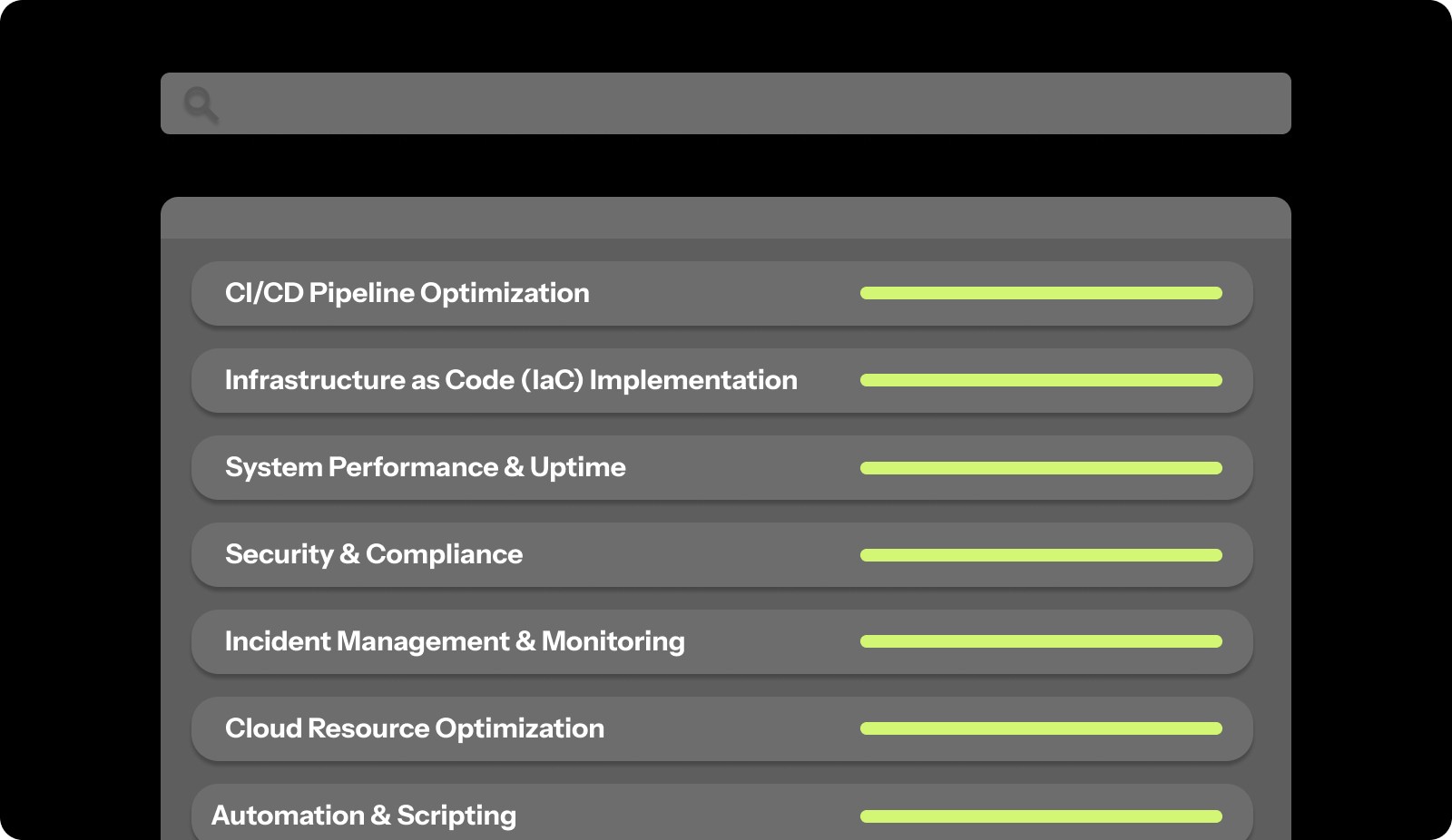
Here are the primary areas where you should set your objectives:
1. CI/CD Pipeline Optimization
Your pipeline is the engine of your software delivery process and must run smoothly. Focus on reducing build times, increasing deployment frequency, and eliminating manual approval steps. A fast pipeline creates a tight feedback loop for developers.
2. Infrastructure as Code (IaC) Implementation
Manual server configuration is a recipe for inconsistencies and disaster during disaster recovery. Goals here should focus on codifying infrastructure, versioning environments, and automating provisioning. This leads to reproducible and scalable environments.
3. System Performance & Uptime
Users expect your application to be available and responsive at all times. Set objectives around High Availability (HA), reducing latency, and maintaining Service Level Agreements (SLAs). This directly impacts customer satisfaction and retention.
4. Security & Compliance
Security cannot be an afterthought added at the end of the development cycle. Shift security left by automating vulnerability scanning, managing secrets properly, and ensuring compliance standards. These OKRs protect the company from liability and data breaches.
5. Incident Management & Monitoring
Failures will happen, so the goal is to recover from them as quickly as possible. Focus on Mean Time to Recovery (MTTR) and the quality of your alerting systems. Effective monitoring filters out noise so the team reacts only to real issues.
6. Cloud Resource Optimization
Cloud bills can spiral out of control without proper governance and oversight. Objectives in this area track cost per transaction, idle resource usage, and instance sizing. Efficient spending allows the company to reinvest savings into innovation.
7. Automation & Scripting
Repetitive manual tasks kill productivity and introduce human error into the system. Aim to automate routine maintenance, documentation updates, and database backups. This frees up engineering time for complex problem-solving.
With a clear understanding of the key focus areas, you can now apply these concepts to specific, actionable goals.
20 DevOps Engineer OKR Examples
Here are 20 concrete examples of DevOps engineer OKR frameworks you can adapt for your team today.
1. CI/CD Speed
Component | Description |
Objective | Accelerate the software delivery lifecycle to support faster feature releases. |
Key Result 1 | Reduce average build and test time from 20 minutes to 10 minutes. |
Key Result 2 | Increase deployment frequency from bi-weekly to daily. |
Key Result 3 | Achieve 100% automated deployment to the staging environment. |
2. Pipeline Reliability
Component | Description |
Objective | Eliminate friction and failures within the deployment pipeline. |
Key Result 1 | Reduce build failure rate due to environment issues to less than 5%. |
Key Result 2 | Decrease pipeline flakiness by isolating and fixing top 3 unstable tests. |
Key Result 3 | Implement automated rollback capabilities for failed production deployments. |
Also read: Understanding Code Scanning for Vulnerabilities
3. IaC Adoption
Component | Description |
Objective | Achieve full infrastructure immutability and reproducibility. |
Key Result 1 | Migrate 90% of legacy infrastructure configuration to Terraform modules. |
Key Result 2 | Eliminate all manual changes to production servers (SSH access revoked). |
Key Result 3 | Reduce time to provision a new dev environment from 2 days to 1 hour. |
4. Containerization
Component | Description |
Objective | Modernize application architecture for better scalability and portability. |
Key Result 1 | Containerize 100% of backend microservices using Docker. |
Key Result 2 | Migrate critical workloads from VMs to a Kubernetes cluster. |
Key Result 3 | Reduce average container startup time to under 5 seconds. |
5. High Availability
Component | Description |
Objective | Ensure the platform remains resilient against outages and high traffic. |
Key Result 1 | Increase system uptime from 99.5% to 99.99%. |
Key Result 2 | Conduct quarterly chaos engineering experiments to test failover mechanisms. |
Key Result 3 | Implement multi-region redundancy for the core database. |
6. Latency Reduction
Component | Description |
Objective | Optimize system performance to provide a snappy user experience. |
Key Result 1 | Reduce API latency p95 scores from 500ms to 200ms. |
Key Result 2 | Optimize CDN caching to offload 80% of static asset requests. |
Key Result 3 | Identify and refactor the top 5 slowest database queries. |
7. Security Integration (DevSecOps)
Component | Description |
Objective | Embed security practices directly into the development workflow. |
Key Result 1 | Integrate SAST (Static Application Security Testing) into the CI pipeline. |
Key Result 2 | Resolve critical vulnerabilities (CVEs) within 48 hours of detection. |
Key Result 3 | Achieve 100% automated scanning for container images before registry push. |
Creating effective OKRs in DevOps engineering is about aligning daily work with measurable outcomes, improving team efficiency, and driving business impact. Using AI-powered tools like Entelligence AI makes this process more precise, data-driven, and actionable. Book a demo to learn more.
8. Access Control
Component | Description |
Objective | Strengthen internal security and adhere to the principle of least privilege. |
Key Result 1 | Implement Role-Based Access Control (RBAC) across all cloud accounts. |
Key Result 2 | Rotate all production API keys and secrets every 90 days automatically. |
Key Result 3 | Enforce Multi-Factor Authentication (MFA) for 100% of engineering access. |
9. Incident Response
Component | Description |
Objective | Improve the team's ability to detect and resolve production incidents. |
Key Result 1 | Reduce Mean Time to Recovery (MTTR) from 4 hours to 1 hour. |
Key Result 2 | Ensure 100% of Sev-1 incidents have a completed post-mortem within 24 hours. |
Key Result 3 | Create automated runbooks for the top 5 recurring alerts. |
10. Monitoring Coverage
Component | Description |
Objective | Gain comprehensive visibility into system health and behavior. |
Key Result 1 | Achieve 100% log aggregation for all production services. |
Key Result 2 | Implement distributed tracing to cover 80% of user transactions. |
Key Result 3 | Reduce alert noise by eliminating 50% of non-actionable notifications. |
11. Cloud Cost Management
Component | Description |
Objective | optimize cloud spending without sacrificing performance. |
Key Result 1 | Reduce monthly AWS/Azure bill by 15% through resource right-sizing. |
Key Result 2 | Increase usage of Spot Instances to 40% for non-critical workloads. |
Key Result 3 | Implement automated tagging policies to track costs by team. |
Also read: How To Revert A Git Pull Request
12. Resource Utilization
Component | Description |
Objective | Maximize the efficiency of allocated computing resources. |
Key Result 1 | Increase average cluster CPU utilization from 20% to 60%. |
Key Result 2 | Identify and decommission 100% of orphaned storage volumes and snapshots. |
Key Result 3 | Automate the shutdown of development environments during weekends. |
13. Documentation & Knowledge Sharing
Component | Description |
Objective | Eliminate knowledge silos and reduce onboarding time for new hires. |
Key Result 1 | Update all system architecture diagrams to reflect the current state. |
Key Result 2 | Automate API documentation generation using Swagger/OpenAPI. |
Key Result 3 | Reduce "How do I..." questions in Slack by 30% by improving the internal wiki. |
14. Compliance Readiness
Component | Description |
Objective | Ensure infrastructure meets industry standards and regulatory requirements. |
Key Result 1 | Pass the annual SOC2 audit with zero major non-conformities. |
Key Result 2 | Automate evidence collection for compliance controls. |
Key Result 3 | Encrypt 100% of data at rest and in transit. |
15. Database Management
Component | Description |
Objective | Improve the reliability and maintainability of data storage layers. |
Key Result 1 | Automate database schema migrations within the deployment pipeline. |
Key Result 2 | Validate backup integrity by performing successful restores monthly. |
Key Result 3 | Implement database pooling to handle 2x current connection load. |
16. Developer Experience (DevEx)
Component | Description |
Objective | Make it easier and faster for developers to write and ship code. |
Key Result 1 | Reduce the time to set up a local dev environment to under 15 minutes. |
Key Result 2 | Achieve a Net Promoter Score (NPS) of 40+ for internal tooling. |
Key Result 3 | Provide self-service capabilities for creating new microservices. |
17. QA Automation
Component | Description |
Objective | Shift testing left to catch bugs before they reach production. |
Key Result 1 | Increase automated regression test coverage to 85%. |
Key Result 2 | Integrate performance testing into the nightly build process. |
Key Result 3 | Reduce manual QA time per release from 3 days to 4 hours. |
18. Disaster Recovery
Component | Description |
Objective | Prepare the organization for catastrophic failures. |
Key Result 1 | Define and document Recovery Time Objective (RTO) for all critical services. |
Key Result 2 | Conduct a full region failover simulation in the staging environment. |
Key Result 3 | Ensure off-site backups are replicated to a secondary region instantly. |
19. Technical Debt Reduction
Component | Description |
Objective | Improve long-term maintainability by addressing accumulated debt. |
Key Result 1 | Upgrade all end-of-life dependencies and libraries. |
Key Result 2 | Deprecate and shut down 2 legacy monolithic services. |
Key Result 3 | Refactor infrastructure code to remove hard-coded IP addresses. |
20. On-Call Health
Component | Description |
Objective | Prevent burnout and ensure a sustainable on-call rotation. |
Key Result 1 | Reduce the number of off-hours pages per week to less than 2. |
Key Result 2 | Ensure every engineer has at least 2 weeks between on-call shifts. |
Key Result 3 | Implement "sleep-friendly" alerting policies for non-critical issues. |
Also read: How To Measure And Improve Code Quality?
Reviewing these examples shows the whats, but setting them up correctly requires a deliberate, multi-step process.
Steps to Set DevOps Engineer OKRs
Setting OKRs is not about copying a list; it is about understanding your current maturity level and where you need to go next. You must analyze your constraints before setting targets.
Follow these steps to build effective objectives:
1. Assess Your Current Baseline Metrics
You cannot improve what you do not measure. Before setting a goal to "reduce build time," you need to know exactly how long builds take today. Use tools to gather historical data on deployment frequency, failure rates, and lead time.
2. Identify Critical Business Bottlenecks
Talk to product managers and engineering leaders. Is the business suffering because features take too long to release? Or is customer churn high due to instability? Align your DevOps OKRs to solve these specific business pain points.
3. Define Ambitious but Achievable Key Results
Key results should be a stretch but not impossible. If your current deployment frequency is monthly, aiming for "hourly" immediately will demoralize the team. Aim for "weekly" first. Ensure every key result has a number attached to it.
As you begin implementing this framework, keep these practical guidelines in mind to avoid common mistakes that derail progress.
Do's and Don'ts When Using OKR for DevOps Engineers
When applying the OKR framework to DevOps, the focus must shift from merely checking off tasks to measuring business-relevant outcomes like speed and stability. Remember to set aspirational, measurable goals while avoiding common pitfalls like measuring output instead of actual value delivered.
Do's | Don'ts |
Do align OKRs with broader business goals to show value. | Don't set OKRs based on "vanity metrics" like lines of code written. |
Do make Key Results quantitative and measurable. | Don't create binary Key Results (e.g., "Done/Not Done") if possible. |
Do review and adjust OKRs quarterly based on progress. | Don't set and forget them until the end of the year. |
Do focus on customer-impacting metrics like latency and uptime. | Don't ignore the human element, such as team burnout or morale. |
Do encourage team collaboration to achieve objectives. | Don't use OKRs as a weapon for individual performance reviews. |
Also read: Sprint Velocity in Scrum: How to Measure and Calculate It Right?
While defining clear OKRs is crucial, measuring and tracking your progress across an entire engineering organization presents a new challenge.
Bringing Clarity To Engineering Productivity
DevOps teams struggle to connect daily technical work to strategic OKRs. Engineering leaders lack visibility into whether process improvements actually move key metrics. Without clear data, OKR tracking becomes guesswork rather than a precise measurement.
Entelligence AI transforms how engineering teams set and achieve their OKRs. Our platform provides the engineering intelligence that connects code-level work to performance outcomes. You get automated tracking of DORA metrics, security posture, and team productivity in a single dashboard.
Automated metric collection: Entelligence automatically calculates deployment frequency, lead time, mean time to recovery, and change failure rate from your existing systems
Contextual code quality analysis: Our AI-powered reviews ensure higher-quality code from the start, directly impacting change failure rate objectives
Sprint assessment dashboards: Get automated health checks on delivery cycles and team performance with data-backed insights
Security posture monitoring: Track vulnerability remediation and compliance status for security-focused OKRs
Team performance visibility: Understand how process changes impact velocity, quality, and engagement metrics
Case study Insight
Vectorial AI implemented Entelligence's AI platform to address rapid expansion challenges while maintaining code quality. The solution automated PR reviews (65% acceptance rate), tracked architectural changes in real-time, and provided manager insights without extra meetings.
Results: 10x faster development workflows, cleaner, maintainable code, improved visibility into changes, and reduced unnecessary syncs. Vectorial AI now scales efficiently with high engineering standards while developers focus on innovation rather than administrative overhead.
Also read: Understanding Development Velocity in Software Engineering
Entelligence provides the engineering intelligence platform that turns ambitious DevOps engineers' OKR goals into measurable, achievable outcomes.
Conclusion
Effective DevOps OKRs create crucial alignment between technical work and business outcomes. The examples in this article provide proven starting points for improving deployment speed, system reliability, security, and efficiency.
Remember that successful OKR implementation requires regular tracking, team engagement, and flexibility to adapt as priorities evolve.
Entelligence AI helps engineering teams move beyond theoretical OKRs to measurable results. Our platform provides the data and visibility needed to set realistic targets and track progress accurately.
From automated code reviews to team performance dashboards, we connect day-to-day engineering work to strategic objectives.
Ready to transform your DevOps OKRs from planning to performance? See how Entelligence AI provides the engineering intelligence platform to achieve your critical objectives. Book a demo now.
FAQs
Q. What is the difference between DevOps KPIs and OKRs?
KPIs (Key Performance Indicators) track the ongoing health of a system, such as uptime or CPU usage. OKRs (Objectives and Key Results) are aggressive goals designed to change or improve that system, such as "Reduce MTTR by 50%." KPIs maintain the status quo; OKRs drive growth.
Q. How often should DevOps engineers review their OKRs?
Teams should typically review OKRs on a quarterly basis. However, progress should be checked weekly or bi-weekly during sprint planning to ensure the team is on track. This allows for course correction if a particular Key Result becomes irrelevant or blocked.
Q. Can OKRs be used for individual performance reviews?
It is generally not recommended to tie OKRs directly to compensation or performance reviews. Doing so encourages "sandbagging," where employees set easily achievable goals to ensure a payout. OKRs should be ambitious stretch goals meant to push the team forward, safe from the fear of failure.
Q. How do I set OKRs for a small DevOps team?
For small teams, focus on 1 or 2 critical objectives per quarter. Do not spread the team too thin by trying to optimize security, speed, and cost all at once. Pick the single biggest bottleneck, likely deployment speed or stability, and focus all efforts there until it is resolved.
Q. What is the ideal number of OKRs for a DevOps team?
A DevOps team should typically focus on 2-3 OKRs per quarter. This provides enough focus to drive meaningful progress without creating overwhelming complexity. Each objective should have 2-4 measurable key results that collectively represent significant but achievable progress.
You spend hours optimizing CI/CD pipelines and infrastructure, yet production incidents can still spike and strategic goals feel disconnected from daily work. This friction between engineering effort and business outcomes leads to wasted effort and missed deadlines.
However, the value of bridging this gap is clear: 87% of companies say DevOps positively impacted customer satisfaction. The challenge is systematically achieving this impact. Objectives and Key Results (OKRs) provide the framework to bridge this execution gap.
They create clear alignment between technical work and business objectives while providing measurable evidence of progress. A well-structured DevOps engineer OKR transforms abstract goals like "improve reliability" into specific, measurable outcomes that drive actual performance improvement.
In this article, we will break down actionable frameworks and provide a comprehensive list of DevOps engineer OKR examples to help your team build better and ship faster.
Quick Look
Focus on Outcomes, Not Outputs: Good OKRs measure the reliability and speed of the system, not just the number of scripts written.
Balance Speed with Stability: If you increase deployment frequency but also increase failure rates, you have missed the mark.
DORA Metrics are Essential: Use Deployment Frequency, Lead Time for Changes, Change Failure Rate, and Time to Restore Service as foundational metrics.
Security is a Shared Responsibility: Integrate security checks early in the pipeline and track them via OKRs.
Automation Drives Efficiency: Set specific goals to reduce manual intervention in testing, deployment, and documentation.
What Are DevOps Engineer OKRs?
DevOps Engineer OKRs (Objectives and Key Results) are goal-setting frameworks that bridge the gap between IT operations and software development. The Objective defines a clear, ambitious goal (the "what"), while the Key Results are specific, measurable milestones used to track achievement (the "how").
Unlike standard KPIs, which track ongoing performance, OKRs drive significant improvements and strategic alignment across the engineering organization.
Understanding what OKRs are is just the beginning; the real value comes from applying them to drive measurable change.

How DevOps OKRs Improve Performance
DevOps OKRs create a direct connection between engineering effort and organizational success. They provide clarity and focus that help teams prioritize high-impact work while avoiding distraction by trivial tasks.
When implemented consistently, this framework transforms how engineering teams work and deliver value.
1. Enhanced Cross-Team Alignment
DevOps OKRs break down silos by creating shared objectives across development, operations, and quality assurance teams. Everyone understands how their individual contributions support broader business goals. This alignment reduces friction in deployment processes and accelerates feature delivery.
2. Data-Driven Performance Measurement
Instead of relying on anecdotal evidence or subjective assessments, OKRs provide quantitative evidence of progress. Teams can precisely track metrics like deployment frequency, mean time to recovery, and infrastructure cost per transaction. This data reveals improvement opportunities and validates process changes.
3. Strategic Focus And Prioritization
With clear OKRs, teams can quickly identify which initiatives support strategic objectives and which represent distractions. This focus prevents scope creep and ensures engineering effort delivers maximum business value. Teams learn to say no to low-impact activities.
4. Continuous Improvement Culture
Regular OKR check-ins create natural reflection points for assessing processes and identifying improvement opportunities. The quarterly cycle encourages experimentation and adaptation based on measurable results rather than assumptions.
To target high-impact improvements, you must focus your OKRs on the distinct phases of the DevOps life cycle.
Key Focus Areas for DevOps OKRs
To build a robust strategy, you must categorize your goals into specific domains of the engineering lifecycle. This ensures you do not over-index on speed while neglecting security or cost.

Here are the primary areas where you should set your objectives:
1. CI/CD Pipeline Optimization
Your pipeline is the engine of your software delivery process and must run smoothly. Focus on reducing build times, increasing deployment frequency, and eliminating manual approval steps. A fast pipeline creates a tight feedback loop for developers.
2. Infrastructure as Code (IaC) Implementation
Manual server configuration is a recipe for inconsistencies and disaster during disaster recovery. Goals here should focus on codifying infrastructure, versioning environments, and automating provisioning. This leads to reproducible and scalable environments.
3. System Performance & Uptime
Users expect your application to be available and responsive at all times. Set objectives around High Availability (HA), reducing latency, and maintaining Service Level Agreements (SLAs). This directly impacts customer satisfaction and retention.
4. Security & Compliance
Security cannot be an afterthought added at the end of the development cycle. Shift security left by automating vulnerability scanning, managing secrets properly, and ensuring compliance standards. These OKRs protect the company from liability and data breaches.
5. Incident Management & Monitoring
Failures will happen, so the goal is to recover from them as quickly as possible. Focus on Mean Time to Recovery (MTTR) and the quality of your alerting systems. Effective monitoring filters out noise so the team reacts only to real issues.
6. Cloud Resource Optimization
Cloud bills can spiral out of control without proper governance and oversight. Objectives in this area track cost per transaction, idle resource usage, and instance sizing. Efficient spending allows the company to reinvest savings into innovation.
7. Automation & Scripting
Repetitive manual tasks kill productivity and introduce human error into the system. Aim to automate routine maintenance, documentation updates, and database backups. This frees up engineering time for complex problem-solving.
With a clear understanding of the key focus areas, you can now apply these concepts to specific, actionable goals.
20 DevOps Engineer OKR Examples
Here are 20 concrete examples of DevOps engineer OKR frameworks you can adapt for your team today.
1. CI/CD Speed
Component | Description |
Objective | Accelerate the software delivery lifecycle to support faster feature releases. |
Key Result 1 | Reduce average build and test time from 20 minutes to 10 minutes. |
Key Result 2 | Increase deployment frequency from bi-weekly to daily. |
Key Result 3 | Achieve 100% automated deployment to the staging environment. |
2. Pipeline Reliability
Component | Description |
Objective | Eliminate friction and failures within the deployment pipeline. |
Key Result 1 | Reduce build failure rate due to environment issues to less than 5%. |
Key Result 2 | Decrease pipeline flakiness by isolating and fixing top 3 unstable tests. |
Key Result 3 | Implement automated rollback capabilities for failed production deployments. |
Also read: Understanding Code Scanning for Vulnerabilities
3. IaC Adoption
Component | Description |
Objective | Achieve full infrastructure immutability and reproducibility. |
Key Result 1 | Migrate 90% of legacy infrastructure configuration to Terraform modules. |
Key Result 2 | Eliminate all manual changes to production servers (SSH access revoked). |
Key Result 3 | Reduce time to provision a new dev environment from 2 days to 1 hour. |
4. Containerization
Component | Description |
Objective | Modernize application architecture for better scalability and portability. |
Key Result 1 | Containerize 100% of backend microservices using Docker. |
Key Result 2 | Migrate critical workloads from VMs to a Kubernetes cluster. |
Key Result 3 | Reduce average container startup time to under 5 seconds. |
5. High Availability
Component | Description |
Objective | Ensure the platform remains resilient against outages and high traffic. |
Key Result 1 | Increase system uptime from 99.5% to 99.99%. |
Key Result 2 | Conduct quarterly chaos engineering experiments to test failover mechanisms. |
Key Result 3 | Implement multi-region redundancy for the core database. |
6. Latency Reduction
Component | Description |
Objective | Optimize system performance to provide a snappy user experience. |
Key Result 1 | Reduce API latency p95 scores from 500ms to 200ms. |
Key Result 2 | Optimize CDN caching to offload 80% of static asset requests. |
Key Result 3 | Identify and refactor the top 5 slowest database queries. |
7. Security Integration (DevSecOps)
Component | Description |
Objective | Embed security practices directly into the development workflow. |
Key Result 1 | Integrate SAST (Static Application Security Testing) into the CI pipeline. |
Key Result 2 | Resolve critical vulnerabilities (CVEs) within 48 hours of detection. |
Key Result 3 | Achieve 100% automated scanning for container images before registry push. |
Creating effective OKRs in DevOps engineering is about aligning daily work with measurable outcomes, improving team efficiency, and driving business impact. Using AI-powered tools like Entelligence AI makes this process more precise, data-driven, and actionable. Book a demo to learn more.
8. Access Control
Component | Description |
Objective | Strengthen internal security and adhere to the principle of least privilege. |
Key Result 1 | Implement Role-Based Access Control (RBAC) across all cloud accounts. |
Key Result 2 | Rotate all production API keys and secrets every 90 days automatically. |
Key Result 3 | Enforce Multi-Factor Authentication (MFA) for 100% of engineering access. |
9. Incident Response
Component | Description |
Objective | Improve the team's ability to detect and resolve production incidents. |
Key Result 1 | Reduce Mean Time to Recovery (MTTR) from 4 hours to 1 hour. |
Key Result 2 | Ensure 100% of Sev-1 incidents have a completed post-mortem within 24 hours. |
Key Result 3 | Create automated runbooks for the top 5 recurring alerts. |
10. Monitoring Coverage
Component | Description |
Objective | Gain comprehensive visibility into system health and behavior. |
Key Result 1 | Achieve 100% log aggregation for all production services. |
Key Result 2 | Implement distributed tracing to cover 80% of user transactions. |
Key Result 3 | Reduce alert noise by eliminating 50% of non-actionable notifications. |
11. Cloud Cost Management
Component | Description |
Objective | optimize cloud spending without sacrificing performance. |
Key Result 1 | Reduce monthly AWS/Azure bill by 15% through resource right-sizing. |
Key Result 2 | Increase usage of Spot Instances to 40% for non-critical workloads. |
Key Result 3 | Implement automated tagging policies to track costs by team. |
Also read: How To Revert A Git Pull Request
12. Resource Utilization
Component | Description |
Objective | Maximize the efficiency of allocated computing resources. |
Key Result 1 | Increase average cluster CPU utilization from 20% to 60%. |
Key Result 2 | Identify and decommission 100% of orphaned storage volumes and snapshots. |
Key Result 3 | Automate the shutdown of development environments during weekends. |
13. Documentation & Knowledge Sharing
Component | Description |
Objective | Eliminate knowledge silos and reduce onboarding time for new hires. |
Key Result 1 | Update all system architecture diagrams to reflect the current state. |
Key Result 2 | Automate API documentation generation using Swagger/OpenAPI. |
Key Result 3 | Reduce "How do I..." questions in Slack by 30% by improving the internal wiki. |
14. Compliance Readiness
Component | Description |
Objective | Ensure infrastructure meets industry standards and regulatory requirements. |
Key Result 1 | Pass the annual SOC2 audit with zero major non-conformities. |
Key Result 2 | Automate evidence collection for compliance controls. |
Key Result 3 | Encrypt 100% of data at rest and in transit. |
15. Database Management
Component | Description |
Objective | Improve the reliability and maintainability of data storage layers. |
Key Result 1 | Automate database schema migrations within the deployment pipeline. |
Key Result 2 | Validate backup integrity by performing successful restores monthly. |
Key Result 3 | Implement database pooling to handle 2x current connection load. |
16. Developer Experience (DevEx)
Component | Description |
Objective | Make it easier and faster for developers to write and ship code. |
Key Result 1 | Reduce the time to set up a local dev environment to under 15 minutes. |
Key Result 2 | Achieve a Net Promoter Score (NPS) of 40+ for internal tooling. |
Key Result 3 | Provide self-service capabilities for creating new microservices. |
17. QA Automation
Component | Description |
Objective | Shift testing left to catch bugs before they reach production. |
Key Result 1 | Increase automated regression test coverage to 85%. |
Key Result 2 | Integrate performance testing into the nightly build process. |
Key Result 3 | Reduce manual QA time per release from 3 days to 4 hours. |
18. Disaster Recovery
Component | Description |
Objective | Prepare the organization for catastrophic failures. |
Key Result 1 | Define and document Recovery Time Objective (RTO) for all critical services. |
Key Result 2 | Conduct a full region failover simulation in the staging environment. |
Key Result 3 | Ensure off-site backups are replicated to a secondary region instantly. |
19. Technical Debt Reduction
Component | Description |
Objective | Improve long-term maintainability by addressing accumulated debt. |
Key Result 1 | Upgrade all end-of-life dependencies and libraries. |
Key Result 2 | Deprecate and shut down 2 legacy monolithic services. |
Key Result 3 | Refactor infrastructure code to remove hard-coded IP addresses. |
20. On-Call Health
Component | Description |
Objective | Prevent burnout and ensure a sustainable on-call rotation. |
Key Result 1 | Reduce the number of off-hours pages per week to less than 2. |
Key Result 2 | Ensure every engineer has at least 2 weeks between on-call shifts. |
Key Result 3 | Implement "sleep-friendly" alerting policies for non-critical issues. |
Also read: How To Measure And Improve Code Quality?
Reviewing these examples shows the whats, but setting them up correctly requires a deliberate, multi-step process.
Steps to Set DevOps Engineer OKRs
Setting OKRs is not about copying a list; it is about understanding your current maturity level and where you need to go next. You must analyze your constraints before setting targets.
Follow these steps to build effective objectives:
1. Assess Your Current Baseline Metrics
You cannot improve what you do not measure. Before setting a goal to "reduce build time," you need to know exactly how long builds take today. Use tools to gather historical data on deployment frequency, failure rates, and lead time.
2. Identify Critical Business Bottlenecks
Talk to product managers and engineering leaders. Is the business suffering because features take too long to release? Or is customer churn high due to instability? Align your DevOps OKRs to solve these specific business pain points.
3. Define Ambitious but Achievable Key Results
Key results should be a stretch but not impossible. If your current deployment frequency is monthly, aiming for "hourly" immediately will demoralize the team. Aim for "weekly" first. Ensure every key result has a number attached to it.
As you begin implementing this framework, keep these practical guidelines in mind to avoid common mistakes that derail progress.
Do's and Don'ts When Using OKR for DevOps Engineers
When applying the OKR framework to DevOps, the focus must shift from merely checking off tasks to measuring business-relevant outcomes like speed and stability. Remember to set aspirational, measurable goals while avoiding common pitfalls like measuring output instead of actual value delivered.
Do's | Don'ts |
Do align OKRs with broader business goals to show value. | Don't set OKRs based on "vanity metrics" like lines of code written. |
Do make Key Results quantitative and measurable. | Don't create binary Key Results (e.g., "Done/Not Done") if possible. |
Do review and adjust OKRs quarterly based on progress. | Don't set and forget them until the end of the year. |
Do focus on customer-impacting metrics like latency and uptime. | Don't ignore the human element, such as team burnout or morale. |
Do encourage team collaboration to achieve objectives. | Don't use OKRs as a weapon for individual performance reviews. |
Also read: Sprint Velocity in Scrum: How to Measure and Calculate It Right?
While defining clear OKRs is crucial, measuring and tracking your progress across an entire engineering organization presents a new challenge.
Bringing Clarity To Engineering Productivity
DevOps teams struggle to connect daily technical work to strategic OKRs. Engineering leaders lack visibility into whether process improvements actually move key metrics. Without clear data, OKR tracking becomes guesswork rather than a precise measurement.
Entelligence AI transforms how engineering teams set and achieve their OKRs. Our platform provides the engineering intelligence that connects code-level work to performance outcomes. You get automated tracking of DORA metrics, security posture, and team productivity in a single dashboard.
Automated metric collection: Entelligence automatically calculates deployment frequency, lead time, mean time to recovery, and change failure rate from your existing systems
Contextual code quality analysis: Our AI-powered reviews ensure higher-quality code from the start, directly impacting change failure rate objectives
Sprint assessment dashboards: Get automated health checks on delivery cycles and team performance with data-backed insights
Security posture monitoring: Track vulnerability remediation and compliance status for security-focused OKRs
Team performance visibility: Understand how process changes impact velocity, quality, and engagement metrics
Case study Insight
Vectorial AI implemented Entelligence's AI platform to address rapid expansion challenges while maintaining code quality. The solution automated PR reviews (65% acceptance rate), tracked architectural changes in real-time, and provided manager insights without extra meetings.
Results: 10x faster development workflows, cleaner, maintainable code, improved visibility into changes, and reduced unnecessary syncs. Vectorial AI now scales efficiently with high engineering standards while developers focus on innovation rather than administrative overhead.
Also read: Understanding Development Velocity in Software Engineering
Entelligence provides the engineering intelligence platform that turns ambitious DevOps engineers' OKR goals into measurable, achievable outcomes.
Conclusion
Effective DevOps OKRs create crucial alignment between technical work and business outcomes. The examples in this article provide proven starting points for improving deployment speed, system reliability, security, and efficiency.
Remember that successful OKR implementation requires regular tracking, team engagement, and flexibility to adapt as priorities evolve.
Entelligence AI helps engineering teams move beyond theoretical OKRs to measurable results. Our platform provides the data and visibility needed to set realistic targets and track progress accurately.
From automated code reviews to team performance dashboards, we connect day-to-day engineering work to strategic objectives.
Ready to transform your DevOps OKRs from planning to performance? See how Entelligence AI provides the engineering intelligence platform to achieve your critical objectives. Book a demo now.
FAQs
Q. What is the difference between DevOps KPIs and OKRs?
KPIs (Key Performance Indicators) track the ongoing health of a system, such as uptime or CPU usage. OKRs (Objectives and Key Results) are aggressive goals designed to change or improve that system, such as "Reduce MTTR by 50%." KPIs maintain the status quo; OKRs drive growth.
Q. How often should DevOps engineers review their OKRs?
Teams should typically review OKRs on a quarterly basis. However, progress should be checked weekly or bi-weekly during sprint planning to ensure the team is on track. This allows for course correction if a particular Key Result becomes irrelevant or blocked.
Q. Can OKRs be used for individual performance reviews?
It is generally not recommended to tie OKRs directly to compensation or performance reviews. Doing so encourages "sandbagging," where employees set easily achievable goals to ensure a payout. OKRs should be ambitious stretch goals meant to push the team forward, safe from the fear of failure.
Q. How do I set OKRs for a small DevOps team?
For small teams, focus on 1 or 2 critical objectives per quarter. Do not spread the team too thin by trying to optimize security, speed, and cost all at once. Pick the single biggest bottleneck, likely deployment speed or stability, and focus all efforts there until it is resolved.
Q. What is the ideal number of OKRs for a DevOps team?
A DevOps team should typically focus on 2-3 OKRs per quarter. This provides enough focus to drive meaningful progress without creating overwhelming complexity. Each objective should have 2-4 measurable key results that collectively represent significant but achievable progress.
Your questions,
Your questions,
Decoded
Decoded
What makes Entelligence different?
Unlike tools that just flag issues, Entelligence understands context — detecting, explaining, and fixing problems while aligning with product goals and team standards.
Does it replace human reviewers?
No. It amplifies them. Entelligence handles repetitive checks so engineers can focus on architecture, logic, and innovation.
What tools does it integrate with?
It fits right into your workflow — GitHub, GitLab, Jira, Linear, Slack, and more. No setup friction, no context switching.
How secure is my code?
Your code never leaves your environment. Entelligence uses encrypted processing and complies with top industry standards like SOC 2 and HIPAA.
Who is it built for?
Fast-growing engineering teams that want to scale quality, security, and velocity without adding more manual reviews or overhead.

What makes Entelligence different?
Does it replace human reviewers?
What tools does it integrate with?
How secure is my code?
Who is it built for?


