Proven Guide to Agile Team Performance Management
Dec 11, 2025
Dec 11, 2025
Tracking performance in an engineering organization often feels like trying to hit a moving target. Traditional reviews happen annually, but your developers ship code weekly or even daily, making standard feedback loops obsolete before they even finish.
This disconnect creates frustration for managers who lack visibility and developers who feel misunderstood by generic HR policies. The impact of getting this right is significant; according to a survey, employees who experience their company as agile are very likely to believe their company is ahead of the competition, the company's financial future is secure, and their employer is successful and growing.
You need a dynamic approach that mirrors the speed and adaptability of the software development lifecycle itself. Moving away from static checklists requires a shift toward continuous improvement, real-time data, and removing the bottlenecks that slow down your best talent.
In this article, we break down agile team performance management into actionable frameworks, essential metrics, and strategies to build a high-velocity engineering culture.
Quick Look
Replace annual appraisals with sprint-based reviews to catch issues immediately.
Use objective metrics like Cycle Time and PR Merge Rate rather than subjective observation.
Balance individual contribution tracking with overall team velocity to prevent siloed working habits.
Shift the management focus from "monitoring people" to "clearing obstacles" for the team.
Manual tracking fails at scale; successful teams use tools to automate performance data collection.
What is Agile Team Performance Management, And Why It's Unique
Agile team performance management is a continuous process of setting goals, providing regular feedback, and developing skills within agile team structures. It aligns individual growth with team objectives through frequent check-ins and data-driven conversations. This approach creates faster feedback cycles that help team members adapt and improve their work in real-time.
Why It's Unique:
Focuses on team outcomes rather than individual task completion
Uses actual work metrics from development tools rather than subjective ratings
Emphasizes continuous feedback over annual review cycles
Adapt goals quarterly or even monthly to match sprint planning
Treats performance development as an ongoing process rather than an event
Also read: Understanding Velocity in Agile Software Development
To truly appreciate the power of agile performance, you must first recognize the critical points where it diverges from traditional, annual HR review models.
Traditional vs Agile Team Performance Management
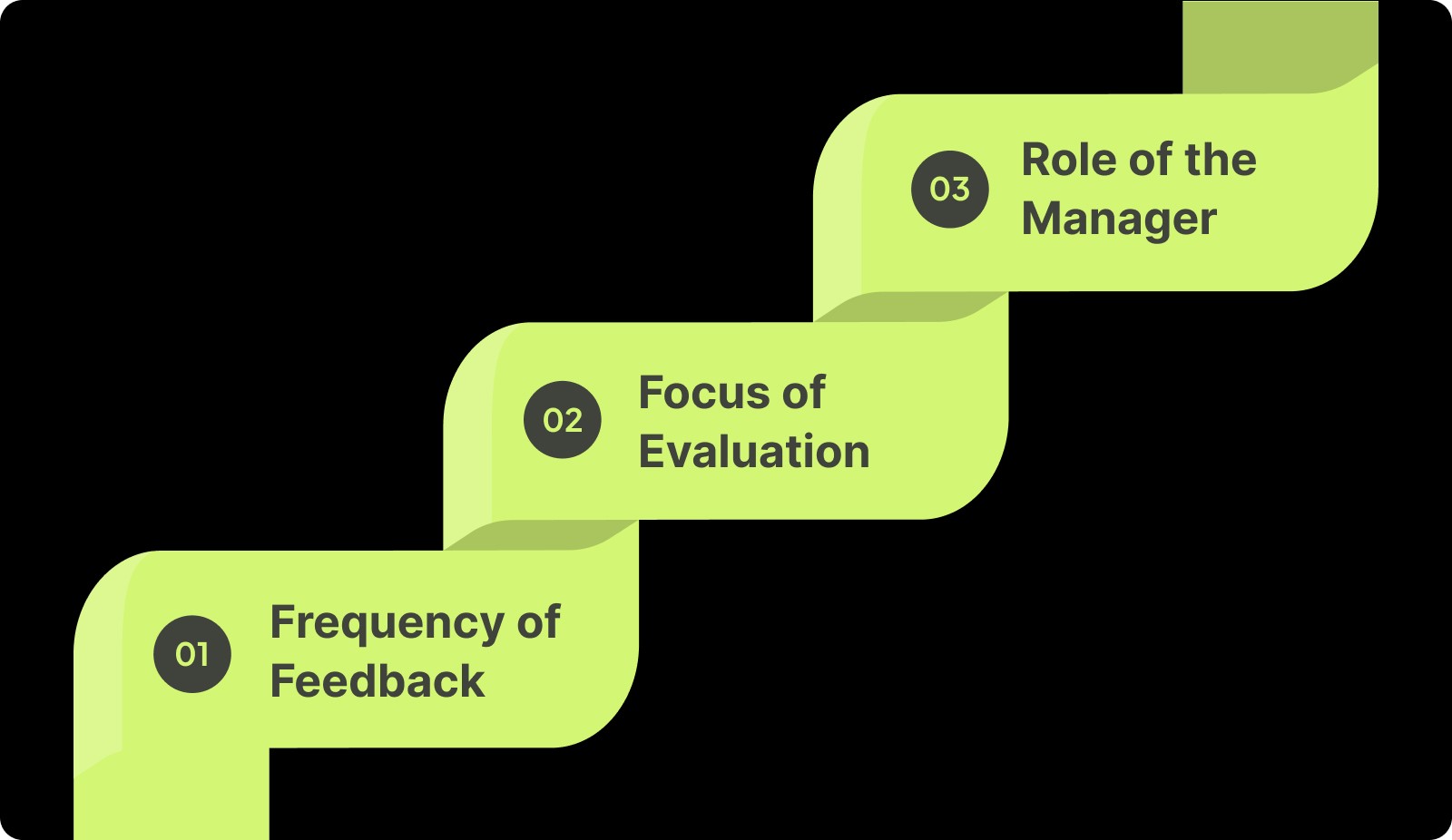
Traditional HR frameworks often clash with the reality of modern engineering workflows. The following comparison highlights where you must shift your strategy to support an agile environment:
1. Frequency of Feedback: From Annual to Continuous
Traditional systems rely on mid-year or annual reviews that often cite outdated examples. Agile management integrates feedback into the daily and weekly workflow. You address code quality issues during the Pull Request (PR) review, not six months later.
2. Focus of Evaluation: From Individual Output to Team Velocity
Standard reviews often pit employees against each other using stack ranking. Agile environments prioritize how well the team ships software together. You measure how an individual contributes to unblocking others and maintaining sprint momentum.
3. Role of the Manager: From Supervisor to Servant Leader
In the old model, a manager dictates tasks and monitors compliance. In an agile setting, the manager acts as a "servant leader." Their primary performance goal is clearing technical debt and administrative hurdles so developers can focus on building.
Shifting your mindset is the first step, but defining success requires objective measurement. We turn now to the core metrics that reveal true team health and effectiveness.
Also read: How to Measure Developer Productivity Effectively
The Core Metrics: Measuring Agile Team Health and Delivery Effectiveness
You cannot improve what you do not measure, but measuring the wrong things, like lines of code, creates perverse incentives. Effective agile tracking focuses on flow, quality, and stability:
1. DORA Metrics (The Industry Standard for Delivery & Stability)
These four metrics provide an objective benchmark for your core software delivery performance.
Deployment Frequency (DF): How often you release to production.
How to measure: Count production deployments over a specific period (day, week, month).
Why it matters: Higher frequency indicates better automation and a culture of small, low-risk changes.
Lead Time for Changes: The total time from code commit to running in production.
How to measure: (Timestamp of Deployment) - (Timestamp of Commit) for a representative sample.
Why it matters: This is the ultimate measure of process efficiency and your ability to respond quickly.
Change Failure Rate (CFR): Assessing Stability.
How to measure: (Number of Failed Deployments / Total Deployments) * 100. A "failed deployment" is one that causes a production incident or requires a hotfix/rollback.
Why it matters: A low, stable rate shows you have robust testing and release practices. A rising rate suggests the team is rushing or lacks sufficient automated testing coverage.
Mean Time to Recovery (MTTR): How fast you restore service after a failure.
How to measure: Average the time between an incident's start and full service restoration.
Why it matters: Fast recovery minimizes user impact and builds organizational confidence to ship more often.
2. Team Effectiveness & Flow Metrics
These metrics complement DORA by focusing on internal process health and predictability.
Cycle Time: Measuring Speed of Delivery.
How to measure: (Date/Time of Deployment) - (Date/Time of First Commit for a work item). This is often more granular than Lead Time, focusing on a single feature or fix.
Why it matters: High cycle times directly indicate bottlenecks in your process, such as lengthy code reviews or QA handoffs.
Sprint Velocity: Predicting Team Capacity.
How to measure: Sum of story points (or equivalent) completed in a sprint.
Why it matters: It helps engineering managers set realistic deadlines and prevents burnout by avoiding over-commitment. Focus on trends, not absolute numbers.
Sprint Completion Rate / Planned vs. Actual: A measure of predictability.
How to measure: (Story Points Completed / Story Points Planned) * 100 per sprint.
Why it matters: High predictability allows for better product planning and reduces management overhead.
3. The Critical People-Centric Metric
Outstanding technical metrics with a burnt-out team are not sustainable.
Developer Satisfaction or Engagement (eNPS or Survey Score)
How to measure: Use a simple quarterly eNPS survey ("On a scale of 0-10, how likely are you to recommend this team as a great place to work?") or track qualitative feedback.
Why it matters: This is a leading indicator of retention, innovation, and quality. It tells you if your process improvements are actually improving life for the team.
The Entelligence AI Advantage: End-to-End Engineering Clarity
Engineering leaders and HR professionals often struggle with the "black box" of development. You know work is happening, but you lack visibility into who is blocked, who is burning out, and where the process is breaking down. Manual tracking is slow, and generic project management tools fail to capture the nuances of code complexity.
Entelligence AI acts as your end-to-end engineering productivity suite. It bridges the gap between daily coding tasks and high-level organizational strategy.
Contextual Code Reviews: AI-powered feedback ensures high quality before code even reaches a human reviewer.
Sprint Assessment: Automated health checks surface blockers and bottlenecks without you having to chase developers for updates.
Leaderboards & Insights: Engage teams with friendly competition while giving managers data-backed visibility into individual and team performance.
Org-Wide Visibility: From individual developer workflows to strategic dashboards, you get a unified view of engineering health.
Entelligence AI transforms engineering data into actionable clarity, helping your organization ship faster and with higher confidence.
These metrics give you the what and the objective data of performance. Next, we will explore the when by mapping your performance management process directly onto the standard agile cycle.
The 4 Stages of the Agile Performance Management Cycle
Aligning performance reviews with the agile ritual creates a natural rhythm for feedback. You should map your HR touchpoints to these four engineering stages:
1. Sprint Planning: Setting Clear Expectations
Before code is written, the team agrees on goals and deliverables for the upcoming cycle.
Action: Ensure every engineer knows exactly which tickets they own and the definition of "done." This eliminates ambiguity regarding performance expectations for the next two weeks.
2. Daily Stand-ups: Micro-Course Corrections
These short meetings allow the team to highlight blockers and progress.
Action: Managers should use this time to identify who is struggling. If a developer reports the same blocker twice, it is a signal for immediate coaching or intervention.
3. Sprint Review: Validating Output
The team demonstrates what they built to the stakeholders.
Action: Evaluate the quality of the work delivered. Did the feature meet the product requirements? This focuses the assessment on tangible outcomes rather than hours worked.
4. Sprint Retrospective: Process Improvement
The team discusses what went well and what did not.
Action: This is a safe space for cultural performance management. Identify toxic patterns, communication gaps, or process inefficiencies that are hurting team morale.
Understanding the cycle ensures continuous feedback, but strategic action drives improvement. Here are seven effective ways to increase your team’s performance right now.
7 Effective Ways to Increase Agile Team Performance
Improving performance requires a mix of cultural shifts and tactical adjustments. Use these strategies to build a more resilient engineering organization:
1. Automate Data Collection
Stop asking developers to fill out status reports. Use tools that ingest data directly from GitHub, Jira, or Slack to visualize work.
How it looks when implemented:
Managers see real-time dashboards of sprint progress.
Developers spend zero time manually logging tasks.
Reviews are based on actual commit history, not memory.
2. Implement Contextual Code Reviews
Use AI and tooling to standardize feedback during the code review process itself.
How it looks when implemented:
Junior developers receive automated suggestions on syntax and style.
Senior engineers spend less time on trivial fixes.
Code quality consistency improves across the entire organization.
3. Establish clear Career Ladders
Define what "senior" means in terms of technical capability and soft skills.
How it looks when implemented:
Developers have a clear roadmap for promotion.
Skill gaps are identified early and addressed with training.
Retention rates increase as employees see a future.
4. Optimize Meeting Loads
Protect "maker time" by clustering meetings or designating no-meeting days.
How it looks when implemented:
Engineers have 4-hour blocks of uninterrupted coding time.
Sprint velocity increases due to better focus.
Frustration regarding context-switching decreases.
5. Encourage Cross-Training
Prevent knowledge silos by rotating developers across different parts of the codebase.
How it looks when implemented:
The "bus factor" (risk if one person leaves) is reduced.
Team members gain empathy for other technical challenges.
Problem-solving becomes more creative due to diverse exposure.
6. Gamify Quality (Carefully)
Use leaderboards to highlight positive behaviors like bug squashing or rapid PR reviews.
How it looks when implemented:
Friendly competition drives engagement.
Focus shifts to high-impact activities like reviewing others' code.
Team morale improves through public recognition of hard work.
7. Conduct Blameless Post-Mortems
When things break, focus on the process failure, not the person.
How it looks when implemented:
Developers report bugs faster without fear of punishment.
Root cause analysis leads to systemic fixes.
Psychological safety allows for honest communication.
Implementing these positive strategies is crucial, but equally important is understanding the common traps that can quickly undermine your new agile performance system.
Also read: Understanding Code Scanning for Vulnerabilities
Key Pitfalls to Avoid When Assessing Team Performance
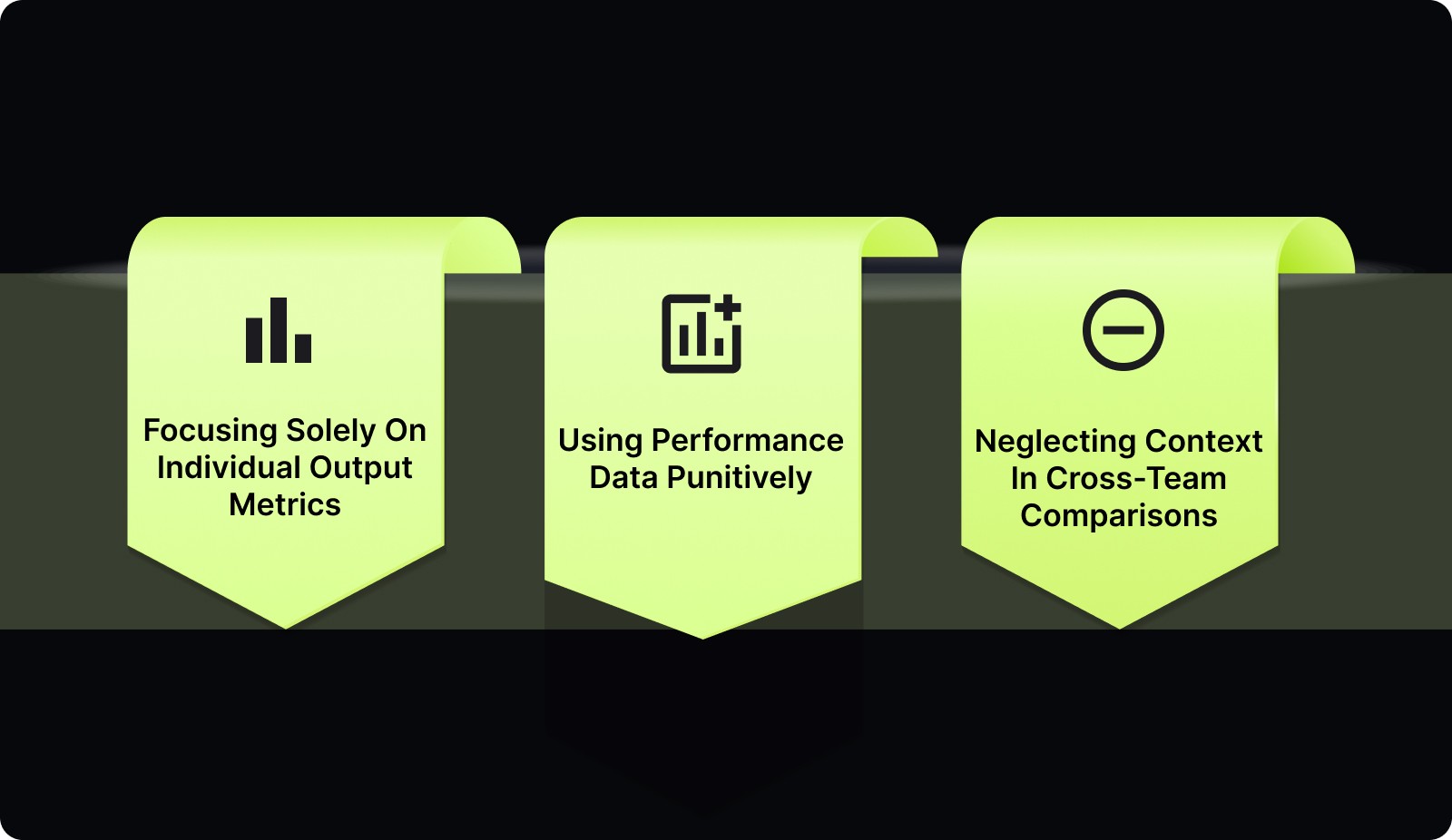
Common mistakes in agile team performance management undermine trust and reduce effectiveness. Recognizing these pitfalls helps you design systems that accurately reflect contributions while maintaining team morale and engagement.
1. Focusing Solely On Individual Output Metrics
Measuring only individual contributions, like commits or closed tickets, misses collaborative work and knowledge sharing. This approach discourages teamwork and creates incentives for quantity over quality. Instead, balance individual metrics with team-level outcomes and qualitative peer feedback.
2. Using Performance Data Punitively
When teams fear negative consequences from performance data, they may manipulate metrics or avoid ambitious goals. This destroys psychological safety and undermines data integrity. Position metrics as improvement tools rather than evaluation weapons to maintain trust and accuracy.
3. Neglecting Context In Cross-Team Comparisons
Comparing teams without considering their different challenges, contexts, and maturity levels creates unfair assessments. Teams working on legacy systems versus greenfield projects face fundamentally different constraints. Focus on team improvement over time rather than comparisons between teams.
Avoiding those pitfalls ensures your system is fair and effective. To illustrate how real engineering organizations achieve this, let's look at a case study.
Also read: Decoding Source Code Management Tools: Types, Benefits, & Top Picks
How AgentOps Used Entelligence AI to Enhance Developer Experience
AgentOps faced a slowing velocity due to manual code reviews and outdated documentation. Needing performance visibility without meeting overhead, they turned to the Entelligence AI platform to resolve these critical bottlenecks.
Result: By leveraging Entelligence AI, AgentOps achieved transformative results in their development process, including 2x faster issue resolution and significant improvement in code quality and architectural consistency.
The platform also provided them with 100% real-time user insights and 24/7 continuous monitoring, enabling them to maintain velocity while improving quality.
Conclusion
Agile team performance management is not just about changing how you review employees; it is about changing how you support them. By adopting continuous feedback loops, tracking the metrics that actually matter, and automating the insights process, you align engineering efforts with business objectives.
Entelligence AI provides the platform necessary to make this transition successful. We unify code quality, security, and team management into a single suite, giving you the tools to optimize velocity and foster a thriving engineering culture.
Want to see how deep insights can transform your engineering team? Request a Demo today.
FAQs
Q. How does agile performance management differ from the waterfall method?
Agile management focuses on continuous, iterative feedback and adapting to change in real-time. Waterfall methods typically rely on rigid, annual, or project-end evaluations that look backward at long timelines, often missing the opportunity for course correction during the work.
Q. What is the best way to handle underperformers in an agile team?
Identify the issue early during sprints or stand-ups. Use data to determine if it is a skill gap or a blocker. Provide immediate coaching or pair programming support. If metrics like cycle time do not improve, move to a formal improvement plan based on specific sprint goals.
Q. Do I need specific software to track agile metrics?
While you can track some data manually, it is inefficient and prone to error. Specialized tools that integrate with your version control systems (like GitHub or GitLab) and project management software provide accurate, automated, real-time insights without disrupting developer flow.
Q. How can HR effectively support engineering managers in this process?
HR should act as a strategic partner by providing frameworks for soft-skill development and ensuring performance data is used fairly. They can help managers translate technical metrics into career development plans and ensure that the review process remains unbiased and constructive.
Q. What metrics should we track first for agile team performance management?
Start with a small, focused set: Cycle Time to understand delivery speed, Change Failure Rate to monitor stability, and Sprint Velocity to estimate capacity. These three agile team performance management metrics give you a balanced view of flow, quality, and predictability without overwhelming managers or developers.
Tracking performance in an engineering organization often feels like trying to hit a moving target. Traditional reviews happen annually, but your developers ship code weekly or even daily, making standard feedback loops obsolete before they even finish.
This disconnect creates frustration for managers who lack visibility and developers who feel misunderstood by generic HR policies. The impact of getting this right is significant; according to a survey, employees who experience their company as agile are very likely to believe their company is ahead of the competition, the company's financial future is secure, and their employer is successful and growing.
You need a dynamic approach that mirrors the speed and adaptability of the software development lifecycle itself. Moving away from static checklists requires a shift toward continuous improvement, real-time data, and removing the bottlenecks that slow down your best talent.
In this article, we break down agile team performance management into actionable frameworks, essential metrics, and strategies to build a high-velocity engineering culture.
Quick Look
Replace annual appraisals with sprint-based reviews to catch issues immediately.
Use objective metrics like Cycle Time and PR Merge Rate rather than subjective observation.
Balance individual contribution tracking with overall team velocity to prevent siloed working habits.
Shift the management focus from "monitoring people" to "clearing obstacles" for the team.
Manual tracking fails at scale; successful teams use tools to automate performance data collection.
What is Agile Team Performance Management, And Why It's Unique
Agile team performance management is a continuous process of setting goals, providing regular feedback, and developing skills within agile team structures. It aligns individual growth with team objectives through frequent check-ins and data-driven conversations. This approach creates faster feedback cycles that help team members adapt and improve their work in real-time.
Why It's Unique:
Focuses on team outcomes rather than individual task completion
Uses actual work metrics from development tools rather than subjective ratings
Emphasizes continuous feedback over annual review cycles
Adapt goals quarterly or even monthly to match sprint planning
Treats performance development as an ongoing process rather than an event
Also read: Understanding Velocity in Agile Software Development
To truly appreciate the power of agile performance, you must first recognize the critical points where it diverges from traditional, annual HR review models.
Traditional vs Agile Team Performance Management
Traditional HR frameworks often clash with the reality of modern engineering workflows. The following comparison highlights where you must shift your strategy to support an agile environment:

1. Frequency of Feedback: From Annual to Continuous
Traditional systems rely on mid-year or annual reviews that often cite outdated examples. Agile management integrates feedback into the daily and weekly workflow. You address code quality issues during the Pull Request (PR) review, not six months later.
2. Focus of Evaluation: From Individual Output to Team Velocity
Standard reviews often pit employees against each other using stack ranking. Agile environments prioritize how well the team ships software together. You measure how an individual contributes to unblocking others and maintaining sprint momentum.
3. Role of the Manager: From Supervisor to Servant Leader
In the old model, a manager dictates tasks and monitors compliance. In an agile setting, the manager acts as a "servant leader." Their primary performance goal is clearing technical debt and administrative hurdles so developers can focus on building.
Shifting your mindset is the first step, but defining success requires objective measurement. We turn now to the core metrics that reveal true team health and effectiveness.

Also read: How to Measure Developer Productivity Effectively
The Core Metrics: Measuring Agile Team Health and Delivery Effectiveness
You cannot improve what you do not measure, but measuring the wrong things, like lines of code, creates perverse incentives. Effective agile tracking focuses on flow, quality, and stability:
1. DORA Metrics (The Industry Standard for Delivery & Stability)
These four metrics provide an objective benchmark for your core software delivery performance.
Deployment Frequency (DF): How often you release to production.
How to measure: Count production deployments over a specific period (day, week, month).
Why it matters: Higher frequency indicates better automation and a culture of small, low-risk changes.
Lead Time for Changes: The total time from code commit to running in production.
How to measure: (Timestamp of Deployment) - (Timestamp of Commit) for a representative sample.
Why it matters: This is the ultimate measure of process efficiency and your ability to respond quickly.
Change Failure Rate (CFR): Assessing Stability.
How to measure: (Number of Failed Deployments / Total Deployments) * 100. A "failed deployment" is one that causes a production incident or requires a hotfix/rollback.
Why it matters: A low, stable rate shows you have robust testing and release practices. A rising rate suggests the team is rushing or lacks sufficient automated testing coverage.
Mean Time to Recovery (MTTR): How fast you restore service after a failure.
How to measure: Average the time between an incident's start and full service restoration.
Why it matters: Fast recovery minimizes user impact and builds organizational confidence to ship more often.
2. Team Effectiveness & Flow Metrics
These metrics complement DORA by focusing on internal process health and predictability.
Cycle Time: Measuring Speed of Delivery.
How to measure: (Date/Time of Deployment) - (Date/Time of First Commit for a work item). This is often more granular than Lead Time, focusing on a single feature or fix.
Why it matters: High cycle times directly indicate bottlenecks in your process, such as lengthy code reviews or QA handoffs.
Sprint Velocity: Predicting Team Capacity.
How to measure: Sum of story points (or equivalent) completed in a sprint.
Why it matters: It helps engineering managers set realistic deadlines and prevents burnout by avoiding over-commitment. Focus on trends, not absolute numbers.
Sprint Completion Rate / Planned vs. Actual: A measure of predictability.
How to measure: (Story Points Completed / Story Points Planned) * 100 per sprint.
Why it matters: High predictability allows for better product planning and reduces management overhead.
3. The Critical People-Centric Metric
Outstanding technical metrics with a burnt-out team are not sustainable.
Developer Satisfaction or Engagement (eNPS or Survey Score)
How to measure: Use a simple quarterly eNPS survey ("On a scale of 0-10, how likely are you to recommend this team as a great place to work?") or track qualitative feedback.
Why it matters: This is a leading indicator of retention, innovation, and quality. It tells you if your process improvements are actually improving life for the team.
The Entelligence AI Advantage: End-to-End Engineering Clarity
Engineering leaders and HR professionals often struggle with the "black box" of development. You know work is happening, but you lack visibility into who is blocked, who is burning out, and where the process is breaking down. Manual tracking is slow, and generic project management tools fail to capture the nuances of code complexity.
Entelligence AI acts as your end-to-end engineering productivity suite. It bridges the gap between daily coding tasks and high-level organizational strategy.
Contextual Code Reviews: AI-powered feedback ensures high quality before code even reaches a human reviewer.
Sprint Assessment: Automated health checks surface blockers and bottlenecks without you having to chase developers for updates.
Leaderboards & Insights: Engage teams with friendly competition while giving managers data-backed visibility into individual and team performance.
Org-Wide Visibility: From individual developer workflows to strategic dashboards, you get a unified view of engineering health.
Entelligence AI transforms engineering data into actionable clarity, helping your organization ship faster and with higher confidence.
These metrics give you the what and the objective data of performance. Next, we will explore the when by mapping your performance management process directly onto the standard agile cycle.
The 4 Stages of the Agile Performance Management Cycle
Aligning performance reviews with the agile ritual creates a natural rhythm for feedback. You should map your HR touchpoints to these four engineering stages:
1. Sprint Planning: Setting Clear Expectations
Before code is written, the team agrees on goals and deliverables for the upcoming cycle.
Action: Ensure every engineer knows exactly which tickets they own and the definition of "done." This eliminates ambiguity regarding performance expectations for the next two weeks.
2. Daily Stand-ups: Micro-Course Corrections
These short meetings allow the team to highlight blockers and progress.
Action: Managers should use this time to identify who is struggling. If a developer reports the same blocker twice, it is a signal for immediate coaching or intervention.
3. Sprint Review: Validating Output
The team demonstrates what they built to the stakeholders.
Action: Evaluate the quality of the work delivered. Did the feature meet the product requirements? This focuses the assessment on tangible outcomes rather than hours worked.
4. Sprint Retrospective: Process Improvement
The team discusses what went well and what did not.
Action: This is a safe space for cultural performance management. Identify toxic patterns, communication gaps, or process inefficiencies that are hurting team morale.
Understanding the cycle ensures continuous feedback, but strategic action drives improvement. Here are seven effective ways to increase your team’s performance right now.
7 Effective Ways to Increase Agile Team Performance
Improving performance requires a mix of cultural shifts and tactical adjustments. Use these strategies to build a more resilient engineering organization:
1. Automate Data Collection
Stop asking developers to fill out status reports. Use tools that ingest data directly from GitHub, Jira, or Slack to visualize work.
How it looks when implemented:
Managers see real-time dashboards of sprint progress.
Developers spend zero time manually logging tasks.
Reviews are based on actual commit history, not memory.
2. Implement Contextual Code Reviews
Use AI and tooling to standardize feedback during the code review process itself.
How it looks when implemented:
Junior developers receive automated suggestions on syntax and style.
Senior engineers spend less time on trivial fixes.
Code quality consistency improves across the entire organization.
3. Establish clear Career Ladders
Define what "senior" means in terms of technical capability and soft skills.
How it looks when implemented:
Developers have a clear roadmap for promotion.
Skill gaps are identified early and addressed with training.
Retention rates increase as employees see a future.
4. Optimize Meeting Loads
Protect "maker time" by clustering meetings or designating no-meeting days.
How it looks when implemented:
Engineers have 4-hour blocks of uninterrupted coding time.
Sprint velocity increases due to better focus.
Frustration regarding context-switching decreases.
5. Encourage Cross-Training
Prevent knowledge silos by rotating developers across different parts of the codebase.
How it looks when implemented:
The "bus factor" (risk if one person leaves) is reduced.
Team members gain empathy for other technical challenges.
Problem-solving becomes more creative due to diverse exposure.
6. Gamify Quality (Carefully)
Use leaderboards to highlight positive behaviors like bug squashing or rapid PR reviews.
How it looks when implemented:
Friendly competition drives engagement.
Focus shifts to high-impact activities like reviewing others' code.
Team morale improves through public recognition of hard work.
7. Conduct Blameless Post-Mortems
When things break, focus on the process failure, not the person.
How it looks when implemented:
Developers report bugs faster without fear of punishment.
Root cause analysis leads to systemic fixes.
Psychological safety allows for honest communication.
Implementing these positive strategies is crucial, but equally important is understanding the common traps that can quickly undermine your new agile performance system.
Also read: Understanding Code Scanning for Vulnerabilities
Key Pitfalls to Avoid When Assessing Team Performance

Common mistakes in agile team performance management undermine trust and reduce effectiveness. Recognizing these pitfalls helps you design systems that accurately reflect contributions while maintaining team morale and engagement.
1. Focusing Solely On Individual Output Metrics
Measuring only individual contributions, like commits or closed tickets, misses collaborative work and knowledge sharing. This approach discourages teamwork and creates incentives for quantity over quality. Instead, balance individual metrics with team-level outcomes and qualitative peer feedback.
2. Using Performance Data Punitively
When teams fear negative consequences from performance data, they may manipulate metrics or avoid ambitious goals. This destroys psychological safety and undermines data integrity. Position metrics as improvement tools rather than evaluation weapons to maintain trust and accuracy.
3. Neglecting Context In Cross-Team Comparisons
Comparing teams without considering their different challenges, contexts, and maturity levels creates unfair assessments. Teams working on legacy systems versus greenfield projects face fundamentally different constraints. Focus on team improvement over time rather than comparisons between teams.
Avoiding those pitfalls ensures your system is fair and effective. To illustrate how real engineering organizations achieve this, let's look at a case study.
Also read: Decoding Source Code Management Tools: Types, Benefits, & Top Picks
How AgentOps Used Entelligence AI to Enhance Developer Experience
AgentOps faced a slowing velocity due to manual code reviews and outdated documentation. Needing performance visibility without meeting overhead, they turned to the Entelligence AI platform to resolve these critical bottlenecks.
Result: By leveraging Entelligence AI, AgentOps achieved transformative results in their development process, including 2x faster issue resolution and significant improvement in code quality and architectural consistency.
The platform also provided them with 100% real-time user insights and 24/7 continuous monitoring, enabling them to maintain velocity while improving quality.
Conclusion
Agile team performance management is not just about changing how you review employees; it is about changing how you support them. By adopting continuous feedback loops, tracking the metrics that actually matter, and automating the insights process, you align engineering efforts with business objectives.
Entelligence AI provides the platform necessary to make this transition successful. We unify code quality, security, and team management into a single suite, giving you the tools to optimize velocity and foster a thriving engineering culture.
Want to see how deep insights can transform your engineering team? Request a Demo today.
FAQs
Q. How does agile performance management differ from the waterfall method?
Agile management focuses on continuous, iterative feedback and adapting to change in real-time. Waterfall methods typically rely on rigid, annual, or project-end evaluations that look backward at long timelines, often missing the opportunity for course correction during the work.
Q. What is the best way to handle underperformers in an agile team?
Identify the issue early during sprints or stand-ups. Use data to determine if it is a skill gap or a blocker. Provide immediate coaching or pair programming support. If metrics like cycle time do not improve, move to a formal improvement plan based on specific sprint goals.
Q. Do I need specific software to track agile metrics?
While you can track some data manually, it is inefficient and prone to error. Specialized tools that integrate with your version control systems (like GitHub or GitLab) and project management software provide accurate, automated, real-time insights without disrupting developer flow.
Q. How can HR effectively support engineering managers in this process?
HR should act as a strategic partner by providing frameworks for soft-skill development and ensuring performance data is used fairly. They can help managers translate technical metrics into career development plans and ensure that the review process remains unbiased and constructive.
Q. What metrics should we track first for agile team performance management?
Start with a small, focused set: Cycle Time to understand delivery speed, Change Failure Rate to monitor stability, and Sprint Velocity to estimate capacity. These three agile team performance management metrics give you a balanced view of flow, quality, and predictability without overwhelming managers or developers.
Your questions,
Your questions,
Decoded
Decoded
What makes Entelligence different?
Unlike tools that just flag issues, Entelligence understands context — detecting, explaining, and fixing problems while aligning with product goals and team standards.
Does it replace human reviewers?
No. It amplifies them. Entelligence handles repetitive checks so engineers can focus on architecture, logic, and innovation.
What tools does it integrate with?
It fits right into your workflow — GitHub, GitLab, Jira, Linear, Slack, and more. No setup friction, no context switching.
How secure is my code?
Your code never leaves your environment. Entelligence uses encrypted processing and complies with top industry standards like SOC 2 and HIPAA.
Who is it built for?
Fast-growing engineering teams that want to scale quality, security, and velocity without adding more manual reviews or overhead.

What makes Entelligence different?
Does it replace human reviewers?
What tools does it integrate with?
How secure is my code?
Who is it built for?


