

Technical Debt in Agile: 7 Strategies to Manage It Effectively
Dec 12, 2025
Dec 12, 2025
Does your engineering team ship features every sprint but somehow feel slower with each release? You’re not alone in this challenge. In fact, according to a Gartner study, 93% of engineering teams report having technical debt in their systems.
When teams prioritize speed in early sprints by taking shortcuts, those decisions create compounding friction that affects every subsequent sprint. What looked like efficient delivery in month one becomes a maintenance burden by month six.
In this guide, we break down how to manage technical debt in agile teams without sacrificing sprint velocity, along with strategies you can implement today.
Key Takeaways
Technical debt in agile refers to shortcuts or suboptimal solutions chosen to meet sprint deadlines, creating future rework that slows velocity.
Agile's speed creates natural pressure for quick solutions, making proactive debt management essential rather than optional.
Allocating 10-20% of each sprint to debt repayment prevents compound interest while maintaining feature delivery momentum.
Not all debt deserves immediate attention; prioritize based on impact to velocity, stability, and future architecture decisions.
Automated code reviews and real-time analysis help teams catch debt before merging rather than discovering it months later during refactors.
What Is Technical Debt in Agile?
Technical debt in agile refers to the implied cost of choosing a fast or convenient solution now that requires rework later to achieve sustainable code quality. It works like financial debt, where you borrow time today but pay interest through slower development speed, more bugs, and harder maintenance work.
In agile, technical debt shows up differently than in waterfall projects. Sprint-based delivery creates natural pressure to ship by the end of each iteration. This leads to incomplete implementations, skipped tests, or patched architecture decisions that seemed fine for that sprint's scope but create problems as the codebase grows.
For example, suppose your team needs to add user authentication to your platform in a two-week sprint. In that case, you can implement proper password encryption, session management, and rate limiting, taking the full two weeks, or use a basic implementation without proper security controls to ship in one week.
The second approach creates debt because you'll need to revisit that code later when security audits flag vulnerabilities or when you need to add OAuth support for enterprise customers.
How Does Agile Create Technical Debt?
Agile practices accelerate delivery, which creates structural pressure to take shortcuts when sprint deadlines approach. Teams working in fixed time boxes face a recurring choice between shipping incomplete work or missing sprint commitments, and the incentive structure usually favors shipping.
This happens through several patterns. Sprint planning often underestimates complexity, leaving teams scrambling in the final days to deliver committed stories. Product owners prioritize visible features over invisible quality work because stakeholders measure progress by shipped functionality, not code health.
Retrospectives identify technical improvements, but those items rarely make it into the next sprint's backlog when new features compete for the same capacity.
The Definition of Done becomes negotiable under deadline pressure. Teams skip documentation updates, defer test coverage, or implement quick fixes instead of proper solutions, telling themselves they'll clean it up next sprint. That next sprint arrives with its own features and deadlines, pushing the cleanup further out.
For instance, when a team promises five story points of work but realizes on day nine they can only finish three without cutting corners, they face pressure to compromise quality rather than reduce scope. Product stakeholders see three completed stories as failure, but five stories with technical shortcuts as success, even though the shortcuts create compound problems for future sprints.
What Are the Types of Technical Debt in Agile Teams?
Technical debt appears in multiple forms across your codebase and development process. Recognizing these types helps you prioritize which debt to address first based on impact to velocity and stability.
Here's how different types of technical debt compare:
Type | Impact on Velocity | Common Causes | Repayment Difficulty |
Code Debt | High | Sprint pressure, copied logic | Medium |
Testing Debt | Very High | Skipped test writing | High |
Documentation Debt | Medium | Time constraints, turnover | Low |
Design Debt | Very High | Early architectural decisions | Very High |
Process Debt | Medium | Skipped quality gates | Medium |
These debt types accumulate at different rates and require varying levels of effort to resolve, making prioritization essential for effective debt management. Here are the specific debt types your team will encounter:
1. Code Debt
Duplicated logic, hardcoded values, or complex functions that accomplish the task but resist modification. This happens when developers copy-paste solutions across features instead of creating reusable components, or when they nest conditional logic five levels deep to handle edge cases quickly.
2. Testing Debt
Missing or incomplete test coverage that leaves functionality unverified. Teams skip writing tests under sprint pressure, making future refactors risky because you can't verify that changes didn't break existing behavior.
3. Documentation Debt
Outdated or missing technical documentation that forces developers to read code or ask teammates for context. This slows onboarding and makes handoffs between team members inefficient, as knowledge lives only in people's heads.
4. Design Debt
Architectural decisions that work for the current scope but don't scale as requirements grow. For example, building a monolithic service that should be split into microservices, or using synchronous processing that needs to become asynchronous as volume increases.
5. Process Debt
Skipped quality gates like code reviews, security scans, or deployment checklists to save time during sprints. These shortcuts create risks that surface as production incidents rather than being caught issues during development.
How Does Technical Debt Impact Agile Velocity?
Technical debt acts as friction in your development process, slowing each subsequent sprint. What seems like small shortcuts in early sprints compound into significant productivity drains as your codebase and team grow.
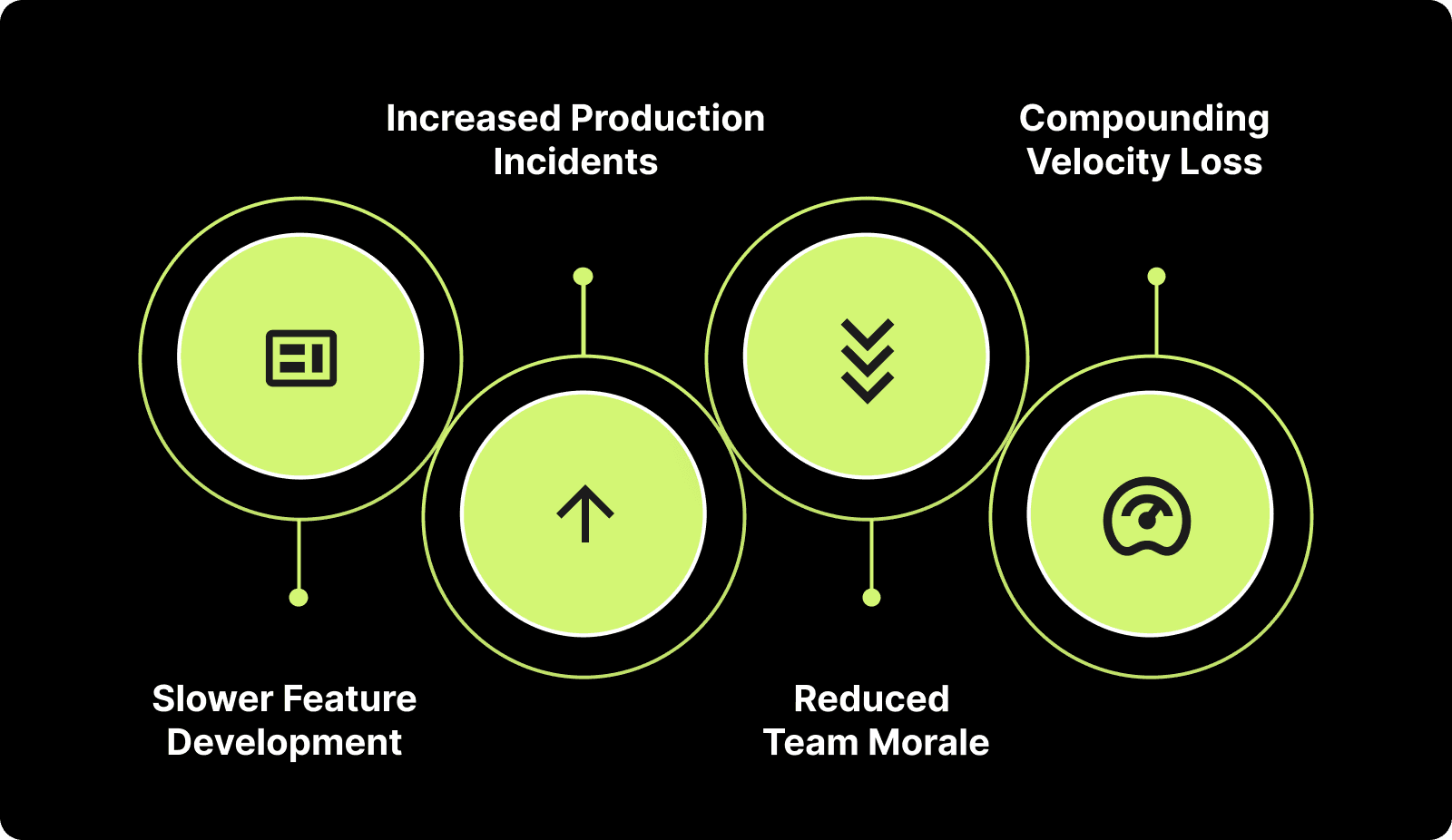
Knowing how debt impacts velocity helps you justify repayment work to stakeholders and prioritize which debt to address first.
1. Slower Feature Development
Developers spend more time understanding existing code before they can add new features. When documentation is missing, and architecture is patched together, engineers need hours to trace through implementation details that should be straightforward. Simple changes touch multiple files because duplicated logic lives across the codebase instead of in shared components.
2. Increased Production Incidents
Production incidents increase when debt accumulates. Incomplete error handling, skipped tests, and architectural shortcuts surface as bugs that interrupt sprint work. Engineers context-switch between planned stories and firefighting, reducing their capacity for feature development. Teams operating in reactive mode struggle to maintain consistent velocity.
3. Reduced Team Morale
Team morale drops when engineers constantly work in messy code. Talented developers leave teams where they can't write quality code because sprint pressure forces compromises. Hiring becomes harder when technical debt makes the codebase unappealing to prospective team members reviewing your GitHub repositories.
4. Compounding Velocity Loss
For instance, a team shipping eight story points per sprint when their codebase is clean might drop to five story points as debt accumulates, not because developers work less hard but because each change requires navigating technical landmines left from previous shortcuts.
How to Manage Technical Debt in Agile Sprints?
Managing technical debt in agile requires integrating debt work into your regular sprint cycle rather than treating it as separate from feature development. Teams that succeed balance new functionality with continuous improvement through systematic approaches. Some effective strategies to follow include:
1. Add Debt Items to Your Product Backlog
Create backlog items for refactoring work, test coverage improvements, and documentation updates. Treat these items like features with clear acceptance criteria and story point estimates so they compete fairly for sprint capacity.
2. Allocate Percentage of Each Sprint to Debt Repayment
Reserve 10-20% of your sprint capacity for addressing technical debt. This creates consistent improvement without requiring separate refactoring sprints that disrupt feature delivery momentum.
3. Track Debt Using Story Points
Estimate technical debt items in story points like any other work. This makes debt visible in velocity metrics and helps product owners understand the capacity trade-off between features and quality improvements.
4. Prioritize High-Impact Debt First
Focus on debt that blocks future features, causes frequent production incidents, or slows development velocity. Not all debt deserves immediate attention; some can live in your codebase indefinitely if it doesn't create ongoing friction.
5. Automate Testing to Prevent New Debt
Implement continuous integration with automated test suites that catch issues before merging. Teams that automate quality gates accumulate less debt because problems get fixed immediately rather than postponed.
6. Make Debt Visible in Retrospectives
Review technical debt trends during sprint retrospectives. Discuss which shortcuts were necessary trade-offs versus avoidable mistakes, and adjust processes to reduce unnecessary debt creation.
7. Use Tools That Flag Debt in Real-Time
Integrate code analysis tools into your development workflow that surface code smells, missing tests, and complexity metrics during pull requests. Real-time feedback helps teams address debt before it gets merged and forgotten.

Common Mistakes When Managing Tech Debt in Agile
Teams often approach technical debt management with the right strategy but make common mistakes that stop them from reducing debt effectively. Avoiding these mistakes helps you maintain both velocity and code quality.
Dedicating entire sprints to debt repayment: Setting aside full sprints for refactoring breaks feature delivery momentum and frustrates stakeholders who see no visible progress. Debt work integrated into regular sprints maintains consistent improvement without stopping feature development.
Treating all debt equally: Not every shortcut deserves immediate attention. Teams waste capacity addressing low-impact debt like minor code style issues while high-impact debt that blocks future features or causes incidents remains unaddressed.
Not quantifying debt impact: Technical arguments alone rarely convince product stakeholders to prioritize refactoring work. Teams that can't explain how debt slows velocity or increases incident rates struggle to secure capacity for debt repayment.
Letting debt accumulate for quarters: Postponing debt work creates compound interest where small problems become architectural challenges. Debt that could be fixed in hours when fresh requires weeks to untangle after it's built upon by additional features.
Skipping debt discussions in planning: When technical debt never appears in sprint planning conversations, it becomes invisible to the team and stakeholders. Make debt a standard agenda item in planning and retrospectives to keep it top of mind.
How to Track Technical Debt Effectively in Agile Teams?
Tracking technical debt makes it visible to both engineers and stakeholders, creating accountability for addressing it and enabling data-driven prioritization decisions. Without tracking, debt remains an abstract concept rather than a concrete backlog item. Here’s how to track it effectively:
1. Integrate Debt Into Backlog Management
Integrate debt into your backlog management tools like Jira or Linear. Create a dedicated label or epic for technical debt items so you can filter and report on debt separately from features. Tag each item with an impact level (critical, high, medium, low) based on how much it slows current or future development.
2. Use Automated Code Analysis
Use automated code analysis to identify debt systematically. Static analysis tools can flag duplicated code, high complexity functions, missing test coverage, and security vulnerabilities. These tools provide objective metrics rather than relying on developers to remember all the shortcuts they took under pressure.
3. Create Visibility Dashboards
Create a debt dashboard that shows trends over time. Track metrics like total debt items, debt items resolved per sprint, and average age of open debt items. Visualizing trends helps teams see whether they're making progress or falling behind.
4. Review Debt Status Regularly
Review debt status in sprint retrospectives. Discuss which new debt was created during the sprint, which debt was paid down, and whether your debt balance is trending in the right direction. This creates team awareness and accountability for code quality.
Manage Tech Debt and Maintain Sprint Velocity with Entelligence AI
Managing technical debt manually creates its own overhead that slows teams down. Engineers spend time documenting debt, prioritizing fixes, and tracking progress across spreadsheets and backlog tools, time that could go toward actually addressing the debt or shipping features.
Entelligence AI automates technical debt detection and tracking, so your team can focus on fixing problems rather than chasing them. Here's how Entelligence AI helps agile teams balance speed with code quality:
AI-powered code reviews: Catch code smells, duplicated logic, and complexity issues during pull requests before they get merged, preventing new debt from entering your codebase.
Real-time security scanning: Detect vulnerabilities and missing security checks automatically so security debt doesn't accumulate invisibly until audits or incidents force emergency fixes.
Automated quality metrics: Track test coverage, code complexity, and maintainability scores across your codebase without manual analysis, giving you objective data for prioritization.
Team performance dashboards: Visualize debt trends, review quality, and velocity metrics in one place so engineering leaders can spot when debt is impacting sprint performance.
Sprint health assessments: Get AI-generated reports on code quality trends, debt accumulation rates, and technical risks that could slow future sprints.
Allocore uses Entelligence AI to review pull requests across its financial services platform, catching issues like missing error handling, resource leaks, and incomplete test coverage before merge. The team saved over 45 hours monthly on code reviews while preventing production incidents from technical shortcuts.

Final Thoughts
Technical debt in agile teams is a natural byproduct of sprint-based delivery, not a sign of poor engineering. The question isn't whether your team will create debt, but whether you manage it proactively before it compounds into architectural problems that slow every future sprint.
Start by allocating consistent sprint capacity to debt repayment, tracking debt in your backlog like any other work, and using automated tools to make debt visible in real-time. Entelligence AI helps agile teams maintain velocity while keeping code quality high through automated reviews, real-time debt detection, and comprehensive tracking dashboards.
Ready to ship fast without accumulating technical debt that slows future sprints? Start your 14-day free trial and see how Entelligence AI keeps your codebase healthy while maintaining agile velocity.
FAQs
1. What is technical debt in Scrum?
Technical debt in Scrum refers to shortcuts or incomplete implementations chosen during sprints to meet iteration deadlines, creating future rework. It includes skipped tests, missing documentation, and a patched architecture that works now but slows later development.
2. Is technical debt always bad?
Technical debt isn't inherently bad when taken strategically to ship critical features faster. Problems arise when teams don't track debt or allocate time to pay it down, allowing compound interest that eventually stops all forward progress.
3. How can you prevent technical debt?
Prevent debt through a clear Definition of Done criteria, automated testing in CI/CD pipelines, regular code reviews, realistic sprint planning, and tools that flag quality issues during development rather than after merge.
4. Who pays for technical debt?
The entire engineering organization pays for technical debt through slower velocity, more production incidents, and reduced team morale. Product stakeholders pay through delayed features and higher costs to implement new capabilities.
5. What is the difference between technical debt and bugs?
Bugs are unintended defects where code doesn't work as designed. Technical debt is intentional shortcuts where code works but uses suboptimal approaches that create future maintenance burden and slow development.
Does your engineering team ship features every sprint but somehow feel slower with each release? You’re not alone in this challenge. In fact, according to a Gartner study, 93% of engineering teams report having technical debt in their systems.
When teams prioritize speed in early sprints by taking shortcuts, those decisions create compounding friction that affects every subsequent sprint. What looked like efficient delivery in month one becomes a maintenance burden by month six.
In this guide, we break down how to manage technical debt in agile teams without sacrificing sprint velocity, along with strategies you can implement today.
Key Takeaways
Technical debt in agile refers to shortcuts or suboptimal solutions chosen to meet sprint deadlines, creating future rework that slows velocity.
Agile's speed creates natural pressure for quick solutions, making proactive debt management essential rather than optional.
Allocating 10-20% of each sprint to debt repayment prevents compound interest while maintaining feature delivery momentum.
Not all debt deserves immediate attention; prioritize based on impact to velocity, stability, and future architecture decisions.
Automated code reviews and real-time analysis help teams catch debt before merging rather than discovering it months later during refactors.
What Is Technical Debt in Agile?
Technical debt in agile refers to the implied cost of choosing a fast or convenient solution now that requires rework later to achieve sustainable code quality. It works like financial debt, where you borrow time today but pay interest through slower development speed, more bugs, and harder maintenance work.
In agile, technical debt shows up differently than in waterfall projects. Sprint-based delivery creates natural pressure to ship by the end of each iteration. This leads to incomplete implementations, skipped tests, or patched architecture decisions that seemed fine for that sprint's scope but create problems as the codebase grows.
For example, suppose your team needs to add user authentication to your platform in a two-week sprint. In that case, you can implement proper password encryption, session management, and rate limiting, taking the full two weeks, or use a basic implementation without proper security controls to ship in one week.
The second approach creates debt because you'll need to revisit that code later when security audits flag vulnerabilities or when you need to add OAuth support for enterprise customers.
How Does Agile Create Technical Debt?
Agile practices accelerate delivery, which creates structural pressure to take shortcuts when sprint deadlines approach. Teams working in fixed time boxes face a recurring choice between shipping incomplete work or missing sprint commitments, and the incentive structure usually favors shipping.
This happens through several patterns. Sprint planning often underestimates complexity, leaving teams scrambling in the final days to deliver committed stories. Product owners prioritize visible features over invisible quality work because stakeholders measure progress by shipped functionality, not code health.
Retrospectives identify technical improvements, but those items rarely make it into the next sprint's backlog when new features compete for the same capacity.
The Definition of Done becomes negotiable under deadline pressure. Teams skip documentation updates, defer test coverage, or implement quick fixes instead of proper solutions, telling themselves they'll clean it up next sprint. That next sprint arrives with its own features and deadlines, pushing the cleanup further out.
For instance, when a team promises five story points of work but realizes on day nine they can only finish three without cutting corners, they face pressure to compromise quality rather than reduce scope. Product stakeholders see three completed stories as failure, but five stories with technical shortcuts as success, even though the shortcuts create compound problems for future sprints.
What Are the Types of Technical Debt in Agile Teams?
Technical debt appears in multiple forms across your codebase and development process. Recognizing these types helps you prioritize which debt to address first based on impact to velocity and stability.
Here's how different types of technical debt compare:
Type | Impact on Velocity | Common Causes | Repayment Difficulty |
Code Debt | High | Sprint pressure, copied logic | Medium |
Testing Debt | Very High | Skipped test writing | High |
Documentation Debt | Medium | Time constraints, turnover | Low |
Design Debt | Very High | Early architectural decisions | Very High |
Process Debt | Medium | Skipped quality gates | Medium |
These debt types accumulate at different rates and require varying levels of effort to resolve, making prioritization essential for effective debt management. Here are the specific debt types your team will encounter:
1. Code Debt
Duplicated logic, hardcoded values, or complex functions that accomplish the task but resist modification. This happens when developers copy-paste solutions across features instead of creating reusable components, or when they nest conditional logic five levels deep to handle edge cases quickly.
2. Testing Debt
Missing or incomplete test coverage that leaves functionality unverified. Teams skip writing tests under sprint pressure, making future refactors risky because you can't verify that changes didn't break existing behavior.
3. Documentation Debt
Outdated or missing technical documentation that forces developers to read code or ask teammates for context. This slows onboarding and makes handoffs between team members inefficient, as knowledge lives only in people's heads.
4. Design Debt
Architectural decisions that work for the current scope but don't scale as requirements grow. For example, building a monolithic service that should be split into microservices, or using synchronous processing that needs to become asynchronous as volume increases.
5. Process Debt
Skipped quality gates like code reviews, security scans, or deployment checklists to save time during sprints. These shortcuts create risks that surface as production incidents rather than being caught issues during development.
How Does Technical Debt Impact Agile Velocity?
Technical debt acts as friction in your development process, slowing each subsequent sprint. What seems like small shortcuts in early sprints compound into significant productivity drains as your codebase and team grow.

Knowing how debt impacts velocity helps you justify repayment work to stakeholders and prioritize which debt to address first.
1. Slower Feature Development
Developers spend more time understanding existing code before they can add new features. When documentation is missing, and architecture is patched together, engineers need hours to trace through implementation details that should be straightforward. Simple changes touch multiple files because duplicated logic lives across the codebase instead of in shared components.
2. Increased Production Incidents
Production incidents increase when debt accumulates. Incomplete error handling, skipped tests, and architectural shortcuts surface as bugs that interrupt sprint work. Engineers context-switch between planned stories and firefighting, reducing their capacity for feature development. Teams operating in reactive mode struggle to maintain consistent velocity.
3. Reduced Team Morale
Team morale drops when engineers constantly work in messy code. Talented developers leave teams where they can't write quality code because sprint pressure forces compromises. Hiring becomes harder when technical debt makes the codebase unappealing to prospective team members reviewing your GitHub repositories.
4. Compounding Velocity Loss
For instance, a team shipping eight story points per sprint when their codebase is clean might drop to five story points as debt accumulates, not because developers work less hard but because each change requires navigating technical landmines left from previous shortcuts.
How to Manage Technical Debt in Agile Sprints?
Managing technical debt in agile requires integrating debt work into your regular sprint cycle rather than treating it as separate from feature development. Teams that succeed balance new functionality with continuous improvement through systematic approaches. Some effective strategies to follow include:
1. Add Debt Items to Your Product Backlog
Create backlog items for refactoring work, test coverage improvements, and documentation updates. Treat these items like features with clear acceptance criteria and story point estimates so they compete fairly for sprint capacity.
2. Allocate Percentage of Each Sprint to Debt Repayment
Reserve 10-20% of your sprint capacity for addressing technical debt. This creates consistent improvement without requiring separate refactoring sprints that disrupt feature delivery momentum.
3. Track Debt Using Story Points
Estimate technical debt items in story points like any other work. This makes debt visible in velocity metrics and helps product owners understand the capacity trade-off between features and quality improvements.
4. Prioritize High-Impact Debt First
Focus on debt that blocks future features, causes frequent production incidents, or slows development velocity. Not all debt deserves immediate attention; some can live in your codebase indefinitely if it doesn't create ongoing friction.
5. Automate Testing to Prevent New Debt
Implement continuous integration with automated test suites that catch issues before merging. Teams that automate quality gates accumulate less debt because problems get fixed immediately rather than postponed.
6. Make Debt Visible in Retrospectives
Review technical debt trends during sprint retrospectives. Discuss which shortcuts were necessary trade-offs versus avoidable mistakes, and adjust processes to reduce unnecessary debt creation.
7. Use Tools That Flag Debt in Real-Time
Integrate code analysis tools into your development workflow that surface code smells, missing tests, and complexity metrics during pull requests. Real-time feedback helps teams address debt before it gets merged and forgotten.

Common Mistakes When Managing Tech Debt in Agile
Teams often approach technical debt management with the right strategy but make common mistakes that stop them from reducing debt effectively. Avoiding these mistakes helps you maintain both velocity and code quality.
Dedicating entire sprints to debt repayment: Setting aside full sprints for refactoring breaks feature delivery momentum and frustrates stakeholders who see no visible progress. Debt work integrated into regular sprints maintains consistent improvement without stopping feature development.
Treating all debt equally: Not every shortcut deserves immediate attention. Teams waste capacity addressing low-impact debt like minor code style issues while high-impact debt that blocks future features or causes incidents remains unaddressed.
Not quantifying debt impact: Technical arguments alone rarely convince product stakeholders to prioritize refactoring work. Teams that can't explain how debt slows velocity or increases incident rates struggle to secure capacity for debt repayment.
Letting debt accumulate for quarters: Postponing debt work creates compound interest where small problems become architectural challenges. Debt that could be fixed in hours when fresh requires weeks to untangle after it's built upon by additional features.
Skipping debt discussions in planning: When technical debt never appears in sprint planning conversations, it becomes invisible to the team and stakeholders. Make debt a standard agenda item in planning and retrospectives to keep it top of mind.
How to Track Technical Debt Effectively in Agile Teams?
Tracking technical debt makes it visible to both engineers and stakeholders, creating accountability for addressing it and enabling data-driven prioritization decisions. Without tracking, debt remains an abstract concept rather than a concrete backlog item. Here’s how to track it effectively:
1. Integrate Debt Into Backlog Management
Integrate debt into your backlog management tools like Jira or Linear. Create a dedicated label or epic for technical debt items so you can filter and report on debt separately from features. Tag each item with an impact level (critical, high, medium, low) based on how much it slows current or future development.
2. Use Automated Code Analysis
Use automated code analysis to identify debt systematically. Static analysis tools can flag duplicated code, high complexity functions, missing test coverage, and security vulnerabilities. These tools provide objective metrics rather than relying on developers to remember all the shortcuts they took under pressure.
3. Create Visibility Dashboards
Create a debt dashboard that shows trends over time. Track metrics like total debt items, debt items resolved per sprint, and average age of open debt items. Visualizing trends helps teams see whether they're making progress or falling behind.
4. Review Debt Status Regularly
Review debt status in sprint retrospectives. Discuss which new debt was created during the sprint, which debt was paid down, and whether your debt balance is trending in the right direction. This creates team awareness and accountability for code quality.
Manage Tech Debt and Maintain Sprint Velocity with Entelligence AI
Managing technical debt manually creates its own overhead that slows teams down. Engineers spend time documenting debt, prioritizing fixes, and tracking progress across spreadsheets and backlog tools, time that could go toward actually addressing the debt or shipping features.
Entelligence AI automates technical debt detection and tracking, so your team can focus on fixing problems rather than chasing them. Here's how Entelligence AI helps agile teams balance speed with code quality:
AI-powered code reviews: Catch code smells, duplicated logic, and complexity issues during pull requests before they get merged, preventing new debt from entering your codebase.
Real-time security scanning: Detect vulnerabilities and missing security checks automatically so security debt doesn't accumulate invisibly until audits or incidents force emergency fixes.
Automated quality metrics: Track test coverage, code complexity, and maintainability scores across your codebase without manual analysis, giving you objective data for prioritization.
Team performance dashboards: Visualize debt trends, review quality, and velocity metrics in one place so engineering leaders can spot when debt is impacting sprint performance.
Sprint health assessments: Get AI-generated reports on code quality trends, debt accumulation rates, and technical risks that could slow future sprints.
Allocore uses Entelligence AI to review pull requests across its financial services platform, catching issues like missing error handling, resource leaks, and incomplete test coverage before merge. The team saved over 45 hours monthly on code reviews while preventing production incidents from technical shortcuts.

Final Thoughts
Technical debt in agile teams is a natural byproduct of sprint-based delivery, not a sign of poor engineering. The question isn't whether your team will create debt, but whether you manage it proactively before it compounds into architectural problems that slow every future sprint.
Start by allocating consistent sprint capacity to debt repayment, tracking debt in your backlog like any other work, and using automated tools to make debt visible in real-time. Entelligence AI helps agile teams maintain velocity while keeping code quality high through automated reviews, real-time debt detection, and comprehensive tracking dashboards.
Ready to ship fast without accumulating technical debt that slows future sprints? Start your 14-day free trial and see how Entelligence AI keeps your codebase healthy while maintaining agile velocity.
FAQs
1. What is technical debt in Scrum?
Technical debt in Scrum refers to shortcuts or incomplete implementations chosen during sprints to meet iteration deadlines, creating future rework. It includes skipped tests, missing documentation, and a patched architecture that works now but slows later development.
2. Is technical debt always bad?
Technical debt isn't inherently bad when taken strategically to ship critical features faster. Problems arise when teams don't track debt or allocate time to pay it down, allowing compound interest that eventually stops all forward progress.
3. How can you prevent technical debt?
Prevent debt through a clear Definition of Done criteria, automated testing in CI/CD pipelines, regular code reviews, realistic sprint planning, and tools that flag quality issues during development rather than after merge.
4. Who pays for technical debt?
The entire engineering organization pays for technical debt through slower velocity, more production incidents, and reduced team morale. Product stakeholders pay through delayed features and higher costs to implement new capabilities.
5. What is the difference between technical debt and bugs?
Bugs are unintended defects where code doesn't work as designed. Technical debt is intentional shortcuts where code works but uses suboptimal approaches that create future maintenance burden and slow development.
Your questions,
Your questions,
Decoded
Decoded
What makes Entelligence different?
Unlike tools that just flag issues, Entelligence understands context — detecting, explaining, and fixing problems while aligning with product goals and team standards.
Does it replace human reviewers?
No. It amplifies them. Entelligence handles repetitive checks so engineers can focus on architecture, logic, and innovation.
What tools does it integrate with?
It fits right into your workflow — GitHub, GitLab, Jira, Linear, Slack, and more. No setup friction, no context switching.
How secure is my code?
Your code never leaves your environment. Entelligence uses encrypted processing and complies with top industry standards like SOC 2 and HIPAA.
Who is it built for?
Fast-growing engineering teams that want to scale quality, security, and velocity without adding more manual reviews or overhead.

What makes Entelligence different?
Does it replace human reviewers?
What tools does it integrate with?
How secure is my code?
Who is it built for?


