

 Code ReviewAI review on every pull requestAgent InsightsBetaVisibility into every agent runAsk EllieAsk anything about your codebase
 Team InsightsEngineering metrics for your team
 CLIEntelligence in your terminal
 DocumentationDocs generated from your code


AI Code Review: The Complete Guide for Engineering Teams
Aditya Jha
AI in Software Development
Aditya Jha
AI in Software Development
AI makes it easier to produce more code. It does not make it easier to know which changes are safe to merge.
Most engineering teams are feeling the gap already. Pull requests arrive faster, diffs are larger, and reviewers have less time to reconstruct the system behind each change.
AI code review can help, but it is not an approval stamp. Its best job is to do a fast first pass: find likely defects, explain the risky part of a change, and give a human reviewer more of their attention back for design, business logic, and trade-offs.
This guide explains how to use it that way. It covers what AI review can see, where it fails, how to evaluate a tool, and how to run a pilot that produces a decision rather than another dashboard.
What is AI code review?
AI code review uses language models and repository context to examine a pull request, identify potential issues, and suggest changes before or alongside a human review.
Depending on the product and configuration, it can inspect a diff, retrieve relevant files, follow dependencies, check repository instructions, and leave comments directly in a pull request. GitHub Copilot Code Review gathers full project context and exposes two review-effort levels: Low for fast feedback on routine changes, and Medium, which routes the pull request to a higher-reasoning model for complex logic, security-sensitive code, and cross-service changes.
The important word is assist. A review model can recognize a suspicious pattern. It cannot own the product decision, verify every assumption in an unfamiliar domain, or take responsibility for a production incident.
Treat AI review as a first-pass risk-reduction layer. Let it clear the obvious work so people can do the irreducibly human work.
Why review becomes the bottleneck
The old review process assumed that writing code was the slow part. A developer made a change, opened a pull request, and a reviewer found time to understand it.
AI coding changes the shape of that system. More changes can be proposed in less time, but the downstream work does not disappear: someone still has to assess correctness, security, operational impact, and whether the team should make the change at all.
The 2025 DORA report puts it directly:
AI’s primary role is as an amplifier, magnifying an organization’s existing strengths and weaknesses.
That is a useful lens for code review. A team with clear ownership, fast feedback, and good tests can use AI to move faster. A team with fragile systems and overloaded reviewers can use AI to build a faster queue of unexamined risk.
That is why the question is not, “Do we have an AI reviewer?” It is: Does the review system help people focus on the changes that deserve their judgment?
What AI review does well, and where humans still lead
AI review works best when the task is grounded in observable code and a clear standard. It is less reliable when the missing context lives in a roadmap conversation, a customer contract, or one engineer’s mental model.
AI review is useful for | Human review remains essential for |
|---|---|
Finding likely null handling, error-path, and API-contract issues | Deciding whether the feature solves the right problem |
Summarizing a large diff and naming affected areas | Evaluating architecture and long-term maintenance trade-offs |
Spotting code that conflicts with repository instructions | Verifying assumptions about customers, data, and business rules |
Suggesting tests, edge cases, and clearer implementations | Owning the merge decision and its consequences |
Surfacing relevant files, dependencies, and prior patterns | Teaching, mentoring, and building shared context across the team |
That last row matters. Google’s 2018 case study on modern code review examined why the company reviews code at all, across decades of changes and millions of reviews. Defect finding was only part of the answer. Review is also how teams coordinate and share knowledge.
If an AI tool turns review into silent rubber-stamping, it has made the process faster at the expense of one of its highest-value outcomes.
The workflow that tends to work
The healthiest setup treats the two as a sequence, where each actor does the work it is best placed to do.
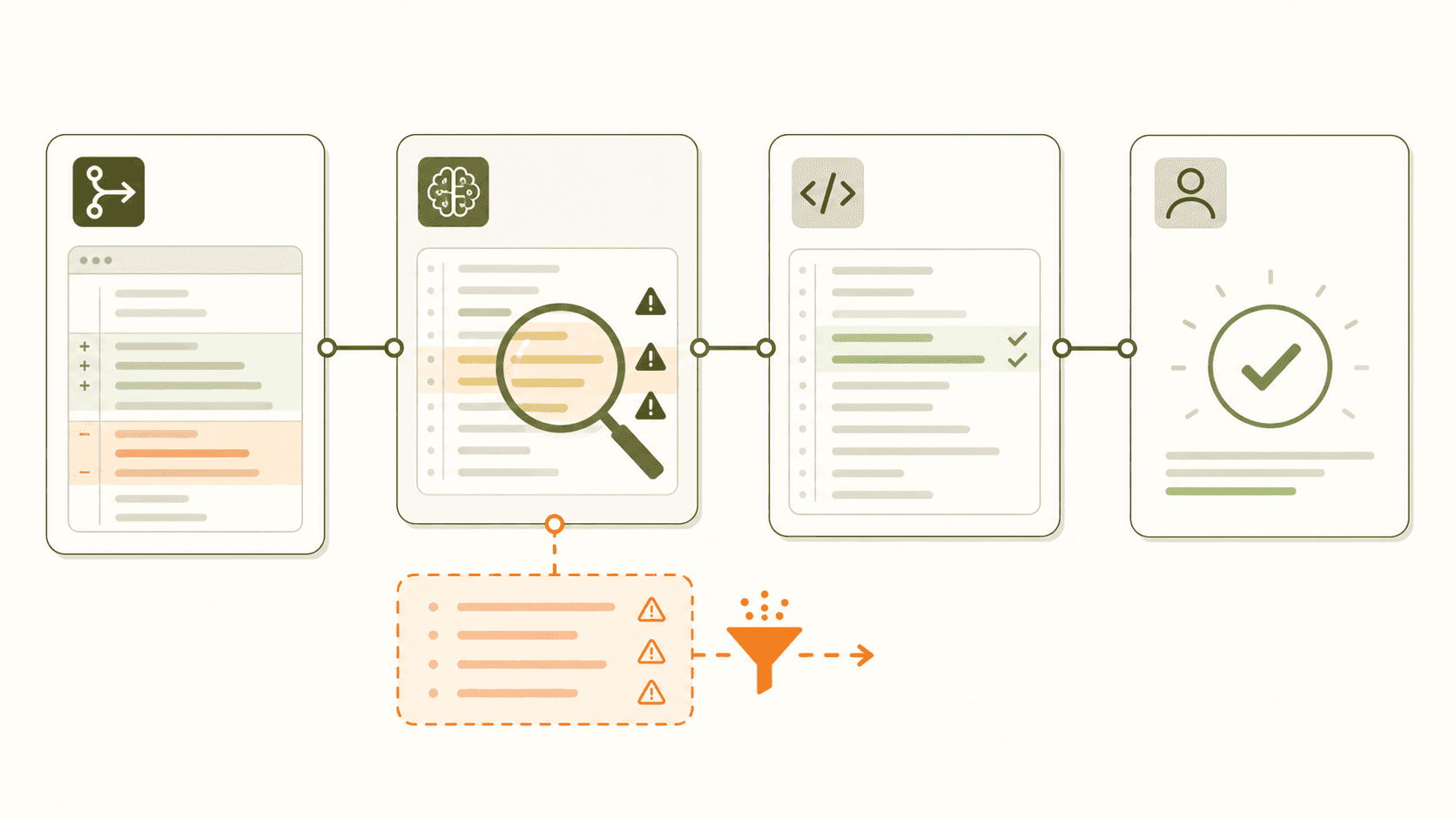
The author opens a focused pull request. Small, well-described changes still matter. AI cannot rescue an unreviewable 3,000-line diff.
The AI runs first. It looks for high-confidence issues, relevant context, and missing tests or safeguards.
The author handles the clear findings. This removes avoidable back-and-forth before a person has to build context.
A human reviews what remains. They assess intent, system design, product risk, and the trade-offs behind the code.
The team uses feedback to tune the system. Repeated false positives, missed issue classes, and unclear policies are inputs to improve the workflow.
This model also keeps the review relationship intact. A reviewer is not there to repeat what an automated check already said. They are there to ask the question the check cannot answer: “Given everything we know about this system, should we ship this?”
A diff is not a system
Most review tools begin with the diff. That is necessary, but it is not enough for a high-stakes change.
Imagine a small edit to a retry setting. The diff may look harmless. The operational meaning changes if the code sits on a high-traffic path, has caused timeout incidents before, or touches a dependency with a known failure mode.
This is where repository and production context matter. A strong reviewer needs to know at least four things:
Codebase context: What calls this code, and what contracts could the change break?
Operational context: Is this a hot path, a sensitive workflow, or an area with a history of incidents?
Team context: Are there conventions, ownership boundaries, or existing decisions the pull request should respect?
Change context: What is the author trying to accomplish, and which risks are intentional?
Applied to that retry setting, each layer changes the verdict on a line that never changes:

By the fourth layer the correct review comment is not about the retry count at all. It is that the fix belongs in the test.
Entelligence’s Code Review product is built around that last missing layer: connecting pull requests with production signals and incident history. That is a meaningful distinction if your team is tired of rediscovering the same failure mode after it ships.
It should still be evaluated on your codebase. Context can make a reviewer more useful, but it does not exempt any tool from proving that its comments are relevant.
How to evaluate an AI code-review tool
Tool comparison pages often declare a single winner. The more useful question is whether a tool improves your team’s review process without creating a fresh source of noise.
Use this scorecard in a pilot:
Criterion | What to inspect | Why it matters |
|---|---|---|
Useful-comment rate | Sample comments and label them useful, unclear, or wrong | Noise causes reviewers to ignore the signal |
Repository context | Which files, instructions, dependencies, and history can it use? | Diff-only review misses cross-file consequences |
Production awareness | Can it connect change risk to runtime behavior or incident history? | A line of code has different risk in different systems |
Control and privacy | Data retention, model access, self-hosting, audit controls | Code review touches sensitive source and operational data |
Workflow fit | Git provider, IDE, CLI, CI, and policy integration | A good tool that lives outside the workflow will not be used |
Cost model | Seat price, usage charges, compute, and setup time | The real cost includes more than the subscription |
Read benchmarks as evidence, not a verdict
Benchmark scores can be helpful, but they do not remove the need for a pilot. Every benchmark picks a dataset, a definition of a correct comment, a configuration, and an evaluation method.
Entelligence’s 2026 benchmark evaluates eight reviewers against 67 real production bugs drawn from five open-source repositories: Cal.com, Sentry, Discourse, Keycloak, and Grafana. Because Entelligence published the study, treat it as vendor-produced evidence, not an independent league table.
Here is the whole field rather than only the winning row:
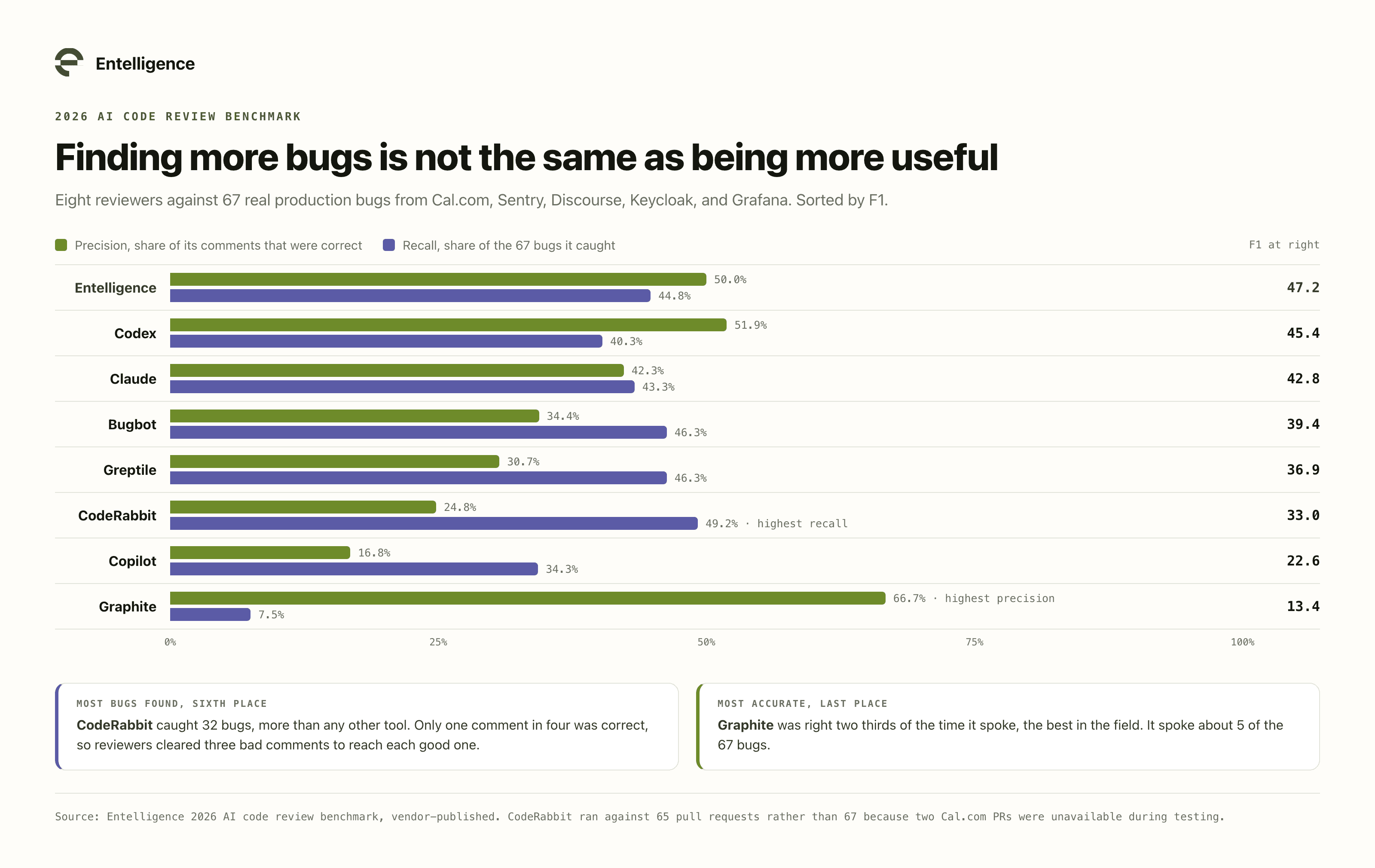
Read precision before F1, because it explains the chart. CodeRabbit found more bugs than any other tool and still finished sixth. It caught 32 and posted the highest recall in the field, but only one comment in four was correct, so a reviewer cleared three bad comments to reach each good one.
Graphite is the mirror image: 66.7% precision, the best of the eight, earned by staying quiet on 62 of the 67 bugs.
The ranking is the least interesting part. Finding more issues and being more useful turn out to be different achievements, and the top four sit within roughly eight points. Even the leading score caught fewer than half the golden comments. Human review remains necessary.
Run a 30-day pilot before you roll out
Do not turn on automatic reviews across the organization on day one. Start with one team that has enough pull-request activity to produce evidence and enough trust to report when the tool is unhelpful.
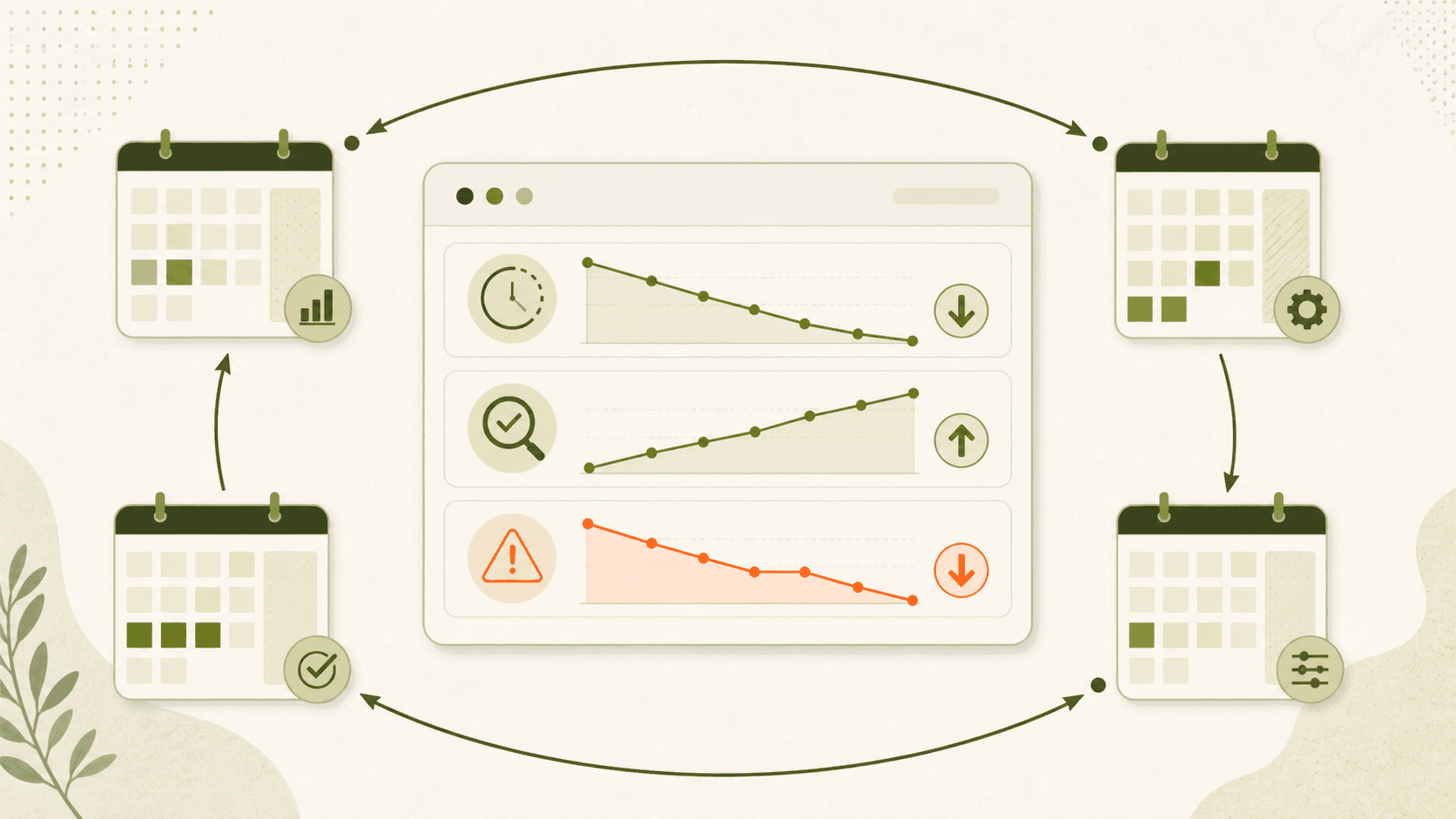
Week 1: Establish a baseline
Capture the current review experience before the tool changes it.
Median time to first review
Median pull-request cycle time
Number of review rounds per pull request
Reviewer load and review distribution
A small sample of escaped defects or regressions
A brief developer pulse: “Does review help you ship safely?”
The baseline does not have to be perfect. It just has to make the before-and-after comparison honest.
Week 2: Start narrowly
Enable the tool for a 5–15 person team or a handful of repositories. Begin with high-confidence findings and informational comments. Do not make AI comments merge-blocking at this stage.
Ask developers to tag or react to comments they consider useful, unclear, or wrong. That feedback is more valuable than a raw comment count.
Week 3: Tune for trust
Review the feedback with the pilot team. Disable repetitive low-value rules, add project instructions, and tighten the scope where needed.
Chase a review stream people still read, rather than maximum recall on every possible issue.
Week 4: Make a decision
Compare the pilot with the baseline. Use the scorecard below, then decide whether to expand, tune further, use the tool only in selected repositories, or stop.
Measure | Healthy direction | Warning sign |
|---|---|---|
Time to first review | Down, without a fall in review quality | Faster acknowledgement but more rework later |
Useful-comment rate | Up or consistently high | Developers dismiss most comments |
Review rounds | Down for routine changes | Fewer rounds because important discussion vanished |
Reviewer load | More evenly distributed | Senior reviewers remain the bottleneck |
Developer sentiment | More confidence and less interruption | “I ignore it” becomes the common response |
Escaped defects | Assess over a longer window | Do not claim improvement from one quiet week |
For a broader measurement framework, pair these review signals with the five AI metrics worth tracking across engineering: spend, outcomes, productive usage, capability adoption, and session efficiency.
Write the policy before the arguments start
An AI review policy does not need to be long. It does need to make accountability clear.
AI CODE REVIEW POLICY

1. AI comments are suggestions, not approvals.
2. A human remains accountable for every merge.
3. High-confidence security findings receive immediate attention,
   but a person verifies the finding before action.
4. Style and preference comments stay informational.
5. The team reviews false positives and missed issues weekly during the pilot.
6. AI-review activity is used to improve systems, not to rank individual developers.
7. The team can disable or narrow the tool when it reduces review quality
AI CODE REVIEW POLICY

1. AI comments are suggestions, not approvals.
2. A human remains accountable for every merge.
3. High-confidence security findings receive immediate attention,
   but a person verifies the finding before action.
4. Style and preference comments stay informational.
5. The team reviews false positives and missed issues weekly during the pilot.
6. AI-review activity is used to improve systems, not to rank individual developers.
7. The team can disable or narrow the tool when it reduces review quality
The sixth point is easy to overlook. Review telemetry can become surveillance if it is attached to individual performance scoring. That will reduce honest feedback and make the tool harder to improve.
The better approach is to use aggregate signals to find process bottlenecks: overloaded reviewers, risky areas of the codebase, and repeated classes of failure. That is the same shift from activity metrics to decision-grade visibility that engineering leaders need everywhere else.
Common failure modes
Each of these appears after the tool is working correctly, which is what makes them easy to miss.
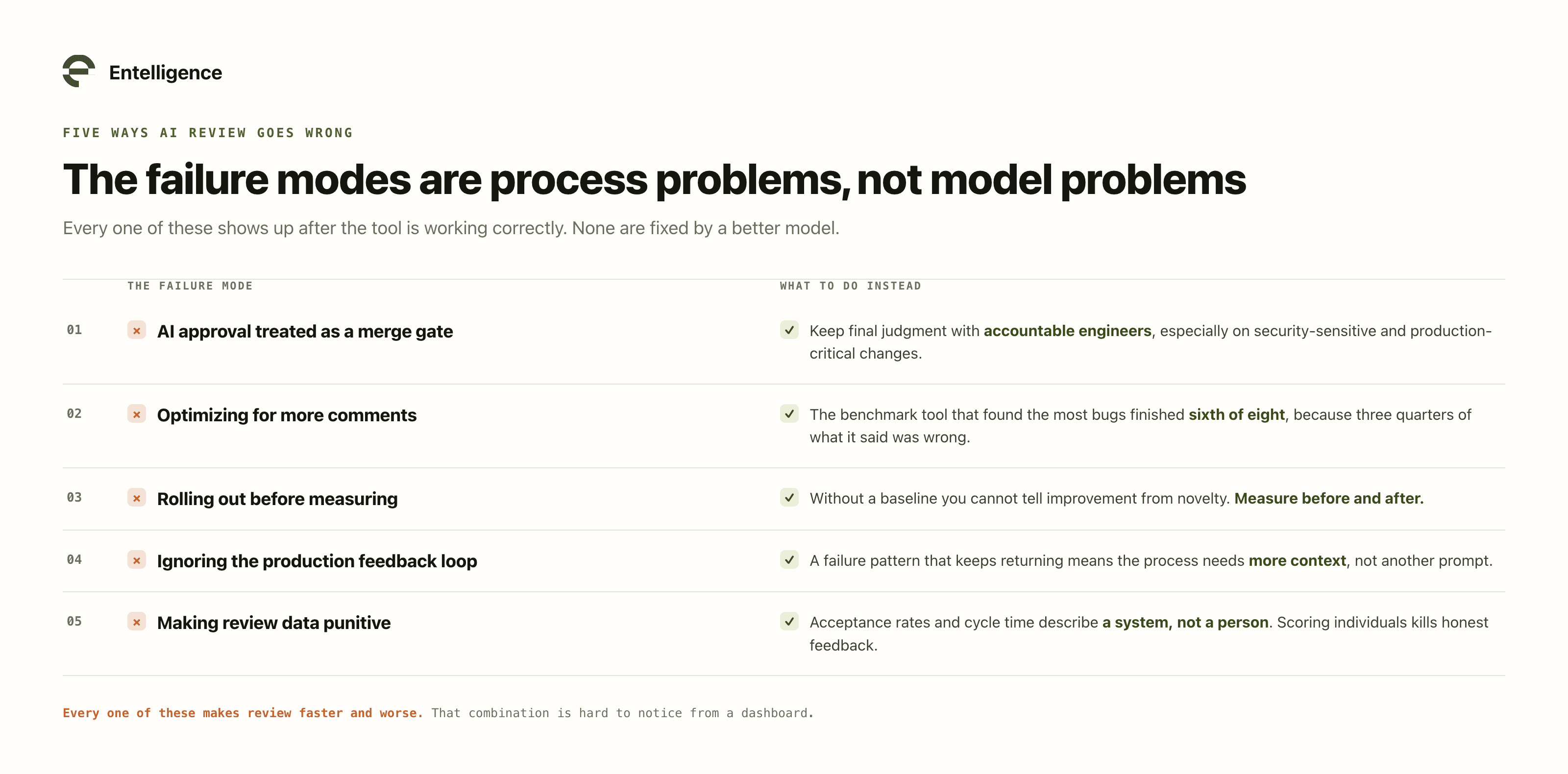
The common thread is that all five make review faster and worse at the same time, and a dashboard reports only the faster half.
The goal is better judgment, not faster approval
AI code review is most valuable when it makes the human review more deliberate. It should shorten the path to a useful conversation, not eliminate the conversation.
Start with one team. Measure whether comments are useful. Keep humans accountable. Then expand only where the evidence says the system is safer and easier to operate.
For teams that need review decisions grounded in real production behavior rather than the text of a diff, explore Entelligence Code Review.
Frequently asked questions
Does AI code review replace human code review?
No. It can identify likely issues and reduce routine review work, but people still need to assess intent, architecture, business rules, and the consequences of a merge.
How accurate is AI code review in 2026?
Less accurate than the marketing implies. In a 2026 benchmark of eight reviewers against 67 real production bugs, the best tool caught 30 of 67 and posted a 47.2% F1 score. Half the field scored under 40%.
Treat any tool’s output as a first pass with a meaningful error rate in both directions: real bugs missed, and confident comments that are wrong.
What is the best AI code review tool?
No tool wins outright, and the top of the field is tight. In the 2026 benchmark above, Entelligence (47.2%), Codex (45.4%), and Claude (42.8%) finished within five points of each other.
Two cautions before you treat that as a buying guide. Entelligence published the benchmark, so it is vendor-produced evidence. And rank order says little about your codebase, your languages, or your review conventions. Run a pilot.
What should we measure in an AI code-review pilot?
Measure time to first review, pull-request cycle time, useful-comment rate, review rounds, reviewer load, developer sentiment, and escaped defects over a meaningful period. Avoid using raw comment count as a success metric.
Should AI-review comments block merges?
Usually not at the start. Begin with suggestions and high-confidence findings, then add narrowly defined quality gates only after you have evidence that the tool is accurate on your codebase.
How do we reduce AI-review noise?
Start with a limited scope, collect feedback on bad comments, add repository-specific instructions, and disable recurring low-value rules. A tool people trust is more valuable than one that comments on everything.
Why does production context matter for code review?
The same code change carries different risk depending on dependencies, traffic, prior incidents, and the workflow it affects. Production context helps reviewers prioritize the changes that could cause real harm.
AI makes it easier to produce more code. It does not make it easier to know which changes are safe to merge.
Most engineering teams are feeling the gap already. Pull requests arrive faster, diffs are larger, and reviewers have less time to reconstruct the system behind each change.
AI code review can help, but it is not an approval stamp. Its best job is to do a fast first pass: find likely defects, explain the risky part of a change, and give a human reviewer more attention back for design, business logic, and trade-offs.
This guide explains how to use it that way. It covers what AI review can see, where it fails, how to evaluate a tool, and how to run a pilot that produces a decision rather than another dashboard.
What is AI code review?
AI code review uses language models and repository context to examine a pull request, identify potential issues, and suggest changes before or alongside a human review.
Depending on the product and configuration, it can inspect a diff, retrieve relevant files, follow dependencies, check repository instructions, and leave comments directly in a pull request.
The important word is assist. A review model can recognize a suspicious pattern. It cannot own the product decision, verify every assumption in an unfamiliar domain, or take responsibility for a production incident.
Why review becomes the bottleneck
The old review process assumed that writing code was the slow part. A developer made a change, opened a pull request, and a reviewer found time to understand it.
AI coding changes the shape of that system. More changes can be proposed in less time, but the downstream work does not disappear: someone still has to assess correctness, security, operational impact, and whether the team should make the change at all.
That is why the question is not, “Do we have an AI reviewer?” It is: Does the review system help people focus on the changes that deserve their judgment?
What AI review does well, and where humans still lead
AI review works best when the task is grounded in observable code and a clear standard. It is less reliable when the missing context lives in a roadmap conversation, a customer contract, or one engineer’s mental model.
That last distinction matters. Modern code review is not only about defect finding; it is also how teams coordinate and share knowledge. If an AI tool turns review into silent rubber-stamping, it has made the process faster at the expense of one of its highest-value outcomes.
The workflow that tends to work
The healthiest setup treats the two as a sequence, where each actor does the work it is best placed to do.
1. The author opens a focused pull request
Small, well-described changes still matter. AI cannot rescue an unreviewable 3,000-line diff.
2. The AI runs first
It looks for high-confidence issues, relevant context, and missing tests or safeguards.
3. The author handles clear findings
This removes avoidable back-and-forth before a person has to build context.
4. A human reviews what remains
They assess intent, system design, product risk, and the trade-offs behind the code.
5. The team tunes the system
Repeated false positives, missed issue classes, and unclear policies are inputs to improve the workflow.
A diff is not a system
Most review tools begin with the diff. That is necessary, but it is not enough for a high-stakes change. A small edit to a retry setting may look harmless, yet its operational meaning changes if the code sits on a high-traffic path, has caused timeout incidents before, or touches a dependency with a known failure mode.
A strong reviewer needs codebase context, operational context, team context, and change context. By the fourth layer, the right review comment may not be about the retry count at all: the fix might belong in the test.
Entelligence’s Code Review product connects pull requests with production signals and incident history. That distinction is meaningful for teams tired of rediscovering the same failure mode after it ships, but it should still be evaluated on the team’s own codebase.
How to evaluate an AI code-review tool
Tool comparison pages often declare a single winner. The more useful question is whether a tool improves your team’s review process without creating a fresh source of noise.
Read benchmarks as evidence, not a verdict
Benchmark scores can be helpful, but they do not remove the need for a pilot. Every benchmark picks a dataset, a definition of a correct comment, a configuration, and an evaluation method.
Entelligence’s 2026 benchmark evaluates eight reviewers against 67 real production bugs from five open-source repositories. Because Entelligence published the study, treat it as vendor-produced evidence, not an independent league table.
The ranking is the least interesting part. Finding more issues and being more useful turn out to be different achievements. Even the leading score caught fewer than half the golden comments, so human review remains necessary.
Run a 30-day pilot before you roll out
Do not turn on automatic reviews across the organization on day one. Start with one team that has enough pull-request activity to produce evidence and enough trust to report when the tool is unhelpful.
Week 1: Establish a baseline
Capture median time to first review, pull-request cycle time, review rounds, reviewer load, escaped defects, and a brief developer pulse before the tool changes the system.
Week 2: Start narrowly
Enable the tool for a 5–15 person team or a handful of repositories. Begin with high-confidence findings and informational comments; do not make AI comments merge-blocking yet.
Week 3: Tune for trust
Disable repetitive low-value rules, add project instructions, and tighten scope where needed. Chase a review stream people still read, rather than maximum recall on every possible issue.
Week 4: Make a decision
Compare the pilot with the baseline, then decide whether to expand, tune further, use the tool only in selected repositories, or stop.
Write the policy before the arguments start
AI comments are suggestions, not approvals. A human remains accountable for every merge. High-confidence security findings receive immediate attention, but a person verifies the finding before action. Style and preference comments stay informational.
Use aggregate signals to find process bottlenecks rather than attaching review telemetry to individual performance scoring. Review data becomes surveillance when it is used to rank people, reducing honest feedback and making the tool harder to improve.
Common failure modes
Treating AI approval as a merge gate, optimizing for more comments, rolling out before measuring, ignoring the production feedback loop, and making review data punitive can all make review faster and worse at the same time.
The goal is better judgment, not faster approval
AI code review is most valuable when it makes human review more deliberate. It should shorten the path to a useful conversation, not eliminate the conversation.
Start with one team. Measure whether comments are useful. Keep humans accountable. Then expand only where the evidence says the system is safer and easier to operate.
Frequently asked questions
Does AI code review replace human code review?
No. It can identify likely issues and reduce routine review work, but people still need to assess intent, architecture, business rules, and the consequences of a merge.
How accurate is AI code review in 2026?
Less accurate than marketing implies. In a 2026 benchmark of eight reviewers against 67 real production bugs, the best tool caught 30 of 67 and posted a 47.2% F1 score. Treat any tool’s output as a first pass with meaningful error rates in both directions.
What should we measure in an AI code-review pilot?
Measure time to first review, pull-request cycle time, useful-comment rate, review rounds, reviewer load, developer sentiment, and escaped defects over a meaningful period. Avoid using raw comment count as a success metric.
Should AI-review comments block merges?
Usually not at the start. Begin with suggestions and high-confidence findings, then add narrowly defined quality gates only after evidence shows the tool is accurate on your codebase.
How do we reduce AI-review noise?
Start with a limited scope, collect feedback on bad comments, add repository-specific instructions, and disable recurring low-value rules. A tool people trust is more valuable than one that comments on everything.
Why does production context matter for code review?
The same code change carries different risk depending on dependencies, traffic, prior incidents, and the workflow it affects. Production context helps reviewers prioritize changes that could cause real harm.
AI review is useful for | Human review remains essential for |
|---|---|
Finding likely null handling, error-path, and API-contract issues | Deciding whether the feature solves the right problem |
Summarizing a large diff and naming affected areas | Evaluating architecture and long-term maintenance trade-offs |
Spotting code that conflicts with repository instructions | Verifying assumptions about customers, data, and business rules |
Suggesting tests, edge cases, and clearer implementations | Owning the merge decision and its consequences |
Criterion | What to inspect | Why it matters |
|---|---|---|
Useful-comment rate | Sample comments and label them useful, unclear, or wrong | Noise causes reviewers to ignore the signal |
Repository context | Which files, instructions, dependencies, and history can it use? | Diff-only review misses cross-file consequences |
Production awareness | Can it connect change risk to runtime behavior or incident history? | A line of code has different risk in different systems |
Control and privacy | Data retention, model access, self-hosting, audit controls | Code review touches sensitive source and operational data |
Workflow fit | Git provider, IDE, CLI, CI, and policy integration | A good tool outside the workflow will not be used |
Measure | Healthy direction | Warning sign |
|---|---|---|
Time to first review | Down, without a fall in review quality | Faster acknowledgement but more rework later |
Useful-comment rate | Up or consistently high | Developers dismiss most comments |
Review rounds | Down for routine changes | Fewer rounds because important discussion vanished |
Reviewer load | More evenly distributed | Senior reviewers remain the bottleneck |
Developer sentiment | More confidence and less interruption | “I ignore it” becomes the common response |
Sources: GitHub Copilot Code Review · 2025 DORA report · Google’s modern code review case study · Entelligence Code Review · Entelligence 2026 benchmark
AI makes it easier to produce more code. It does not make it easier to know which changes are safe to merge.
Most engineering teams are feeling the gap already. Pull requests arrive faster, diffs are larger, and reviewers have less time to reconstruct the system behind each change.
AI code review can help, but it is not an approval stamp. Its best job is to do a fast first pass: find likely defects, explain the risky part of a change, and give a human reviewer more of their attention back for design, business logic, and trade-offs.
This guide explains how to use it that way. It covers what AI review can see, where it fails, how to evaluate a tool, and how to run a pilot that produces a decision rather than another dashboard.
What is AI code review?
AI code review uses language models and repository context to examine a pull request, identify potential issues, and suggest changes before or alongside a human review.
Depending on the product and configuration, it can inspect a diff, retrieve relevant files, follow dependencies, check repository instructions, and leave comments directly in a pull request. GitHub Copilot Code Review gathers full project context and exposes two review-effort levels: Low for fast feedback on routine changes, and Medium, which routes the pull request to a higher-reasoning model for complex logic, security-sensitive code, and cross-service changes.
The important word is assist. A review model can recognize a suspicious pattern. It cannot own the product decision, verify every assumption in an unfamiliar domain, or take responsibility for a production incident.
Treat AI review as a first-pass risk-reduction layer. Let it clear the obvious work so people can do the irreducibly human work.
Why review becomes the bottleneck
The old review process assumed that writing code was the slow part. A developer made a change, opened a pull request, and a reviewer found time to understand it.
AI coding changes the shape of that system. More changes can be proposed in less time, but the downstream work does not disappear: someone still has to assess correctness, security, operational impact, and whether the team should make the change at all.
The 2025 DORA report puts it directly:
AI’s primary role is as an amplifier, magnifying an organization’s existing strengths and weaknesses.
That is a useful lens for code review. A team with clear ownership, fast feedback, and good tests can use AI to move faster. A team with fragile systems and overloaded reviewers can use AI to build a faster queue of unexamined risk.
That is why the question is not, “Do we have an AI reviewer?” It is: Does the review system help people focus on the changes that deserve their judgment?
What AI review does well, and where humans still lead
AI review works best when the task is grounded in observable code and a clear standard. It is less reliable when the missing context lives in a roadmap conversation, a customer contract, or one engineer’s mental model.
AI review is useful for | Human review remains essential for |
|---|---|
Finding likely null handling, error-path, and API-contract issues | Deciding whether the feature solves the right problem |
Summarizing a large diff and naming affected areas | Evaluating architecture and long-term maintenance trade-offs |
Spotting code that conflicts with repository instructions | Verifying assumptions about customers, data, and business rules |
Suggesting tests, edge cases, and clearer implementations | Owning the merge decision and its consequences |
Surfacing relevant files, dependencies, and prior patterns | Teaching, mentoring, and building shared context across the team |
That last row matters. Google’s 2018 case study on modern code review examined why the company reviews code at all, across decades of changes and millions of reviews. Defect finding was only part of the answer. Review is also how teams coordinate and share knowledge.
If an AI tool turns review into silent rubber-stamping, it has made the process faster at the expense of one of its highest-value outcomes.
The workflow that tends to work
The healthiest setup treats the two as a sequence, where each actor does the work it is best placed to do.
The author opens a focused pull request. Small, well-described changes still matter. AI cannot rescue an unreviewable 3,000-line diff.
The AI runs first. It looks for high-confidence issues, relevant context, and missing tests or safeguards.
The author handles the clear findings. This removes avoidable back-and-forth before a person has to build context.
A human reviews what remains. They assess intent, system design, product risk, and the trade-offs behind the code.
The team uses feedback to tune the system. Repeated false positives, missed issue classes, and unclear policies are inputs to improve the workflow.
This model also keeps the review relationship intact. A reviewer is not there to repeat what an automated check already said. They are there to ask the question the check cannot answer: “Given everything we know about this system, should we ship this?”
A diff is not a system
Most review tools begin with the diff. That is necessary, but it is not enough for a high-stakes change.
Imagine a small edit to a retry setting. The diff may look harmless. The operational meaning changes if the code sits on a high-traffic path, has caused timeout incidents before, or touches a dependency with a known failure mode.
This is where repository and production context matter. A strong reviewer needs to know at least four things:
Codebase context: What calls this code, and what contracts could the change break?
Operational context: Is this a hot path, a sensitive workflow, or an area with a history of incidents?
Team context: Are there conventions, ownership boundaries, or existing decisions the pull request should respect?
Change context: What is the author trying to accomplish, and which risks are intentional?
Applied to that retry setting, each layer changes the verdict on a line that never changes:
By the fourth layer the correct review comment is not about the retry count at all. It is that the fix belongs in the test.
Entelligence’s Code Review product is built around that last missing layer: connecting pull requests with production signals and incident history. That is a meaningful distinction if your team is tired of rediscovering the same failure mode after it ships.
It should still be evaluated on your codebase. Context can make a reviewer more useful, but it does not exempt any tool from proving that its comments are relevant.
How to evaluate an AI code-review tool
Tool comparison pages often declare a single winner. The more useful question is whether a tool improves your team’s review process without creating a fresh source of noise.
Use this scorecard in a pilot:
Criterion | What to inspect | Why it matters |
|---|---|---|
Useful-comment rate | Sample comments and label them useful, unclear, or wrong | Noise causes reviewers to ignore the signal |
Repository context | Which files, instructions, dependencies, and history can it use? | Diff-only review misses cross-file consequences |
Production awareness | Can it connect change risk to runtime behavior or incident history? | A line of code has different risk in different systems |
Control and privacy | Data retention, model access, self-hosting, audit controls | Code review touches sensitive source and operational data |
Workflow fit | Git provider, IDE, CLI, CI, and policy integration | A good tool that lives outside the workflow will not be used |
Cost model | Seat price, usage charges, compute, and setup time | The real cost includes more than the subscription |
Read benchmarks as evidence, not a verdict
Benchmark scores can be helpful, but they do not remove the need for a pilot. Every benchmark picks a dataset, a definition of a correct comment, a configuration, and an evaluation method.
Entelligence’s 2026 benchmark evaluates eight reviewers against 67 real production bugs drawn from five open-source repositories: Cal.com, Sentry, Discourse, Keycloak, and Grafana. Because Entelligence published the study, treat it as vendor-produced evidence, not an independent league table.
Here is the whole field rather than only the winning row:
Read precision before F1, because it explains the chart. CodeRabbit found more bugs than any other tool and still finished sixth. It caught 32 and posted the highest recall in the field, but only one comment in four was correct, so a reviewer cleared three bad comments to reach each good one.
Graphite is the mirror image: 66.7% precision, the best of the eight, earned by staying quiet on 62 of the 67 bugs.
The ranking is the least interesting part. Finding more issues and being more useful turn out to be different achievements, and the top four sit within roughly eight points. Even the leading score caught fewer than half the golden comments. Human review remains necessary.
Run a 30-day pilot before you roll out
Do not turn on automatic reviews across the organization on day one. Start with one team that has enough pull-request activity to produce evidence and enough trust to report when the tool is unhelpful.
Week 1: Establish a baseline
Capture the current review experience before the tool changes it.
Median time to first review
Median pull-request cycle time
Number of review rounds per pull request
Reviewer load and review distribution
A small sample of escaped defects or regressions
A brief developer pulse: “Does review help you ship safely?”
The baseline does not have to be perfect. It just has to make the before-and-after comparison honest.
Week 2: Start narrowly
Enable the tool for a 5–15 person team or a handful of repositories. Begin with high-confidence findings and informational comments. Do not make AI comments merge-blocking at this stage.
Ask developers to tag or react to comments they consider useful, unclear, or wrong. That feedback is more valuable than a raw comment count.
Week 3: Tune for trust
Review the feedback with the pilot team. Disable repetitive low-value rules, add project instructions, and tighten the scope where needed.
Chase a review stream people still read, rather than maximum recall on every possible issue.
Week 4: Make a decision
Compare the pilot with the baseline. Use the scorecard below, then decide whether to expand, tune further, use the tool only in selected repositories, or stop.
Measure | Healthy direction | Warning sign |
|---|---|---|
Time to first review | Down, without a fall in review quality | Faster acknowledgement but more rework later |
Useful-comment rate | Up or consistently high | Developers dismiss most comments |
Review rounds | Down for routine changes | Fewer rounds because important discussion vanished |
Reviewer load | More evenly distributed | Senior reviewers remain the bottleneck |
Developer sentiment | More confidence and less interruption | “I ignore it” becomes the common response |
Escaped defects | Assess over a longer window | Do not claim improvement from one quiet week |
For a broader measurement framework, pair these review signals with the five AI metrics worth tracking across engineering: spend, outcomes, productive usage, capability adoption, and session efficiency.
Write the policy before the arguments start
An AI review policy does not need to be long. It does need to make accountability clear.
AI CODE REVIEW POLICY

1. AI comments are suggestions, not approvals.
2. A human remains accountable for every merge.
3. High-confidence security findings receive immediate attention,
   but a person verifies the finding before action.
4. Style and preference comments stay informational.
5. The team reviews false positives and missed issues weekly during the pilot.
6. AI-review activity is used to improve systems, not to rank individual developers.
7. The team can disable or narrow the tool when it reduces review quality
The sixth point is easy to overlook. Review telemetry can become surveillance if it is attached to individual performance scoring. That will reduce honest feedback and make the tool harder to improve.
The better approach is to use aggregate signals to find process bottlenecks: overloaded reviewers, risky areas of the codebase, and repeated classes of failure. That is the same shift from activity metrics to decision-grade visibility that engineering leaders need everywhere else.
Common failure modes
Each of these appears after the tool is working correctly, which is what makes them easy to miss.
The common thread is that all five make review faster and worse at the same time, and a dashboard reports only the faster half.
The goal is better judgment, not faster approval
AI code review is most valuable when it makes the human review more deliberate. It should shorten the path to a useful conversation, not eliminate the conversation.
Start with one team. Measure whether comments are useful. Keep humans accountable. Then expand only where the evidence says the system is safer and easier to operate.
For teams that need review decisions grounded in real production behavior rather than the text of a diff, explore Entelligence Code Review.
Frequently asked questions
Does AI code review replace human code review?
No. It can identify likely issues and reduce routine review work, but people still need to assess intent, architecture, business rules, and the consequences of a merge.
How accurate is AI code review in 2026?
Less accurate than the marketing implies. In a 2026 benchmark of eight reviewers against 67 real production bugs, the best tool caught 30 of 67 and posted a 47.2% F1 score. Half the field scored under 40%.
Treat any tool’s output as a first pass with a meaningful error rate in both directions: real bugs missed, and confident comments that are wrong.
What is the best AI code review tool?
No tool wins outright, and the top of the field is tight. In the 2026 benchmark above, Entelligence (47.2%), Codex (45.4%), and Claude (42.8%) finished within five points of each other.
Two cautions before you treat that as a buying guide. Entelligence published the benchmark, so it is vendor-produced evidence. And rank order says little about your codebase, your languages, or your review conventions. Run a pilot.
What should we measure in an AI code-review pilot?
Measure time to first review, pull-request cycle time, useful-comment rate, review rounds, reviewer load, developer sentiment, and escaped defects over a meaningful period. Avoid using raw comment count as a success metric.
Should AI-review comments block merges?
Usually not at the start. Begin with suggestions and high-confidence findings, then add narrowly defined quality gates only after you have evidence that the tool is accurate on your codebase.
How do we reduce AI-review noise?
Start with a limited scope, collect feedback on bad comments, add repository-specific instructions, and disable recurring low-value rules. A tool people trust is more valuable than one that comments on everything.
Why does production context matter for code review?
The same code change carries different risk depending on dependencies, traffic, prior incidents, and the workflow it affects. Production context helps reviewers prioritize the changes that could cause real harm.
AI makes it easier to produce more code. It does not make it easier to know which changes are safe to merge.
Most engineering teams are feeling the gap already. Pull requests arrive faster, diffs are larger, and reviewers have less time to reconstruct the system behind each change.
AI code review can help, but it is not an approval stamp. Its best job is to do a fast first pass: find likely defects, explain the risky part of a change, and give a human reviewer more attention back for design, business logic, and trade-offs.
This guide explains how to use it that way. It covers what AI review can see, where it fails, how to evaluate a tool, and how to run a pilot that produces a decision rather than another dashboard.
What is AI code review?
AI code review uses language models and repository context to examine a pull request, identify potential issues, and suggest changes before or alongside a human review.
Depending on the product and configuration, it can inspect a diff, retrieve relevant files, follow dependencies, check repository instructions, and leave comments directly in a pull request.
The important word is assist. A review model can recognize a suspicious pattern. It cannot own the product decision, verify every assumption in an unfamiliar domain, or take responsibility for a production incident.
Why review becomes the bottleneck
The old review process assumed that writing code was the slow part. A developer made a change, opened a pull request, and a reviewer found time to understand it.
AI coding changes the shape of that system. More changes can be proposed in less time, but the downstream work does not disappear: someone still has to assess correctness, security, operational impact, and whether the team should make the change at all.
That is why the question is not, “Do we have an AI reviewer?” It is: Does the review system help people focus on the changes that deserve their judgment?
What AI review does well, and where humans still lead
AI review works best when the task is grounded in observable code and a clear standard. It is less reliable when the missing context lives in a roadmap conversation, a customer contract, or one engineer’s mental model.
That last distinction matters. Modern code review is not only about defect finding; it is also how teams coordinate and share knowledge. If an AI tool turns review into silent rubber-stamping, it has made the process faster at the expense of one of its highest-value outcomes.
The workflow that tends to work
The healthiest setup treats the two as a sequence, where each actor does the work it is best placed to do.
1. The author opens a focused pull request
Small, well-described changes still matter. AI cannot rescue an unreviewable 3,000-line diff.
2. The AI runs first
It looks for high-confidence issues, relevant context, and missing tests or safeguards.
3. The author handles clear findings
This removes avoidable back-and-forth before a person has to build context.
4. A human reviews what remains
They assess intent, system design, product risk, and the trade-offs behind the code.
5. The team tunes the system
Repeated false positives, missed issue classes, and unclear policies are inputs to improve the workflow.
A diff is not a system
Most review tools begin with the diff. That is necessary, but it is not enough for a high-stakes change. A small edit to a retry setting may look harmless, yet its operational meaning changes if the code sits on a high-traffic path, has caused timeout incidents before, or touches a dependency with a known failure mode.
A strong reviewer needs codebase context, operational context, team context, and change context. By the fourth layer, the right review comment may not be about the retry count at all: the fix might belong in the test.
Entelligence’s Code Review product connects pull requests with production signals and incident history. That distinction is meaningful for teams tired of rediscovering the same failure mode after it ships, but it should still be evaluated on the team’s own codebase.
How to evaluate an AI code-review tool
Tool comparison pages often declare a single winner. The more useful question is whether a tool improves your team’s review process without creating a fresh source of noise.
Read benchmarks as evidence, not a verdict
Benchmark scores can be helpful, but they do not remove the need for a pilot. Every benchmark picks a dataset, a definition of a correct comment, a configuration, and an evaluation method.
Entelligence’s 2026 benchmark evaluates eight reviewers against 67 real production bugs from five open-source repositories. Because Entelligence published the study, treat it as vendor-produced evidence, not an independent league table.
The ranking is the least interesting part. Finding more issues and being more useful turn out to be different achievements. Even the leading score caught fewer than half the golden comments, so human review remains necessary.
Run a 30-day pilot before you roll out
Do not turn on automatic reviews across the organization on day one. Start with one team that has enough pull-request activity to produce evidence and enough trust to report when the tool is unhelpful.
Week 1: Establish a baseline
Capture median time to first review, pull-request cycle time, review rounds, reviewer load, escaped defects, and a brief developer pulse before the tool changes the system.
Week 2: Start narrowly
Enable the tool for a 5–15 person team or a handful of repositories. Begin with high-confidence findings and informational comments; do not make AI comments merge-blocking yet.
Week 3: Tune for trust
Disable repetitive low-value rules, add project instructions, and tighten scope where needed. Chase a review stream people still read, rather than maximum recall on every possible issue.
Week 4: Make a decision
Compare the pilot with the baseline, then decide whether to expand, tune further, use the tool only in selected repositories, or stop.
Write the policy before the arguments start
AI comments are suggestions, not approvals. A human remains accountable for every merge. High-confidence security findings receive immediate attention, but a person verifies the finding before action. Style and preference comments stay informational.
Use aggregate signals to find process bottlenecks rather than attaching review telemetry to individual performance scoring. Review data becomes surveillance when it is used to rank people, reducing honest feedback and making the tool harder to improve.
Common failure modes
Treating AI approval as a merge gate, optimizing for more comments, rolling out before measuring, ignoring the production feedback loop, and making review data punitive can all make review faster and worse at the same time.
The goal is better judgment, not faster approval
AI code review is most valuable when it makes human review more deliberate. It should shorten the path to a useful conversation, not eliminate the conversation.
Start with one team. Measure whether comments are useful. Keep humans accountable. Then expand only where the evidence says the system is safer and easier to operate.
Frequently asked questions
Does AI code review replace human code review?
No. It can identify likely issues and reduce routine review work, but people still need to assess intent, architecture, business rules, and the consequences of a merge.
How accurate is AI code review in 2026?
Less accurate than marketing implies. In a 2026 benchmark of eight reviewers against 67 real production bugs, the best tool caught 30 of 67 and posted a 47.2% F1 score. Treat any tool’s output as a first pass with meaningful error rates in both directions.
What should we measure in an AI code-review pilot?
Measure time to first review, pull-request cycle time, useful-comment rate, review rounds, reviewer load, developer sentiment, and escaped defects over a meaningful period. Avoid using raw comment count as a success metric.
Should AI-review comments block merges?
Usually not at the start. Begin with suggestions and high-confidence findings, then add narrowly defined quality gates only after evidence shows the tool is accurate on your codebase.
How do we reduce AI-review noise?
Start with a limited scope, collect feedback on bad comments, add repository-specific instructions, and disable recurring low-value rules. A tool people trust is more valuable than one that comments on everything.
Why does production context matter for code review?
The same code change carries different risk depending on dependencies, traffic, prior incidents, and the workflow it affects. Production context helps reviewers prioritize changes that could cause real harm.
AI review is useful for | Human review remains essential for |
|---|---|
Finding likely null handling, error-path, and API-contract issues | Deciding whether the feature solves the right problem |
Summarizing a large diff and naming affected areas | Evaluating architecture and long-term maintenance trade-offs |
Spotting code that conflicts with repository instructions | Verifying assumptions about customers, data, and business rules |
Suggesting tests, edge cases, and clearer implementations | Owning the merge decision and its consequences |
Criterion | What to inspect | Why it matters |
|---|---|---|
Useful-comment rate | Sample comments and label them useful, unclear, or wrong | Noise causes reviewers to ignore the signal |
Repository context | Which files, instructions, dependencies, and history can it use? | Diff-only review misses cross-file consequences |
Production awareness | Can it connect change risk to runtime behavior or incident history? | A line of code has different risk in different systems |
Control and privacy | Data retention, model access, self-hosting, audit controls | Code review touches sensitive source and operational data |
Workflow fit | Git provider, IDE, CLI, CI, and policy integration | A good tool outside the workflow will not be used |
Measure | Healthy direction | Warning sign |
|---|---|---|
Time to first review | Down, without a fall in review quality | Faster acknowledgement but more rework later |
Useful-comment rate | Up or consistently high | Developers dismiss most comments |
Review rounds | Down for routine changes | Fewer rounds because important discussion vanished |
Reviewer load | More evenly distributed | Senior reviewers remain the bottleneck |
Developer sentiment | More confidence and less interruption | “I ignore it” becomes the common response |
Sources: GitHub Copilot Code Review · 2025 DORA report · Google’s modern code review case study · Entelligence Code Review · Entelligence 2026 benchmark
We raised $5M to run your Engineering team on Autopilot
We raised $5M to run your Engineering team on Autopilot
Watch our launch video
Talk to Sales
Production reliability, solved.
The AI engineer that reviews every PR against your incident history, watches production, and self-heals when things break. The same class of bug will not ship twice.
Talk to Sales
Production reliability, solved.
Connect with our team to see how Entelliegnce helps engineering leaders with full visibility into sprint performance, Team insights & Product Delivery
Try Entelligence now