
High Velocity Engineering: Build Teams That Ship Faster
Dec 12, 2025
Dec 12, 2025
Ever wondered what separates teams that ship every few days from teams that ship monthly? Recent data shows that by 2028, up to 90% of software engineers in enterprises will be using AI to automate repetitive tasks, highlighting the critical role automation plays in maintaining development speed.
Most engineering teams struggle with slow release cycles, bottlenecks in code reviews, and manual processes that drain productivity. High velocity engineering solves this by using automation, AI-powered tools, and proven practices that let teams ship faster while maintaining code quality.
In this guide, we break down what high velocity engineering actually means, which practices drive improvements, and how to build a development team that moves fast.
Key Takeaways
High velocity engineering focuses on removing development bottlenecks through automation and AI tools rather than just coding faster or adding more engineers.
Teams using automated code reviews can reduce PR turnaround time from days to hours, with platforms catching critical bugs before they reach production.
The biggest velocity obstacles are manual code reviews, unclear team ownership, missing automation, and a lack of performance visibility into actual bottlenecks.
High velocity teams measure success through DORA metrics, sprint completion rates, and PR turnaround time to identify improvement opportunities.
Building high velocity teams requires AI-powered code reviews, automated testing, clear ownership structures, and real-time visibility into team performance.
What Is High Velocity Engineering?
High velocity engineering is a development approach that accelerates software delivery by removing bottlenecks through automation, AI-powered tools, and clear team structures. Instead of just writing code faster, teams focus on removing delays in reviews, testing, deployment, and collaboration.
Traditional development treats speed and quality as trade-offs. High velocity engineering rejects this. Teams achieve faster shipping by using AI code reviews to catch issues instantly, automating repetitive tasks, and giving engineers ownership of complete features from code to deployment.
For example, when a high velocity team uses automated PR reviews, engineers can get feedback within minutes instead of waiting hours for human reviewers. This immediate guidance on security issues, code quality problems, and architectural concerns allows teams to fix issues and merge faster while maintaining standards.
Why High Velocity Engineering Matters for Modern Teams
Software companies win or lose based on how fast they ship valuable features. When competitors release updates weekly, and your team ships monthly, you fall behind on customer needs, market opportunities, and talent retention.
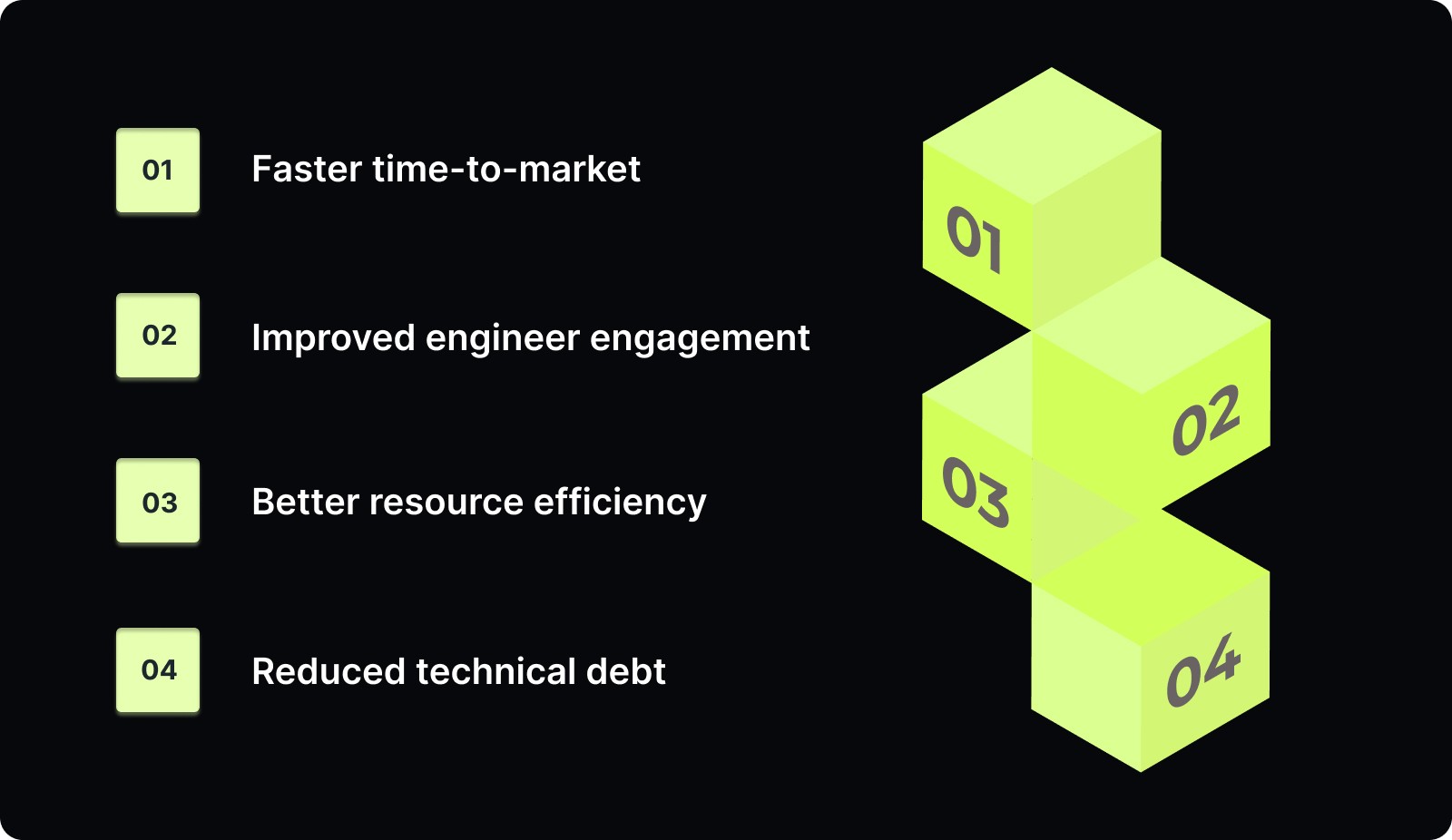
Here's why high velocity engineering delivers competitive advantages:
Faster time-to-market: Teams can respond to customer feedback and competitive threats within days instead of quarters when they ship continuously.
Improved engineer engagement: Engineers stay motivated when they see their work reach users quickly rather than sitting in review queues for weeks.
Better resource efficiency: Automation and AI tools reduce manual work, letting teams accomplish more without growing headcount or budgets.
Reduced technical debt: Continuous delivery with quality gates prevents the accumulation of issues that slow teams over time.
These advantages compound over time. For instance, when teams reduce PR review time from 48 hours to 4 hours, they can complete more features per sprint. At the same time, engineers spend less hours context-switching between old PRs and new work, maintaining focus and momentum throughout development cycles.
How to Build a High Velocity Development Team
Building a high velocity development team requires systematic changes across your development process. Follow these steps to transform how your team ships software.
1. Identify Your Current Bottlenecks
Start by measuring where time disappears in your development process. Track PR creation to merge time, review response time, time spent in testing, and deployment frequency.
Use data to find your biggest delays:
Measure PR lifecycle time: Track how long PRs sit from creation to merge and identify where delays occur.
Analyze review response patterns: Calculate average time to first review and time spent waiting between review rounds.
Track deployment frequency: Compare how often you deploy versus how often you could deploy with better automation.
For example, when PRs average 36 hours from creation to merge but only 4 hours of actual review time, the problem is review response time, not review thoroughness. When deployments happen weekly but could happen daily, your deployment process needs automation.
2. Automate Repetitive Development Tasks
Automation removes the manual work that slows teams down. Focus on three areas that can deliver immediate velocity gains:
Automate testing pipelines: Configure CI/CD so every PR runs unit tests, integration tests, and security scans, without manual intervention.
Automate deployment processes: Set up systems where merging to main triggers production releases automatically with proper safeguards.
Automate environment setup: Provide tools so engineers can spin up development environments in minutes instead of days.
For instance, when teams automate infrastructure provisioning with tools like Terraform, they can reduce new service setup from weeks to hours, letting engineers focus on building features instead of configuring servers.
3. Implement AI-Powered Code Reviews
AI-powered code reviews can provide velocity improvements with minimal disruption. These tools review every PR automatically, catching bugs, security issues, and code quality problems within minutes of creation.
Traditional manual reviews create bottlenecks because senior engineers must review every change, taking time away from their own work. Here's how AI reviews change the workflow:
Instant feedback delivery: Engineers get immediate feedback instead of waiting hours or days for human reviewer availability.
Consistent quality checks: AI tools catch every instance of common issues that humans might miss when tired or rushed.
Focus human reviews on value: AI handles repetitive checks for syntax errors, security vulnerabilities, and code standards, letting human reviewers focus on architecture and business logic.
When teams implement AI code reviews, reviews become more consistent, and engineers maintain momentum without waiting on senior team members for initial feedback.
4. Build a Clear Team Structure and Ownership
Velocity requires clear ownership where engineers take features from idea through deployment without handoffs. When teams split work between backend engineers, frontend engineers, QA, and DevOps, each handoff creates a delay.
Structure teams around products or features, not technical layers:
Product-aligned teams: Give each team ownership of complete capabilities, including code, testing, deployment, and monitoring.
Reduce handoffs: Let engineers deploy their own changes, fix their own bugs, and respond to their own incidents.
Create feedback loops: Direct ownership creates immediate feedback that improves both velocity and quality.
For example, when a feature team owns an entire workflow rather than splitting work between separate backend, frontend, and infrastructure teams, they remove waiting and maintain momentum throughout development.
5. Establish Velocity Metrics and Dashboards
You can't improve velocity without measuring it. Track metrics that reveal bottlenecks and improvements over time:
DORA metrics foundation: Monitor deployment frequency, lead time for changes, change failure rate, and time to restore service.
Process-specific metrics: Add PR turnaround time, code review response time, and percentage of PRs merged without changes.
Real-time visibility: Make metrics visible to the entire team through dashboards that are updated continuously.
When engineers see that PR turnaround time increased this week, they can investigate and fix the issue immediately instead of discovering it during quarterly retrospectives.
6. Create Feedback Loops for Continuous Improvement
High velocity teams treat their development process like a product, iterating to make it better every sprint:
Track AI review adoption: Monitor how engineers use AI review comments and refine checks when feedback gets consistently ignored.
Measure escaped issues: Track which types of issues reach production and adjust your review process to catch them earlier.
Survey engineer feedback: Ask monthly what slows teams down most and prioritize removing those blockers.
For instance, when data shows that database migration PRs take 3 times longer to merge than other PRs, teams can investigate whether review guidelines need clarification or if those changes need dedicated review time from database experts.
Common Mistakes That Slow Down Engineering Velocity
Even well-intentioned efforts to increase velocity can cause issues when teams make these mistakes. Avoid these common traps that slow teams down.
Skipping code review to move faster: Teams that merge code without review can see velocity drop within weeks as bugs and technical debt compound, forcing engineers to spend more time fixing issues than building features.
Adding more engineers without fixing processes: Doubling team size without removing bottlenecks just creates more work stuck in the same queues, often slowing velocity as communication overhead increases.
Measuring only output metrics: Tracking story points or PR count without measuring quality can lead teams to ship more low-value work while critical bugs escape to production.
Ignoring developer experience: When engineers fight with slow CI/CD pipelines, unclear documentation, or difficult local setup, they lose hours daily to friction that automated tools could address.
Implementing too many changes at once: Teams that try to adopt new tools, processes, and structures simultaneously create chaos that temporarily tanks velocity before any improvements take hold.
Optimizing individual velocity over team velocity: Rewarding engineers for shipping more PRs can encourage rushed work and create review bottlenecks as quality drops and other team members spend more time reviewing and fixing issues.

Best Practices That Drive High Velocity
There are some specific practices that separate high velocity teams from average performers. Follow these effective approaches to maintain momentum.
Build security by default: Integrate security checks into development workflows so engineers catch vulnerabilities while writing code instead of during separate audits.
Use feature flags for deployment: Decouple deployment from release so teams can merge continuously while controlling when features go live.
Maintain small PR sizes: Encourage PRs under 400 lines so reviews stay fast, and changes stay focused on single concerns.
Implement blameless postmortems: Create psychological safety so teams learn from incidents instead of hiding problems that slow velocity.
Invest in developer experience: Treat internal tools and processes as products that need continuous improvement based on engineer feedback.
These practices work together to create an environment where shipping fast becomes natural. When engineers trust automated security checks, use feature flags to control releases, keep changes small, and work in a supportive culture, velocity increases without sacrificing quality.
How to Measure and Track Engineering Velocity?
Measuring velocity properly shows you where improvements work and where bottlenecks remain. Focus on metrics that reveal both speed and sustainability. Here are the key metrics to track:
DORA metrics foundation: Track deployment frequency to measure how often you ship to production, monitor lead time for changes to see how long features take from commit to deployment, and measure change failure rate to ensure quality stays high as velocity increases.
PR cycle time metrics: Measure PR turnaround time from creation to merge, time to first review, and number of review cycles per PR to identify review bottlenecks.
Sprint performance indicators: Track sprint completion rates and story points completed per sprint to identify planning accuracy issues and capacity constraints.
Recovery metrics: Monitor time to restore service to gauge how quickly you recover from incidents and maintain system reliability.
For instance, when deployment frequency increases but the change failure rate also rises, velocity improvements might be creating quality problems. When PR turnaround time drops but sprint completion rate stays flat, bottlenecks can exist elsewhere in your process that metrics haven't surfaced yet.
Ship Faster Without Sacrificing Quality with Entelligence AI
High velocity engineering requires more than good intentions and agile processes. You need a platform that automates the repetitive work slowing your team down while maintaining the quality standards that prevent production incidents.
Most teams struggle because manual code reviews create bottlenecks. Engineers wait days for feedback, context-switch between old PRs and new work, and senior developers spend significant time reviewing instead of building. This friction caps how fast you can move, regardless of how many engineers you hire.
That’s where Entelligence AI comes in, helping engineering teams achieve high velocity. Here’s how:
AI-powered code reviews: Get instant feedback on every PR with context-aware reviews that catch bugs, security issues, and quality problems within minutes instead of waiting hours for human reviewers.
Background agents for velocity: Maintain momentum with AI agents that run continuously in the background, automatically improving observability, writing design docs, and managing incidents so engineers stay focused on shipping features.
Automated security scanning: Block vulnerabilities before they reach production with real-time SAST scanning and auto-remediation suggestions that fix issues with one click.
Team performance visibility: Track velocity metrics, identify bottlenecks, and get visibility into team performance through AI-powered dashboards that show exactly what's slowing delivery.
Sprint health monitoring: Get complete sprint assessments that track goal completion and provide insights to keep teams on track for delivery commitments.
Vectorial AI achieved 10x faster development workflows using Entelligence AI. They maintained high code quality and gained complete visibility into team contributions without adding extra meetings.
Final Thoughts
High velocity engineering changes how teams deliver software by removing bottlenecks through automation and AI-powered tools. Teams that adopt these practices can ship faster while maintaining or improving quality because they focus on removing delays rather than rushing code.
Start by measuring your current velocity to identify bottlenecks, then implement AI-powered code reviews and automation that remove manual work from your development process. Build clear team ownership structures, track velocity metrics, and iterate continuously to keep improving.
Entelligence AI gives you the platform to automate reviews, catch security issues early, and gain visibility into team performance so you can ship faster without breaking things. Start your 14-day free trial and see how automated reviews, security scanning, and performance visibility help your team ship faster.
FAQs
1. How do AI code reviews improve velocity?
AI code reviews provide instant feedback on every PR, catching bugs and security issues within minutes instead of waiting hours for human reviewers. This can reduce PR turnaround time significantly while maintaining quality standards.
2. What tools do high velocity engineering teams use?
High velocity teams use AI-powered code review platforms, comprehensive CI/CD pipelines, automated testing frameworks, real-time security scanning, and engineering analytics dashboards. These tools automate repetitive work and surface bottlenecks immediately.
3. Can small teams achieve high velocity engineering?
Small teams often achieve high velocity faster than large teams because they have less coordination overhead. Automated tools and clear ownership structures can help small teams achieve high velocity by removing manual bottlenecks.
4. Does high velocity engineering sacrifice code quality?
Properly implemented high velocity engineering improves quality by catching issues earlier through automated reviews and continuous testing. Teams that try to increase velocity by skipping reviews or testing can create technical debt that slows them down long-term.
5. How do you maintain high velocity as teams scale?
Maintain velocity during scaling by preserving clear ownership structures, investing in automation that scales with team size, and using real-time metrics to identify new bottlenecks. Teams that maintain velocity while growing focus on processes and tooling, not just hiring.
Ever wondered what separates teams that ship every few days from teams that ship monthly? Recent data shows that by 2028, up to 90% of software engineers in enterprises will be using AI to automate repetitive tasks, highlighting the critical role automation plays in maintaining development speed.
Most engineering teams struggle with slow release cycles, bottlenecks in code reviews, and manual processes that drain productivity. High velocity engineering solves this by using automation, AI-powered tools, and proven practices that let teams ship faster while maintaining code quality.
In this guide, we break down what high velocity engineering actually means, which practices drive improvements, and how to build a development team that moves fast.
Key Takeaways
High velocity engineering focuses on removing development bottlenecks through automation and AI tools rather than just coding faster or adding more engineers.
Teams using automated code reviews can reduce PR turnaround time from days to hours, with platforms catching critical bugs before they reach production.
The biggest velocity obstacles are manual code reviews, unclear team ownership, missing automation, and a lack of performance visibility into actual bottlenecks.
High velocity teams measure success through DORA metrics, sprint completion rates, and PR turnaround time to identify improvement opportunities.
Building high velocity teams requires AI-powered code reviews, automated testing, clear ownership structures, and real-time visibility into team performance.
What Is High Velocity Engineering?
High velocity engineering is a development approach that accelerates software delivery by removing bottlenecks through automation, AI-powered tools, and clear team structures. Instead of just writing code faster, teams focus on removing delays in reviews, testing, deployment, and collaboration.
Traditional development treats speed and quality as trade-offs. High velocity engineering rejects this. Teams achieve faster shipping by using AI code reviews to catch issues instantly, automating repetitive tasks, and giving engineers ownership of complete features from code to deployment.
For example, when a high velocity team uses automated PR reviews, engineers can get feedback within minutes instead of waiting hours for human reviewers. This immediate guidance on security issues, code quality problems, and architectural concerns allows teams to fix issues and merge faster while maintaining standards.
Why High Velocity Engineering Matters for Modern Teams
Software companies win or lose based on how fast they ship valuable features. When competitors release updates weekly, and your team ships monthly, you fall behind on customer needs, market opportunities, and talent retention.

Here's why high velocity engineering delivers competitive advantages:
Faster time-to-market: Teams can respond to customer feedback and competitive threats within days instead of quarters when they ship continuously.
Improved engineer engagement: Engineers stay motivated when they see their work reach users quickly rather than sitting in review queues for weeks.
Better resource efficiency: Automation and AI tools reduce manual work, letting teams accomplish more without growing headcount or budgets.
Reduced technical debt: Continuous delivery with quality gates prevents the accumulation of issues that slow teams over time.
These advantages compound over time. For instance, when teams reduce PR review time from 48 hours to 4 hours, they can complete more features per sprint. At the same time, engineers spend less hours context-switching between old PRs and new work, maintaining focus and momentum throughout development cycles.
How to Build a High Velocity Development Team
Building a high velocity development team requires systematic changes across your development process. Follow these steps to transform how your team ships software.
1. Identify Your Current Bottlenecks
Start by measuring where time disappears in your development process. Track PR creation to merge time, review response time, time spent in testing, and deployment frequency.
Use data to find your biggest delays:
Measure PR lifecycle time: Track how long PRs sit from creation to merge and identify where delays occur.
Analyze review response patterns: Calculate average time to first review and time spent waiting between review rounds.
Track deployment frequency: Compare how often you deploy versus how often you could deploy with better automation.
For example, when PRs average 36 hours from creation to merge but only 4 hours of actual review time, the problem is review response time, not review thoroughness. When deployments happen weekly but could happen daily, your deployment process needs automation.
2. Automate Repetitive Development Tasks
Automation removes the manual work that slows teams down. Focus on three areas that can deliver immediate velocity gains:
Automate testing pipelines: Configure CI/CD so every PR runs unit tests, integration tests, and security scans, without manual intervention.
Automate deployment processes: Set up systems where merging to main triggers production releases automatically with proper safeguards.
Automate environment setup: Provide tools so engineers can spin up development environments in minutes instead of days.
For instance, when teams automate infrastructure provisioning with tools like Terraform, they can reduce new service setup from weeks to hours, letting engineers focus on building features instead of configuring servers.
3. Implement AI-Powered Code Reviews
AI-powered code reviews can provide velocity improvements with minimal disruption. These tools review every PR automatically, catching bugs, security issues, and code quality problems within minutes of creation.
Traditional manual reviews create bottlenecks because senior engineers must review every change, taking time away from their own work. Here's how AI reviews change the workflow:
Instant feedback delivery: Engineers get immediate feedback instead of waiting hours or days for human reviewer availability.
Consistent quality checks: AI tools catch every instance of common issues that humans might miss when tired or rushed.
Focus human reviews on value: AI handles repetitive checks for syntax errors, security vulnerabilities, and code standards, letting human reviewers focus on architecture and business logic.
When teams implement AI code reviews, reviews become more consistent, and engineers maintain momentum without waiting on senior team members for initial feedback.
4. Build a Clear Team Structure and Ownership
Velocity requires clear ownership where engineers take features from idea through deployment without handoffs. When teams split work between backend engineers, frontend engineers, QA, and DevOps, each handoff creates a delay.
Structure teams around products or features, not technical layers:
Product-aligned teams: Give each team ownership of complete capabilities, including code, testing, deployment, and monitoring.
Reduce handoffs: Let engineers deploy their own changes, fix their own bugs, and respond to their own incidents.
Create feedback loops: Direct ownership creates immediate feedback that improves both velocity and quality.
For example, when a feature team owns an entire workflow rather than splitting work between separate backend, frontend, and infrastructure teams, they remove waiting and maintain momentum throughout development.
5. Establish Velocity Metrics and Dashboards
You can't improve velocity without measuring it. Track metrics that reveal bottlenecks and improvements over time:
DORA metrics foundation: Monitor deployment frequency, lead time for changes, change failure rate, and time to restore service.
Process-specific metrics: Add PR turnaround time, code review response time, and percentage of PRs merged without changes.
Real-time visibility: Make metrics visible to the entire team through dashboards that are updated continuously.
When engineers see that PR turnaround time increased this week, they can investigate and fix the issue immediately instead of discovering it during quarterly retrospectives.
6. Create Feedback Loops for Continuous Improvement
High velocity teams treat their development process like a product, iterating to make it better every sprint:
Track AI review adoption: Monitor how engineers use AI review comments and refine checks when feedback gets consistently ignored.
Measure escaped issues: Track which types of issues reach production and adjust your review process to catch them earlier.
Survey engineer feedback: Ask monthly what slows teams down most and prioritize removing those blockers.
For instance, when data shows that database migration PRs take 3 times longer to merge than other PRs, teams can investigate whether review guidelines need clarification or if those changes need dedicated review time from database experts.
Common Mistakes That Slow Down Engineering Velocity
Even well-intentioned efforts to increase velocity can cause issues when teams make these mistakes. Avoid these common traps that slow teams down.
Skipping code review to move faster: Teams that merge code without review can see velocity drop within weeks as bugs and technical debt compound, forcing engineers to spend more time fixing issues than building features.
Adding more engineers without fixing processes: Doubling team size without removing bottlenecks just creates more work stuck in the same queues, often slowing velocity as communication overhead increases.
Measuring only output metrics: Tracking story points or PR count without measuring quality can lead teams to ship more low-value work while critical bugs escape to production.
Ignoring developer experience: When engineers fight with slow CI/CD pipelines, unclear documentation, or difficult local setup, they lose hours daily to friction that automated tools could address.
Implementing too many changes at once: Teams that try to adopt new tools, processes, and structures simultaneously create chaos that temporarily tanks velocity before any improvements take hold.
Optimizing individual velocity over team velocity: Rewarding engineers for shipping more PRs can encourage rushed work and create review bottlenecks as quality drops and other team members spend more time reviewing and fixing issues.

Best Practices That Drive High Velocity
There are some specific practices that separate high velocity teams from average performers. Follow these effective approaches to maintain momentum.
Build security by default: Integrate security checks into development workflows so engineers catch vulnerabilities while writing code instead of during separate audits.
Use feature flags for deployment: Decouple deployment from release so teams can merge continuously while controlling when features go live.
Maintain small PR sizes: Encourage PRs under 400 lines so reviews stay fast, and changes stay focused on single concerns.
Implement blameless postmortems: Create psychological safety so teams learn from incidents instead of hiding problems that slow velocity.
Invest in developer experience: Treat internal tools and processes as products that need continuous improvement based on engineer feedback.
These practices work together to create an environment where shipping fast becomes natural. When engineers trust automated security checks, use feature flags to control releases, keep changes small, and work in a supportive culture, velocity increases without sacrificing quality.
How to Measure and Track Engineering Velocity?
Measuring velocity properly shows you where improvements work and where bottlenecks remain. Focus on metrics that reveal both speed and sustainability. Here are the key metrics to track:
DORA metrics foundation: Track deployment frequency to measure how often you ship to production, monitor lead time for changes to see how long features take from commit to deployment, and measure change failure rate to ensure quality stays high as velocity increases.
PR cycle time metrics: Measure PR turnaround time from creation to merge, time to first review, and number of review cycles per PR to identify review bottlenecks.
Sprint performance indicators: Track sprint completion rates and story points completed per sprint to identify planning accuracy issues and capacity constraints.
Recovery metrics: Monitor time to restore service to gauge how quickly you recover from incidents and maintain system reliability.
For instance, when deployment frequency increases but the change failure rate also rises, velocity improvements might be creating quality problems. When PR turnaround time drops but sprint completion rate stays flat, bottlenecks can exist elsewhere in your process that metrics haven't surfaced yet.
Ship Faster Without Sacrificing Quality with Entelligence AI
High velocity engineering requires more than good intentions and agile processes. You need a platform that automates the repetitive work slowing your team down while maintaining the quality standards that prevent production incidents.
Most teams struggle because manual code reviews create bottlenecks. Engineers wait days for feedback, context-switch between old PRs and new work, and senior developers spend significant time reviewing instead of building. This friction caps how fast you can move, regardless of how many engineers you hire.
That’s where Entelligence AI comes in, helping engineering teams achieve high velocity. Here’s how:
AI-powered code reviews: Get instant feedback on every PR with context-aware reviews that catch bugs, security issues, and quality problems within minutes instead of waiting hours for human reviewers.
Background agents for velocity: Maintain momentum with AI agents that run continuously in the background, automatically improving observability, writing design docs, and managing incidents so engineers stay focused on shipping features.
Automated security scanning: Block vulnerabilities before they reach production with real-time SAST scanning and auto-remediation suggestions that fix issues with one click.
Team performance visibility: Track velocity metrics, identify bottlenecks, and get visibility into team performance through AI-powered dashboards that show exactly what's slowing delivery.
Sprint health monitoring: Get complete sprint assessments that track goal completion and provide insights to keep teams on track for delivery commitments.
Vectorial AI achieved 10x faster development workflows using Entelligence AI. They maintained high code quality and gained complete visibility into team contributions without adding extra meetings.

Final Thoughts
High velocity engineering changes how teams deliver software by removing bottlenecks through automation and AI-powered tools. Teams that adopt these practices can ship faster while maintaining or improving quality because they focus on removing delays rather than rushing code.
Start by measuring your current velocity to identify bottlenecks, then implement AI-powered code reviews and automation that remove manual work from your development process. Build clear team ownership structures, track velocity metrics, and iterate continuously to keep improving.
Entelligence AI gives you the platform to automate reviews, catch security issues early, and gain visibility into team performance so you can ship faster without breaking things. Start your 14-day free trial and see how automated reviews, security scanning, and performance visibility help your team ship faster.
FAQs
1. How do AI code reviews improve velocity?
AI code reviews provide instant feedback on every PR, catching bugs and security issues within minutes instead of waiting hours for human reviewers. This can reduce PR turnaround time significantly while maintaining quality standards.
2. What tools do high velocity engineering teams use?
High velocity teams use AI-powered code review platforms, comprehensive CI/CD pipelines, automated testing frameworks, real-time security scanning, and engineering analytics dashboards. These tools automate repetitive work and surface bottlenecks immediately.
3. Can small teams achieve high velocity engineering?
Small teams often achieve high velocity faster than large teams because they have less coordination overhead. Automated tools and clear ownership structures can help small teams achieve high velocity by removing manual bottlenecks.
4. Does high velocity engineering sacrifice code quality?
Properly implemented high velocity engineering improves quality by catching issues earlier through automated reviews and continuous testing. Teams that try to increase velocity by skipping reviews or testing can create technical debt that slows them down long-term.
5. How do you maintain high velocity as teams scale?
Maintain velocity during scaling by preserving clear ownership structures, investing in automation that scales with team size, and using real-time metrics to identify new bottlenecks. Teams that maintain velocity while growing focus on processes and tooling, not just hiring.
Your questions,
Your questions,
Decoded
Decoded
What makes Entelligence different?
Unlike tools that just flag issues, Entelligence understands context — detecting, explaining, and fixing problems while aligning with product goals and team standards.
Does it replace human reviewers?
No. It amplifies them. Entelligence handles repetitive checks so engineers can focus on architecture, logic, and innovation.
What tools does it integrate with?
It fits right into your workflow — GitHub, GitLab, Jira, Linear, Slack, and more. No setup friction, no context switching.
How secure is my code?
Your code never leaves your environment. Entelligence uses encrypted processing and complies with top industry standards like SOC 2 and HIPAA.
Who is it built for?
Fast-growing engineering teams that want to scale quality, security, and velocity without adding more manual reviews or overhead.

What makes Entelligence different?
Does it replace human reviewers?
What tools does it integrate with?
How secure is my code?
Who is it built for?


