

PR Merge Time KPI: How to Calculate and Improve It

Dec 12, 2025

Dec 12, 2025

Recent data shows that tracking developer productivity more thoroughly can reduce time to launch by up to 40%. The development acceleration happens when teams fix review bottlenecks, reduce PR wait times, and create smooth workflows.

PR merge time KPI gives you visibility, tracking how long pull requests take from creation to merge. It shows you exactly where reviews slow down and why. When you measure this metric consistently, you can reduce wait times, improve forecasting accuracy, and help developers ship work faster.

In this guide, we break down in detail what PR merge time KPI measures, how to calculate it, and strategies to reduce bottlenecks in your code review process.

Key Takeaways

  • PR merge time KPI tracks the total duration from when a developer creates a pull request to when it merges into the main branch, reflecting your team's code review efficiency.

  • Teams with optimized PR merge times typically achieve 24-48 hour cycles, compared to teams without clear review processes.

  • Median merge time provides more accurate insights than average when your team has occasional outlier PRs that stay open for weeks.

  • Breaking large PRs into smaller, focused changes can reduce review time because reviewers can process them faster and with better accuracy.

  • Setting clear review SLAs transforms merge time from a passive metric into an active driver of team behavior and accountability.

What Is PR Merge Time KPI?

PR merge time KPI measures the total duration from when a developer creates a pull request to when that code merges into the main branch. It captures how efficiently your team reviews, approves, and integrates code changes.

This metric includes every step in your review workflow. A developer opens a PR with proposed changes. Reviewers examine the code, leave comments, and request modifications. The developer addresses feedback and updates the PR. Finally, once approved, the code merges. PR merge time spans this entire cycle.

For example, if a developer creates a PR on Monday at 9 AM and it merges on Tuesday at 3 PM, the merge time is 30 hours. Teams with smooth processes typically complete this cycle in 24-48 hours, while teams with bottlenecks can see PRs sit open for 5-7 days or longer.

Why Is PR Merge Time Important?

PR merge time directly impacts how fast your engineering team ships value to customers. When PRs merge quickly, developers stay productive, code stays fresh in everyone's minds, and features reach production faster. Here's why engineering leaders track this KPI:
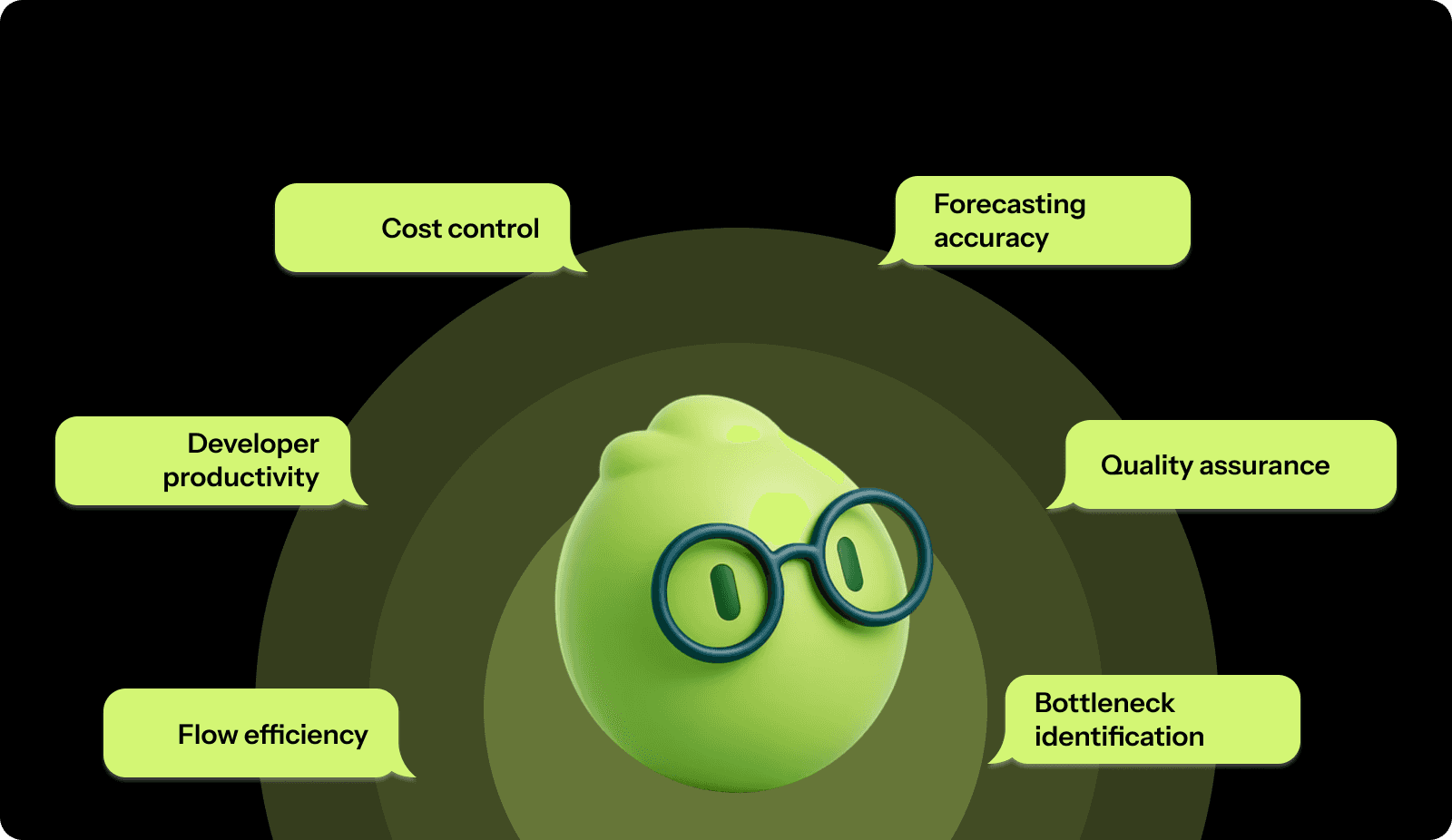
Why Is PR Merge Time Important?
  • Flow efficiency: PR merge time reveals how smoothly work moves through your development pipeline, showing whether your review process helps or hinders velocity.

  • Developer productivity: Fast merge cycles keep developers in flow state because they get timely feedback and see their work integrated quickly, which improves morale and output.

  • Cost control: Long-running PRs drain resources as developers context-switch between old branches and new work, reviewers lose context, and merge conflicts multiply.

  • Forecasting accuracy: Consistent merge times let engineering managers predict release timelines with confidence instead of guessing when code will actually ship.

  • Quality assurance: Well-optimized merge time means reviews are thorough without causing significant delays, balancing speed with the rigor needed to catch bugs early.

  • Bottleneck identification: Tracking merge time by team, repository, or developer reveals where your process breaks down so you can fix root causes instead of symptoms.

How to Calculate PR Merge Time KPI

Calculating PR merge time accurately requires choosing the right formula and understanding what to include in your measurement. Most teams use one of two approaches, depending on their goals and data distribution.

Basic Formula

The simplest calculation is:

PR Merge Time = Merge Date - PR Creation Date

This formula gives you the total elapsed time from when a developer opens the PR to when it merges into the main branch. For example, if a PR is created on January 5 at 10:00 AM and merges on January 7 at 2:00 PM, the merge time is 52 hours.

This basic approach works well for teams just starting to track the metric. It captures the complete lifecycle and provides a clear picture of how long code sits in review limbo.

Average vs. Median Merge Time

You can calculate merge time using either average or median, and the choice matters for accuracy.

Average merge time adds up all PR durations and divides by the number of PRs. Use this when your team has consistent review patterns without extreme outliers. For instance, if your last 10 PRs took 20, 24, 22, 26, 20, 23, 21, 25, 22, and 24 hours, the average is 22.7 hours.

Median merge time finds the middle value when you sort all merge times from shortest to longest. This approach better reflects typical performance when occasional PRs stay open much longer than normal. For example, if most PRs merge in 24 hours but one sat for 10 days, the median shows your true baseline better than an average skewed by that outlier.

What to Include in Your Calculation

Your merge time calculation should reflect the actual review and integration process, not unrelated delays.

Include time from PR creation through final merge, counting all review cycles, feedback iterations, and approval steps. This captures the true cost of getting code from "ready for review" to "in production."

Exclude time when PRs are in draft status if your team uses drafts for work-in-progress sharing rather than active review. Also, exclude time when PRs are explicitly marked as blocked by external dependencies, like waiting for design assets or third-party API changes.

For reopened or revised PRs, calculate from the most recent "ready for review" timestamp to avoid penalizing teams for legitimate process steps like splitting large PRs or addressing major architectural feedback.

What Are the Different Types of PR Merge Time Metrics?

Breaking PR merge time into components reveals exactly where delays happen in your review workflow. Each component measures a specific stage, helping you target improvements precisely.

Here's how different merge time metrics compare:

Metric

What It Measures

Example Benchmark

Time to First Review

PR creation to first reviewer comment

Under 4 hours

Time to Approval

PR creation to final approval

12-24 hours

Time from Approval to Merge

Approval to code integration

Minutes to hours

Total Merge Time

PR creation to merge completion

24-48 hours

These metrics work together to show your complete review cycle:

1. Time to First Review

Time to first review measures how long PRs wait before anyone looks at them. This metric starts when the developer creates the PR and ends when the first reviewer leaves comments or approves the changes.

Fast time to first review (under 4 hours) signals that your team prioritizes code review and has clear ownership. Slow first review times (over 24 hours) usually mean unclear responsibility, overloaded reviewers, or missing notifications.

2. Time to Approval

Time to approval tracks the duration from PR creation to when reviewers formally approve the changes. This includes all review rounds, feedback cycles, and revisions.

Teams with efficient review processes see 12-24 hour approval times for typical PRs. Longer approval cycles often indicate oversized PRs, unclear requirements, or insufficient automated testing that forces reviewers to question correctness.

3. Time from Approval to Merge

This component measures the final step: how long approved PRs wait before merging. The clock starts when all required approvers say "yes" and ends when the code actually lands in the main branch.

Good teams merge within minutes or hours after approval because they have automated quality gates and clear merge policies. Delays here often come from waiting for CI/CD pipelines, merge conflicts, or organizational policies requiring manual final checks.

What Is a Good PR Merge Time Benchmark?

Industry data shows most high-performing engineering teams target 24-48 hours for total PR merge time. This baseline balances thorough review with maintaining development velocity.

Knowing how benchmarks vary helps you set realistic targets:

Team Size

Typical Merge Time

Key Factors

Small (3-5 developers)

12-24 hours

Simple communication, high context awareness

Mid-size (10-20 developers)

24-48 hours

More coordination needed, clear processes required

Large (50+ developers)

48-72 hours

Complex systems, multiple approval layers

Team size affects benchmarks significantly. Small teams (3-5 developers) can often hit 12-24 hour merge times because communication is simple and everyone stays context-aware. Mid-size teams (10-20 developers) typically see 24-48 hours as collaboration requires more coordination. Large teams (50+ developers) might accept 48-72 hours for complex PRs touching multiple systems.

Project complexity also matters. Microservice architectures with clear boundaries allow faster reviews than monolithic codebases, where every change has ripple effects. Regulated industries (finance, healthcare) need longer review cycles to meet compliance requirements.

Tip: Set your target based on your current baseline, not industry averages. If your team currently averages 5 days, aim for 3 days first, then iterate down to 48 hours over several quarters. Rapid improvement attempts often create problems by encouraging rushed reviews that miss critical issues.

How to Improve PR Merge Time: Top 8 Strategies

Reducing PR merge time requires addressing both process bottlenecks and team behavior. These strategies tackle the most common delays that slow code integration.
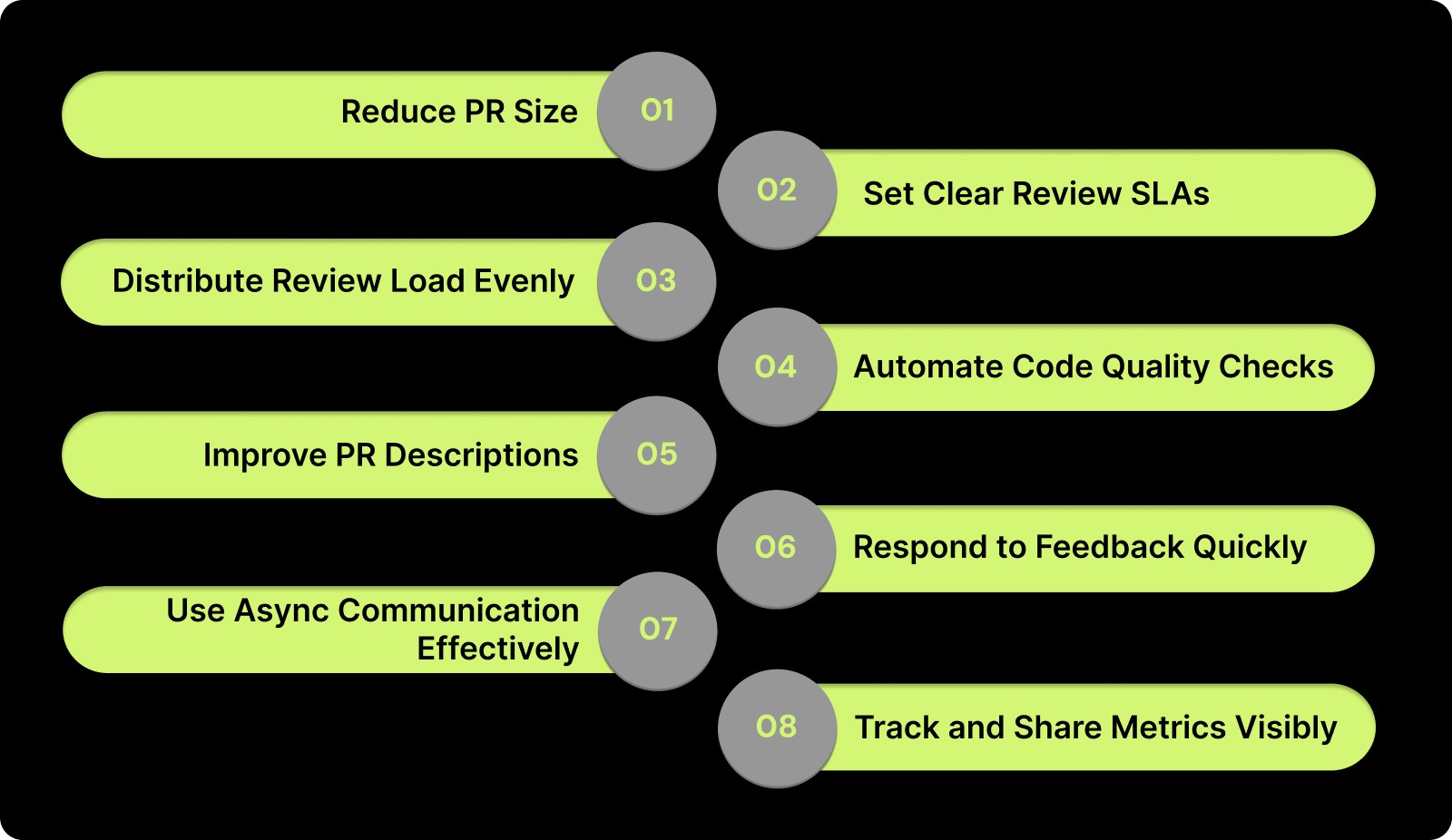
How to Improve PR Merge Time: Top 8 Strategies

1. Reduce PR Size

Large pull requests slow review speed because reviewers need more time to understand context, spot issues, and verify correctness. Breaking changes into smaller, focused PRs speeds reviews dramatically.

Target 200-400 lines of code changed per PR. Reviewers catch more bugs in small PRs compared to large ones, and review time drops proportionally. For example, instead of submitting a 2,000-line feature PR, break it into four 500-line PRs that implement the feature incrementally.

Use feature flags to merge incomplete features safely. Deploy code behind a flag, merge it quickly, then enable the feature when ready instead of keeping long-lived branches open.

2. Set Clear Review SLAs

Service level agreements for code review create accountability and urgency without adding pressure. When everyone knows the expected response time, PRs stop getting stuck.

Define specific SLAs for each review stage. For instance, "first review within 4 hours during business hours" and "approval or feedback within 24 hours of submission." Communicate these expectations clearly and track adherence.

Make SLAs visible through dashboards or notifications. For example, highlight PRs approaching their SLA deadline in your team chat or send gentle reminders when reviews are overdue.

3. Distribute Review Load Evenly

Single points of failure in code review create bottlenecks when one or two senior engineers become gatekeepers for all PRs. Spreading review responsibility speeds merges and develops team expertise.

Implement reviewer rotation systems that assign PRs to different team members based on expertise and availability. Use code ownership tools to route PRs automatically to the right reviewers while preventing any single person from becoming overwhelmed.

Pair junior reviewers with senior mentors on complex PRs. This builds review capability across the engineering team while maintaining quality standards.

4. Automate Code Quality Checks

Automated checks catch issues instantly without waiting for human reviewers, letting reviews focus on architecture and logic rather than style and syntax.

Set up continuous integration pipelines that run tests, linters, security scans, and code coverage checks automatically on every PR. Block merges until automated checks pass, which prevents reviewers from wasting time on code that fails basic quality gates.

For example, configure your CI system to verify that new code includes tests, follows formatting standards, and doesn't introduce security vulnerabilities. Developers fix these issues before human review starts, making the review process faster and more focused.

5. Improve PR Descriptions

Clear PR descriptions give reviewers the context they need to review quickly and accurately. Poor descriptions force reviewers to reverse-engineer intent from code alone, which slows everything down.

Include the problem being solved, the approach taken, and any trade-offs made in every PR description. Add screenshots or videos for UI changes, explain why you chose one implementation over alternatives, and link to relevant tickets or design documents.

For instance, instead of writing "Fix bug in user service," write "Fix null pointer exception when users have no email address. Added null check in UserService.validateEmail() and added test coverage for this edge case. Fixes JIRA-1234."

6. Respond to Feedback Quickly

Review time includes the developer's response to feedback, not just reviewer wait time. Developer productivity improves when developers address comments quickly and keep PRs moving toward merge.

Check for review feedback at least twice daily during work hours. Respond to questions immediately even if you can't implement changes right away. Quick responses keep reviewers engaged and prevent context loss.

Set aside dedicated time for PR revisions rather than treating them as interruptions. For example, reserve 30 minutes after lunch specifically for addressing review feedback so PRs don't sit idle while you focus on new features.

7. Use Async Communication Effectively

Not every review comment needs a synchronous discussion. Distinguishing when to review asynchronously versus when to hop on a call speeds resolution.

Handle straightforward feedback (code style, simple refactors, obvious bugs) through PR comments. Schedule quick calls for architectural disagreements or when comment threads get longer than 3-4 exchanges: these discussions resolve faster synchronously.

Use inline code suggestions in PR comments when possible. Reviewers can propose specific changes that developers apply with one click instead of interpreting written feedback.

8. Track and Share Metrics Visibly

Making PR merge time data transparent creates natural accountability and drives improvement. When teams see their performance, they self-correct bottlenecks.

Display merge time dashboards in team spaces or share weekly reports showing trends by team, repository, and individual. Celebrate improvements publicly when merge times decrease or when teams consistently hit SLA targets.

Use metrics to identify systemic issues rather than blaming individuals. For instance, if one repository consistently shows slow merge times, investigate whether it lacks clear ownership, has inadequate test coverage, or needs better documentation.

Common Mistakes That Slow Down PR Merge Time

Understanding what not to do matters as much as knowing best practices. These mistakes create persistent bottlenecks in code review workflows.

  • Massive PRs: Changes exceeding 500 lines overwhelm reviewers and guarantee slow, superficial reviews that miss critical issues while taking days to complete.

  • Unclear expectations: Teams without explicit review SLAs let PRs drift indefinitely because no one feels accountable for response times or knows when to escalate delays.

  • Review bottlenecks: Depending on one or two senior engineers to review everything creates queues that slow all development, regardless of how efficient individual reviews are.

  • Context switching: Keeping too many PRs open simultaneously (more than 2-3 per developer) fragments attention and slows progress on all of them.

  • Missing automation: Manual verification of code style, test coverage, and security issues wastes reviewer time on mechanical checks that computers handle instantly.

  • Poor PR descriptions: Forcing reviewers to deduce context from code alone adds 30-60 minutes to every review and increases the chance they miss important considerations.

How to Track PR Merge Time Effectively

Accurate tracking requires capturing the right data points and presenting them in ways that drive action. Manual tracking quickly becomes unsustainable as team size and PR volume grow.

Here's how to implement effective merge time tracking:

  • Capture key timestamps: Record PR creation, first review, approval, and merge times automatically through your version control system to eliminate manual data entry errors.

  • Build comprehensive dashboards: Create views showing both aggregate metrics (team average, median, trends over time) and detailed breakdowns (per-developer, per-repository, outlier identification) so leaders can spot patterns.

  • Set up proactive alerts: Configure notifications for PRs open longer than your target SLA or sudden spikes in merge time to catch problems early before they become cultural norms.

  • Establish review cadence: Schedule weekly tactical reviews of merge time data in standups and monthly strategic assessments in retrospectives to maintain a consistent focus on improvement.

  • Make data accessible: Ensure all team members can view current metrics without requesting reports, creating transparency that drives accountability and continuous improvement.

Review metrics in regular engineering meetings: weekly for tactical adjustments, monthly for strategic process improvements. Use data to guide discussions about what's working and where the team needs help.

Reduce PR Merge Time and Improve Team Velocity with Entelligence AI

Manual PR merge time tracking creates blind spots that hide the real bottlenecks slowing your team down. Engineering leaders spend hours pulling data from GitHub, building spreadsheets, and trying to figure out where delays actually happen. All these consume the time that could go toward solving the problems instead.

Entelligence AI automates PR merge time tracking and surfaces actionable insights so you can focus on improving velocity instead of chasing data. The platform connects directly to your repositories and gives you real-time visibility into review cycles, bottlenecks, and team performance.

Here's how Entelligence AI enhances PR merge time tracking:

  • AI PR Reviews: Automated line-level analysis catches issues instantly so human reviewers can focus on architecture and logic rather than syntax and style, significantly reducing first-review time.

  • Real-Time Merge Time Dashboards: See exactly where PRs stall with automated tracking of time to first review, approval cycles, and merge delays without any manual data collection required.

  • Review Load Distribution: AI identifies bottlenecks when one reviewer blocks multiple PRs and suggests rebalancing to prevent single points of failure.

  • Automated Quality Gates: Built-in security scans, code coverage checks, and static analysis provide instant feedback before human review starts, reducing back-and-forth cycles.

  • Team Performance Analytics: Track merge time trends by team, repository, and individual with drill-down views that reveal root causes instead of surface symptoms.

Entelligence AI gives you complete visibility into your code review workflow without adding manual tracking overhead. You see real-time data on merge time bottlenecks, get AI-powered suggestions to unblock PRs faster, and measure improvement as process changes take effect.

Engineering teams using Entelligence AI reduce significantly reduce PR merge time. For example, Digibee merged 191 PRs in 2 months with zero production defects, saving roughly 110 engineering hours that previously went to manual review coordination and post-merge debugging.

Final Thoughts

PR merge time KPI reveals how efficiently your engineering team moves code from development to production. Fast merge cycles improve developer productivity, enable accurate forecasting, and help teams ship features faster without sacrificing code quality.

Start by measuring your current baseline using median merge time to account for outliers. Set realistic targets based on your team size and complexity, then implement the strategies that address your specific bottlenecks: whether that's breaking down PR size, distributing review load, or automating quality checks.

Entelligence AI takes the manual work out of tracking PR merge time and gives you real-time visibility into exactly where your review process slows down. Start your 14-day free trial and reduce your PR merge time starting today.

FAQs

1. What is the difference between PR merge time and PR cycle time?

PR merge time measures only the duration from PR creation to merge, while PR cycle time includes the entire development process from first commit to production deployment. Merge time focuses specifically on review efficiency.

2. How often should I review PR merge time metrics with my team?

Review merge time data weekly in team standups to spot immediate bottlenecks and monthly in retrospectives to assess process improvements. Weekly reviews enable quick tactical adjustments while monthly reviews inform strategic changes.

3. What causes PR merge time to increase suddenly?

Common causes include team members on vacation creating review bottlenecks, increased PR size without corresponding process adjustments, new team members unfamiliar with review standards, or depleted CI/CD resources slowing automated checks.

4. How do I balance PR merge time with thorough security reviews?

Automate security scanning to catch common vulnerabilities instantly, then reserve human review time for architectural security concerns. This approach maintains security while keeping standard merge times for most changes.

5. What's the relationship between PR merge time and code deployment frequency?

Faster merge times directly enable higher deployment frequency because code moves from development to production more quickly. Teams that merge PRs within a few hours typically deploy more frequently than teams with multi-day merge cycles.

Recent data shows that tracking developer productivity more thoroughly can reduce time to launch by up to 40%. The development acceleration happens when teams fix review bottlenecks, reduce PR wait times, and create smooth workflows.

PR merge time KPI gives you visibility, tracking how long pull requests take from creation to merge. It shows you exactly where reviews slow down and why. When you measure this metric consistently, you can reduce wait times, improve forecasting accuracy, and help developers ship work faster.

In this guide, we break down in detail what PR merge time KPI measures, how to calculate it, and strategies to reduce bottlenecks in your code review process.

Key Takeaways

  • PR merge time KPI tracks the total duration from when a developer creates a pull request to when it merges into the main branch, reflecting your team's code review efficiency.

  • Teams with optimized PR merge times typically achieve 24-48 hour cycles, compared to teams without clear review processes.

  • Median merge time provides more accurate insights than average when your team has occasional outlier PRs that stay open for weeks.

  • Breaking large PRs into smaller, focused changes can reduce review time because reviewers can process them faster and with better accuracy.

  • Setting clear review SLAs transforms merge time from a passive metric into an active driver of team behavior and accountability.

What Is PR Merge Time KPI?

PR merge time KPI measures the total duration from when a developer creates a pull request to when that code merges into the main branch. It captures how efficiently your team reviews, approves, and integrates code changes.

This metric includes every step in your review workflow. A developer opens a PR with proposed changes. Reviewers examine the code, leave comments, and request modifications. The developer addresses feedback and updates the PR. Finally, once approved, the code merges. PR merge time spans this entire cycle.

For example, if a developer creates a PR on Monday at 9 AM and it merges on Tuesday at 3 PM, the merge time is 30 hours. Teams with smooth processes typically complete this cycle in 24-48 hours, while teams with bottlenecks can see PRs sit open for 5-7 days or longer.

Why Is PR Merge Time Important?

PR merge time directly impacts how fast your engineering team ships value to customers. When PRs merge quickly, developers stay productive, code stays fresh in everyone's minds, and features reach production faster. Here's why engineering leaders track this KPI:

Why Is PR Merge Time Important?
  • Flow efficiency: PR merge time reveals how smoothly work moves through your development pipeline, showing whether your review process helps or hinders velocity.

  • Developer productivity: Fast merge cycles keep developers in flow state because they get timely feedback and see their work integrated quickly, which improves morale and output.

  • Cost control: Long-running PRs drain resources as developers context-switch between old branches and new work, reviewers lose context, and merge conflicts multiply.

  • Forecasting accuracy: Consistent merge times let engineering managers predict release timelines with confidence instead of guessing when code will actually ship.

  • Quality assurance: Well-optimized merge time means reviews are thorough without causing significant delays, balancing speed with the rigor needed to catch bugs early.

  • Bottleneck identification: Tracking merge time by team, repository, or developer reveals where your process breaks down so you can fix root causes instead of symptoms.

How to Calculate PR Merge Time KPI

Calculating PR merge time accurately requires choosing the right formula and understanding what to include in your measurement. Most teams use one of two approaches, depending on their goals and data distribution.

Basic Formula

The simplest calculation is:

PR Merge Time = Merge Date - PR Creation Date

This formula gives you the total elapsed time from when a developer opens the PR to when it merges into the main branch. For example, if a PR is created on January 5 at 10:00 AM and merges on January 7 at 2:00 PM, the merge time is 52 hours.

This basic approach works well for teams just starting to track the metric. It captures the complete lifecycle and provides a clear picture of how long code sits in review limbo.

Average vs. Median Merge Time

You can calculate merge time using either average or median, and the choice matters for accuracy.

Average merge time adds up all PR durations and divides by the number of PRs. Use this when your team has consistent review patterns without extreme outliers. For instance, if your last 10 PRs took 20, 24, 22, 26, 20, 23, 21, 25, 22, and 24 hours, the average is 22.7 hours.

Median merge time finds the middle value when you sort all merge times from shortest to longest. This approach better reflects typical performance when occasional PRs stay open much longer than normal. For example, if most PRs merge in 24 hours but one sat for 10 days, the median shows your true baseline better than an average skewed by that outlier.

What to Include in Your Calculation

Your merge time calculation should reflect the actual review and integration process, not unrelated delays.

Include time from PR creation through final merge, counting all review cycles, feedback iterations, and approval steps. This captures the true cost of getting code from "ready for review" to "in production."

Exclude time when PRs are in draft status if your team uses drafts for work-in-progress sharing rather than active review. Also, exclude time when PRs are explicitly marked as blocked by external dependencies, like waiting for design assets or third-party API changes.

For reopened or revised PRs, calculate from the most recent "ready for review" timestamp to avoid penalizing teams for legitimate process steps like splitting large PRs or addressing major architectural feedback.

What Are the Different Types of PR Merge Time Metrics?

Breaking PR merge time into components reveals exactly where delays happen in your review workflow. Each component measures a specific stage, helping you target improvements precisely.

Here's how different merge time metrics compare:

Metric

What It Measures

Example Benchmark

Time to First Review

PR creation to first reviewer comment

Under 4 hours

Time to Approval

PR creation to final approval

12-24 hours

Time from Approval to Merge

Approval to code integration

Minutes to hours

Total Merge Time

PR creation to merge completion

24-48 hours

These metrics work together to show your complete review cycle:

1. Time to First Review

Time to first review measures how long PRs wait before anyone looks at them. This metric starts when the developer creates the PR and ends when the first reviewer leaves comments or approves the changes.

Fast time to first review (under 4 hours) signals that your team prioritizes code review and has clear ownership. Slow first review times (over 24 hours) usually mean unclear responsibility, overloaded reviewers, or missing notifications.

2. Time to Approval

Time to approval tracks the duration from PR creation to when reviewers formally approve the changes. This includes all review rounds, feedback cycles, and revisions.

Teams with efficient review processes see 12-24 hour approval times for typical PRs. Longer approval cycles often indicate oversized PRs, unclear requirements, or insufficient automated testing that forces reviewers to question correctness.

3. Time from Approval to Merge

This component measures the final step: how long approved PRs wait before merging. The clock starts when all required approvers say "yes" and ends when the code actually lands in the main branch.

Good teams merge within minutes or hours after approval because they have automated quality gates and clear merge policies. Delays here often come from waiting for CI/CD pipelines, merge conflicts, or organizational policies requiring manual final checks.

What Is a Good PR Merge Time Benchmark?

Industry data shows most high-performing engineering teams target 24-48 hours for total PR merge time. This baseline balances thorough review with maintaining development velocity.

Knowing how benchmarks vary helps you set realistic targets:

Team Size

Typical Merge Time

Key Factors

Small (3-5 developers)

12-24 hours

Simple communication, high context awareness

Mid-size (10-20 developers)

24-48 hours

More coordination needed, clear processes required

Large (50+ developers)

48-72 hours

Complex systems, multiple approval layers

Team size affects benchmarks significantly. Small teams (3-5 developers) can often hit 12-24 hour merge times because communication is simple and everyone stays context-aware. Mid-size teams (10-20 developers) typically see 24-48 hours as collaboration requires more coordination. Large teams (50+ developers) might accept 48-72 hours for complex PRs touching multiple systems.

Project complexity also matters. Microservice architectures with clear boundaries allow faster reviews than monolithic codebases, where every change has ripple effects. Regulated industries (finance, healthcare) need longer review cycles to meet compliance requirements.

Tip: Set your target based on your current baseline, not industry averages. If your team currently averages 5 days, aim for 3 days first, then iterate down to 48 hours over several quarters. Rapid improvement attempts often create problems by encouraging rushed reviews that miss critical issues.

How to Improve PR Merge Time: Top 8 Strategies

Reducing PR merge time requires addressing both process bottlenecks and team behavior. These strategies tackle the most common delays that slow code integration.

How to Improve PR Merge Time: Top 8 Strategies

1. Reduce PR Size

Large pull requests slow review speed because reviewers need more time to understand context, spot issues, and verify correctness. Breaking changes into smaller, focused PRs speeds reviews dramatically.

Target 200-400 lines of code changed per PR. Reviewers catch more bugs in small PRs compared to large ones, and review time drops proportionally. For example, instead of submitting a 2,000-line feature PR, break it into four 500-line PRs that implement the feature incrementally.

Use feature flags to merge incomplete features safely. Deploy code behind a flag, merge it quickly, then enable the feature when ready instead of keeping long-lived branches open.

2. Set Clear Review SLAs

Service level agreements for code review create accountability and urgency without adding pressure. When everyone knows the expected response time, PRs stop getting stuck.

Define specific SLAs for each review stage. For instance, "first review within 4 hours during business hours" and "approval or feedback within 24 hours of submission." Communicate these expectations clearly and track adherence.

Make SLAs visible through dashboards or notifications. For example, highlight PRs approaching their SLA deadline in your team chat or send gentle reminders when reviews are overdue.

3. Distribute Review Load Evenly

Single points of failure in code review create bottlenecks when one or two senior engineers become gatekeepers for all PRs. Spreading review responsibility speeds merges and develops team expertise.

Implement reviewer rotation systems that assign PRs to different team members based on expertise and availability. Use code ownership tools to route PRs automatically to the right reviewers while preventing any single person from becoming overwhelmed.

Pair junior reviewers with senior mentors on complex PRs. This builds review capability across the engineering team while maintaining quality standards.

4. Automate Code Quality Checks

Automated checks catch issues instantly without waiting for human reviewers, letting reviews focus on architecture and logic rather than style and syntax.

Set up continuous integration pipelines that run tests, linters, security scans, and code coverage checks automatically on every PR. Block merges until automated checks pass, which prevents reviewers from wasting time on code that fails basic quality gates.

For example, configure your CI system to verify that new code includes tests, follows formatting standards, and doesn't introduce security vulnerabilities. Developers fix these issues before human review starts, making the review process faster and more focused.

5. Improve PR Descriptions

Clear PR descriptions give reviewers the context they need to review quickly and accurately. Poor descriptions force reviewers to reverse-engineer intent from code alone, which slows everything down.

Include the problem being solved, the approach taken, and any trade-offs made in every PR description. Add screenshots or videos for UI changes, explain why you chose one implementation over alternatives, and link to relevant tickets or design documents.

For instance, instead of writing "Fix bug in user service," write "Fix null pointer exception when users have no email address. Added null check in UserService.validateEmail() and added test coverage for this edge case. Fixes JIRA-1234."

6. Respond to Feedback Quickly

Review time includes the developer's response to feedback, not just reviewer wait time. Developer productivity improves when developers address comments quickly and keep PRs moving toward merge.

Check for review feedback at least twice daily during work hours. Respond to questions immediately even if you can't implement changes right away. Quick responses keep reviewers engaged and prevent context loss.

Set aside dedicated time for PR revisions rather than treating them as interruptions. For example, reserve 30 minutes after lunch specifically for addressing review feedback so PRs don't sit idle while you focus on new features.

7. Use Async Communication Effectively

Not every review comment needs a synchronous discussion. Distinguishing when to review asynchronously versus when to hop on a call speeds resolution.

Handle straightforward feedback (code style, simple refactors, obvious bugs) through PR comments. Schedule quick calls for architectural disagreements or when comment threads get longer than 3-4 exchanges: these discussions resolve faster synchronously.

Use inline code suggestions in PR comments when possible. Reviewers can propose specific changes that developers apply with one click instead of interpreting written feedback.

8. Track and Share Metrics Visibly

Making PR merge time data transparent creates natural accountability and drives improvement. When teams see their performance, they self-correct bottlenecks.

Display merge time dashboards in team spaces or share weekly reports showing trends by team, repository, and individual. Celebrate improvements publicly when merge times decrease or when teams consistently hit SLA targets.

Use metrics to identify systemic issues rather than blaming individuals. For instance, if one repository consistently shows slow merge times, investigate whether it lacks clear ownership, has inadequate test coverage, or needs better documentation.

Common Mistakes That Slow Down PR Merge Time

Understanding what not to do matters as much as knowing best practices. These mistakes create persistent bottlenecks in code review workflows.

  • Massive PRs: Changes exceeding 500 lines overwhelm reviewers and guarantee slow, superficial reviews that miss critical issues while taking days to complete.

  • Unclear expectations: Teams without explicit review SLAs let PRs drift indefinitely because no one feels accountable for response times or knows when to escalate delays.

  • Review bottlenecks: Depending on one or two senior engineers to review everything creates queues that slow all development, regardless of how efficient individual reviews are.

  • Context switching: Keeping too many PRs open simultaneously (more than 2-3 per developer) fragments attention and slows progress on all of them.

  • Missing automation: Manual verification of code style, test coverage, and security issues wastes reviewer time on mechanical checks that computers handle instantly.

  • Poor PR descriptions: Forcing reviewers to deduce context from code alone adds 30-60 minutes to every review and increases the chance they miss important considerations.

How to Track PR Merge Time Effectively

Accurate tracking requires capturing the right data points and presenting them in ways that drive action. Manual tracking quickly becomes unsustainable as team size and PR volume grow.

Here's how to implement effective merge time tracking:

  • Capture key timestamps: Record PR creation, first review, approval, and merge times automatically through your version control system to eliminate manual data entry errors.

  • Build comprehensive dashboards: Create views showing both aggregate metrics (team average, median, trends over time) and detailed breakdowns (per-developer, per-repository, outlier identification) so leaders can spot patterns.

  • Set up proactive alerts: Configure notifications for PRs open longer than your target SLA or sudden spikes in merge time to catch problems early before they become cultural norms.

  • Establish review cadence: Schedule weekly tactical reviews of merge time data in standups and monthly strategic assessments in retrospectives to maintain a consistent focus on improvement.

  • Make data accessible: Ensure all team members can view current metrics without requesting reports, creating transparency that drives accountability and continuous improvement.

Review metrics in regular engineering meetings: weekly for tactical adjustments, monthly for strategic process improvements. Use data to guide discussions about what's working and where the team needs help.

Reduce PR Merge Time and Improve Team Velocity with Entelligence AI

Manual PR merge time tracking creates blind spots that hide the real bottlenecks slowing your team down. Engineering leaders spend hours pulling data from GitHub, building spreadsheets, and trying to figure out where delays actually happen. All these consume the time that could go toward solving the problems instead.

Entelligence AI automates PR merge time tracking and surfaces actionable insights so you can focus on improving velocity instead of chasing data. The platform connects directly to your repositories and gives you real-time visibility into review cycles, bottlenecks, and team performance.

Here's how Entelligence AI enhances PR merge time tracking:

  • AI PR Reviews: Automated line-level analysis catches issues instantly so human reviewers can focus on architecture and logic rather than syntax and style, significantly reducing first-review time.

  • Real-Time Merge Time Dashboards: See exactly where PRs stall with automated tracking of time to first review, approval cycles, and merge delays without any manual data collection required.

  • Review Load Distribution: AI identifies bottlenecks when one reviewer blocks multiple PRs and suggests rebalancing to prevent single points of failure.

  • Automated Quality Gates: Built-in security scans, code coverage checks, and static analysis provide instant feedback before human review starts, reducing back-and-forth cycles.

  • Team Performance Analytics: Track merge time trends by team, repository, and individual with drill-down views that reveal root causes instead of surface symptoms.

Entelligence AI gives you complete visibility into your code review workflow without adding manual tracking overhead. You see real-time data on merge time bottlenecks, get AI-powered suggestions to unblock PRs faster, and measure improvement as process changes take effect.

Engineering teams using Entelligence AI reduce significantly reduce PR merge time. For example, Digibee merged 191 PRs in 2 months with zero production defects, saving roughly 110 engineering hours that previously went to manual review coordination and post-merge debugging.

Final Thoughts

PR merge time KPI reveals how efficiently your engineering team moves code from development to production. Fast merge cycles improve developer productivity, enable accurate forecasting, and help teams ship features faster without sacrificing code quality.

Start by measuring your current baseline using median merge time to account for outliers. Set realistic targets based on your team size and complexity, then implement the strategies that address your specific bottlenecks: whether that's breaking down PR size, distributing review load, or automating quality checks.

Entelligence AI takes the manual work out of tracking PR merge time and gives you real-time visibility into exactly where your review process slows down. Start your 14-day free trial and reduce your PR merge time starting today.

FAQs

1. What is the difference between PR merge time and PR cycle time?

PR merge time measures only the duration from PR creation to merge, while PR cycle time includes the entire development process from first commit to production deployment. Merge time focuses specifically on review efficiency.

2. How often should I review PR merge time metrics with my team?

Review merge time data weekly in team standups to spot immediate bottlenecks and monthly in retrospectives to assess process improvements. Weekly reviews enable quick tactical adjustments while monthly reviews inform strategic changes.

3. What causes PR merge time to increase suddenly?

Common causes include team members on vacation creating review bottlenecks, increased PR size without corresponding process adjustments, new team members unfamiliar with review standards, or depleted CI/CD resources slowing automated checks.

4. How do I balance PR merge time with thorough security reviews?

Automate security scanning to catch common vulnerabilities instantly, then reserve human review time for architectural security concerns. This approach maintains security while keeping standard merge times for most changes.

5. What's the relationship between PR merge time and code deployment frequency?

Faster merge times directly enable higher deployment frequency because code moves from development to production more quickly. Teams that merge PRs within a few hours typically deploy more frequently than teams with multi-day merge cycles.

Your questions,

Your questions,

Decoded

Decoded

What makes Entelligence different?

Unlike tools that just flag issues, Entelligence understands context — detecting, explaining, and fixing problems while aligning with product goals and team standards.

Does it replace human reviewers?

No. It amplifies them. Entelligence handles repetitive checks so engineers can focus on architecture, logic, and innovation.

What tools does it integrate with?

It fits right into your workflow — GitHub, GitLab, Jira, Linear, Slack, and more. No setup friction, no context switching.

How secure is my code?

Your code never leaves your environment. Entelligence uses encrypted processing and complies with top industry standards like SOC 2 and HIPAA.

Who is it built for?

Fast-growing engineering teams that want to scale quality, security, and velocity without adding more manual reviews or overhead.

What makes Entelligence different?
Does it replace human reviewers?
What tools does it integrate with?
How secure is my code?
Who is it built for?

Drop your details

We’ll reach out before your next deploy hits production.

We’ll reach out before your next deploy hits production.