How to Manage an Engineering Team: 10 Steps and Expert Tips

Jan 1, 2026

Jan 1, 2026

Engineering teams that deploy code with effective management practices do so 46x times more frequently and recover from incidents 2,604 times faster than their peers, according to the DevOps Research and Assessment group. The difference between high-performing and struggling teams often comes down to one factor: how you manage an engineering team.

Managing engineers requires a different approach than managing other types of teams. Engineers solve complex problems, work with abstract systems, and thrive on autonomy paired with clear direction. Get the balance right, and your team ships faster with fewer bugs. Get it wrong, and you'll watch talented developers leave for opportunities where they feel trusted and supported.

In this blog, we will break down exactly how to manage an engineering team, covering everything from structuring roles to measuring performance while keeping your team motivated and productive.

Key Takeaways

  • High-performing engineering teams thrive on trust, clear priorities, and proactive blocker removal.

  • Structured team organization with defined roles and communication lines accelerates delivery and reduces friction.

  • Measuring outcomes, not activity, ensures continuous improvement without micromanaging engineers.

  • Protecting focus time and fostering knowledge sharing sustains productivity and prevents burnout.

  • Modern tools provide real-time insights, enabling managers to support their team while maintaining high performance.

What Does Managing an Engineering Team Actually Mean?

Managing an engineering team means creating the environment, structure, and clarity engineers need to consistently deliver high-quality software. It’s building the systems that make excellent engineering possible.
What Does Managing an Engineering Team Actually Mean?

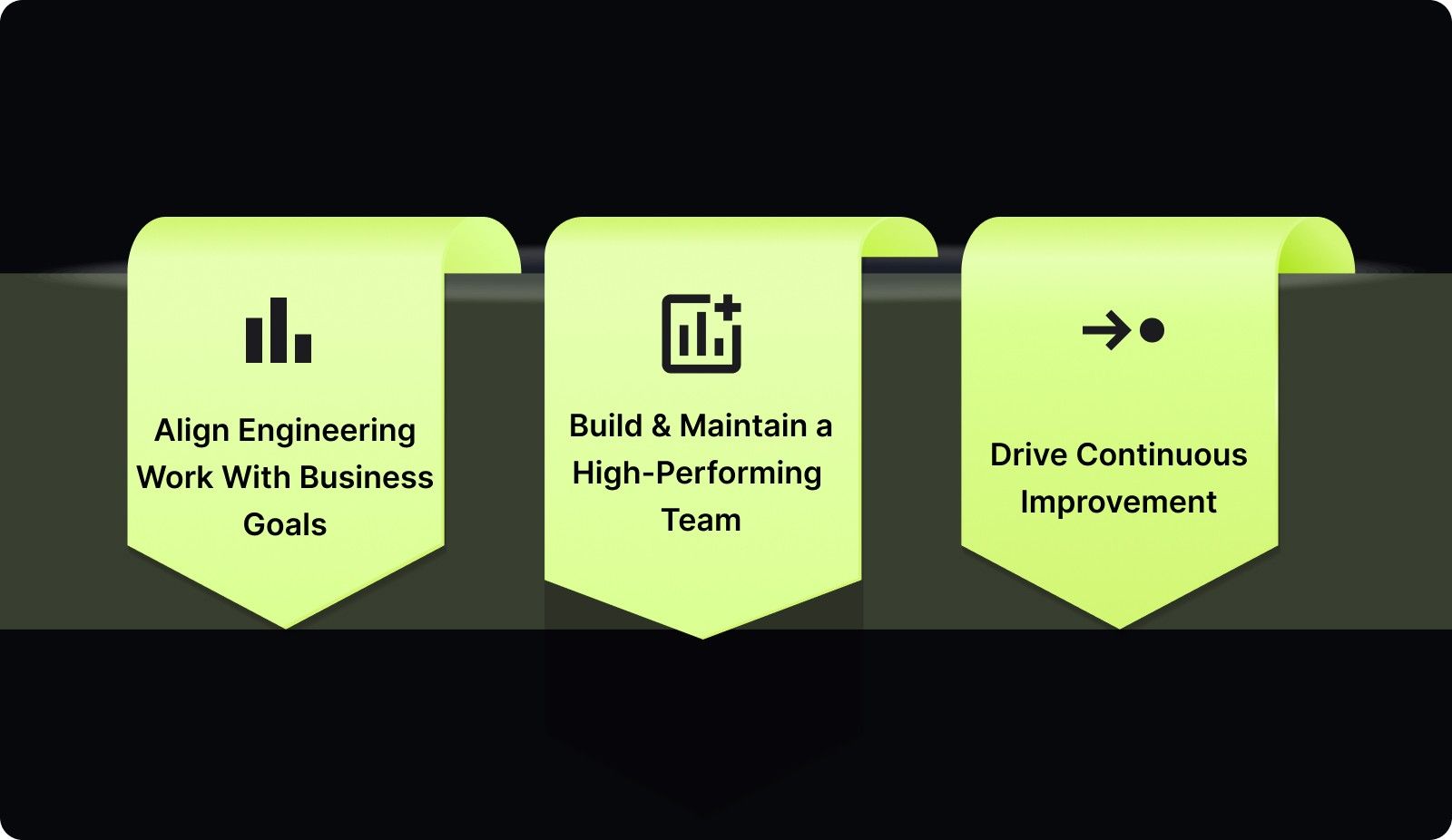
The role centers on three core responsibilities:

1. Align Engineering Work With Business Goals

You translate product and business needs into realistic plans, set priorities, track delivery, and explain performance changes using precise data and metrics.

2. Build and Maintain a High-Performing Team

You create a culture where engineers can focus, grow, and do meaningful work. That includes reducing friction, removing blockers, and retaining strong talent.

3. Drive Continuous Improvement

You ensure the team improves over time, reducing technical debt, strengthening code quality, refining processes, and helping engineers develop new skills.

In short, engineering management sits between technical execution and business strategy, protecting the team from unrealistic demands while ensuring they deliver real value.

Why Effective Engineering Management Is Critical?

Engineering management is essential because it determines whether a team can consistently deliver high-quality software, meet business goals, and grow sustainably. Without strong management, teams face missed deadlines, low morale, technical debt, and high turnover. With strong management, teams work efficiently, produce reliable products, and remain motivated.

Effective engineering management improves outcomes such as: 

  • Faster delivery: Clear priorities, planning, and support help teams ship features on time and respond to changes quickly.

  • Higher code quality: Engineers can write tests, properly review code, and reduce technical debt, leading to more stable, reliable software.

  • Better talent retention: Developers stay at companies where their work matters, they feel supported, and they have opportunities to grow.

  • Stronger team morale: Transparent communication, realistic expectations, and trust allow teams to collaborate, share ideas, and solve problems without fear.

  • Smarter technical decisions: Managers guide technical choices to align with long-term business goals, preventing costly mistakes and uncontrolled technical debt.

Strong engineering management ensures teams deliver real value, maintain high standards, and grow over time. Poor management has the opposite effect, slowing delivery, frustrating customers, and causing engineers to disengage.

How to Manage an Engineering Team?

Managing an engineering team effectively requires specific practices that address the unique challenges of software development. These steps form the foundation of strong engineering management.

Step 1: Build Trust and Credibility

Trust is the foundation of any high-performing team. Engineers need to know you support them and follow through on commitments.

  • Keep detailed notes from each 1:1 and reference previous conversations.

  • If you commit to removing a blocker, follow up within 48 hours.

  • When you make mistakes, acknowledge them publicly and explain what you'll do differently.

  • Share your reasoning behind decisions, especially unpopular ones.

Step 2: Set Clear Expectations and Priorities

Engineers perform best when they understand what success looks like and why it matters.

  • Start each sprint with written goals that tie to business objectives.

  • When priorities shift, explain why and which work should stop or pause.

  • Create a priority framework for your team to use when making decisions independently.

  • Document decision criteria so engineers understand how you choose between competing work.

Step 3: Remove Blockers Proactively

Part of your role is clearing obstacles before they slow progress.

  • Review work in progress daily to spot emerging blockers. To do this effectively, you can try tools like Entelligence AI to speed up the process.

  • Build relationships with adjacent teams to resolve cross-team issues quickly.

  • Create a shared document where engineers log blockers and track resolution.

  • Escalate issues to leadership early instead of hoping they resolve themselves.

Step 4: Provide Context, Not Just Tasks

Engineers make better decisions when they understand why their work matters. 

  • Include the "why" in every ticket or user story.

  • Share customer feedback related to the features your team builds.

  • Explain how this sprint fits into the quarterly roadmap.

  • Walk through the business metrics that your engineering work impacts.

Step 5: Balance Autonomy with Accountability

Give engineers ownership of solutions. 

  • Present problems to solve rather than solutions to implement.

  • Set boundaries around time, resources, and technical approach, then let engineers design within them.

  • Hold regular check-ins to track progress without micromanaging daily work.

  • Ask "What do you think we should do?" before sharing your opinion.

Step 6: Invest in Structured Onboarding

Teams perform better when knowledge flows freely, and onboarding is structured.

  • Build a 30-60-90-day onboarding plan with specific learning goals.

  • Assign a buddy who's not their direct manager.

  • Schedule weekly check-ins during the first month, then biweekly.

  • Create documentation that actually explains your systems, not just how to run commands.

Step 7: Facilitate Knowledge Sharing

Knowledge silos create bottlenecks and risk when people leave. Encourage pair programming, code reviews, and internal documentation.

  • Rotate on-call responsibilities so multiple people understand critical systems.

  • Host monthly "lunch and learn" sessions where engineers teach each other.

  • Require documentation as part of your definition of done.

Step 8: Protect Focus Time

Engineers need long, uninterrupted blocks of time to write code, debug issues, and think through complex problems.

  • Establish "no meeting" blocks (like Tuesday/Thursday afternoons).

  • Batch your team meetings into one or two days per week.

  • Question whether every meeting really needs to happen.

  • Use async updates for information sharing instead of status meetings.

Step 9: Address Performance Issues Early

Avoiding difficult conversations helps nobody. When you spot performance problems, give specific feedback quickly.

  • Document specific examples when you notice patterns (missed deadlines, code quality issues, communication problems).

  • Schedule a private conversation within a week of identifying the issue.

  • Create a written improvement plan with measurable goals and a timeline.

  • Follow up weekly to track progress and provide support.

Step 10: Celebrate Wins and Learn from Failures

Acknowledge both individual contributions and team achievements.

  • Share team wins in company channels, crediting specific contributors.

  • Send personalized thank-you messages when engineers go above expectations.

  • Run blameless postmortems after incidents, focusing on "what can we improve?"

  • Create action items from postmortems and track completion.

These steps form the foundation of high-performing engineering teams. Once you’ve established trust, clarity, and accountability, the next step is structuring your team.

How to Structure and Organize Your Engineering Team?

The way you structure your engineering team directly impacts productivity, collaboration, and scalability. A clear, well-organized structure ensures engineers know their responsibilities, decisions get made efficiently, and work flows smoothly from idea to production.

Here’s how to approach it step by step:

1. Choose the Right Team Model

Select a team structure that fits your product, technical complexity, and company stage:

  • Feature Teams: Teams own specific product features end-to-end. Ideal when features map clearly to business domains. Engineers are responsible for all layers: frontend, backend, testing, and deployment.

  • Component Teams: Teams specialize in a technical layer, such as frontend, backend, or infrastructure. Useful for deep expertise but requires careful coordination for cross-team features.

  • Cross-Functional Squads: Small, self-contained teams including engineers, a designer, and a PM. Each squad owns a product area and can make decisions autonomously, helping scale without slowing coordination.

  • Hybrid/Matrix Models: Engineers may report to both functional and product lines. This provides flexibility but requires careful communication to avoid conflicting priorities.

Tip: Start simple and evolve your structure as the team and product grow. The goal is to balance speed, quality, and coordination.

2. Define Roles and Responsibilities Clearly

Every team member should know their scope of work, decision-making authority, and how they contribute to team goals:

  • Engineering Managers (EMs): Focus on people, process, and delivery. Remove blockers, run 1:1s, track progress, and coordinate with other teams.

  • Tech Leads (TLs): Own architecture and technical direction. Mentor engineers, enforce code quality, and guide implementation decisions.

  • Product Managers (PMs): Define priorities based on customer needs and business objectives. Align product goals with engineering capacity.

  • Individual Contributors (ICs): Build features, fix bugs, and maintain quality. Senior ICs mentor juniors and help shape technical decisions.

  • QA Engineers: Ensure quality throughout development via testing, automation, and feedback.

  • DevOps Engineers: Manage infrastructure, deployment pipelines, and monitoring. They enable fast, safe delivery.

Actionable step: Document responsibilities and decision authority. Make it clear who approves features, technical trade-offs, or refactors to prevent confusion.

3. Create Clear Communication and Reporting Lines

A well-structured team communicates efficiently. Make sure everyone knows:

  • How work flows between roles and teams.

  • Who to approach for approvals, guidance, or blockers.

  • Regular reporting rhythms (standups, reviews, planning sessions).

4. Organize Around Product and Technical Goals

Structure your team so it aligns with what the company is trying to achieve:

  • Group people around product features, technical layers, or customer outcomes.

  • Ensure squads or teams have clear ownership to minimize dependencies.

  • Avoid overlapping responsibilities that slow down decisions.

When your team has clear ownership, defined roles, and solid communication lines, work stops getting stuck in handoffs and confusion. After setting up this structure, it’s essential to measure how well it’s working.

How to Measure Engineering Performance (Without Micromanaging)

Measuring engineering performance is essential to spot issues early, guide improvements, and demonstrate impact. The key is to track outcomes, not activity, and avoid metrics that incentivize the wrong behavior, such as lines of code or tickets closed.

1. Focus on Meaningful Metrics

Instead of tracking vanity metrics, use measures that reflect speed, stability, and team health:

DORA Metrics

These four metrics give a clear picture of engineering performance:

  • Deployment Frequency – how often code reaches production. Frequent deployments indicate efficient processes.

  • Lead Time for Changes – time from code commit to production. Shorter lead times mean faster feedback and quicker value delivery.

  • Change Failure Rate – percentage of failed deployments. Lower rates signal higher quality and better testing.

  • Mean Time to Recover (MTTR) – how quickly the team restores service after a failure. Fast recovery shows resilience.

Process Metrics

  • Cycle Time – total time from starting work to deployment. Breaking it into coding, review, and deployment stages helps identify bottlenecks.

  • PR Review Time – time between pull request creation and first meaningful review. Long review times frustrate engineers and slow delivery.

Tip: Look at trends over time rather than absolute numbers. For example, rising cycle time signals a process bottleneck to investigate.

2. Use Metrics to Guide, Not Control

  • Never rank or compare individual engineers; it destroys collaboration.

  • Combine quantitative metrics with qualitative feedback. Numbers show what is happening; conversations explain why.

  • Set team goals instead of individual targets to encourage shared accountability.

  • Make metrics visible to the team so issues are noticed early and improvements are suggested collaboratively.

  • Context matters: new teams or teams addressing technical debt may have slower metrics temporarily. Adjust expectations accordingly.

3. Improve Visibility With Tools

Manual tracking is slow and error-prone. Use modern tools that:

  • Automatically track DORA and process metrics.

  • Integrate with GitHub, GitLab, and CI/CD pipelines.

  • Provide dashboards with real-time trend and alert data.

  • Surface context-rich insights to help you understand why performance patterns appear.

Example: Platforms like Entelligence AI provide continuous, automated insights into deployment frequency, PR review times, and team performance, reducing manual reporting and allowing managers to focus on improvement rather than tracking numbers.

Tips to Manage Offshore Engineering Teams

Managing an offshore engineering team comes with unique challenges, different time zones, cultural contexts, and communication gaps. Here’s how you can keep your team aligned, productive, and engaged:
Tips to Manage Offshore Engineering Teams

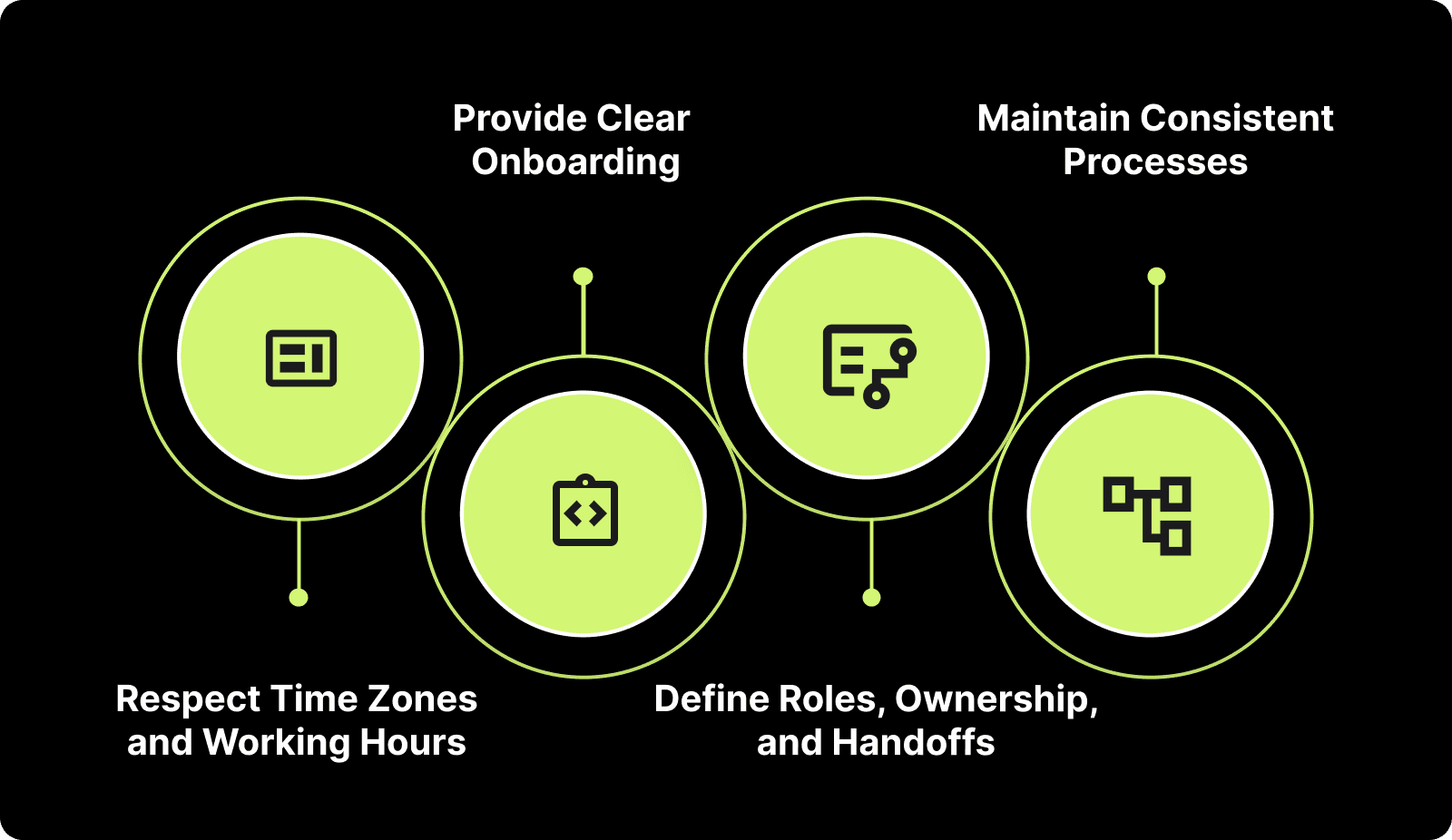
1. Respect Time Zones and Working Hours

  • Schedule meetings during overlapping hours, not just your own working day.

  • Avoid setting deadlines without considering local holidays or work schedules.

  • Use asynchronous updates so everyone stays informed even when working at different times.

2. Provide Clear Onboarding and Documentation

  • Create step-by-step onboarding guides for tools, processes, and codebases.

  • Assign a mentor or buddy to help new offshore engineers ramp up faster.

  • Document architectural decisions, coding standards, and workflows so engineers can find answers without constant hand-holding.

3. Define Roles, Ownership, and Handoffs

  • Clearly assign ownership for modules or features to avoid duplication or confusion.

  • Use written handoffs for tasks moving between teams or time zones.

  • Track decisions and responsibilities so everyone knows who makes which technical calls.

4. Maintain Consistent Processes

  • Standardize code reviews, CI/CD pipelines, and documentation practices across locations.

  • Use tools to enforce workflows, track PRs, and ensure visibility without micromanagement.

  • Make progress and blockers transparent so your offshore team knows priorities and dependencies.

Following these strategies helps your offshore engineers stay productive, aligned, and engaged. To amplify all these efforts and reduce overhead, modern tools can provide real-time insights into code quality and team performance.

Supercharge Engineering Team Management with Entelligence AI

Managing an engineering team is messy. You want to know what’s happening in your code, spot blockers before they derail progress, and understand how your team is performing, all without drowning in spreadsheets or micromanaging every task.

Entelligence AI gives you that visibility. It helps you catch issues early, keep documentation up to date, and see how your team is doing in real time, so you can spend more time helping your engineers do their best work.

Here’s how Entelligence AI can make your life easier:

AI‑Powered Code Reviews

  • Automated, context‑aware pull request reviews that go beyond simple style checks.

  • AI generates actionable comments, summaries, and suggestions based on your team’s codebase and standards.

  • Helps catch bugs, design issues, and quality concerns earlier in the process.

Real‑Time IDE Feedback

  • Get intelligent code feedback directly in your development environment (e.g., VS Code), so developers spot issues before submitting.

  • Reduces review cycles and improves code quality before human review.

Team Performance Insights

  • Dashboards that show how teams are performing across delivery, review work, and other productivity signals.

  • Compare multiple teams, identify trends, and make data‑driven decisions.

Individual Performance Reviews

  • Detailed analytics on individual contributions, including code review quality, story points delivered, and skill assessments.

  • Useful for coaching, performance conversations, and career development.

Automated Documentation Generation

  • Generates and maintains technical documentation like architecture summaries and code explanations.

  • Keeps docs in sync with your codebase automatically.

Deep Analytics and Visualization

  • Aggregate metrics over time across teams, review quality, and work distribution.

  • Helps spot bottlenecks and measure improvements without manual spreadsheets.

Integrations With Your Toolchain

  • Works with tools you already use (GitHub, GitLab, Jira, Slack, Notion, Confluence, and more).

  • Reduces context‑switching and centralizes insights in one place.

With Entelligence AI, you gain the insights and automation to empower your engineers, streamline delivery, and lead a high-performing team all without juggling from one deck to another.

Conclusion

Learning how to manage an engineering team comes down to building trust, providing clarity, and removing obstacles that slow down great engineers. The practices covered in this guide give you a framework for managing teams that ship fast without burning out.

Start with the fundamentals. Managing engineering teams well requires continuous improvement. What works for a team of five won't work for fifty. What works during rapid growth needs adjustment during stability. Stay close to your team, listen to feedback, and adapt your approach as circumstances change.

Entelligence AI helps engineering managers at every stage by automating visibility, surfacing insights, and reducing manual reporting overhead. When you spend less time tracking status and more time supporting your team, everyone wins.

Start building a more effective engineering organization today. Try Entelligence AI's free trial and see immediate improvements in team clarity, code quality, and delivery speed.

FAQ’s 

1. What are the five principles of engineering management?

Focus on aligning engineering work with business goals, building trust, enabling continuous improvement, fostering collaboration, and maintaining clear communication to deliver value efficiently while supporting team growth and morale.

2. What are the 4 C's of engineering design?

Creativity to generate ideas, clarity to define requirements, consistency to maintain quality, and cost-effectiveness to ensure feasible solutions while meeting technical and business objectives effectively.

3. What are the five basics of management?

Planning work strategically, organizing resources and roles, leading teams effectively, monitoring performance through meaningful metrics, and continuously improving processes to achieve organizational goals efficiently.

4. What are the 10 qualities of a great engineer?

Problem-solving skills, creativity, adaptability, attention to detail, communication, collaboration, technical expertise, continuous learning, accountability, and empathy for users and team dynamics.

5. How can engineering managers prevent burnout in their teams?

Encourage realistic workloads, protect focus time, provide autonomy, recognize achievements, rotate responsibilities, promote knowledge sharing, and maintain open communication to sustain engagement, morale, and long-term productivity.
Engineering teams that deploy code with effective management practices do so 46x times more frequently and recover from incidents 2,604 times faster than their peers, according to the DevOps Research and Assessment group. The difference between high-performing and struggling teams often comes down to one factor: how you manage an engineering team.

Managing engineers requires a different approach than managing other types of teams. Engineers solve complex problems, work with abstract systems, and thrive on autonomy paired with clear direction. Get the balance right, and your team ships faster with fewer bugs. Get it wrong, and you'll watch talented developers leave for opportunities where they feel trusted and supported.

In this blog, we will break down exactly how to manage an engineering team, covering everything from structuring roles to measuring performance while keeping your team motivated and productive.

Key Takeaways

  • High-performing engineering teams thrive on trust, clear priorities, and proactive blocker removal.

  • Structured team organization with defined roles and communication lines accelerates delivery and reduces friction.

  • Measuring outcomes, not activity, ensures continuous improvement without micromanaging engineers.

  • Protecting focus time and fostering knowledge sharing sustains productivity and prevents burnout.

  • Modern tools provide real-time insights, enabling managers to support their team while maintaining high performance.

What Does Managing an Engineering Team Actually Mean?

Managing an engineering team means creating the environment, structure, and clarity engineers need to consistently deliver high-quality software. It’s building the systems that make excellent engineering possible.

What Does Managing an Engineering Team Actually Mean?

The role centers on three core responsibilities:

1. Align Engineering Work With Business Goals

You translate product and business needs into realistic plans, set priorities, track delivery, and explain performance changes using precise data and metrics.

2. Build and Maintain a High-Performing Team

You create a culture where engineers can focus, grow, and do meaningful work. That includes reducing friction, removing blockers, and retaining strong talent.

3. Drive Continuous Improvement

You ensure the team improves over time, reducing technical debt, strengthening code quality, refining processes, and helping engineers develop new skills.

In short, engineering management sits between technical execution and business strategy, protecting the team from unrealistic demands while ensuring they deliver real value.

Why Effective Engineering Management Is Critical?

Engineering management is essential because it determines whether a team can consistently deliver high-quality software, meet business goals, and grow sustainably. Without strong management, teams face missed deadlines, low morale, technical debt, and high turnover. With strong management, teams work efficiently, produce reliable products, and remain motivated.

Effective engineering management improves outcomes such as: 

  • Faster delivery: Clear priorities, planning, and support help teams ship features on time and respond to changes quickly.

  • Higher code quality: Engineers can write tests, properly review code, and reduce technical debt, leading to more stable, reliable software.

  • Better talent retention: Developers stay at companies where their work matters, they feel supported, and they have opportunities to grow.

  • Stronger team morale: Transparent communication, realistic expectations, and trust allow teams to collaborate, share ideas, and solve problems without fear.

  • Smarter technical decisions: Managers guide technical choices to align with long-term business goals, preventing costly mistakes and uncontrolled technical debt.

Strong engineering management ensures teams deliver real value, maintain high standards, and grow over time. Poor management has the opposite effect, slowing delivery, frustrating customers, and causing engineers to disengage.

How to Manage an Engineering Team?

Managing an engineering team effectively requires specific practices that address the unique challenges of software development. These steps form the foundation of strong engineering management.

Step 1: Build Trust and Credibility

Trust is the foundation of any high-performing team. Engineers need to know you support them and follow through on commitments.

  • Keep detailed notes from each 1:1 and reference previous conversations.

  • If you commit to removing a blocker, follow up within 48 hours.

  • When you make mistakes, acknowledge them publicly and explain what you'll do differently.

  • Share your reasoning behind decisions, especially unpopular ones.

Step 2: Set Clear Expectations and Priorities

Engineers perform best when they understand what success looks like and why it matters.

  • Start each sprint with written goals that tie to business objectives.

  • When priorities shift, explain why and which work should stop or pause.

  • Create a priority framework for your team to use when making decisions independently.

  • Document decision criteria so engineers understand how you choose between competing work.

Step 3: Remove Blockers Proactively

Part of your role is clearing obstacles before they slow progress.

  • Review work in progress daily to spot emerging blockers. To do this effectively, you can try tools like Entelligence AI to speed up the process.

  • Build relationships with adjacent teams to resolve cross-team issues quickly.

  • Create a shared document where engineers log blockers and track resolution.

  • Escalate issues to leadership early instead of hoping they resolve themselves.

Step 4: Provide Context, Not Just Tasks

Engineers make better decisions when they understand why their work matters. 

  • Include the "why" in every ticket or user story.

  • Share customer feedback related to the features your team builds.

  • Explain how this sprint fits into the quarterly roadmap.

  • Walk through the business metrics that your engineering work impacts.

Step 5: Balance Autonomy with Accountability

Give engineers ownership of solutions. 

  • Present problems to solve rather than solutions to implement.

  • Set boundaries around time, resources, and technical approach, then let engineers design within them.

  • Hold regular check-ins to track progress without micromanaging daily work.

  • Ask "What do you think we should do?" before sharing your opinion.

Step 6: Invest in Structured Onboarding

Teams perform better when knowledge flows freely, and onboarding is structured.

  • Build a 30-60-90-day onboarding plan with specific learning goals.

  • Assign a buddy who's not their direct manager.

  • Schedule weekly check-ins during the first month, then biweekly.

  • Create documentation that actually explains your systems, not just how to run commands.

Step 7: Facilitate Knowledge Sharing

Knowledge silos create bottlenecks and risk when people leave. Encourage pair programming, code reviews, and internal documentation.

  • Rotate on-call responsibilities so multiple people understand critical systems.

  • Host monthly "lunch and learn" sessions where engineers teach each other.

  • Require documentation as part of your definition of done.

Step 8: Protect Focus Time

Engineers need long, uninterrupted blocks of time to write code, debug issues, and think through complex problems.

  • Establish "no meeting" blocks (like Tuesday/Thursday afternoons).

  • Batch your team meetings into one or two days per week.

  • Question whether every meeting really needs to happen.

  • Use async updates for information sharing instead of status meetings.

Step 9: Address Performance Issues Early

Avoiding difficult conversations helps nobody. When you spot performance problems, give specific feedback quickly.

  • Document specific examples when you notice patterns (missed deadlines, code quality issues, communication problems).

  • Schedule a private conversation within a week of identifying the issue.

  • Create a written improvement plan with measurable goals and a timeline.

  • Follow up weekly to track progress and provide support.

Step 10: Celebrate Wins and Learn from Failures

Acknowledge both individual contributions and team achievements.

  • Share team wins in company channels, crediting specific contributors.

  • Send personalized thank-you messages when engineers go above expectations.

  • Run blameless postmortems after incidents, focusing on "what can we improve?"

  • Create action items from postmortems and track completion.

These steps form the foundation of high-performing engineering teams. Once you’ve established trust, clarity, and accountability, the next step is structuring your team.

How to Structure and Organize Your Engineering Team?

The way you structure your engineering team directly impacts productivity, collaboration, and scalability. A clear, well-organized structure ensures engineers know their responsibilities, decisions get made efficiently, and work flows smoothly from idea to production.

Here’s how to approach it step by step:

1. Choose the Right Team Model

Select a team structure that fits your product, technical complexity, and company stage:

  • Feature Teams: Teams own specific product features end-to-end. Ideal when features map clearly to business domains. Engineers are responsible for all layers: frontend, backend, testing, and deployment.

  • Component Teams: Teams specialize in a technical layer, such as frontend, backend, or infrastructure. Useful for deep expertise but requires careful coordination for cross-team features.

  • Cross-Functional Squads: Small, self-contained teams including engineers, a designer, and a PM. Each squad owns a product area and can make decisions autonomously, helping scale without slowing coordination.

  • Hybrid/Matrix Models: Engineers may report to both functional and product lines. This provides flexibility but requires careful communication to avoid conflicting priorities.

Tip: Start simple and evolve your structure as the team and product grow. The goal is to balance speed, quality, and coordination.

2. Define Roles and Responsibilities Clearly

Every team member should know their scope of work, decision-making authority, and how they contribute to team goals:

  • Engineering Managers (EMs): Focus on people, process, and delivery. Remove blockers, run 1:1s, track progress, and coordinate with other teams.

  • Tech Leads (TLs): Own architecture and technical direction. Mentor engineers, enforce code quality, and guide implementation decisions.

  • Product Managers (PMs): Define priorities based on customer needs and business objectives. Align product goals with engineering capacity.

  • Individual Contributors (ICs): Build features, fix bugs, and maintain quality. Senior ICs mentor juniors and help shape technical decisions.

  • QA Engineers: Ensure quality throughout development via testing, automation, and feedback.

  • DevOps Engineers: Manage infrastructure, deployment pipelines, and monitoring. They enable fast, safe delivery.

Actionable step: Document responsibilities and decision authority. Make it clear who approves features, technical trade-offs, or refactors to prevent confusion.

3. Create Clear Communication and Reporting Lines

A well-structured team communicates efficiently. Make sure everyone knows:

  • How work flows between roles and teams.

  • Who to approach for approvals, guidance, or blockers.

  • Regular reporting rhythms (standups, reviews, planning sessions).

4. Organize Around Product and Technical Goals

Structure your team so it aligns with what the company is trying to achieve:

  • Group people around product features, technical layers, or customer outcomes.

  • Ensure squads or teams have clear ownership to minimize dependencies.

  • Avoid overlapping responsibilities that slow down decisions.

When your team has clear ownership, defined roles, and solid communication lines, work stops getting stuck in handoffs and confusion. After setting up this structure, it’s essential to measure how well it’s working.

How to Measure Engineering Performance (Without Micromanaging)

Measuring engineering performance is essential to spot issues early, guide improvements, and demonstrate impact. The key is to track outcomes, not activity, and avoid metrics that incentivize the wrong behavior, such as lines of code or tickets closed.

1. Focus on Meaningful Metrics

Instead of tracking vanity metrics, use measures that reflect speed, stability, and team health:

DORA Metrics

These four metrics give a clear picture of engineering performance:

  • Deployment Frequency – how often code reaches production. Frequent deployments indicate efficient processes.

  • Lead Time for Changes – time from code commit to production. Shorter lead times mean faster feedback and quicker value delivery.

  • Change Failure Rate – percentage of failed deployments. Lower rates signal higher quality and better testing.

  • Mean Time to Recover (MTTR) – how quickly the team restores service after a failure. Fast recovery shows resilience.

Process Metrics

  • Cycle Time – total time from starting work to deployment. Breaking it into coding, review, and deployment stages helps identify bottlenecks.

  • PR Review Time – time between pull request creation and first meaningful review. Long review times frustrate engineers and slow delivery.

Tip: Look at trends over time rather than absolute numbers. For example, rising cycle time signals a process bottleneck to investigate.

2. Use Metrics to Guide, Not Control

  • Never rank or compare individual engineers; it destroys collaboration.

  • Combine quantitative metrics with qualitative feedback. Numbers show what is happening; conversations explain why.

  • Set team goals instead of individual targets to encourage shared accountability.

  • Make metrics visible to the team so issues are noticed early and improvements are suggested collaboratively.

  • Context matters: new teams or teams addressing technical debt may have slower metrics temporarily. Adjust expectations accordingly.

3. Improve Visibility With Tools

Manual tracking is slow and error-prone. Use modern tools that:

  • Automatically track DORA and process metrics.

  • Integrate with GitHub, GitLab, and CI/CD pipelines.

  • Provide dashboards with real-time trend and alert data.

  • Surface context-rich insights to help you understand why performance patterns appear.

Example: Platforms like Entelligence AI provide continuous, automated insights into deployment frequency, PR review times, and team performance, reducing manual reporting and allowing managers to focus on improvement rather than tracking numbers.

Tips to Manage Offshore Engineering Teams

Managing an offshore engineering team comes with unique challenges, different time zones, cultural contexts, and communication gaps. Here’s how you can keep your team aligned, productive, and engaged:

Tips to Manage Offshore Engineering Teams

1. Respect Time Zones and Working Hours

  • Schedule meetings during overlapping hours, not just your own working day.

  • Avoid setting deadlines without considering local holidays or work schedules.

  • Use asynchronous updates so everyone stays informed even when working at different times.

2. Provide Clear Onboarding and Documentation

  • Create step-by-step onboarding guides for tools, processes, and codebases.

  • Assign a mentor or buddy to help new offshore engineers ramp up faster.

  • Document architectural decisions, coding standards, and workflows so engineers can find answers without constant hand-holding.

3. Define Roles, Ownership, and Handoffs

  • Clearly assign ownership for modules or features to avoid duplication or confusion.

  • Use written handoffs for tasks moving between teams or time zones.

  • Track decisions and responsibilities so everyone knows who makes which technical calls.

4. Maintain Consistent Processes

  • Standardize code reviews, CI/CD pipelines, and documentation practices across locations.

  • Use tools to enforce workflows, track PRs, and ensure visibility without micromanagement.

  • Make progress and blockers transparent so your offshore team knows priorities and dependencies.

Following these strategies helps your offshore engineers stay productive, aligned, and engaged. To amplify all these efforts and reduce overhead, modern tools can provide real-time insights into code quality and team performance.

Supercharge Engineering Team Management with Entelligence AI

Managing an engineering team is messy. You want to know what’s happening in your code, spot blockers before they derail progress, and understand how your team is performing, all without drowning in spreadsheets or micromanaging every task.

Entelligence AI gives you that visibility. It helps you catch issues early, keep documentation up to date, and see how your team is doing in real time, so you can spend more time helping your engineers do their best work.

Here’s how Entelligence AI can make your life easier:

AI‑Powered Code Reviews

  • Automated, context‑aware pull request reviews that go beyond simple style checks.

  • AI generates actionable comments, summaries, and suggestions based on your team’s codebase and standards.

  • Helps catch bugs, design issues, and quality concerns earlier in the process.

Real‑Time IDE Feedback

  • Get intelligent code feedback directly in your development environment (e.g., VS Code), so developers spot issues before submitting.

  • Reduces review cycles and improves code quality before human review.

Team Performance Insights

  • Dashboards that show how teams are performing across delivery, review work, and other productivity signals.

  • Compare multiple teams, identify trends, and make data‑driven decisions.

Individual Performance Reviews

  • Detailed analytics on individual contributions, including code review quality, story points delivered, and skill assessments.

  • Useful for coaching, performance conversations, and career development.

Automated Documentation Generation

  • Generates and maintains technical documentation like architecture summaries and code explanations.

  • Keeps docs in sync with your codebase automatically.

Deep Analytics and Visualization

  • Aggregate metrics over time across teams, review quality, and work distribution.

  • Helps spot bottlenecks and measure improvements without manual spreadsheets.

Integrations With Your Toolchain

  • Works with tools you already use (GitHub, GitLab, Jira, Slack, Notion, Confluence, and more).

  • Reduces context‑switching and centralizes insights in one place.

With Entelligence AI, you gain the insights and automation to empower your engineers, streamline delivery, and lead a high-performing team all without juggling from one deck to another.

Conclusion

Learning how to manage an engineering team comes down to building trust, providing clarity, and removing obstacles that slow down great engineers. The practices covered in this guide give you a framework for managing teams that ship fast without burning out.

Start with the fundamentals. Managing engineering teams well requires continuous improvement. What works for a team of five won't work for fifty. What works during rapid growth needs adjustment during stability. Stay close to your team, listen to feedback, and adapt your approach as circumstances change.

Entelligence AI helps engineering managers at every stage by automating visibility, surfacing insights, and reducing manual reporting overhead. When you spend less time tracking status and more time supporting your team, everyone wins.

Start building a more effective engineering organization today. Try Entelligence AI's free trial and see immediate improvements in team clarity, code quality, and delivery speed.

FAQ’s 

1. What are the five principles of engineering management?

Focus on aligning engineering work with business goals, building trust, enabling continuous improvement, fostering collaboration, and maintaining clear communication to deliver value efficiently while supporting team growth and morale.

2. What are the 4 C's of engineering design?

Creativity to generate ideas, clarity to define requirements, consistency to maintain quality, and cost-effectiveness to ensure feasible solutions while meeting technical and business objectives effectively.

3. What are the five basics of management?

Planning work strategically, organizing resources and roles, leading teams effectively, monitoring performance through meaningful metrics, and continuously improving processes to achieve organizational goals efficiently.

4. What are the 10 qualities of a great engineer?

Problem-solving skills, creativity, adaptability, attention to detail, communication, collaboration, technical expertise, continuous learning, accountability, and empathy for users and team dynamics.

5. How can engineering managers prevent burnout in their teams?

Encourage realistic workloads, protect focus time, provide autonomy, recognize achievements, rotate responsibilities, promote knowledge sharing, and maintain open communication to sustain engagement, morale, and long-term productivity.
Your questions,

Your questions,

Decoded

Decoded

What makes Entelligence different?

Unlike tools that just flag issues, Entelligence understands context — detecting, explaining, and fixing problems while aligning with product goals and team standards.

Does it replace human reviewers?

No. It amplifies them. Entelligence handles repetitive checks so engineers can focus on architecture, logic, and innovation.

What tools does it integrate with?

It fits right into your workflow — GitHub, GitLab, Jira, Linear, Slack, and more. No setup friction, no context switching.

How secure is my code?

Your code never leaves your environment. Entelligence uses encrypted processing and complies with top industry standards like SOC 2 and HIPAA.

Who is it built for?

Fast-growing engineering teams that want to scale quality, security, and velocity without adding more manual reviews or overhead.

What makes Entelligence different?
Does it replace human reviewers?
What tools does it integrate with?
How secure is my code?
Who is it built for?

Drop your details

We’ll reach out before your next deploy hits production.

We’ll reach out before your next deploy hits production.