

How OKRs Help Engineering Teams Align with Company Objectives

Dec 12, 2025

Dec 12, 2025

Your engineering team ships features every week. But when executives ask how those features move the business forward, can you explain confidently? 

Most engineering leaders struggle with this disconnect. Teams work hard, but without clear alignment between technical work and company objectives, their efforts are wasted on low-impact projects.

OKRs solve this problem by creating a direct connection between company goals and engineering tasks. In fact, recent data shows that employee performance jumps by 22% when goals connect to both what the organization needs and what matters to the people doing the work.

In this guide, we break down in detail how OKRs help engineering teams align with company objectives, including all the steps you need to start implementing them right away.

Key Takeaways

  • OKRs translate high-level company objectives into specific, measurable engineering goals that teams can act on every day.

  • Teams gain the ability to say no to distractions and focus on high-impact work when objectives are clearly defined and connected to business outcomes.

  • Cross-team collaboration improves significantly when OKRs create transparency around shared priorities across engineering, product, and sales.

  • Data-driven decisions become easier when teams have clear, measurable outcomes to track progress and identify what needs adjustment.

  • Regular OKR reviews help teams learn what works, adjust course quickly, and build momentum toward meaningful results instead of just shipping features.

What are OKRs for Engineering Teams?

OKRs stand for Objectives and Key Results. They're a goal-setting framework that helps engineering teams connect daily work to company strategy.

An Objective answers "what do we want to achieve?" It's qualitative, inspirational, and time-bound. For example, "Improve platform reliability for enterprise customers" gives direction without prescribing how to get there.

Key Results answer "how will we know we succeeded?" They're quantitative measures that track progress. For the reliability objective, key results might be "Reduce P0 incidents from 12 to 3 per quarter" or "Achieve 99.9% uptime across all services."

For engineering teams specifically, OKRs work differently than other departments. While sales might track revenue and marketing tracks leads, engineering OKRs balance technical excellence with business impact. You're not just measuring lines of code or tickets closed. You're tracking how technical improvements create customer value, reduce costs, or enable new capabilities.

How do OKRs Help Engineering Teams Align with Company Objectives?

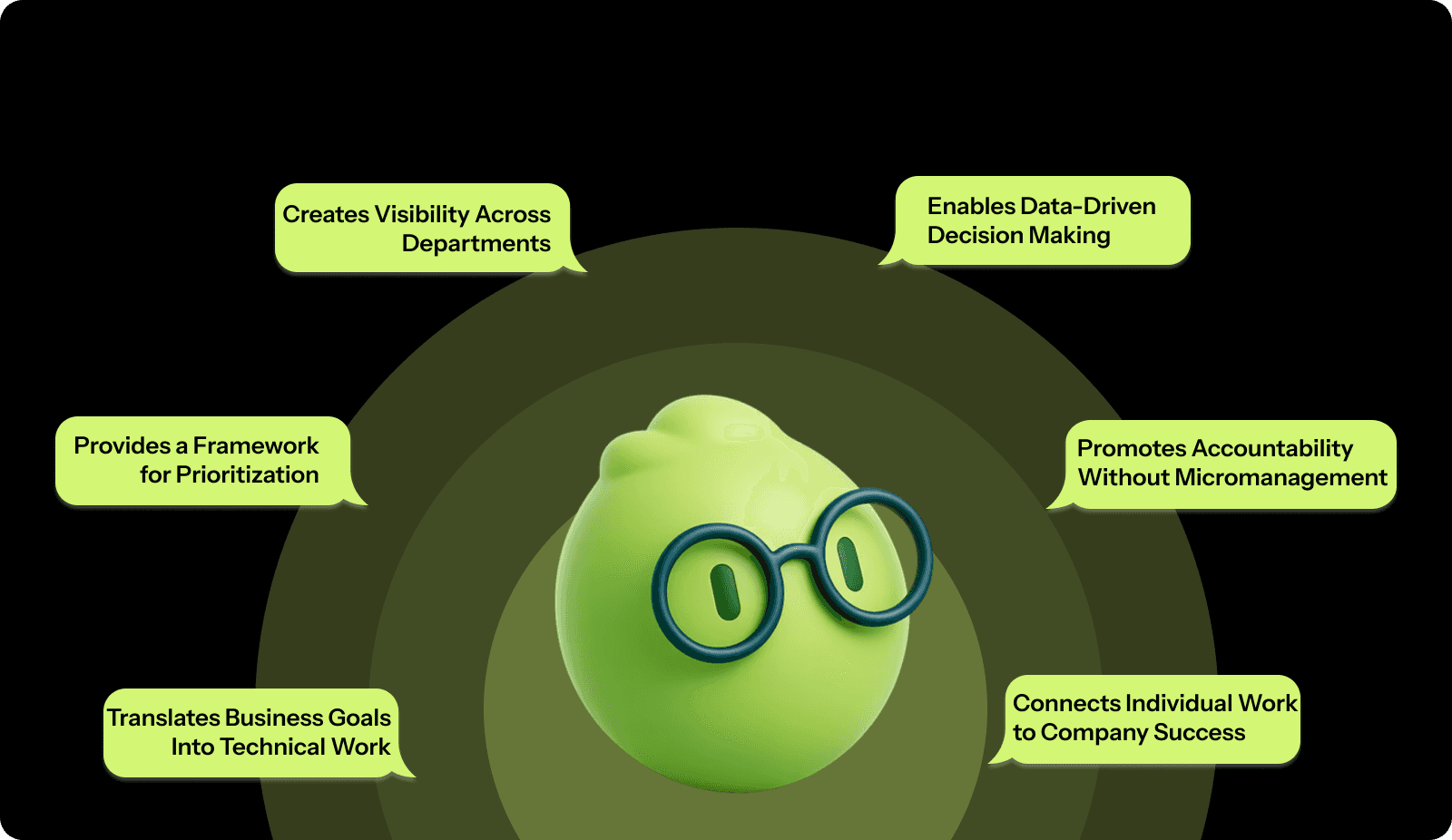
OKRs create alignment by connecting every level of work to the business strategy. Company-level objectives flow down to department objectives, then to team objectives, and finally to individual work. This ensures every sprint connects to broader business goals.
How do OKRs Help Engineering Teams Align with Company Objectives?

Here's how OKRs help engineering teams align with company objectives:

1. Translates Business Goals Into Technical Work

OKRs connect executive strategy to engineering execution by converting abstract business goals into concrete technical objectives. This cascade ensures engineers understand not just what to build, but why it matters to the business.

For example, if the company objective is "Expand into the enterprise market," product translates this into "Launch enterprise-tier features," and engineering creates objectives like "Build multi-tenant architecture" with key results tracking migration completion, performance benchmarks, and security audits.

2. Provides a Framework for Prioritization

With clear objectives, teams can evaluate every feature request, bug fix, and technical improvement against current goals. If a request doesn't move a key result forward, it gets deprioritized or deferred to next quarter.

For instance, when a team's objective focuses on platform reliability, they can confidently postpone experimental features that don't impact stability metrics. This framework prevents scope creep and keeps teams focused on delivering the highest-impact work first.

3. Creates Visibility Across Departments

When product, engineering, and sales all use the same OKR framework, everyone can see how their work connects to shared outcomes. Engineering understands why certain features matter to revenue. Product sees technical constraints clearly.

Leadership gets a unified view of progress without jumping between different tracking systems. This transparency helps teams work together instead of in silos, reducing miscommunication and duplicated effort.

4. Enables Data-Driven Decision Making

Key results provide objective metrics that show whether strategies are working or need adjustment. Teams can quickly identify what's on track and what needs attention without lengthy status meetings.

For example, if a key result shows "Reduce API response time to under 200ms" is stuck at 350ms after four weeks, the team knows to change the approach or ask for help. This clear visibility helps teams course-correct early instead of discovering problems at quarter-end.

5. Promotes Accountability Without Micromanagement

Each objective has an owner, and each key result has someone responsible for moving the metric forward. When progress stalls, teams know exactly who to talk to and what blockers exist.

This clarity reduces finger-pointing and helps teams solve problems together. For instance, if the backend team's reliability objective depends on infrastructure improvements, both teams can see that dependency clearly and coordinate their work accordingly.

6. Connects Individual Work to Company Success

Engineers see how their daily commits, code reviews, and bug fixes contribute to business outcomes that leadership cares about. This connection makes work feel more meaningful and helps teams understand which technical decisions create the most business value.

When an engineer optimizes a database query that improves a key result by 15%, they see their technical expertise driving measurable company progress.

OKRs transform engineering from a cost center that ships features into a strategic function that delivers business results. Teams move from asking "what should we build?" to "what business outcomes do we need to achieve?"

How to Set Effective OKRs for Engineering Teams?

Effective OKRs clarify priorities and motivate teams. Here’s a step-by-step process that will help you build effective engineering OKRs:

Step 1: Start with Company Objectives

Before writing any engineering OKRs, understand what the company wants to achieve this quarter or year. Talk to executives, review strategic plans, and identify the 3-5 most critical company goals.

Your engineering OKRs should directly support at least one of these goals. For example, if the company objective is "Achieve $10M ARR," engineering objectives can focus on platform stability for larger customers, feature parity with competitors, or infrastructure that supports scale.

Step 2: Collaborate with Cross-Functional Partners

Don't set engineering OKRs separately. Meet with product, design, sales, and customer success. Understand their priorities and constraints.

For instance, sales can share that slow load times lose deals. This insight leads to an objective like "Deliver fast, responsive user experience" with key results around page load time, time to interactive, and performance scores.

Step 3: Define Aspirational but Achievable Objectives

Good objectives stretch teams without breaking them. Aim for about 70% confidence in achievement. If you're certain you'll hit an objective, it's not ambitious enough.

If success seems impossible, you'll demotivate the team. Frame objectives in terms of impact, not activities. Instead of "Migrate to Kubernetes," write "Improve deployment reliability and speed." The first is a project. The second is an outcome that migration enables.

Step 4: Set Measurable Key Results

Each objective needs 2-4 key results that prove success. Key results must be numbers you can track. Avoid vague metrics like "improve quality." Use specific measures like "Reduce bug escape rate from 8% to 3%."

For a reliability objective, good key results can be: Achieve 99.95% uptime (up from 99.5%), reduce mean time to recovery from 45 minutes to 15 minutes, and decrease customer-reported incidents by 60%. These are clear, measurable, and directly tied to the objective.

Step 5: Ensure Alignment Across Teams

Map out dependencies between team OKRs. If the frontend team's objective depends on backend API improvements, those need to be explicit in both teams' key results. This prevents misalignment where one team waits on another without clear expectations.

Create a simple visual showing how team OKRs ladder up to department and company objectives. This makes alignment visible to everyone.

Step 6: Review and Adjust Regularly

Set up weekly check-ins to track key result progress. These don't need to be long meetings. A 15-minute standup where each team shares their numbers and blockers works well.

Monthly reviews let you assess if you're on track or need to adjust your approach. If a key result isn't moving, discuss why and what needs to change. Sometimes the strategy needs adjustment. Sometimes, external factors change priorities.

Common Mistakes to Avoid When Implementing Engineering OKRs

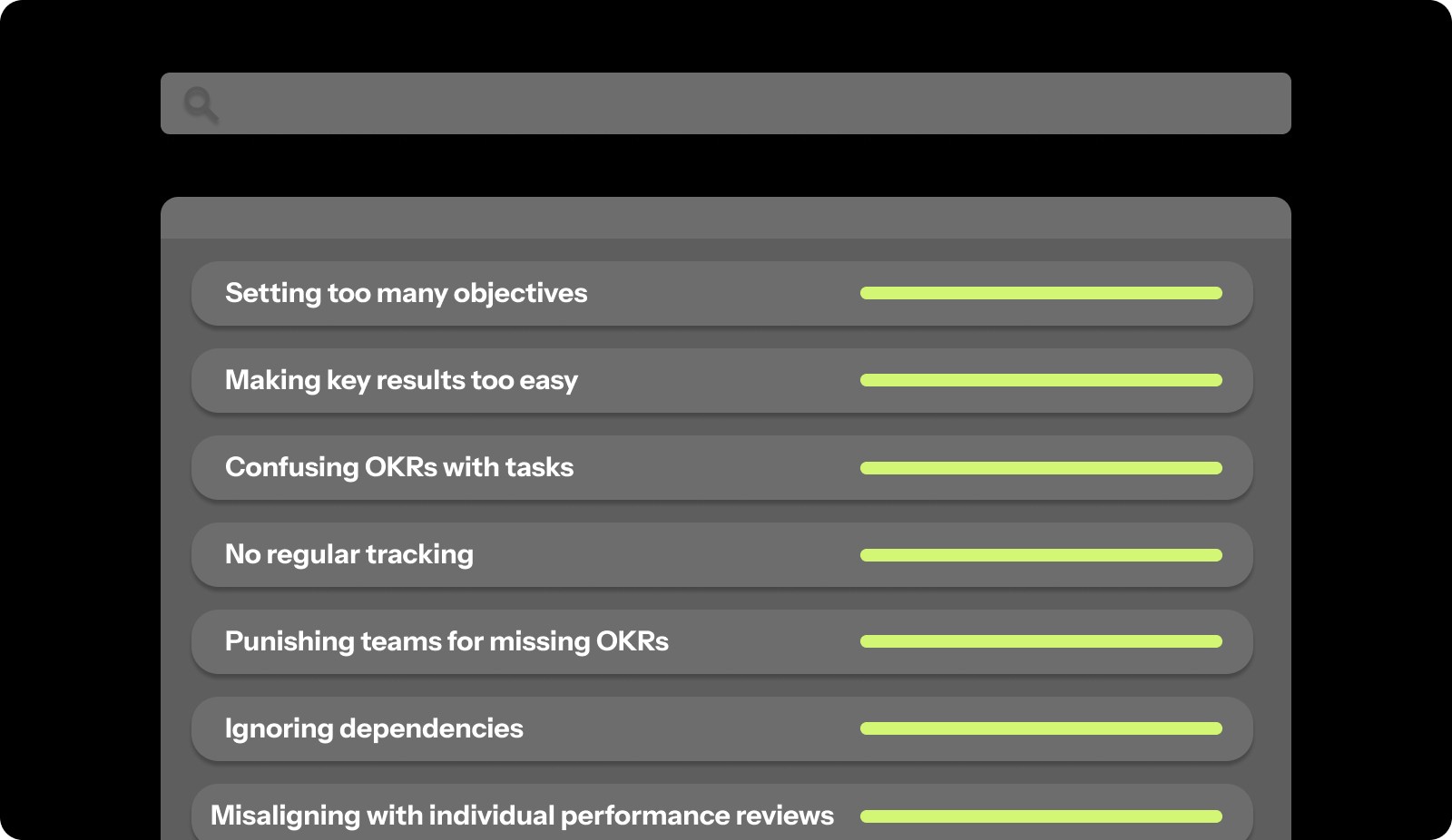
OKRs look simple on paper, but implementation shows hidden pitfalls. Teams that know what to avoid save months of wasted effort and confusion. Some of the common mistakes to watch for include:
Common Mistakes to Avoid When Implementing Engineering OKRs
  • Setting too many objectives: More than 3-5 objectives per team per quarter dilutes focus and causes teams to make little progress on everything instead of meaningful progress on what matters most.

  • Making key results too easy: If teams consistently hit 100% of key results, you're not setting ambitious enough targets since healthy OKR achievement is around 70-80%.

  • Confusing OKRs with tasks: "Migrate database to PostgreSQL" is a task, not an objective, while "Improve data infrastructure scalability" with key results around query performance and storage costs focuses on why the work matters.

  • No regular tracking: Setting OKRs in a kickoff meeting, then ignoring them until quarter-end, defeats the purpose since teams need weekly visibility into progress to adjust course when needed.

  • Punishing teams for missing OKRs: If missing OKRs leads to negative consequences, teams will sandbag by setting easy goals instead of stretching themselves appropriately.

  • Ignoring dependencies: When one team's OKRs depend on another team's delivery, make those dependencies explicit or teams will blame each other when progress stalls instead of proactively managing handoffs.

  • Misaligning with individual performance reviews: Don't tie compensation or performance ratings directly to OKR achievement since OKRs guide team priorities while performance reviews assess individual contributions, growth, and collaboration.

How to Track and Measure OKR Progress Effectively?

Tracking keeps OKRs alive throughout the quarter instead of being forgotten after the kickoff meeting. Without consistent tracking, OKRs become aspirational documents rather than working frameworks that guide daily decisions. Here's how to track OKR progress effectively:

  • Create one central location: Maintain one shared location for all OKRs, whether it's a dashboard or document, so everyone looks at the same data and avoids confusion about current status or ownership.

  • Automate data collection: Pull metrics directly from CI/CD tools, monitoring systems, and application logs to get real-time progress without manual entry that wastes time and introduces errors.

  • Use visual dashboards: Implement color-coded dashboards that show progress at a glance so leaders can quickly see what's on track (green), at risk (yellow), or blocked (red) without reading detailed reports.

  • Hold regular check-ins at multiple levels: Review team OKRs weekly in standups, department OKRs monthly with leaders, and company OKRs quarterly with executives to create accountability at each level without overwhelming anyone.

  • Celebrate progress, not just completion: Acknowledge when teams move key results significantly to maintain momentum and remind everyone that incremental progress matters.

  • Document learnings throughout the quarter: Capture what works and what doesn't work in real-time so these insights can inform next quarter's planning and help teams continuously improve their approach.

Tools like Entelligence AI automate much of this tracking work, pulling data directly from your development tools and presenting it in clear dashboards that show both OKR progress and underlying team performance metrics.

How do OKRs Improve Collaboration Between Engineering and Other Teams?

OKRs break down silos by creating shared language and visibility across departments. When teams operate with different goals and metrics, miscommunication and duplicated effort become common problems.

Here's how OKRs improve cross-team collaboration:

  • Creates shared language: When everyone uses the same OKR framework, product managers can see exactly what engineering is committed to delivering, while engineering can see what sales needs to close deals.

  • Enables cross-functional OKRs: Shared objectives like "Launch self-service onboarding for SMB customers" require product, design, engineering, and marketing to work together toward the same outcome instead of pursuing separate goals.

  • Provides transparent progress tracking: When the product sees an engineering key result slipping, they can adjust launch timelines early instead of discovering delays at the last minute.

  • Improves prioritization discussions: Teams can evaluate requests against current objectives and defer work that doesn't move key results, which depersonalizes priority decisions and focuses them on business impact.

  • Creates natural alignment checkpoints: Monthly meetings where engineering, product, sales, and customer success review progress together surface blockers early, and keep everyone working toward the same goals.

  • Reduces unnecessary meetings: With clear visibility into what each team is working on and why, teams can get updates from dashboards instead of scheduling status meetings to ask basic questions.

OKRs transform departmental collaboration from reactive coordination into proactive partnership around shared outcomes.

Manage OKRs and Team Performance with Entelligence AI

Manual OKR tracking consumes hours every week. Spreadsheets get out of date. Status updates pile up. Leaders lose visibility into what's actually happening.

Entelligence AI connects OKR management with your entire engineering productivity stack. Instead of asking for updates, you see progress automatically based on actual work completed.

Here's how Entelligence AI helps engineering teams align with company objectives:

  • AI-powered sprint planning: Automatically align sprint work with OKRs and track progress toward key results without manual updates.

  • Real-time team insights: See which engineers contribute to which objectives, spot bottlenecks early, and rebalance work based on actual capacity and performance.

  • Automated performance reviews: Generate data-driven reviews that show how individual work connects to team OKRs and company objectives, saving hours of manager time.

  • Executive dashboards: Give leadership clear visibility into engineering impact with metrics tied directly to business outcomes and OKR progress.

  • Recognition and engagement: Celebrate engineers who drive key results forward with AI-driven leaderboards and achievement tracking that reinforces goal-aligned work.

Entelligence AI turns OKR tracking from a manual burden into an automated system that actually improves team performance. You get the alignment benefits of OKRs without the administrative overhead that usually hinders adoption.

For example, Composio tripled their development speed while saving 100+ hours monthly by using Entelligence AI to catch critical code issues, automate documentation, and provide manager insights without extra meetings.

Final Thoughts

OKRs help engineering teams align with company objectives by creating clear connections between daily work and strategic goals. When implemented well, they improve focus, increase accountability, and make engineering impact visible in business terms.

The key is starting simple, tracking progress consistently, and using tools that reduce manual overhead. Teams that adopt OKRs with good tracking systems see faster delivery, better collaboration, and clearer demonstration of engineering value.

Entelligence AI gives you the framework and automation to make OKRs work without the administrative burden. Get started today to connect engineering work to company objectives.

FAQs

1. How often should engineering teams update their OKRs?

Set new OKRs quarterly, review progress weekly in team meetings, and do deeper monthly reviews with leadership. Weekly check-ins keep momentum going, while quarterly cycles provide enough time to achieve meaningful results.

2. How do you balance technical debt work with OKRs focused on new features?

Include technical health as explicit objectives when needed. For instance, "Improve platform maintainability" with key results around test coverage, deployment time, or incident frequency makes infrastructure work visible alongside feature delivery.

3. Can OKRs work with Agile or Scrum methodologies?

Yes, OKRs provide quarterly direction while Agile manages sprint-level execution. Sprint planning should select stories that move current key results forward, creating natural alignment between long-term goals and short-term work.

4. How do you handle OKRs when priorities change mid-quarter?

Review and adjust if business conditions change significantly. Small adjustments are fine, but frequent major changes signal poor planning or unstable strategy. Document why changes happened to improve future planning.

5. Should engineering OKRs align with product OKRs or have a separate focus?

Engineering OKRs should complement product OKRs, not duplicate them. Product focuses on customer outcomes and feature delivery, while engineering focuses on platform capabilities, technical excellence, and infrastructure that enables product success.

Your engineering team ships features every week. But when executives ask how those features move the business forward, can you explain confidently? 

Most engineering leaders struggle with this disconnect. Teams work hard, but without clear alignment between technical work and company objectives, their efforts are wasted on low-impact projects.

OKRs solve this problem by creating a direct connection between company goals and engineering tasks. In fact, recent data shows that employee performance jumps by 22% when goals connect to both what the organization needs and what matters to the people doing the work.

In this guide, we break down in detail how OKRs help engineering teams align with company objectives, including all the steps you need to start implementing them right away.

Key Takeaways

  • OKRs translate high-level company objectives into specific, measurable engineering goals that teams can act on every day.

  • Teams gain the ability to say no to distractions and focus on high-impact work when objectives are clearly defined and connected to business outcomes.

  • Cross-team collaboration improves significantly when OKRs create transparency around shared priorities across engineering, product, and sales.

  • Data-driven decisions become easier when teams have clear, measurable outcomes to track progress and identify what needs adjustment.

  • Regular OKR reviews help teams learn what works, adjust course quickly, and build momentum toward meaningful results instead of just shipping features.

What are OKRs for Engineering Teams?

OKRs stand for Objectives and Key Results. They're a goal-setting framework that helps engineering teams connect daily work to company strategy.

An Objective answers "what do we want to achieve?" It's qualitative, inspirational, and time-bound. For example, "Improve platform reliability for enterprise customers" gives direction without prescribing how to get there.

Key Results answer "how will we know we succeeded?" They're quantitative measures that track progress. For the reliability objective, key results might be "Reduce P0 incidents from 12 to 3 per quarter" or "Achieve 99.9% uptime across all services."

For engineering teams specifically, OKRs work differently than other departments. While sales might track revenue and marketing tracks leads, engineering OKRs balance technical excellence with business impact. You're not just measuring lines of code or tickets closed. You're tracking how technical improvements create customer value, reduce costs, or enable new capabilities.

How do OKRs Help Engineering Teams Align with Company Objectives?

OKRs create alignment by connecting every level of work to the business strategy. Company-level objectives flow down to department objectives, then to team objectives, and finally to individual work. This ensures every sprint connects to broader business goals.

How do OKRs Help Engineering Teams Align with Company Objectives?

Here's how OKRs help engineering teams align with company objectives:

1. Translates Business Goals Into Technical Work

OKRs connect executive strategy to engineering execution by converting abstract business goals into concrete technical objectives. This cascade ensures engineers understand not just what to build, but why it matters to the business.

For example, if the company objective is "Expand into the enterprise market," product translates this into "Launch enterprise-tier features," and engineering creates objectives like "Build multi-tenant architecture" with key results tracking migration completion, performance benchmarks, and security audits.

2. Provides a Framework for Prioritization

With clear objectives, teams can evaluate every feature request, bug fix, and technical improvement against current goals. If a request doesn't move a key result forward, it gets deprioritized or deferred to next quarter.

For instance, when a team's objective focuses on platform reliability, they can confidently postpone experimental features that don't impact stability metrics. This framework prevents scope creep and keeps teams focused on delivering the highest-impact work first.

3. Creates Visibility Across Departments

When product, engineering, and sales all use the same OKR framework, everyone can see how their work connects to shared outcomes. Engineering understands why certain features matter to revenue. Product sees technical constraints clearly.

Leadership gets a unified view of progress without jumping between different tracking systems. This transparency helps teams work together instead of in silos, reducing miscommunication and duplicated effort.

4. Enables Data-Driven Decision Making

Key results provide objective metrics that show whether strategies are working or need adjustment. Teams can quickly identify what's on track and what needs attention without lengthy status meetings.

For example, if a key result shows "Reduce API response time to under 200ms" is stuck at 350ms after four weeks, the team knows to change the approach or ask for help. This clear visibility helps teams course-correct early instead of discovering problems at quarter-end.

5. Promotes Accountability Without Micromanagement

Each objective has an owner, and each key result has someone responsible for moving the metric forward. When progress stalls, teams know exactly who to talk to and what blockers exist.

This clarity reduces finger-pointing and helps teams solve problems together. For instance, if the backend team's reliability objective depends on infrastructure improvements, both teams can see that dependency clearly and coordinate their work accordingly.

6. Connects Individual Work to Company Success

Engineers see how their daily commits, code reviews, and bug fixes contribute to business outcomes that leadership cares about. This connection makes work feel more meaningful and helps teams understand which technical decisions create the most business value.

When an engineer optimizes a database query that improves a key result by 15%, they see their technical expertise driving measurable company progress.

OKRs transform engineering from a cost center that ships features into a strategic function that delivers business results. Teams move from asking "what should we build?" to "what business outcomes do we need to achieve?"

How to Set Effective OKRs for Engineering Teams?

Effective OKRs clarify priorities and motivate teams. Here’s a step-by-step process that will help you build effective engineering OKRs:

Step 1: Start with Company Objectives

Before writing any engineering OKRs, understand what the company wants to achieve this quarter or year. Talk to executives, review strategic plans, and identify the 3-5 most critical company goals.

Your engineering OKRs should directly support at least one of these goals. For example, if the company objective is "Achieve $10M ARR," engineering objectives can focus on platform stability for larger customers, feature parity with competitors, or infrastructure that supports scale.

Step 2: Collaborate with Cross-Functional Partners

Don't set engineering OKRs separately. Meet with product, design, sales, and customer success. Understand their priorities and constraints.

For instance, sales can share that slow load times lose deals. This insight leads to an objective like "Deliver fast, responsive user experience" with key results around page load time, time to interactive, and performance scores.

Step 3: Define Aspirational but Achievable Objectives

Good objectives stretch teams without breaking them. Aim for about 70% confidence in achievement. If you're certain you'll hit an objective, it's not ambitious enough.

If success seems impossible, you'll demotivate the team. Frame objectives in terms of impact, not activities. Instead of "Migrate to Kubernetes," write "Improve deployment reliability and speed." The first is a project. The second is an outcome that migration enables.

Step 4: Set Measurable Key Results

Each objective needs 2-4 key results that prove success. Key results must be numbers you can track. Avoid vague metrics like "improve quality." Use specific measures like "Reduce bug escape rate from 8% to 3%."

For a reliability objective, good key results can be: Achieve 99.95% uptime (up from 99.5%), reduce mean time to recovery from 45 minutes to 15 minutes, and decrease customer-reported incidents by 60%. These are clear, measurable, and directly tied to the objective.

Step 5: Ensure Alignment Across Teams

Map out dependencies between team OKRs. If the frontend team's objective depends on backend API improvements, those need to be explicit in both teams' key results. This prevents misalignment where one team waits on another without clear expectations.

Create a simple visual showing how team OKRs ladder up to department and company objectives. This makes alignment visible to everyone.

Step 6: Review and Adjust Regularly

Set up weekly check-ins to track key result progress. These don't need to be long meetings. A 15-minute standup where each team shares their numbers and blockers works well.

Monthly reviews let you assess if you're on track or need to adjust your approach. If a key result isn't moving, discuss why and what needs to change. Sometimes the strategy needs adjustment. Sometimes, external factors change priorities.

Common Mistakes to Avoid When Implementing Engineering OKRs

OKRs look simple on paper, but implementation shows hidden pitfalls. Teams that know what to avoid save months of wasted effort and confusion. Some of the common mistakes to watch for include:

Common Mistakes to Avoid When Implementing Engineering OKRs
  • Setting too many objectives: More than 3-5 objectives per team per quarter dilutes focus and causes teams to make little progress on everything instead of meaningful progress on what matters most.

  • Making key results too easy: If teams consistently hit 100% of key results, you're not setting ambitious enough targets since healthy OKR achievement is around 70-80%.

  • Confusing OKRs with tasks: "Migrate database to PostgreSQL" is a task, not an objective, while "Improve data infrastructure scalability" with key results around query performance and storage costs focuses on why the work matters.

  • No regular tracking: Setting OKRs in a kickoff meeting, then ignoring them until quarter-end, defeats the purpose since teams need weekly visibility into progress to adjust course when needed.

  • Punishing teams for missing OKRs: If missing OKRs leads to negative consequences, teams will sandbag by setting easy goals instead of stretching themselves appropriately.

  • Ignoring dependencies: When one team's OKRs depend on another team's delivery, make those dependencies explicit or teams will blame each other when progress stalls instead of proactively managing handoffs.

  • Misaligning with individual performance reviews: Don't tie compensation or performance ratings directly to OKR achievement since OKRs guide team priorities while performance reviews assess individual contributions, growth, and collaboration.

How to Track and Measure OKR Progress Effectively?

Tracking keeps OKRs alive throughout the quarter instead of being forgotten after the kickoff meeting. Without consistent tracking, OKRs become aspirational documents rather than working frameworks that guide daily decisions. Here's how to track OKR progress effectively:

  • Create one central location: Maintain one shared location for all OKRs, whether it's a dashboard or document, so everyone looks at the same data and avoids confusion about current status or ownership.

  • Automate data collection: Pull metrics directly from CI/CD tools, monitoring systems, and application logs to get real-time progress without manual entry that wastes time and introduces errors.

  • Use visual dashboards: Implement color-coded dashboards that show progress at a glance so leaders can quickly see what's on track (green), at risk (yellow), or blocked (red) without reading detailed reports.

  • Hold regular check-ins at multiple levels: Review team OKRs weekly in standups, department OKRs monthly with leaders, and company OKRs quarterly with executives to create accountability at each level without overwhelming anyone.

  • Celebrate progress, not just completion: Acknowledge when teams move key results significantly to maintain momentum and remind everyone that incremental progress matters.

  • Document learnings throughout the quarter: Capture what works and what doesn't work in real-time so these insights can inform next quarter's planning and help teams continuously improve their approach.

Tools like Entelligence AI automate much of this tracking work, pulling data directly from your development tools and presenting it in clear dashboards that show both OKR progress and underlying team performance metrics.

How do OKRs Improve Collaboration Between Engineering and Other Teams?

OKRs break down silos by creating shared language and visibility across departments. When teams operate with different goals and metrics, miscommunication and duplicated effort become common problems.

Here's how OKRs improve cross-team collaboration:

  • Creates shared language: When everyone uses the same OKR framework, product managers can see exactly what engineering is committed to delivering, while engineering can see what sales needs to close deals.

  • Enables cross-functional OKRs: Shared objectives like "Launch self-service onboarding for SMB customers" require product, design, engineering, and marketing to work together toward the same outcome instead of pursuing separate goals.

  • Provides transparent progress tracking: When the product sees an engineering key result slipping, they can adjust launch timelines early instead of discovering delays at the last minute.

  • Improves prioritization discussions: Teams can evaluate requests against current objectives and defer work that doesn't move key results, which depersonalizes priority decisions and focuses them on business impact.

  • Creates natural alignment checkpoints: Monthly meetings where engineering, product, sales, and customer success review progress together surface blockers early, and keep everyone working toward the same goals.

  • Reduces unnecessary meetings: With clear visibility into what each team is working on and why, teams can get updates from dashboards instead of scheduling status meetings to ask basic questions.

OKRs transform departmental collaboration from reactive coordination into proactive partnership around shared outcomes.

Manage OKRs and Team Performance with Entelligence AI

Manual OKR tracking consumes hours every week. Spreadsheets get out of date. Status updates pile up. Leaders lose visibility into what's actually happening.

Entelligence AI connects OKR management with your entire engineering productivity stack. Instead of asking for updates, you see progress automatically based on actual work completed.

Here's how Entelligence AI helps engineering teams align with company objectives:

  • AI-powered sprint planning: Automatically align sprint work with OKRs and track progress toward key results without manual updates.

  • Real-time team insights: See which engineers contribute to which objectives, spot bottlenecks early, and rebalance work based on actual capacity and performance.

  • Automated performance reviews: Generate data-driven reviews that show how individual work connects to team OKRs and company objectives, saving hours of manager time.

  • Executive dashboards: Give leadership clear visibility into engineering impact with metrics tied directly to business outcomes and OKR progress.

  • Recognition and engagement: Celebrate engineers who drive key results forward with AI-driven leaderboards and achievement tracking that reinforces goal-aligned work.

Entelligence AI turns OKR tracking from a manual burden into an automated system that actually improves team performance. You get the alignment benefits of OKRs without the administrative overhead that usually hinders adoption.

For example, Composio tripled their development speed while saving 100+ hours monthly by using Entelligence AI to catch critical code issues, automate documentation, and provide manager insights without extra meetings.

Final Thoughts

OKRs help engineering teams align with company objectives by creating clear connections between daily work and strategic goals. When implemented well, they improve focus, increase accountability, and make engineering impact visible in business terms.

The key is starting simple, tracking progress consistently, and using tools that reduce manual overhead. Teams that adopt OKRs with good tracking systems see faster delivery, better collaboration, and clearer demonstration of engineering value.

Entelligence AI gives you the framework and automation to make OKRs work without the administrative burden. Get started today to connect engineering work to company objectives.

FAQs

1. How often should engineering teams update their OKRs?

Set new OKRs quarterly, review progress weekly in team meetings, and do deeper monthly reviews with leadership. Weekly check-ins keep momentum going, while quarterly cycles provide enough time to achieve meaningful results.

2. How do you balance technical debt work with OKRs focused on new features?

Include technical health as explicit objectives when needed. For instance, "Improve platform maintainability" with key results around test coverage, deployment time, or incident frequency makes infrastructure work visible alongside feature delivery.

3. Can OKRs work with Agile or Scrum methodologies?

Yes, OKRs provide quarterly direction while Agile manages sprint-level execution. Sprint planning should select stories that move current key results forward, creating natural alignment between long-term goals and short-term work.

4. How do you handle OKRs when priorities change mid-quarter?

Review and adjust if business conditions change significantly. Small adjustments are fine, but frequent major changes signal poor planning or unstable strategy. Document why changes happened to improve future planning.

5. Should engineering OKRs align with product OKRs or have a separate focus?

Engineering OKRs should complement product OKRs, not duplicate them. Product focuses on customer outcomes and feature delivery, while engineering focuses on platform capabilities, technical excellence, and infrastructure that enables product success.

Your questions,

Your questions,

Decoded

Decoded

What makes Entelligence different?

Unlike tools that just flag issues, Entelligence understands context — detecting, explaining, and fixing problems while aligning with product goals and team standards.

Does it replace human reviewers?

No. It amplifies them. Entelligence handles repetitive checks so engineers can focus on architecture, logic, and innovation.

What tools does it integrate with?

It fits right into your workflow — GitHub, GitLab, Jira, Linear, Slack, and more. No setup friction, no context switching.

How secure is my code?

Your code never leaves your environment. Entelligence uses encrypted processing and complies with top industry standards like SOC 2 and HIPAA.

Who is it built for?

Fast-growing engineering teams that want to scale quality, security, and velocity without adding more manual reviews or overhead.

What makes Entelligence different?
Does it replace human reviewers?
What tools does it integrate with?
How secure is my code?
Who is it built for?

Drop your details

We’ll reach out before your next deploy hits production.

We’ll reach out before your next deploy hits production.