

25 Practical OKR Examples for Software Engineers
Dec 8, 2025
Dec 8, 2025
Keeping software engineering teams aligned with company goals is often a challenge, especially when juggling multiple projects and tight deadlines. Without the right framework, key priorities can easily get lost.
This is where OKRs (Objectives and Key Results) come in. OKRs help software engineers focus on what matters most, track progress, and ensure their work supports broader business objectives.
The impact of OKRs is clear: organizations that implement them effectively report higher productivity and better alignment across teams. In fact, the global OKR software market is projected to reach $2.98 billion by 2029, growing at a CAGR of 16.9%, showing how essential these tools have become for driving team performance.
In this blog, we’ll share 25 practical OKR examples for software engineers, giving you actionable objectives and key results that help you achieve measurable impact in 2026.
Key Takeaways:
OKRs help software engineers stay focused on the most important tasks while ensuring their work aligns with company goals.
Measurable Key Results make it easy to track progress and evaluate the impact of engineering efforts.
Using OKRs allows teams to maintain a balance between fast delivery and high-quality software.
AI tools like Entelligence support engineers by automating repetitive tasks and improving overall productivity.
Regular tracking, reviews, and cross-team collaboration ensure that OKRs remain relevant and drive meaningful results.
Why OKRs Matter for Software Engineers?
Software engineers often juggle many tasks, from writing code to fixing bugs and meeting deadlines. OKRs (Objectives and Key Results) give a clear plan to focus on the most important work, track progress, and achieve real results. They help teams stay organized, work efficiently, and improve continuously.
Here’s why OKRs are useful for software engineers:
Stay Focused: Make sure daily tasks help the team and company goals.
Measure Progress: Use numbers and metrics to see real impact.
Balance Speed and Quality: Deliver work quickly without compromising on correctness.
Encourage Innovation: Set aside time to try new tools, ideas, or technologies.
Work Smarter as a Team: Reduce repetitive tasks, long manual reviews, and delays.
Use AI for Support: Tools like Entelligence automate reviews, create documentation, and give useful insights to improve productivity.
With OKRs, engineers can clearly see what matters, track results, and keep improving while supporting the team’s success.

Understanding the value of OKRs is only the first step. The real difference comes from creating objectives and key results that are specific, measurable, and aligned with your team’s priorities.
How can software engineering teams develop effective OKRs?
Creating impactful OKRs in software engineering is about aligning daily work with measurable outcomes, improving team efficiency, and driving business impact. Using AI-powered tools like Entelligence AI makes this process more precise, data-driven, and actionable.
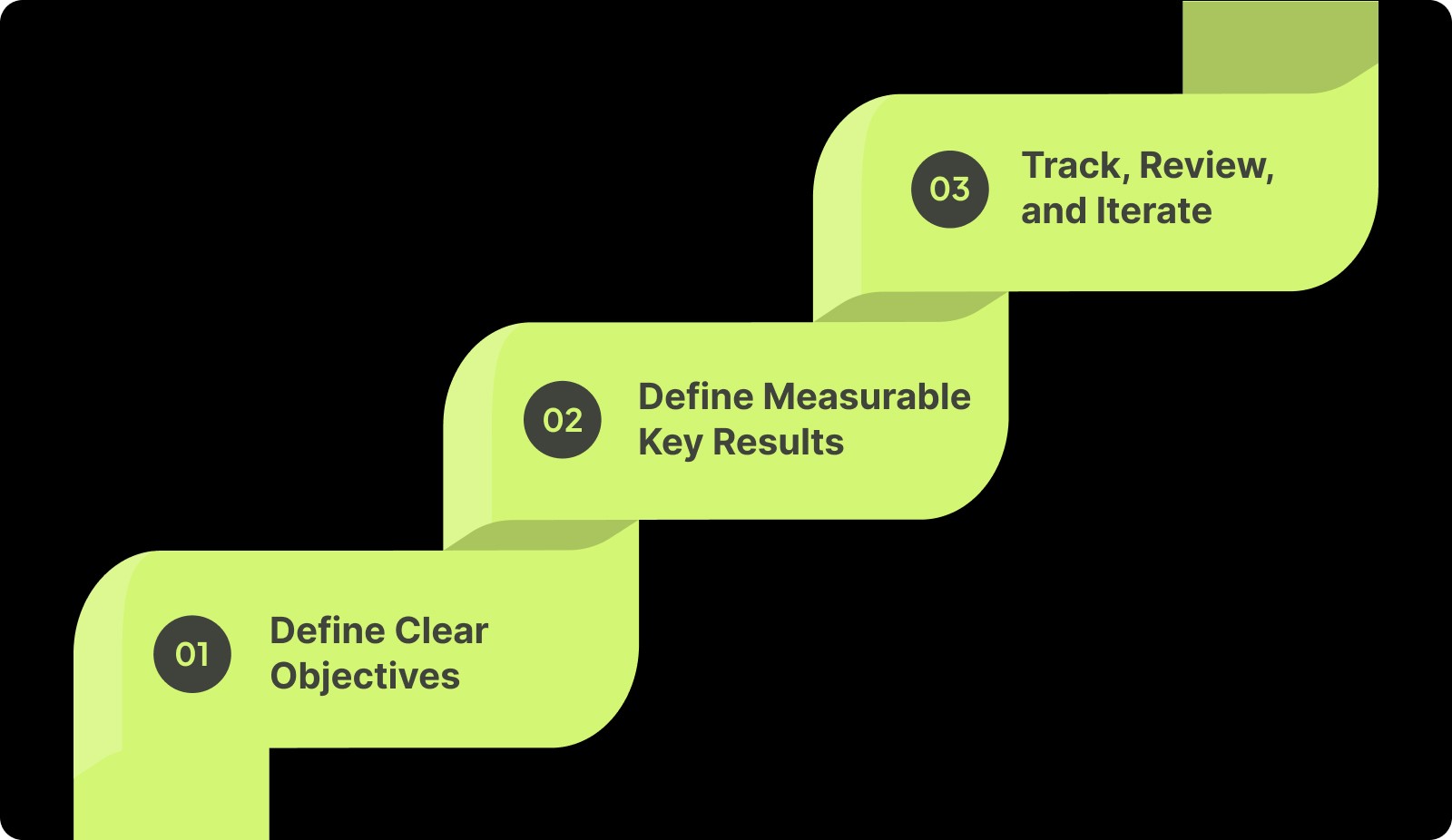
Step 1: Define Clear Objectives
Objectives should be specific, actionable, and tightly aligned with both team and company priorities. Avoid vague statements that do not clearly indicate what success looks like.
Weak objective: “Improve software quality”
Strong objective: “Reduce customer-reported bugs to improve product stability”
Clear objectives provide direction and focus, ensuring everyone understands what they are working toward and why it matters.
Step 2: Define Measurable Key Results
Key Results turn objectives into quantifiable targets. They provide concrete evidence of progress and help track the impact of team efforts.
Example for the objective above:
KR1: Reduce customer-reported bugs by 50% in the next quarter
KR2: Achieve a 95% customer satisfaction rating for product quality
Using measurable KRs ensures that outcomes are tracked objectively rather than relying on subjective impressions. AI tools can automatically collect metrics, highlight bottlenecks, and track improvements across multiple repositories and teams.
Step 3: Track, Review, and Iterate
Setting OKRs is only the first step. Continuous monitoring, review, and iteration are essential for success. Dashboards and analytics from AI-powered platforms allow teams to visualize progress in real time, detect patterns, and adjust priorities dynamically.
Regular code review cycles help identify roadblocks, optimize workflows, and celebrate milestones.
Iterating on OKRs ensures they remain aligned with changing project requirements, business goals, and team capacity.
By following these steps and leveraging AI-driven insights, software engineering teams can focus on delivering high-quality, reliable software while maintaining speed, efficiency, and innovation.
Now that we know how to set effective OKRs, let’s look at practical examples specifically designed for software engineers, these will help you apply the framework in real-world scenarios.
25 Practical OKR Examples for Software Engineers
In modern software engineering, aligning team activities with measurable goals is critical. OKRs (Objectives and Key Results) help engineers prioritize tasks, improve efficiency, and maintain high-quality standards while delivering business value.
The following 25 OKRs are designed to address key areas of software development, from quality and collaboration to innovation and security, along with actionable insights for implementation
1. Deliver High-Quality Software Products
Ensuring software is reliable and bug-free is essential for user satisfaction and long-term success. By focusing on test coverage and QA success rates, teams can detect issues early and reduce costly rework.
Objective: To build software features that are reliable, thoroughly tested, and free from critical bugs, ensuring a smooth experience for users.
Key Results:
Achieve 95% unit test coverage to detect errors early and prevent issues from reaching production.
Reduce production bugs by 20% to enhance overall software stability and maintain user trust.
Ensure that 90% of features pass QA on the first attempt, minimizing rework and accelerating delivery.
Case Study Insight: Allocore flagged 862 PRs, saving over 45 hours per month while maintaining zero security regressions, illustrating how early detection improves team efficiency.
2. Eliminate Technical Debt
Technical debt can significantly slow down development, increase maintenance overhead, and introduce hidden risks into your codebase. Addressing technical debt proactively helps ensure long-term stability, maintainability, and efficiency.
By prioritizing refactoring and resolving high-priority issues, engineering teams can reduce recurring problems and improve overall productivity.
Objective: Reduce fragile code and refactor legacy systems to make the codebase more robust, maintainable, and easier to enhance in the future.
Key Results:
Refactor 30% of core modules to improve maintainability and reduce potential bugs.
Close all high-priority technical debt tickets to prevent recurring issues and streamline development workflows.
3. Optimize Resource Allocation
Efficient allocation of developer time and system resources is crucial for maintaining high productivity and ensuring teams focus on tasks that deliver the most value.
By minimizing time spent on repetitive or low-impact activities, engineering teams can dedicate more effort to innovation and critical features, improving overall throughput and output.
Objective: Enhance developer efficiency and maximize system throughput by optimizing workflows and reducing bottlenecks in the software development process.
Key Results:
Reduce the average build time by 25%, enabling faster iteration cycles and quicker delivery of features.
Automate three repetitive DevOps workflows to save engineering time and reduce manual errors, allowing the team to focus on high-priority tasks.
4. Empower Teams with AI Tools
Using AI tools can significantly enhance team productivity, reduce human errors, and streamline documentation processes.
By integrating AI into daily workflows, engineers can focus more on innovation and high-impact development tasks rather than repetitive manual work.
Objective: Empower the engineering team to maximize productivity and efficiency by adopting AI-driven tools that improve code quality and documentation.
Key Results:
Ensure that 80% of pull requests incorporate Entelligence AI suggestions, thereby improving code quality and reducing post-merge issues.
Generate automated documentation for 50% of code updates to maintain clarity, consistency, and easy access to technical knowledge.

5. Balance Speed with Quality
Delivering features quickly is important, but it should never come at the cost of quality. Maintaining the right balance between speed and correctness ensures that software is reliable and users remain satisfied. It also helps teams meet deadlines without compromising on standards.
Objective: Ensure features are delivered quickly while maintaining high quality and correctness.
Key Results:
Achieve 90% of sprint goals to consistently meet project deadlines and planned commitments.
Keep the defect escape rate below 2% to reduce issues that reach production and affect users.
Provide pull request (PR) feedback within an average of 24 hours to maintain a smooth development flow and prevent bottlenecks.
6. Enhance Testing and Quality Assurance
Effective quality assurance practices help prevent software defects from reaching production, improve reliability, and build trust with users. By combining automation with regular audits, teams can maintain high standards and deliver better software consistently.
Objective: Focus on raising the overall reliability of the software so that it performs as expected and meets quality standards.
Key Results:
Automate 70% of regression tests to reduce manual effort and save time for the QA team.
Reduce the failed test rate by 30% to ensure that new code changes are stable and reliable.
Conduct monthly code quality audits to continuously enforce standards and identify areas for improvement.
7. Optimize Product Development
Predictable product delivery is essential for keeping projects on track, maintaining stakeholder trust, and consistently delivering value. By improving processes and removing bottlenecks, teams can achieve smoother and more reliable development cycles.
Objective: Ensure that features are delivered on time and according to planned specifications, so the development process becomes more predictable and efficient.
Key Results:
Reduce the overall cycle time by 20%, allowing features to be released faster without compromising quality.
Complete all action items identified during retrospectives, addressing recurring bottlenecks that slow down the team.
Make sure that every feature meets the agreed-upon “Definition of Done,” ensuring consistent quality and readiness for release.
8. Streamline CI/CD Pipeline
Having a smooth CI/CD (Continuous Integration/Continuous Deployment) pipeline helps teams release software more quickly and safely. It reduces errors, ensures updates are reliable, and speeds up the overall development process.
Objective: The goal is to make software deployments faster while keeping them safe and reliable.
Key Results:
Reduce deployment failures by 15% so that releases are more dependable and fewer issues reach users.
Automate rollback procedures to quickly fix problems if a release causes errors.
Reduce build time by 25% to allow faster delivery of updates and features.
9. Amplify DevOps Automation
In modern software development, repetitive DevOps tasks can slow down teams and introduce errors. By automating these processes, teams can work more efficiently, reduce mistakes, and focus on strategic, high-value work.
Objective: Simplify DevOps workflows by reducing manual tasks and improving automation, ensuring faster and more reliable operations.
Key Results:
Automate three critical server-monitoring jobs to proactively detect and prevent issues before they impact the system.
Implement alerts for 90% of critical incidents to guarantee rapid response and minimize downtime.
Reduce manual deployment steps by 40% to ensure consistent, repeatable, and faster software releases.
10. Lead Software Development Productivity
Improving the productivity of your software development team helps ensure that projects are completed on time, resources are used effectively, and overall business goals are met consistently.
By focusing on measurable outcomes, teams can identify bottlenecks and improve efficiency.
Objective: Improve the team’s overall throughput so that tasks are completed faster and more efficiently.
Key Results:
Increase the number of pull requests (PRs) closed by 20% to reduce backlog and keep development moving smoothly.
Maintain 95% on-time delivery of tasks and projects to meet team and stakeholder commitments reliably.
Reduce the average review time by 30% so developers can move from one task to the next more efficiently.
Also Read: Introducing Entelligence Engineering Leaderboard: a real time scoreboard for developers
11. Enhance Manual Testing Effectiveness
While automated tests cover most scenarios, manual testing is essential for catching issues that automation might miss. By focusing on consistency and thorough bug detection, teams can ensure higher software reliability and better user experiences.
Objective: Strengthen the quality and impact of manual testing to identify issues early and improve product stability.
Key Results:
Detect 25% more bugs than the previous quarter, ensuring critical issues are caught before release.
Standardize test case templates so all testers follow the same process, reducing errors and improving coverage.
12. Implement Robust Automated Testing
Automation plays a key role in improving the reliability of testing, saving time, and catching issues early across all stages of software development. By setting clear goals for automation, teams can ensure higher-quality releases and reduce manual effort.
Objective: Strengthen automation in the testing process to make it more reliable, consistent, and efficient.
Key Results:
Ensure that 90% of automated tests pass successfully, confirming that the software behaves as expected.
Run automated tests on every code commit so that issues are detected immediately and can be fixed early.
Automate critical end-to-end workflows to make the QA process faster, more consistent, and less error-prone.
13. Improve Developer Platform & Tools
Optimizing the developer platform and tools helps engineers work more efficiently, spend less time on setup, and focus on building high-quality software. A smooth, reliable platform ensures that daily tasks are faster and less frustrating, which directly improves productivity.
Objective: Make engineers’ workflow smoother by providing reliable tools and platforms that reduce manual effort and setup time.
Key Results:
Integrate with the help of Entelligence AI across all repositories so that engineers have consistent support and insights while coding.
Reduce onboarding setup time by 50% so new team members can start contributing faster.
Maintain 95% platform uptime to ensure engineers can work without interruptions or delays.
14. Elevate User Experience
Focusing on user experience ensures that your software is enjoyable, reliable, and meets the needs of its users. A strong UX increases engagement, encourages users to keep using your product, and reduces frustration or churn.
Objective: The goal is to build software that delights users and provides a smooth, reliable experience.
Key Results:
Reduce the crash rate by 20% to make the software more stable and dependable.
Achieve 90% positive user feedback, ensuring that most users are satisfied with their experience.
Resolve high-impact bugs within 48 hours so that critical issues are fixed quickly and do not disrupt the user experience.
15. Develop Effective Project Portfolio Software
Centralizing project information helps teams stay aligned with organizational goals and make better decisions. By tracking progress in one place, teams can quickly identify bottlenecks, prioritize tasks, and ensure projects move forward smoothly.
Objective: Improve project visibility so that teams can see the status of all ongoing projects and make informed decisions.
Key Results:
Create unified dashboards that show progress across all projects, making it easier to monitor and manage work.
Publish weekly updates to keep everyone informed and maintain transparency across teams.
Ensure that 90% of deliverables are aligned with product OKRs so that all projects contribute directly to company goals.
16. Improve Release Predictability
Reliable software releases are critical for maintaining stakeholder trust, reducing emergency fixes, and ensuring smooth planning for development teams.
When release schedules are predictable, teams can focus on quality, avoid last-minute firefighting, and deliver consistent value.
Objective: Ensure that every software release happens as planned and meets the expected quality standards.
Key Results:
Deliver 95% of planned releases on schedule, ensuring timelines are respected and stakeholders stay confident.
Reduce emergency hotfixes by 30%, preventing disruptions and maintaining system stability.
17. Reduce System Downtime
High uptime is essential for keeping customers happy, ensuring smooth business operations, and preventing revenue loss. Minimizing downtime allows teams to maintain trust and deliver reliable services consistently.
Objective: Improve the stability of the platform so that it runs smoothly and reliably for all users.
Key Results:
Maintain 99.9% uptime for all critical services to ensure minimal interruptions.
Resolve at least 90% of incidents within the agreed Service Level Agreement (SLA) to restore functionality quickly.
18. Promote Cross-Functional Collaboration
Collaboration across teams helps break down silos, encourages faster problem-solving, and ensures everyone works toward the same goals.
Building strong cross-functional connections improves communication, reduces delays, and aligns efforts toward delivering better products.
Objective: Work closely with different teams to remove communication barriers and ensure smooth collaboration across the organization.
Key Results:
Hold weekly sync meetings with at least 90% attendance to keep all teams aligned and informed.
Resolve or unblock 100% of issues within 24 hours to maintain workflow and prevent bottlenecks.
19. Increase Code Review Efficiency
Efficient code reviews are crucial for maintaining software quality while ensuring that development does not slow down. By improving the speed and consistency of code reviews, teams can reduce delays and prevent bottlenecks in the delivery process.
Objective: The goal is to complete code reviews faster without compromising the quality of feedback or missing critical issues.
Key Results:
Ensure that all pull request (PR) reviews are completed within 24 hours to keep development moving smoothly.
Maintain 95% adherence to the review checklist so that all essential quality checks are consistently followed.
Also Read: How AI Transforms Code Comments and Documentation?
20. Optimize Incident Response
Quickly identifying and addressing production issues is crucial to keeping systems running smoothly and maintaining a positive user experience.
Objective: Ensure production issues are detected and resolved as quickly as possible to reduce downtime and maintain service reliability.
Key Results:
Reduce incident detection time by 30% to catch issues earlier and prevent escalation.
Shorten incident resolution time by 40% to restore services promptly and minimize impact on users.
21. Innovate with New Technologies
Experimenting with new technologies helps software teams stay competitive and explore better ways of building products. At the same time, it is important to adopt these tools safely so they don’t disrupt ongoing development or introduce unnecessary risks.
Objective: Adopt new technologies safely to improve team capabilities and product innovation.
Key Results:
Pilot one new AI-driven feature every quarter to test and learn from emerging technologies.
Trial two new development frameworks each fiscal year to identify tools that improve efficiency and quality.
22. Enhance Mobile Application Performance
Optimizing the performance of mobile applications is essential for keeping users satisfied and engaged. Faster, more stable apps reduce frustration, increase usage, and encourage users to return more often.
Objective: Improve the speed and reliability of mobile apps so that users have a smooth and enjoyable experience.
Key Results:
Reduce the app’s load time by 25% to ensure users can access content quickly.
Fix 90% of reported crashes to increase stability and prevent disruptions for users.
23. Improve Customer Onboarding Flow
A smooth and easy onboarding process helps users start using your product quickly, allowing them to experience its value without confusion or delays. Simplifying this process increases user adoption, engagement, and satisfaction.
Objective: Make the initial user experience simple and seamless for all new customers.
Key Results:
Reduce the time it takes for a new user to complete onboarding by 30%, so they can start using the product faster.
Ensure that 90% of users successfully complete all onboarding tasks, providing a clear and guided experience.
24. Advance API Performance
APIs are the backbone of modern software, enabling different systems to communicate smoothly. Fast and reliable APIs ensure seamless integrations, better scalability, and an overall improved user experience. To achieve this, setting clear objectives and measurable key results is essential.
Objective: Ensure that APIs perform reliably and efficiently at all times, providing fast responses and minimizing downtime for users and connected systems.
Key Results:
Maintain 99% API uptime to guarantee consistent availability for all users and integrated services.
Reduce average API response time by 20% to make data access faster and improve overall system performance.
Resolve any API bugs within 24 hours to prevent disruptions and maintain seamless operations.
25. Strengthen Security Practices
Strong security practices are essential for protecting user data, safeguarding intellectual property, and ensuring compliance with internal policies and regulations.
Effective security measures also help prevent potential breaches that can disrupt development and harm the organization’s reputation.
Objective: The goal is to protect both the software code and all sensitive data from security risks.
Key Results:
Patch all critical vulnerabilities to eliminate potential security threats.
Ensure 100% compliance with internal security standards to maintain a secure development environment.
These examples show what strong OKRs look like in practice. Next, we’ll explore real-world case studies that demonstrate how teams achieved results using OKRs paired with AI tools like Entelligence.
How Engineering Teams Achieved Results Using Entelligence AI?
Here are some powerful examples of how engineering teams used OKRs alongside Entelligence AI to improve quality, speed, and collaboration.
1. Digibee
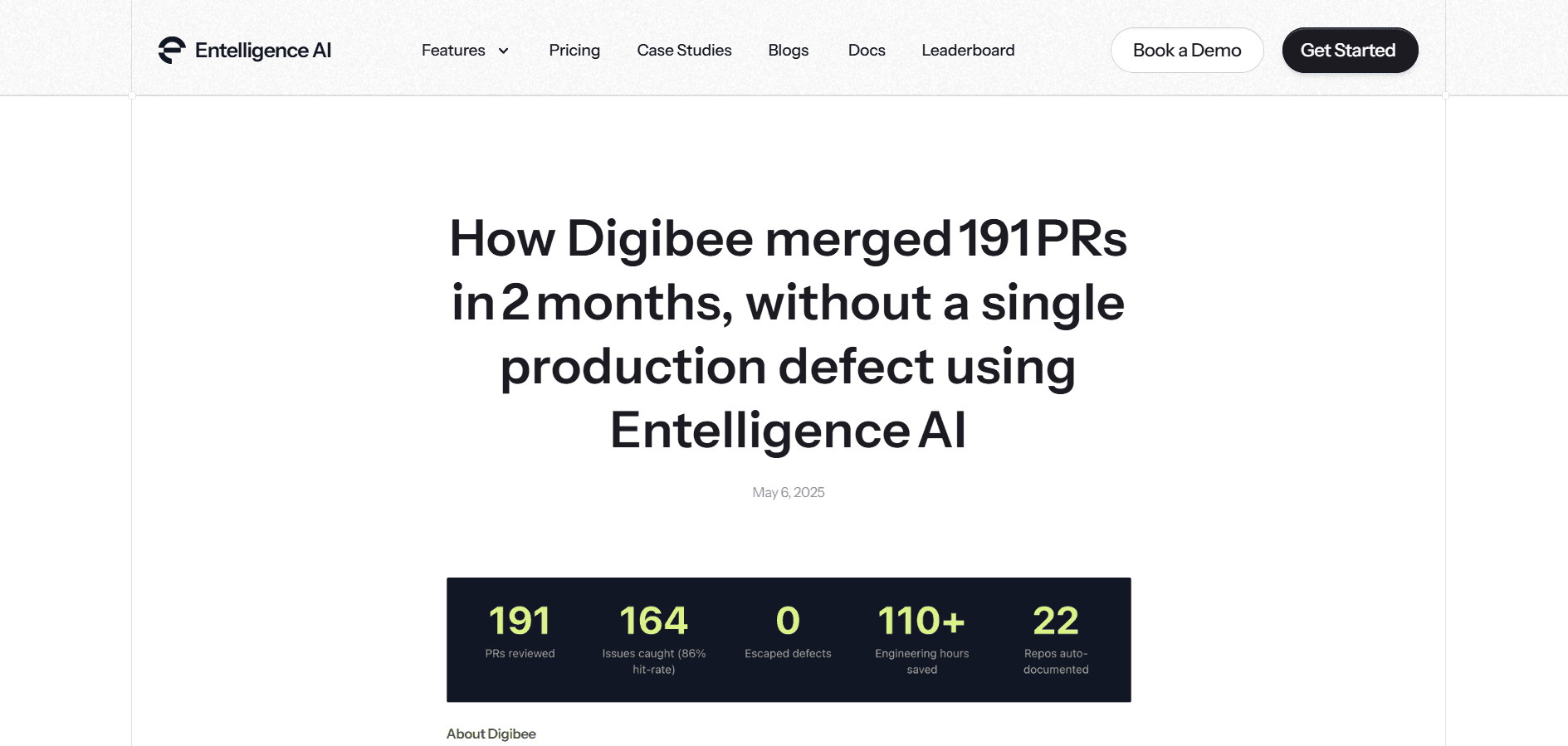
Digibee integrated Entelligence across all its GitLab repositories in under ten minutes. The AI tool added line-level reviews, refreshed documentation automatically, and provided a chat assistant for developer queries.
In just two months, it reviewed 191 merge requests.
It caught 164 real issues, helping avoid potential runtime problems.
The team saved over 110 engineering hours and documented 22 repositories automatically.
There were zero production incidents during this period.
2. SybillAI
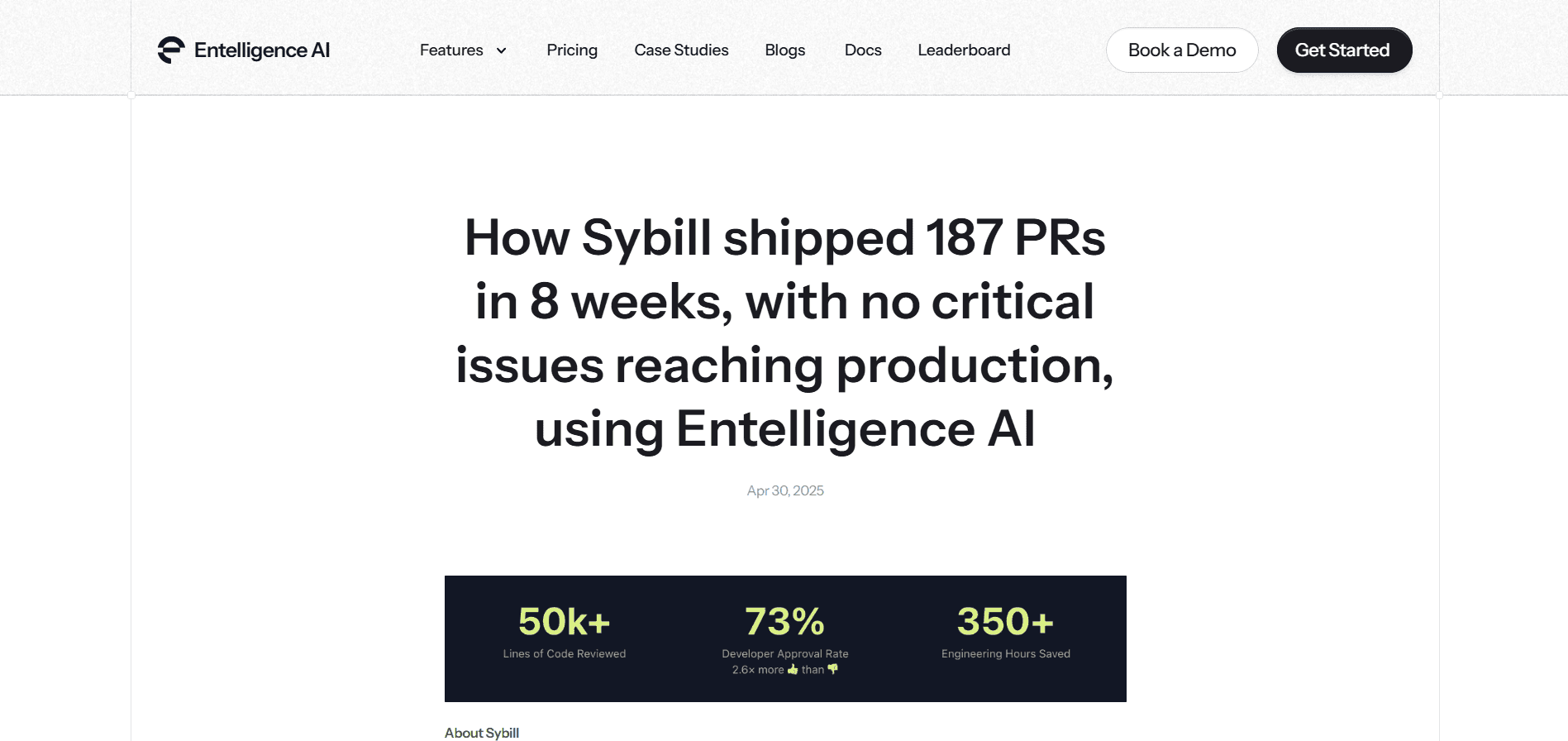
SybillAI needed a reliable way to scale code reviews without slowing down weekly feature releases.
After integrating Entelligence, the team shipped 187 pull requests in eight weeks.
The platform prevented five production-level bugs and saved around 350 engineering hours.
PR turnaround time dropped from a median of 5 hours 12 minutes to 1 hour 47 minutes, as Entelligence handled first-pass checks.
Developers reported that AI comments improved code review quality and reduced rework.
3. Composio
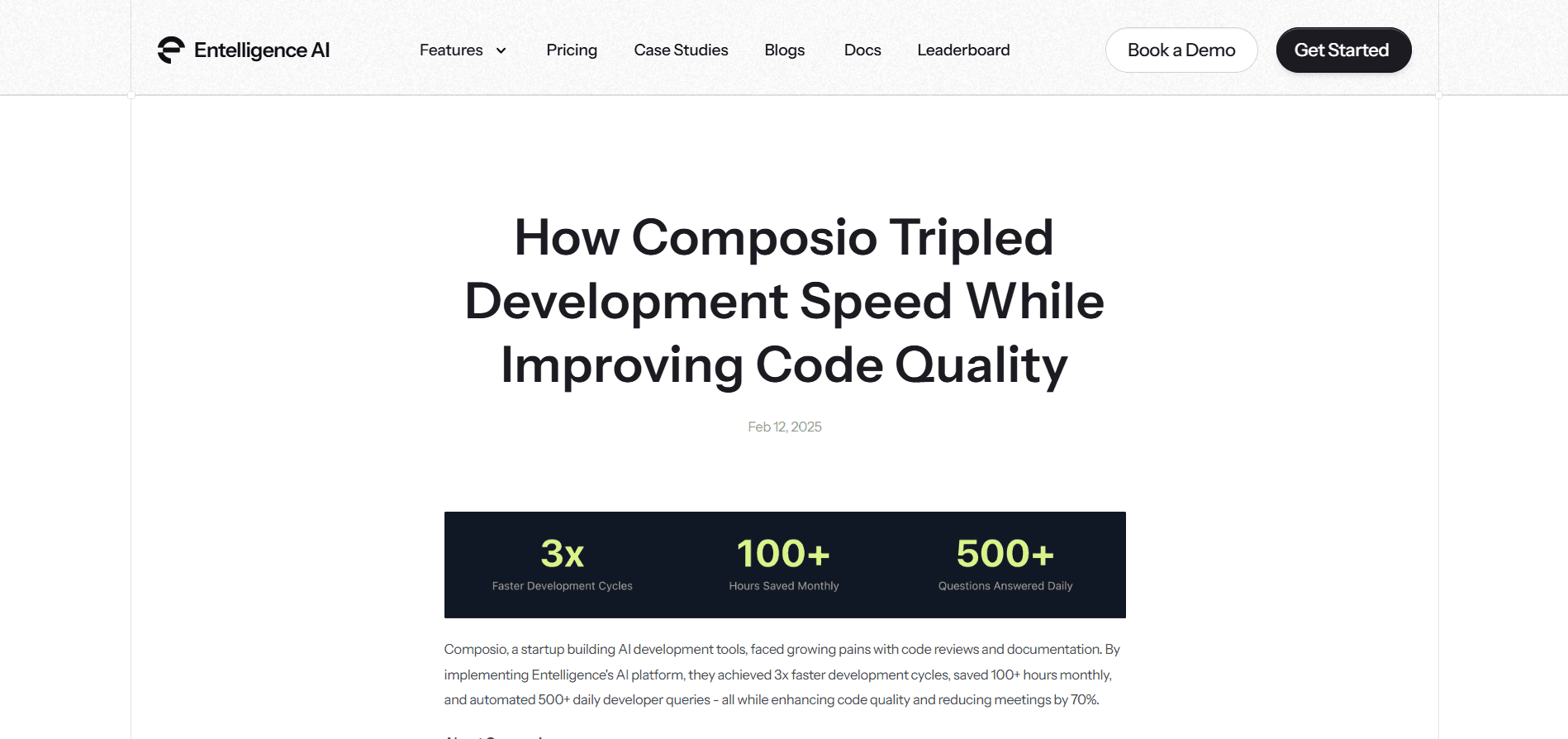
Composio, a startup building AI development tools, struggled with slow code reviews, repetitive questions, and lagging documentation. Entelligence transformed their workflow.
They achieved three times faster development cycles without sacrificing code quality.
The team saved more than 100 hours each month on code reviews and documentation.
Over 500 developer queries were automated daily through AI-powered documentation assistance.
Meeting overhead was reduced by approximately 70 percent due to fewer syncs.
4. Allocore
Allocore, a high-throughput financial infrastructure platform, improved its review process using Entelligence.
Entelligence reviewed 862 PRs and generated over 1,300 AI comments, uncovering subtle but important issues.
The team saved over 45 hours per month on reviews.
The company experienced zero security regressions, increasing confidence in code stability.
Key Insight
Across these companies, combining OKRs with AI-driven workflows helped engineering teams deliver higher quality, move faster, and free up time for strategic work. These case studies demonstrate that Entelligence supports individual productivity and scales impact across entire teams.
Seeing these results in action highlights the impact of combining OKRs with AI. Here’s how your team can replicate this success to achieve measurable goals faster.
Also Read: Introducing the Entelligence AI Code Review in Your IDE!
Maximize Your Software Engineering OKRs with Entelligence AI
Tracking and achieving OKRs can be tough without the right tools. Engineers often juggle code quality, deadlines, and collaboration, making it hard to stay aligned with team goals. Entelligence AI simplifies this process by automating key tasks and providing actionable insights.
Here’s how Entelligence AI helps your team hit OKRs faster:
AI-Powered PR Reviews: Automates code reviews, delivers precise feedback, and speeds up merges without compromising quality.
Real-Time OKR Tracking: Monitors progress on key results, highlights bottlenecks, and provides actionable metrics for better decision-making.
Automated Documentation: Keeps project documentation up-to-date effortlessly, saving time and reducing errors.
Collaboration Insights: Tracks team communication, identifies blockers, and improves workflow efficiency.
AI-Driven Sprint Optimization: Helps plan sprints, prioritize tasks, and track outcomes to improve team productivity.

With Entelligence AI, your engineering team can focus on delivering high-quality software, achieving measurable goals, and driving innovation, all while reducing manual work and improving efficiency.
Conclusion
Measuring software engineering performance goes beyond setting tasks; it requires a structured approach that values both results and process. By combining clear OKRs, measurable key results, and AI-driven insights, teams can continuously improve code quality, speed, and collaboration. They can also align their work with business goals and drive meaningful outcomes.
If you're ready to make your software development more focused and productive, see how Entelligence AI can help you set, track, and achieve your OKRs.
Why not give it a try? Start a free trial today and experience how our tools can transform your team’s performance.
FAQs
1. What Are OKRs for Software Engineers?
OKRs (Objectives and Key Results) help software engineers set clear goals, track progress, and align their daily work with team and company priorities. They turn broad ambitions into measurable outcomes, improving productivity and software quality.
2. How Do I Write Effective OKRs?
Start with a clear objective describing what you want to achieve, such as improving code quality or speeding up releases. Then define key results that are measurable, like reducing bugs by 20% or achieving 90% unit test coverage. Make them realistic and actionable.
3. How Often Should OKRs Be Reviewed?
Review OKRs weekly or biweekly to monitor progress, address blockers, and adjust priorities. Frequent reviews keep engineers aligned, motivated, and ensure projects stay on track.
4. Can AI Tools Help Track OKRs?
Yes. Tools like Entelligence automate performance tracking, provide real-time insights on code quality, and measure progress against key results, letting engineers focus more on coding and less on manual reporting.
5. What Makes an OKR Successful for Software Engineers?
A successful OKR is clear, measurable, and time-bound. It aligns with team goals, drives meaningful results, and balances speed with quality. Tracking real metrics ensures progress is visible and decisions are data-driven.
Keeping software engineering teams aligned with company goals is often a challenge, especially when juggling multiple projects and tight deadlines. Without the right framework, key priorities can easily get lost.
This is where OKRs (Objectives and Key Results) come in. OKRs help software engineers focus on what matters most, track progress, and ensure their work supports broader business objectives.
The impact of OKRs is clear: organizations that implement them effectively report higher productivity and better alignment across teams. In fact, the global OKR software market is projected to reach $2.98 billion by 2029, growing at a CAGR of 16.9%, showing how essential these tools have become for driving team performance.
In this blog, we’ll share 25 practical OKR examples for software engineers, giving you actionable objectives and key results that help you achieve measurable impact in 2026.
Key Takeaways:
OKRs help software engineers stay focused on the most important tasks while ensuring their work aligns with company goals.
Measurable Key Results make it easy to track progress and evaluate the impact of engineering efforts.
Using OKRs allows teams to maintain a balance between fast delivery and high-quality software.
AI tools like Entelligence support engineers by automating repetitive tasks and improving overall productivity.
Regular tracking, reviews, and cross-team collaboration ensure that OKRs remain relevant and drive meaningful results.
Why OKRs Matter for Software Engineers?
Software engineers often juggle many tasks, from writing code to fixing bugs and meeting deadlines. OKRs (Objectives and Key Results) give a clear plan to focus on the most important work, track progress, and achieve real results. They help teams stay organized, work efficiently, and improve continuously.
Here’s why OKRs are useful for software engineers:
Stay Focused: Make sure daily tasks help the team and company goals.
Measure Progress: Use numbers and metrics to see real impact.
Balance Speed and Quality: Deliver work quickly without compromising on correctness.
Encourage Innovation: Set aside time to try new tools, ideas, or technologies.
Work Smarter as a Team: Reduce repetitive tasks, long manual reviews, and delays.
Use AI for Support: Tools like Entelligence automate reviews, create documentation, and give useful insights to improve productivity.
With OKRs, engineers can clearly see what matters, track results, and keep improving while supporting the team’s success.

Understanding the value of OKRs is only the first step. The real difference comes from creating objectives and key results that are specific, measurable, and aligned with your team’s priorities.
How can software engineering teams develop effective OKRs?
Creating impactful OKRs in software engineering is about aligning daily work with measurable outcomes, improving team efficiency, and driving business impact. Using AI-powered tools like Entelligence AI makes this process more precise, data-driven, and actionable.

Step 1: Define Clear Objectives
Objectives should be specific, actionable, and tightly aligned with both team and company priorities. Avoid vague statements that do not clearly indicate what success looks like.
Weak objective: “Improve software quality”
Strong objective: “Reduce customer-reported bugs to improve product stability”
Clear objectives provide direction and focus, ensuring everyone understands what they are working toward and why it matters.
Step 2: Define Measurable Key Results
Key Results turn objectives into quantifiable targets. They provide concrete evidence of progress and help track the impact of team efforts.
Example for the objective above:
KR1: Reduce customer-reported bugs by 50% in the next quarter
KR2: Achieve a 95% customer satisfaction rating for product quality
Using measurable KRs ensures that outcomes are tracked objectively rather than relying on subjective impressions. AI tools can automatically collect metrics, highlight bottlenecks, and track improvements across multiple repositories and teams.
Step 3: Track, Review, and Iterate
Setting OKRs is only the first step. Continuous monitoring, review, and iteration are essential for success. Dashboards and analytics from AI-powered platforms allow teams to visualize progress in real time, detect patterns, and adjust priorities dynamically.
Regular code review cycles help identify roadblocks, optimize workflows, and celebrate milestones.
Iterating on OKRs ensures they remain aligned with changing project requirements, business goals, and team capacity.
By following these steps and leveraging AI-driven insights, software engineering teams can focus on delivering high-quality, reliable software while maintaining speed, efficiency, and innovation.
Now that we know how to set effective OKRs, let’s look at practical examples specifically designed for software engineers, these will help you apply the framework in real-world scenarios.
25 Practical OKR Examples for Software Engineers
In modern software engineering, aligning team activities with measurable goals is critical. OKRs (Objectives and Key Results) help engineers prioritize tasks, improve efficiency, and maintain high-quality standards while delivering business value.
The following 25 OKRs are designed to address key areas of software development, from quality and collaboration to innovation and security, along with actionable insights for implementation
1. Deliver High-Quality Software Products
Ensuring software is reliable and bug-free is essential for user satisfaction and long-term success. By focusing on test coverage and QA success rates, teams can detect issues early and reduce costly rework.
Objective: To build software features that are reliable, thoroughly tested, and free from critical bugs, ensuring a smooth experience for users.
Key Results:
Achieve 95% unit test coverage to detect errors early and prevent issues from reaching production.
Reduce production bugs by 20% to enhance overall software stability and maintain user trust.
Ensure that 90% of features pass QA on the first attempt, minimizing rework and accelerating delivery.
Case Study Insight: Allocore flagged 862 PRs, saving over 45 hours per month while maintaining zero security regressions, illustrating how early detection improves team efficiency.
2. Eliminate Technical Debt
Technical debt can significantly slow down development, increase maintenance overhead, and introduce hidden risks into your codebase. Addressing technical debt proactively helps ensure long-term stability, maintainability, and efficiency.
By prioritizing refactoring and resolving high-priority issues, engineering teams can reduce recurring problems and improve overall productivity.
Objective: Reduce fragile code and refactor legacy systems to make the codebase more robust, maintainable, and easier to enhance in the future.
Key Results:
Refactor 30% of core modules to improve maintainability and reduce potential bugs.
Close all high-priority technical debt tickets to prevent recurring issues and streamline development workflows.
3. Optimize Resource Allocation
Efficient allocation of developer time and system resources is crucial for maintaining high productivity and ensuring teams focus on tasks that deliver the most value.
By minimizing time spent on repetitive or low-impact activities, engineering teams can dedicate more effort to innovation and critical features, improving overall throughput and output.
Objective: Enhance developer efficiency and maximize system throughput by optimizing workflows and reducing bottlenecks in the software development process.
Key Results:
Reduce the average build time by 25%, enabling faster iteration cycles and quicker delivery of features.
Automate three repetitive DevOps workflows to save engineering time and reduce manual errors, allowing the team to focus on high-priority tasks.
4. Empower Teams with AI Tools
Using AI tools can significantly enhance team productivity, reduce human errors, and streamline documentation processes.
By integrating AI into daily workflows, engineers can focus more on innovation and high-impact development tasks rather than repetitive manual work.
Objective: Empower the engineering team to maximize productivity and efficiency by adopting AI-driven tools that improve code quality and documentation.
Key Results:
Ensure that 80% of pull requests incorporate Entelligence AI suggestions, thereby improving code quality and reducing post-merge issues.
Generate automated documentation for 50% of code updates to maintain clarity, consistency, and easy access to technical knowledge.

5. Balance Speed with Quality
Delivering features quickly is important, but it should never come at the cost of quality. Maintaining the right balance between speed and correctness ensures that software is reliable and users remain satisfied. It also helps teams meet deadlines without compromising on standards.
Objective: Ensure features are delivered quickly while maintaining high quality and correctness.
Key Results:
Achieve 90% of sprint goals to consistently meet project deadlines and planned commitments.
Keep the defect escape rate below 2% to reduce issues that reach production and affect users.
Provide pull request (PR) feedback within an average of 24 hours to maintain a smooth development flow and prevent bottlenecks.
6. Enhance Testing and Quality Assurance
Effective quality assurance practices help prevent software defects from reaching production, improve reliability, and build trust with users. By combining automation with regular audits, teams can maintain high standards and deliver better software consistently.
Objective: Focus on raising the overall reliability of the software so that it performs as expected and meets quality standards.
Key Results:
Automate 70% of regression tests to reduce manual effort and save time for the QA team.
Reduce the failed test rate by 30% to ensure that new code changes are stable and reliable.
Conduct monthly code quality audits to continuously enforce standards and identify areas for improvement.
7. Optimize Product Development
Predictable product delivery is essential for keeping projects on track, maintaining stakeholder trust, and consistently delivering value. By improving processes and removing bottlenecks, teams can achieve smoother and more reliable development cycles.
Objective: Ensure that features are delivered on time and according to planned specifications, so the development process becomes more predictable and efficient.
Key Results:
Reduce the overall cycle time by 20%, allowing features to be released faster without compromising quality.
Complete all action items identified during retrospectives, addressing recurring bottlenecks that slow down the team.
Make sure that every feature meets the agreed-upon “Definition of Done,” ensuring consistent quality and readiness for release.
8. Streamline CI/CD Pipeline
Having a smooth CI/CD (Continuous Integration/Continuous Deployment) pipeline helps teams release software more quickly and safely. It reduces errors, ensures updates are reliable, and speeds up the overall development process.
Objective: The goal is to make software deployments faster while keeping them safe and reliable.
Key Results:
Reduce deployment failures by 15% so that releases are more dependable and fewer issues reach users.
Automate rollback procedures to quickly fix problems if a release causes errors.
Reduce build time by 25% to allow faster delivery of updates and features.
9. Amplify DevOps Automation
In modern software development, repetitive DevOps tasks can slow down teams and introduce errors. By automating these processes, teams can work more efficiently, reduce mistakes, and focus on strategic, high-value work.
Objective: Simplify DevOps workflows by reducing manual tasks and improving automation, ensuring faster and more reliable operations.
Key Results:
Automate three critical server-monitoring jobs to proactively detect and prevent issues before they impact the system.
Implement alerts for 90% of critical incidents to guarantee rapid response and minimize downtime.
Reduce manual deployment steps by 40% to ensure consistent, repeatable, and faster software releases.
10. Lead Software Development Productivity
Improving the productivity of your software development team helps ensure that projects are completed on time, resources are used effectively, and overall business goals are met consistently.
By focusing on measurable outcomes, teams can identify bottlenecks and improve efficiency.
Objective: Improve the team’s overall throughput so that tasks are completed faster and more efficiently.
Key Results:
Increase the number of pull requests (PRs) closed by 20% to reduce backlog and keep development moving smoothly.
Maintain 95% on-time delivery of tasks and projects to meet team and stakeholder commitments reliably.
Reduce the average review time by 30% so developers can move from one task to the next more efficiently.
Also Read: Introducing Entelligence Engineering Leaderboard: a real time scoreboard for developers
11. Enhance Manual Testing Effectiveness
While automated tests cover most scenarios, manual testing is essential for catching issues that automation might miss. By focusing on consistency and thorough bug detection, teams can ensure higher software reliability and better user experiences.
Objective: Strengthen the quality and impact of manual testing to identify issues early and improve product stability.
Key Results:
Detect 25% more bugs than the previous quarter, ensuring critical issues are caught before release.
Standardize test case templates so all testers follow the same process, reducing errors and improving coverage.
12. Implement Robust Automated Testing
Automation plays a key role in improving the reliability of testing, saving time, and catching issues early across all stages of software development. By setting clear goals for automation, teams can ensure higher-quality releases and reduce manual effort.
Objective: Strengthen automation in the testing process to make it more reliable, consistent, and efficient.
Key Results:
Ensure that 90% of automated tests pass successfully, confirming that the software behaves as expected.
Run automated tests on every code commit so that issues are detected immediately and can be fixed early.
Automate critical end-to-end workflows to make the QA process faster, more consistent, and less error-prone.
13. Improve Developer Platform & Tools
Optimizing the developer platform and tools helps engineers work more efficiently, spend less time on setup, and focus on building high-quality software. A smooth, reliable platform ensures that daily tasks are faster and less frustrating, which directly improves productivity.
Objective: Make engineers’ workflow smoother by providing reliable tools and platforms that reduce manual effort and setup time.
Key Results:
Integrate with the help of Entelligence AI across all repositories so that engineers have consistent support and insights while coding.
Reduce onboarding setup time by 50% so new team members can start contributing faster.
Maintain 95% platform uptime to ensure engineers can work without interruptions or delays.
14. Elevate User Experience
Focusing on user experience ensures that your software is enjoyable, reliable, and meets the needs of its users. A strong UX increases engagement, encourages users to keep using your product, and reduces frustration or churn.
Objective: The goal is to build software that delights users and provides a smooth, reliable experience.
Key Results:
Reduce the crash rate by 20% to make the software more stable and dependable.
Achieve 90% positive user feedback, ensuring that most users are satisfied with their experience.
Resolve high-impact bugs within 48 hours so that critical issues are fixed quickly and do not disrupt the user experience.
15. Develop Effective Project Portfolio Software
Centralizing project information helps teams stay aligned with organizational goals and make better decisions. By tracking progress in one place, teams can quickly identify bottlenecks, prioritize tasks, and ensure projects move forward smoothly.
Objective: Improve project visibility so that teams can see the status of all ongoing projects and make informed decisions.
Key Results:
Create unified dashboards that show progress across all projects, making it easier to monitor and manage work.
Publish weekly updates to keep everyone informed and maintain transparency across teams.
Ensure that 90% of deliverables are aligned with product OKRs so that all projects contribute directly to company goals.
16. Improve Release Predictability
Reliable software releases are critical for maintaining stakeholder trust, reducing emergency fixes, and ensuring smooth planning for development teams.
When release schedules are predictable, teams can focus on quality, avoid last-minute firefighting, and deliver consistent value.
Objective: Ensure that every software release happens as planned and meets the expected quality standards.
Key Results:
Deliver 95% of planned releases on schedule, ensuring timelines are respected and stakeholders stay confident.
Reduce emergency hotfixes by 30%, preventing disruptions and maintaining system stability.
17. Reduce System Downtime
High uptime is essential for keeping customers happy, ensuring smooth business operations, and preventing revenue loss. Minimizing downtime allows teams to maintain trust and deliver reliable services consistently.
Objective: Improve the stability of the platform so that it runs smoothly and reliably for all users.
Key Results:
Maintain 99.9% uptime for all critical services to ensure minimal interruptions.
Resolve at least 90% of incidents within the agreed Service Level Agreement (SLA) to restore functionality quickly.
18. Promote Cross-Functional Collaboration
Collaboration across teams helps break down silos, encourages faster problem-solving, and ensures everyone works toward the same goals.
Building strong cross-functional connections improves communication, reduces delays, and aligns efforts toward delivering better products.
Objective: Work closely with different teams to remove communication barriers and ensure smooth collaboration across the organization.
Key Results:
Hold weekly sync meetings with at least 90% attendance to keep all teams aligned and informed.
Resolve or unblock 100% of issues within 24 hours to maintain workflow and prevent bottlenecks.
19. Increase Code Review Efficiency
Efficient code reviews are crucial for maintaining software quality while ensuring that development does not slow down. By improving the speed and consistency of code reviews, teams can reduce delays and prevent bottlenecks in the delivery process.
Objective: The goal is to complete code reviews faster without compromising the quality of feedback or missing critical issues.
Key Results:
Ensure that all pull request (PR) reviews are completed within 24 hours to keep development moving smoothly.
Maintain 95% adherence to the review checklist so that all essential quality checks are consistently followed.
Also Read: How AI Transforms Code Comments and Documentation?
20. Optimize Incident Response
Quickly identifying and addressing production issues is crucial to keeping systems running smoothly and maintaining a positive user experience.
Objective: Ensure production issues are detected and resolved as quickly as possible to reduce downtime and maintain service reliability.
Key Results:
Reduce incident detection time by 30% to catch issues earlier and prevent escalation.
Shorten incident resolution time by 40% to restore services promptly and minimize impact on users.
21. Innovate with New Technologies
Experimenting with new technologies helps software teams stay competitive and explore better ways of building products. At the same time, it is important to adopt these tools safely so they don’t disrupt ongoing development or introduce unnecessary risks.
Objective: Adopt new technologies safely to improve team capabilities and product innovation.
Key Results:
Pilot one new AI-driven feature every quarter to test and learn from emerging technologies.
Trial two new development frameworks each fiscal year to identify tools that improve efficiency and quality.
22. Enhance Mobile Application Performance
Optimizing the performance of mobile applications is essential for keeping users satisfied and engaged. Faster, more stable apps reduce frustration, increase usage, and encourage users to return more often.
Objective: Improve the speed and reliability of mobile apps so that users have a smooth and enjoyable experience.
Key Results:
Reduce the app’s load time by 25% to ensure users can access content quickly.
Fix 90% of reported crashes to increase stability and prevent disruptions for users.
23. Improve Customer Onboarding Flow
A smooth and easy onboarding process helps users start using your product quickly, allowing them to experience its value without confusion or delays. Simplifying this process increases user adoption, engagement, and satisfaction.
Objective: Make the initial user experience simple and seamless for all new customers.
Key Results:
Reduce the time it takes for a new user to complete onboarding by 30%, so they can start using the product faster.
Ensure that 90% of users successfully complete all onboarding tasks, providing a clear and guided experience.
24. Advance API Performance
APIs are the backbone of modern software, enabling different systems to communicate smoothly. Fast and reliable APIs ensure seamless integrations, better scalability, and an overall improved user experience. To achieve this, setting clear objectives and measurable key results is essential.
Objective: Ensure that APIs perform reliably and efficiently at all times, providing fast responses and minimizing downtime for users and connected systems.
Key Results:
Maintain 99% API uptime to guarantee consistent availability for all users and integrated services.
Reduce average API response time by 20% to make data access faster and improve overall system performance.
Resolve any API bugs within 24 hours to prevent disruptions and maintain seamless operations.
25. Strengthen Security Practices
Strong security practices are essential for protecting user data, safeguarding intellectual property, and ensuring compliance with internal policies and regulations.
Effective security measures also help prevent potential breaches that can disrupt development and harm the organization’s reputation.
Objective: The goal is to protect both the software code and all sensitive data from security risks.
Key Results:
Patch all critical vulnerabilities to eliminate potential security threats.
Ensure 100% compliance with internal security standards to maintain a secure development environment.
These examples show what strong OKRs look like in practice. Next, we’ll explore real-world case studies that demonstrate how teams achieved results using OKRs paired with AI tools like Entelligence.
How Engineering Teams Achieved Results Using Entelligence AI?
Here are some powerful examples of how engineering teams used OKRs alongside Entelligence AI to improve quality, speed, and collaboration.
1. Digibee

Digibee integrated Entelligence across all its GitLab repositories in under ten minutes. The AI tool added line-level reviews, refreshed documentation automatically, and provided a chat assistant for developer queries.
In just two months, it reviewed 191 merge requests.
It caught 164 real issues, helping avoid potential runtime problems.
The team saved over 110 engineering hours and documented 22 repositories automatically.
There were zero production incidents during this period.
2. SybillAI

SybillAI needed a reliable way to scale code reviews without slowing down weekly feature releases.
After integrating Entelligence, the team shipped 187 pull requests in eight weeks.
The platform prevented five production-level bugs and saved around 350 engineering hours.
PR turnaround time dropped from a median of 5 hours 12 minutes to 1 hour 47 minutes, as Entelligence handled first-pass checks.
Developers reported that AI comments improved code review quality and reduced rework.
3. Composio

Composio, a startup building AI development tools, struggled with slow code reviews, repetitive questions, and lagging documentation. Entelligence transformed their workflow.
They achieved three times faster development cycles without sacrificing code quality.
The team saved more than 100 hours each month on code reviews and documentation.
Over 500 developer queries were automated daily through AI-powered documentation assistance.
Meeting overhead was reduced by approximately 70 percent due to fewer syncs.
4. Allocore
Allocore, a high-throughput financial infrastructure platform, improved its review process using Entelligence.
Entelligence reviewed 862 PRs and generated over 1,300 AI comments, uncovering subtle but important issues.
The team saved over 45 hours per month on reviews.
The company experienced zero security regressions, increasing confidence in code stability.
Key Insight
Across these companies, combining OKRs with AI-driven workflows helped engineering teams deliver higher quality, move faster, and free up time for strategic work. These case studies demonstrate that Entelligence supports individual productivity and scales impact across entire teams.
Seeing these results in action highlights the impact of combining OKRs with AI. Here’s how your team can replicate this success to achieve measurable goals faster.
Also Read: Introducing the Entelligence AI Code Review in Your IDE!
Maximize Your Software Engineering OKRs with Entelligence AI
Tracking and achieving OKRs can be tough without the right tools. Engineers often juggle code quality, deadlines, and collaboration, making it hard to stay aligned with team goals. Entelligence AI simplifies this process by automating key tasks and providing actionable insights.
Here’s how Entelligence AI helps your team hit OKRs faster:
AI-Powered PR Reviews: Automates code reviews, delivers precise feedback, and speeds up merges without compromising quality.
Real-Time OKR Tracking: Monitors progress on key results, highlights bottlenecks, and provides actionable metrics for better decision-making.
Automated Documentation: Keeps project documentation up-to-date effortlessly, saving time and reducing errors.
Collaboration Insights: Tracks team communication, identifies blockers, and improves workflow efficiency.
AI-Driven Sprint Optimization: Helps plan sprints, prioritize tasks, and track outcomes to improve team productivity.

With Entelligence AI, your engineering team can focus on delivering high-quality software, achieving measurable goals, and driving innovation, all while reducing manual work and improving efficiency.
Conclusion
Measuring software engineering performance goes beyond setting tasks; it requires a structured approach that values both results and process. By combining clear OKRs, measurable key results, and AI-driven insights, teams can continuously improve code quality, speed, and collaboration. They can also align their work with business goals and drive meaningful outcomes.
If you're ready to make your software development more focused and productive, see how Entelligence AI can help you set, track, and achieve your OKRs.
Why not give it a try? Start a free trial today and experience how our tools can transform your team’s performance.
FAQs
1. What Are OKRs for Software Engineers?
OKRs (Objectives and Key Results) help software engineers set clear goals, track progress, and align their daily work with team and company priorities. They turn broad ambitions into measurable outcomes, improving productivity and software quality.
2. How Do I Write Effective OKRs?
Start with a clear objective describing what you want to achieve, such as improving code quality or speeding up releases. Then define key results that are measurable, like reducing bugs by 20% or achieving 90% unit test coverage. Make them realistic and actionable.
3. How Often Should OKRs Be Reviewed?
Review OKRs weekly or biweekly to monitor progress, address blockers, and adjust priorities. Frequent reviews keep engineers aligned, motivated, and ensure projects stay on track.
4. Can AI Tools Help Track OKRs?
Yes. Tools like Entelligence automate performance tracking, provide real-time insights on code quality, and measure progress against key results, letting engineers focus more on coding and less on manual reporting.
5. What Makes an OKR Successful for Software Engineers?
A successful OKR is clear, measurable, and time-bound. It aligns with team goals, drives meaningful results, and balances speed with quality. Tracking real metrics ensures progress is visible and decisions are data-driven.
Your questions,
Your questions,
Decoded
Decoded
What makes Entelligence different?
Unlike tools that just flag issues, Entelligence understands context — detecting, explaining, and fixing problems while aligning with product goals and team standards.
Does it replace human reviewers?
No. It amplifies them. Entelligence handles repetitive checks so engineers can focus on architecture, logic, and innovation.
What tools does it integrate with?
It fits right into your workflow — GitHub, GitLab, Jira, Linear, Slack, and more. No setup friction, no context switching.
How secure is my code?
Your code never leaves your environment. Entelligence uses encrypted processing and complies with top industry standards like SOC 2 and HIPAA.
Who is it built for?
Fast-growing engineering teams that want to scale quality, security, and velocity without adding more manual reviews or overhead.

What makes Entelligence different?
Does it replace human reviewers?
What tools does it integrate with?
How secure is my code?
Who is it built for?


