

How to Measure Technical Debt: Types, Key Metrics, & Tools
Dec 12, 2025
Dec 12, 2025
When was the last time you confidently answered how much technical debt your team carries? Industry data shows that close to 40% of infrastructure setups struggle with technical debt issues. Your organization likely deals with similar challenges, where debt silently slows delivery and increases maintenance costs.
Without measurement, you can't prove how much debt costs or where to focus your efforts. Quality conversations turn into vague debates instead of data-driven decisions about what needs fixing.
In this guide, we show you exactly how to measure technical debt using the right metrics and tools, and track your improvements over time.
Key Takeaways
Technical debt accumulates from quick fixes and shortcuts that save time upfront but create ongoing maintenance costs that slow every future change.
Measuring debt transforms abstract quality concerns into concrete metrics that prove to stakeholders exactly how much velocity your team loses each sprint.
Code complexity metrics identify fragile modules where bugs hide, while code churn shows which files your team touches most and where debt hurts daily.
Developer surveys capture pain that automated tools miss, revealing which modules frustrate engineers even when metrics look acceptable on dashboards.
Tracking debt trends monthly proves whether your refactoring efforts actually work or if new problems arrive faster than you can fix them.
What is Technical Debt?
Technical debt is the cost of rework incurred by choosing faster solutions now rather than better approaches that would take more time upfront. Every codebase accumulates some debt.
Quick fixes to meet deadlines, outdated dependencies, duplicate code across services, or poorly documented functions all create debt. The problem isn't that debt exists, but it's when you don't know how much you have or where it concentrates.
Measuring technical debt makes this invisible problem visible. You can track which parts of your codebase carry the most risk, quantify costs in velocity and stability, and make evidence-based decisions about what to refactor.
Why Measuring Technical Debt Matters
Most engineering teams know they have technical debt. What they don't have is a way to prove how much it costs or where to focus their efforts. Here's why measurement changes everything:
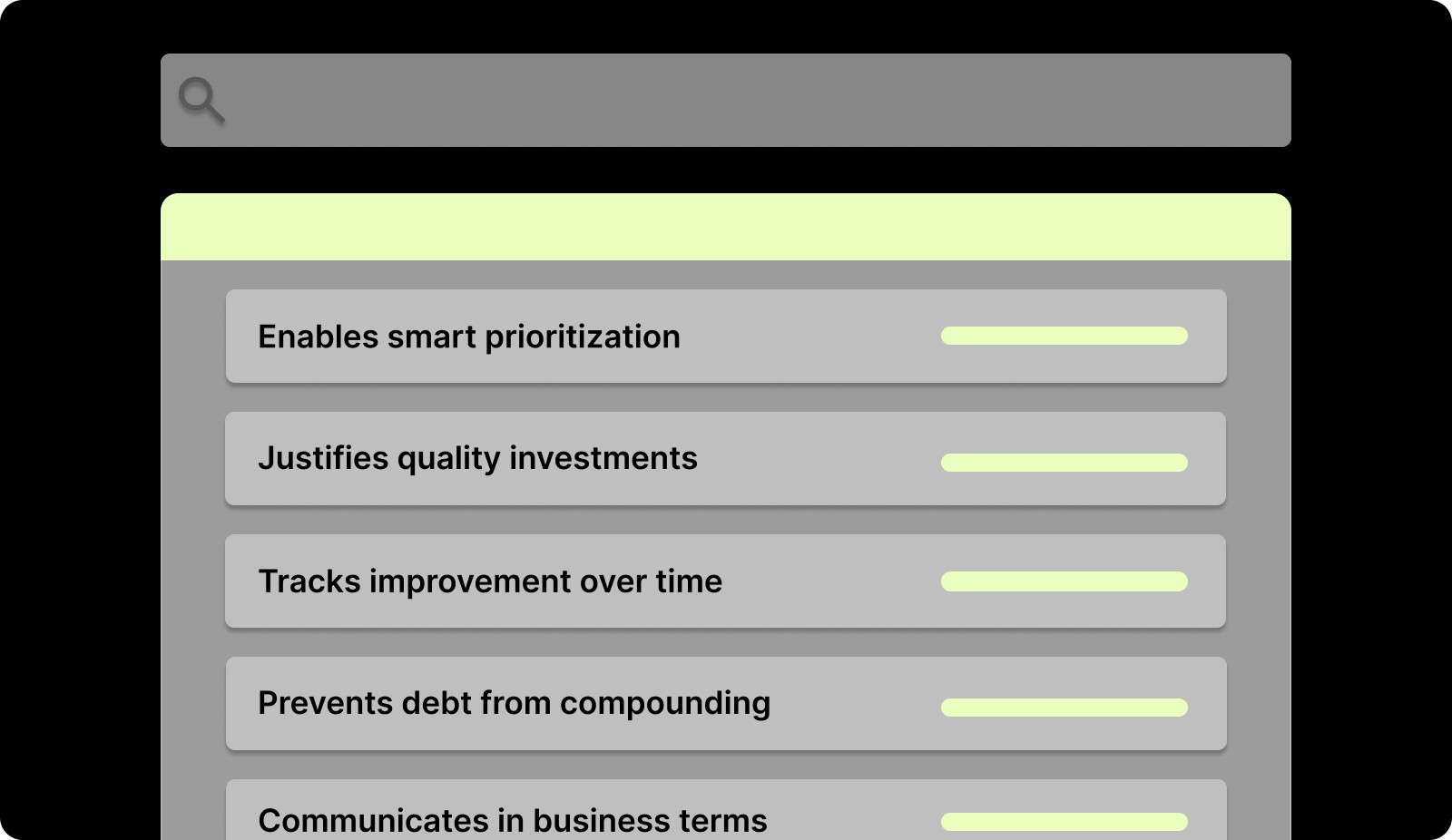
Enables smart prioritization: Shows which debt hotspots slow your team the most, so you can focus refactoring where it delivers the biggest velocity gains instead of random cleanup.
Justifies quality investments: Gives you data to prove to stakeholders that debt reduction will improve delivery speed and reduce incidents, not just make developers happier.
Tracks improvement over time: Shows whether your refactoring efforts are working or if debt is compounding faster than you can address problems.
Prevents debt from compounding: Quality gates catch new debt before it merges, stopping the problem from growing while you work on existing issues.
Communicates in business terms: Translates technical problems into maintenance costs, delivery delays, and velocity loss that non-technical leaders understand.
Without measurement, debt conversations turn into vague debates about code quality versus anecdotes about painful refactors. With measurement, you have objective data to answer critical questions about where you are and where you need to focus.
Different Types of Technical Debt
Technical debt shows up in different forms across your codebase. Knowing the types helps you identify what you're measuring and where to focus your reduction efforts. Here's how different types of debt compare:
Type | Cause | Impact | Detection Method |
Deliberate debt | Conscious shortcuts to meet deadlines | Planned rework, usually documented | Code comments, issue tracker |
Accidental debt | Lack of knowledge or experience | Unplanned maintenance burden | Code reviews, complexity metrics |
Architectural debt | Outdated design decisions | Slows all future changes | System analysis, churn patterns |
Code debt | Poor implementation quality | Bugs, slow reviews, fragile changes | Static analysis, complexity tools |
Documentation debt | Missing or outdated docs | Slow onboarding, knowledge silos | Manual review, developer surveys |
Test debt | Low or missing test coverage | Risky changes, more bugs in production | Coverage reports, quality gates |
Different debt types require different measurement approaches and remediation strategies.
1. Deliberate Debt
Deliberate debt happens when teams consciously choose speed over quality to hit a deadline. You skip writing tests, hard-code a value, or implement a quick workaround instead of the proper solution.
For example, a team might disable a failing test to deploy a critical bug fix, planning to fix the test later. This debt is often documented and tracked but frequently gets deprioritized as new work arrives.
2. Accidental Debt
Accidental debt accumulates when developers don't know better patterns or make mistakes during implementation. Code that seemed fine when written turns out to create maintenance problems later.
For instance, a junior engineer might write deeply nested conditionals that work correctly but are hard for others to modify. The debt wasn't intentional but still costs the team time.
3. Architectural Debt
Architectural debt results from design decisions that made sense initially but don't scale as requirements change. Monolithic architectures that need to become microservices or databases that can't handle current load are common examples.
Architectural debt is the most expensive to fix because it affects multiple components. Measuring it requires analyzing system dependencies and change patterns across services.
4. Code Debt
Code debt includes duplicate code, high complexity, poor naming, and other implementation quality issues. Static analysis tools excel at detecting this type of debt through complexity metrics and code smell detection.
Code debt slows every engineer who touches the affected files. A module with cyclomatic complexity of 40 takes longer to understand, test, and modify safely.
5. Documentation Debt
Documentation debt happens when documentation doesn't exist, is outdated, or lives only in developer heads. New engineers spend weeks getting up to speed, and knowledge transfer becomes a bottleneck.
For example, if your authentication flow changed six months ago but the architecture docs still show the old design, every new engineer wastes time learning the wrong system first.
6. Test Debt
Test debt is code without adequate test coverage. Changes become risky because you can't verify that you didn't break anything, leading to more manual testing and more bugs reaching production.
Test debt is measurable through coverage metrics and particularly dangerous in high-churn areas where a lack of tests means every change carries significant risk.
Key Metrics for Measuring Technical Debt
No single metric tells the complete story. Combining automated metrics that track code quality with qualitative signals that capture team pain gives you a clear picture. Here's how the most useful metrics compare:
Metric | What It Measures | Best For | Update Frequency |
Technical Debt Ratio (TDR) | Remediation cost vs. development cost | Overall codebase health trends | Monthly or quarterly |
Code Complexity | Execution paths and cognitive load | Identifying fragile code areas | Continuous via CI/CD |
Code Churn | Frequency of file changes | Finding high-impact debt zones | Weekly or sprint-based |
DORA Metrics | Lead time and change failure rate | Delivery velocity impact | Continuous via CI/CD |
Test Coverage | Percentage of code with tests | Risk assessment and quality gates | Continuous via CI/CD |
Developer Surveys | Team perception of codebase health | Qualitative pain points | Quarterly |
Each metric reveals different aspects of technical debt and how it affects your team. Let’s take a detailed look at each one of them.
1. Technical Debt Ratio (TDR)
Technical Debt Ratio is the cost to fix maintainability issues divided by the original cost to develop the code. It gives you a percentage that represents how much remediation work exists relative to your codebase size.
Tips to measure TDR:
Use static analysis tools: SonarQube or CodeScene can analyze your codebase and estimate remediation effort based on code smells and complexity issues.
Track over time: Compare your ratio monthly or quarterly to see if debt is growing or shrinking relative to previous periods.
Baseline first: Run your first scan to establish a starting point, then measure progress from there as you address issues.
2. Code Complexity Metrics
Cyclomatic complexity counts the number of independent paths through code. More paths mean more testing scenarios and more places for bugs to hide.
The cognitive complexity measures how hard code is for humans to understand, accounting for nested logic and control flow. High complexity scores indicate technical debt hotspots.
Tips to track complexity:
Automate in CI/CD: Configure static analysis tools to scan your codebase during every build and flag functions exceeding your thresholds.
Set meaningful limits: Define complexity thresholds that work for your team, like flagging functions with cyclomatic complexity above 10 or 15.
Focus on hotspots: Prioritize reviewing files that show both high complexity scores and frequent changes in your recent commit history.
3. Code Churn and Behavioral Analysis
Code churn tracks how frequently files or modules change. High churn areas are where your team works most often, which means debt in those areas slows you down daily.
Behavioral code analysis combines churn with complexity to identify critical hotspots. Files with both high complexity and high churn are your biggest sources of technical debt impact.
Tips for measuring churn patterns:
Pull from version control: Analyze your git commit history over the past three to six months to see which files change most frequently.
Cross-reference with complexity: Overlay churn data with complexity metrics to find files that are both messy and frequently modified by your team.
Visualize hotspots: Use tools like CodeScene that create visual heat maps showing where high churn and high complexity intersect in your codebase.
4. Velocity and Delivery Metrics
Technical debt slows your ability to ship. The lead time for changes measures how long it takes from code commit to production deployment.
Change Failure Rate (CFR) shows what percentage of production changes cause incidents or require immediate fixes. High-debt areas typically have higher CFRs because the code is fragile and poorly understood.
Tips for tracking delivery impact:
Extract from CI/CD: Pull lead time, deployment frequency, and change failure rate directly from your existing pipeline and deployment tools.
Correlate with services: Map spikes in lead time or CFR to specific services or modules to identify where debt impacts delivery most.
Monitor trends weekly: Review these metrics regularly to catch degradation early before debt severely impacts your team's ability to ship.
5. Test Coverage and Quality Gates
Test coverage measures the percentage of your code that has automated tests. Low coverage is a form of technical debt because it makes refactoring risky and lets bugs slip through more easily.
Quality gates enforce minimum standards before code can merge. They catch new debt at the source by blocking PRs that decrease test coverage, introduce security vulnerabilities, or exceed complexity thresholds.
Tips for implementing coverage tracking:
Generate reports automatically: Configure your testing framework to produce coverage reports on every build so you always know current percentages.
Set quality gate rules: Define minimum coverage thresholds in your CI/CD system that fail builds dropping below your standards or adding uncovered code.
Track by module: Monitor coverage at the module or service level to identify which parts of your system carry the most test debt.
6. Developer Surveys and Qualitative Feedback
Your engineers know which parts of the codebase are painful to work with, even if metrics don't fully reflect problems. Developer surveys ask your team directly about codebase health, documentation quality, and the impact of debt on their daily work.
Questions like "How confident are you in making changes to this service?" or "How much time do you spend working around code quality issues?" surface qualitative debt that quantitative tools miss.
Tips for gathering team insights:
Run quarterly surveys: Use simple forms or retrospective sessions to ask targeted questions about codebase pain points and confidence levels.
Ask specific questions: Focus on concrete areas like which modules feel risky, where documentation is missing, or what slows down their daily work.
Track patterns over time: Compare survey results across quarters to identify modules that consistently frustrate engineers despite acceptable automated scores.
How to Measure Technical Debt?
Measuring technical debt works best as a continuous practice, not a one-time assessment. Follow these steps to build a sustainable measurement system.
Step 1: Run Static Analysis on Your Codebase
Start with automated tools that provide baseline metrics. Tools like SonarQube, CodeScene, or Snyk scan your code and calculate your Technical Debt Ratio, complexity scores, code duplication, and security vulnerabilities.
For instance, running SonarQube on your main repository might reveal that your authentication module has cyclomatic complexity of 40 and you have 200 hours of estimated remediation work. That's your baseline.
Step 2: Identify High-Impact Debt Areas
Add behavioral analysis by tracking code churn. Pull data from your version control system to see which files or modules change most frequently.
Cross-reference this with your complexity metrics to identify high-impact debt areas. For example, a file that changes in 50% of your PRs and has a complexity of 30 is costing your team significant time every sprint.
Step 3: Implement Quality Gates
Configure your tools to block PRs that introduce new debt. Set thresholds for declining test coverage, security vulnerabilities, or complexity that exceeds your standards.
This prevents debt from growing while you work to reduce existing problems. Quality gates act as guardrails that keep your codebase from deteriorating.
Step 4: Track Delivery Metrics
Pull DORA metrics from your CI/CD system, including lead time, deployment frequency, change failure rate, and mean time to recovery. Watch how these correlate with your technical debt metrics.
If lead time increases as TDR rises, you have clear evidence that debt is slowing your delivery. For example, if your lead time was 2 days when TDR was 8% but climbs to 4 days when TDR hits 15%, you can quantify the velocity impact.
Step 5: Gather Developer Feedback
Ask your team which parts of the codebase slow them down, where they lack confidence making changes, and what refactoring would help most. This qualitative data helps you prioritize between areas that look similar in automated metrics.
Run these surveys quarterly and track trends. Use issue trackers to label tech debt items explicitly so you can quantify backlog size.
Step 6: Create a Measurement Dashboard
Bring all these metrics together in one place. Track TDR, complexity hotspots, churn patterns, DORA metrics, and survey results.
Review this dashboard monthly with your team and quarterly with leadership to spot trends early. Most importantly, act on the data by allocating time each sprint for debt reduction focused on high-churn, high-complexity areas.
Step 7: Track Progress over Time
Single measurements don't show much. Consistent tracking reveals patterns. If your TDR drops from 15% to 11% over two quarters while your change failure rate decreases by 25%, you have proof that your debt reduction efforts are working.
Share these wins with stakeholders to maintain support for ongoing quality investment. Measurement only helps if you use it to guide decisions and prove results.

Best Tools for Measuring Technical Debt
The right tools automate measurement and integrate into your existing workflow. Here's how leading platforms compare:
Tool | Best For | Key Features | Integration |
Complete visibility with team metrics | Automated reviews, security scans, DORA metrics, and IDE support | GitHub, GitLab, Bitbucket, VS Code | |
SonarQube | Code quality and complexity analysis | TDR calculation, code smells, and duplication detection | CI/CD pipelines, major Git platforms |
CodeScene | Behavioral code analysis | Churn patterns, hotspot detection, team insights | Version control systems, Jira |
Snyk | Security vulnerability detection | Dependency scanning, container security, IaC checks | CI/CD, IDEs, container registries |
CAST Imaging | Legacy system architecture | Dependency mapping, impact analysis, and architecture debt | Enterprise systems, mainframes |
Common Challenges in Measuring Technical Debt
Even with the right metrics and tools, measuring technical debt comes with challenges. Here's what teams struggle with most:
Inconsistent measurement: Teams measure debt once, get overwhelmed by the numbers, and never look again, but measurement only helps when you track trends consistently over time.
Metric overload: Trying to track too many metrics creates dashboards no one uses, so focus on the few metrics that matter for your specific context and goals.
Lack of stakeholder buy-in: Technical metrics mean little to business leaders, so translate measurements into business impact like velocity loss, maintenance costs, and delivery delays.
Tool accuracy varies: Static analysis estimates remediation time based on algorithms that may not match your team's actual work patterns, so use estimates as relative measures rather than absolute predictions.
Measurement without action: Teams sometimes spend so much time measuring that they never get to remediation, so set aside dedicated time for debt reduction alongside your measurement practices.
Difficulty prioritizing: When metrics show problems everywhere, teams struggle to know where to start, so focus on high-churn areas where debt affects daily work most.
The key is starting simple with a few core metrics, tracking them consistently, and using the data to guide actual remediation work. Measurement is a means to an end, not the end itself.
Get Complete Visibility into Technical Debt with Entelligence AI
Measuring technical debt manually across multiple tools and data sources takes time your team doesn't have. You need automated analysis, quality enforcement, and team insights in one place without adding more meetings or dashboards to maintain.
Entelligence AI combines code quality analysis, security scanning, and team performance metrics to give you complete visibility into technical debt. You get automated measurement that tracks debt over time, identifies high-impact areas, and shows exactly how quality affects your delivery velocity.
Here's how Entelligence helps you measure and manage technical debt effectively:
Automated code quality reviews: Catch complexity issues, maintainability problems, and architectural debt in every PR before they reach production with contextual feedback on code that would increase technical debt.
Real-time security scanning: Identify and auto-fix security vulnerabilities, preventing security debt from accumulating in your codebase while blocking risky code from merging with smart quality gates.
DORA metrics and velocity tracking: See exactly how technical debt affects your team's delivery speed, change failure rate, and overall productivity with AI-driven insights into bottlenecks and performance trends.
Team performance dashboards: Track code review quality, AI code adoption, and individual contributor metrics alongside technical debt indicators to spot areas where debt slows specific teams or services.
Continuous monitoring without manual work: Entelligence runs in the background on every commit and PR, giving you always-current debt metrics without requiring anyone to run scans or generate reports manually.
Entelligence AI helps you measure what matters, focus remediation where it counts, and prove that your quality investments are working. Your team gets clear metrics, automated enforcement, and effective insights without adding process overhead.
Teams using Entelligence see immediate results. Allocore reduced review time by 70% while catching critical bugs across 862 PRs before production. The platform saved them 45+ hours monthly and maintained zero escaped defects.

Final Thoughts
Technical debt affects how fast you ship, how often things break, and how much time your team spends firefighting instead of building. To measure it effectively, start with the metrics that matter, such as Technical Debt Ratio, complexity scores, velocity trends, and change failure rates.
Add behavioral analysis to find high-impact debt areas, and layer in developer feedback to capture pain that numbers miss. Then, track these metrics consistently over time to spot trends early and prove that your remediation efforts are working. The goal isn't perfect code, it's maintaining a codebase that lets your team ship confidently and quickly.
Ready to measure and manage technical debt easily? Entelligence AI gives you automated code analysis, quality enforcement, and team metrics in one platform. Start your 14-day free trial today and get visibility into the debt that's slowing your team down.
FAQs
1. How often should you measure technical debt?
Track automated metrics like TDR and complexity continuously through your CI/CD pipeline. Review aggregated trends monthly with your team and quarterly with leadership. Single measurements don't show much detail; consistent tracking reveals patterns.
2. How do you communicate technical debt to non-technical stakeholders?
Translate metrics into business impact. Show how debt increases lead time, raises change failure rates, and consumes engineering time that could build features. Use velocity loss and maintenance costs rather than complexity scores when talking to business leaders.
3. Does all technical debt need to be fixed?
No, some debt is fine to live with if it's in stable code that rarely changes. Focus on debt that's actively slowing your team down or increasing your incident rate, not on achieving perfect code quality everywhere.
4. How do quality gates help prevent technical debt?
Quality gates block PRs that would introduce new debt by declining test coverage, adding security vulnerabilities, or exceeding complexity thresholds. They don't fix existing debt, but stop the problem from getting worse while you work on remediation.
5. What's the difference between technical debt and bugs?
Bugs are functional defects where code doesn't work as intended. Technical debt is code that works but is difficult to maintain, modify, or understand. Both slow you down, but debt creates ongoing costs across many features, while bugs are usually isolated issues.
When was the last time you confidently answered how much technical debt your team carries? Industry data shows that close to 40% of infrastructure setups struggle with technical debt issues. Your organization likely deals with similar challenges, where debt silently slows delivery and increases maintenance costs.
Without measurement, you can't prove how much debt costs or where to focus your efforts. Quality conversations turn into vague debates instead of data-driven decisions about what needs fixing.
In this guide, we show you exactly how to measure technical debt using the right metrics and tools, and track your improvements over time.
Key Takeaways
Technical debt accumulates from quick fixes and shortcuts that save time upfront but create ongoing maintenance costs that slow every future change.
Measuring debt transforms abstract quality concerns into concrete metrics that prove to stakeholders exactly how much velocity your team loses each sprint.
Code complexity metrics identify fragile modules where bugs hide, while code churn shows which files your team touches most and where debt hurts daily.
Developer surveys capture pain that automated tools miss, revealing which modules frustrate engineers even when metrics look acceptable on dashboards.
Tracking debt trends monthly proves whether your refactoring efforts actually work or if new problems arrive faster than you can fix them.
What is Technical Debt?
Technical debt is the cost of rework incurred by choosing faster solutions now rather than better approaches that would take more time upfront. Every codebase accumulates some debt.
Quick fixes to meet deadlines, outdated dependencies, duplicate code across services, or poorly documented functions all create debt. The problem isn't that debt exists, but it's when you don't know how much you have or where it concentrates.
Measuring technical debt makes this invisible problem visible. You can track which parts of your codebase carry the most risk, quantify costs in velocity and stability, and make evidence-based decisions about what to refactor.
Why Measuring Technical Debt Matters
Most engineering teams know they have technical debt. What they don't have is a way to prove how much it costs or where to focus their efforts. Here's why measurement changes everything:

Enables smart prioritization: Shows which debt hotspots slow your team the most, so you can focus refactoring where it delivers the biggest velocity gains instead of random cleanup.
Justifies quality investments: Gives you data to prove to stakeholders that debt reduction will improve delivery speed and reduce incidents, not just make developers happier.
Tracks improvement over time: Shows whether your refactoring efforts are working or if debt is compounding faster than you can address problems.
Prevents debt from compounding: Quality gates catch new debt before it merges, stopping the problem from growing while you work on existing issues.
Communicates in business terms: Translates technical problems into maintenance costs, delivery delays, and velocity loss that non-technical leaders understand.
Without measurement, debt conversations turn into vague debates about code quality versus anecdotes about painful refactors. With measurement, you have objective data to answer critical questions about where you are and where you need to focus.
Different Types of Technical Debt
Technical debt shows up in different forms across your codebase. Knowing the types helps you identify what you're measuring and where to focus your reduction efforts. Here's how different types of debt compare:
Type | Cause | Impact | Detection Method |
Deliberate debt | Conscious shortcuts to meet deadlines | Planned rework, usually documented | Code comments, issue tracker |
Accidental debt | Lack of knowledge or experience | Unplanned maintenance burden | Code reviews, complexity metrics |
Architectural debt | Outdated design decisions | Slows all future changes | System analysis, churn patterns |
Code debt | Poor implementation quality | Bugs, slow reviews, fragile changes | Static analysis, complexity tools |
Documentation debt | Missing or outdated docs | Slow onboarding, knowledge silos | Manual review, developer surveys |
Test debt | Low or missing test coverage | Risky changes, more bugs in production | Coverage reports, quality gates |
Different debt types require different measurement approaches and remediation strategies.
1. Deliberate Debt
Deliberate debt happens when teams consciously choose speed over quality to hit a deadline. You skip writing tests, hard-code a value, or implement a quick workaround instead of the proper solution.
For example, a team might disable a failing test to deploy a critical bug fix, planning to fix the test later. This debt is often documented and tracked but frequently gets deprioritized as new work arrives.
2. Accidental Debt
Accidental debt accumulates when developers don't know better patterns or make mistakes during implementation. Code that seemed fine when written turns out to create maintenance problems later.
For instance, a junior engineer might write deeply nested conditionals that work correctly but are hard for others to modify. The debt wasn't intentional but still costs the team time.
3. Architectural Debt
Architectural debt results from design decisions that made sense initially but don't scale as requirements change. Monolithic architectures that need to become microservices or databases that can't handle current load are common examples.
Architectural debt is the most expensive to fix because it affects multiple components. Measuring it requires analyzing system dependencies and change patterns across services.
4. Code Debt
Code debt includes duplicate code, high complexity, poor naming, and other implementation quality issues. Static analysis tools excel at detecting this type of debt through complexity metrics and code smell detection.
Code debt slows every engineer who touches the affected files. A module with cyclomatic complexity of 40 takes longer to understand, test, and modify safely.
5. Documentation Debt
Documentation debt happens when documentation doesn't exist, is outdated, or lives only in developer heads. New engineers spend weeks getting up to speed, and knowledge transfer becomes a bottleneck.
For example, if your authentication flow changed six months ago but the architecture docs still show the old design, every new engineer wastes time learning the wrong system first.
6. Test Debt
Test debt is code without adequate test coverage. Changes become risky because you can't verify that you didn't break anything, leading to more manual testing and more bugs reaching production.
Test debt is measurable through coverage metrics and particularly dangerous in high-churn areas where a lack of tests means every change carries significant risk.
Key Metrics for Measuring Technical Debt
No single metric tells the complete story. Combining automated metrics that track code quality with qualitative signals that capture team pain gives you a clear picture. Here's how the most useful metrics compare:
Metric | What It Measures | Best For | Update Frequency |
Technical Debt Ratio (TDR) | Remediation cost vs. development cost | Overall codebase health trends | Monthly or quarterly |
Code Complexity | Execution paths and cognitive load | Identifying fragile code areas | Continuous via CI/CD |
Code Churn | Frequency of file changes | Finding high-impact debt zones | Weekly or sprint-based |
DORA Metrics | Lead time and change failure rate | Delivery velocity impact | Continuous via CI/CD |
Test Coverage | Percentage of code with tests | Risk assessment and quality gates | Continuous via CI/CD |
Developer Surveys | Team perception of codebase health | Qualitative pain points | Quarterly |
Each metric reveals different aspects of technical debt and how it affects your team. Let’s take a detailed look at each one of them.
1. Technical Debt Ratio (TDR)
Technical Debt Ratio is the cost to fix maintainability issues divided by the original cost to develop the code. It gives you a percentage that represents how much remediation work exists relative to your codebase size.
Tips to measure TDR:
Use static analysis tools: SonarQube or CodeScene can analyze your codebase and estimate remediation effort based on code smells and complexity issues.
Track over time: Compare your ratio monthly or quarterly to see if debt is growing or shrinking relative to previous periods.
Baseline first: Run your first scan to establish a starting point, then measure progress from there as you address issues.
2. Code Complexity Metrics
Cyclomatic complexity counts the number of independent paths through code. More paths mean more testing scenarios and more places for bugs to hide.
The cognitive complexity measures how hard code is for humans to understand, accounting for nested logic and control flow. High complexity scores indicate technical debt hotspots.
Tips to track complexity:
Automate in CI/CD: Configure static analysis tools to scan your codebase during every build and flag functions exceeding your thresholds.
Set meaningful limits: Define complexity thresholds that work for your team, like flagging functions with cyclomatic complexity above 10 or 15.
Focus on hotspots: Prioritize reviewing files that show both high complexity scores and frequent changes in your recent commit history.
3. Code Churn and Behavioral Analysis
Code churn tracks how frequently files or modules change. High churn areas are where your team works most often, which means debt in those areas slows you down daily.
Behavioral code analysis combines churn with complexity to identify critical hotspots. Files with both high complexity and high churn are your biggest sources of technical debt impact.
Tips for measuring churn patterns:
Pull from version control: Analyze your git commit history over the past three to six months to see which files change most frequently.
Cross-reference with complexity: Overlay churn data with complexity metrics to find files that are both messy and frequently modified by your team.
Visualize hotspots: Use tools like CodeScene that create visual heat maps showing where high churn and high complexity intersect in your codebase.
4. Velocity and Delivery Metrics
Technical debt slows your ability to ship. The lead time for changes measures how long it takes from code commit to production deployment.
Change Failure Rate (CFR) shows what percentage of production changes cause incidents or require immediate fixes. High-debt areas typically have higher CFRs because the code is fragile and poorly understood.
Tips for tracking delivery impact:
Extract from CI/CD: Pull lead time, deployment frequency, and change failure rate directly from your existing pipeline and deployment tools.
Correlate with services: Map spikes in lead time or CFR to specific services or modules to identify where debt impacts delivery most.
Monitor trends weekly: Review these metrics regularly to catch degradation early before debt severely impacts your team's ability to ship.
5. Test Coverage and Quality Gates
Test coverage measures the percentage of your code that has automated tests. Low coverage is a form of technical debt because it makes refactoring risky and lets bugs slip through more easily.
Quality gates enforce minimum standards before code can merge. They catch new debt at the source by blocking PRs that decrease test coverage, introduce security vulnerabilities, or exceed complexity thresholds.
Tips for implementing coverage tracking:
Generate reports automatically: Configure your testing framework to produce coverage reports on every build so you always know current percentages.
Set quality gate rules: Define minimum coverage thresholds in your CI/CD system that fail builds dropping below your standards or adding uncovered code.
Track by module: Monitor coverage at the module or service level to identify which parts of your system carry the most test debt.
6. Developer Surveys and Qualitative Feedback
Your engineers know which parts of the codebase are painful to work with, even if metrics don't fully reflect problems. Developer surveys ask your team directly about codebase health, documentation quality, and the impact of debt on their daily work.
Questions like "How confident are you in making changes to this service?" or "How much time do you spend working around code quality issues?" surface qualitative debt that quantitative tools miss.
Tips for gathering team insights:
Run quarterly surveys: Use simple forms or retrospective sessions to ask targeted questions about codebase pain points and confidence levels.
Ask specific questions: Focus on concrete areas like which modules feel risky, where documentation is missing, or what slows down their daily work.
Track patterns over time: Compare survey results across quarters to identify modules that consistently frustrate engineers despite acceptable automated scores.
How to Measure Technical Debt?
Measuring technical debt works best as a continuous practice, not a one-time assessment. Follow these steps to build a sustainable measurement system.
Step 1: Run Static Analysis on Your Codebase
Start with automated tools that provide baseline metrics. Tools like SonarQube, CodeScene, or Snyk scan your code and calculate your Technical Debt Ratio, complexity scores, code duplication, and security vulnerabilities.
For instance, running SonarQube on your main repository might reveal that your authentication module has cyclomatic complexity of 40 and you have 200 hours of estimated remediation work. That's your baseline.
Step 2: Identify High-Impact Debt Areas
Add behavioral analysis by tracking code churn. Pull data from your version control system to see which files or modules change most frequently.
Cross-reference this with your complexity metrics to identify high-impact debt areas. For example, a file that changes in 50% of your PRs and has a complexity of 30 is costing your team significant time every sprint.
Step 3: Implement Quality Gates
Configure your tools to block PRs that introduce new debt. Set thresholds for declining test coverage, security vulnerabilities, or complexity that exceeds your standards.
This prevents debt from growing while you work to reduce existing problems. Quality gates act as guardrails that keep your codebase from deteriorating.
Step 4: Track Delivery Metrics
Pull DORA metrics from your CI/CD system, including lead time, deployment frequency, change failure rate, and mean time to recovery. Watch how these correlate with your technical debt metrics.
If lead time increases as TDR rises, you have clear evidence that debt is slowing your delivery. For example, if your lead time was 2 days when TDR was 8% but climbs to 4 days when TDR hits 15%, you can quantify the velocity impact.
Step 5: Gather Developer Feedback
Ask your team which parts of the codebase slow them down, where they lack confidence making changes, and what refactoring would help most. This qualitative data helps you prioritize between areas that look similar in automated metrics.
Run these surveys quarterly and track trends. Use issue trackers to label tech debt items explicitly so you can quantify backlog size.
Step 6: Create a Measurement Dashboard
Bring all these metrics together in one place. Track TDR, complexity hotspots, churn patterns, DORA metrics, and survey results.
Review this dashboard monthly with your team and quarterly with leadership to spot trends early. Most importantly, act on the data by allocating time each sprint for debt reduction focused on high-churn, high-complexity areas.
Step 7: Track Progress over Time
Single measurements don't show much. Consistent tracking reveals patterns. If your TDR drops from 15% to 11% over two quarters while your change failure rate decreases by 25%, you have proof that your debt reduction efforts are working.
Share these wins with stakeholders to maintain support for ongoing quality investment. Measurement only helps if you use it to guide decisions and prove results.

Best Tools for Measuring Technical Debt
The right tools automate measurement and integrate into your existing workflow. Here's how leading platforms compare:
Tool | Best For | Key Features | Integration |
Complete visibility with team metrics | Automated reviews, security scans, DORA metrics, and IDE support | GitHub, GitLab, Bitbucket, VS Code | |
SonarQube | Code quality and complexity analysis | TDR calculation, code smells, and duplication detection | CI/CD pipelines, major Git platforms |
CodeScene | Behavioral code analysis | Churn patterns, hotspot detection, team insights | Version control systems, Jira |
Snyk | Security vulnerability detection | Dependency scanning, container security, IaC checks | CI/CD, IDEs, container registries |
CAST Imaging | Legacy system architecture | Dependency mapping, impact analysis, and architecture debt | Enterprise systems, mainframes |
Common Challenges in Measuring Technical Debt
Even with the right metrics and tools, measuring technical debt comes with challenges. Here's what teams struggle with most:
Inconsistent measurement: Teams measure debt once, get overwhelmed by the numbers, and never look again, but measurement only helps when you track trends consistently over time.
Metric overload: Trying to track too many metrics creates dashboards no one uses, so focus on the few metrics that matter for your specific context and goals.
Lack of stakeholder buy-in: Technical metrics mean little to business leaders, so translate measurements into business impact like velocity loss, maintenance costs, and delivery delays.
Tool accuracy varies: Static analysis estimates remediation time based on algorithms that may not match your team's actual work patterns, so use estimates as relative measures rather than absolute predictions.
Measurement without action: Teams sometimes spend so much time measuring that they never get to remediation, so set aside dedicated time for debt reduction alongside your measurement practices.
Difficulty prioritizing: When metrics show problems everywhere, teams struggle to know where to start, so focus on high-churn areas where debt affects daily work most.
The key is starting simple with a few core metrics, tracking them consistently, and using the data to guide actual remediation work. Measurement is a means to an end, not the end itself.
Get Complete Visibility into Technical Debt with Entelligence AI
Measuring technical debt manually across multiple tools and data sources takes time your team doesn't have. You need automated analysis, quality enforcement, and team insights in one place without adding more meetings or dashboards to maintain.
Entelligence AI combines code quality analysis, security scanning, and team performance metrics to give you complete visibility into technical debt. You get automated measurement that tracks debt over time, identifies high-impact areas, and shows exactly how quality affects your delivery velocity.
Here's how Entelligence helps you measure and manage technical debt effectively:
Automated code quality reviews: Catch complexity issues, maintainability problems, and architectural debt in every PR before they reach production with contextual feedback on code that would increase technical debt.
Real-time security scanning: Identify and auto-fix security vulnerabilities, preventing security debt from accumulating in your codebase while blocking risky code from merging with smart quality gates.
DORA metrics and velocity tracking: See exactly how technical debt affects your team's delivery speed, change failure rate, and overall productivity with AI-driven insights into bottlenecks and performance trends.
Team performance dashboards: Track code review quality, AI code adoption, and individual contributor metrics alongside technical debt indicators to spot areas where debt slows specific teams or services.
Continuous monitoring without manual work: Entelligence runs in the background on every commit and PR, giving you always-current debt metrics without requiring anyone to run scans or generate reports manually.
Entelligence AI helps you measure what matters, focus remediation where it counts, and prove that your quality investments are working. Your team gets clear metrics, automated enforcement, and effective insights without adding process overhead.
Teams using Entelligence see immediate results. Allocore reduced review time by 70% while catching critical bugs across 862 PRs before production. The platform saved them 45+ hours monthly and maintained zero escaped defects.

Final Thoughts
Technical debt affects how fast you ship, how often things break, and how much time your team spends firefighting instead of building. To measure it effectively, start with the metrics that matter, such as Technical Debt Ratio, complexity scores, velocity trends, and change failure rates.
Add behavioral analysis to find high-impact debt areas, and layer in developer feedback to capture pain that numbers miss. Then, track these metrics consistently over time to spot trends early and prove that your remediation efforts are working. The goal isn't perfect code, it's maintaining a codebase that lets your team ship confidently and quickly.
Ready to measure and manage technical debt easily? Entelligence AI gives you automated code analysis, quality enforcement, and team metrics in one platform. Start your 14-day free trial today and get visibility into the debt that's slowing your team down.
FAQs
1. How often should you measure technical debt?
Track automated metrics like TDR and complexity continuously through your CI/CD pipeline. Review aggregated trends monthly with your team and quarterly with leadership. Single measurements don't show much detail; consistent tracking reveals patterns.
2. How do you communicate technical debt to non-technical stakeholders?
Translate metrics into business impact. Show how debt increases lead time, raises change failure rates, and consumes engineering time that could build features. Use velocity loss and maintenance costs rather than complexity scores when talking to business leaders.
3. Does all technical debt need to be fixed?
No, some debt is fine to live with if it's in stable code that rarely changes. Focus on debt that's actively slowing your team down or increasing your incident rate, not on achieving perfect code quality everywhere.
4. How do quality gates help prevent technical debt?
Quality gates block PRs that would introduce new debt by declining test coverage, adding security vulnerabilities, or exceeding complexity thresholds. They don't fix existing debt, but stop the problem from getting worse while you work on remediation.
5. What's the difference between technical debt and bugs?
Bugs are functional defects where code doesn't work as intended. Technical debt is code that works but is difficult to maintain, modify, or understand. Both slow you down, but debt creates ongoing costs across many features, while bugs are usually isolated issues.
Your questions,
Your questions,
Decoded
Decoded
What makes Entelligence different?
Unlike tools that just flag issues, Entelligence understands context — detecting, explaining, and fixing problems while aligning with product goals and team standards.
Does it replace human reviewers?
No. It amplifies them. Entelligence handles repetitive checks so engineers can focus on architecture, logic, and innovation.
What tools does it integrate with?
It fits right into your workflow — GitHub, GitLab, Jira, Linear, Slack, and more. No setup friction, no context switching.
How secure is my code?
Your code never leaves your environment. Entelligence uses encrypted processing and complies with top industry standards like SOC 2 and HIPAA.
Who is it built for?
Fast-growing engineering teams that want to scale quality, security, and velocity without adding more manual reviews or overhead.

What makes Entelligence different?
Does it replace human reviewers?
What tools does it integrate with?
How secure is my code?
Who is it built for?


