15 Leadership Strategies for Scaling Engineering Teams That Actually Work
Dec 31, 2025
Dec 31, 2025
Growing your engineering team is not just about adding more people. It's a complex leadership challenge. New hires struggle to onboard, communication slows down, and a once-sharp culture can quickly become diluted. You add developers, but your team's velocity plateaus.
According to recent research, developers report that "engineering system friction" is a primary cause of unproductive days, a problem that multiplies with scale. To scale successfully, you must evolve your leadership approach.
It requires shifting from hands-on management to building systems, empowering teams, and creating clarity from the ground up. You need strategies that maintain your team's core strengths while building new structures for growth.
In this guide, we break down actionable leadership strategies for scaling engineering teams. You will learn how to establish clear strategic pillars, implement day-to-day management tactics, measure the right outcomes, and avoid common pitfalls that derail growth.
At a Glance
According to recent research, developers report that "engineering system friction" is a primary cause of unproductive days, a problem that multiplies with scale.
Move decision-making power to the edges of the organization to prevent leadership bottlenecks.
Write down your values and operating principles to ensure consistency as new hires join.
Friction increases with size; prioritize tooling that automates environments and reduces administrative overhead.
Retain top technical talent by offering equal growth paths for individual contributors and managers.
Shift focus from "lines of code" to DORA metrics like deployment frequency and change failure rate.
Why Scaling Breaks Engineering Teams
Scaling an engineering team isn't just about hiring more people; it's about managing the exponential growth in complexity and communication overhead that comes with it. As your team size doubles, the number of potential communication pathways grows much faster. This leads to bottlenecks, fragmented ownership, and a significant drop in collective velocity.
The fundamental challenge is shifting from a startup-era leadership model, where everyone knows everything and decisions are informal, to a scaled leadership model that relies on strong, deliberate systems.
Here are the four key areas where engineering organizations typically break down during rapid scaling:
Communication Overhead: Every new person adds to the N-squared problem of team interactions. Decision-making slows down because more people must be consulted, leading to "meeting fatigue" and project stagnation.
Organizational Friction: Without clear boundaries, smaller, high-velocity teams get replaced by large, slow monolithic teams. This creates confusing dependencies, where one team can't ship without another team's approval, destroying autonomy.
Loss of Context and Quality: New hires lack deep historical knowledge, and technical debt accelerates because of rapid feature mandates. The focus shifts from architectural quality and maintainability to simply delivering output, leading to instability and developer frustration.
Leadership Drain: Existing leaders, often top technical contributors, get bogged down in recruiting, administrative tasks, and resolving inter-team conflicts. They are forced to shift from technical coaching to pure people management, stretching them thin and creating a bottleneck for strategic work.
Also read: Effective Strategies to Reduce Technical Debt
Scaling exposes cracks in your foundation, but the right strategic pillars can turn those weaknesses into strengths.
3 Strategic Pillars for Scaling Engineering Leadership
Scaling successfully requires a fundamental shift from "building the product" to "building the machine that builds the product." You must establish a foundation that supports rapid growth without requiring your constant intervention in every decision.
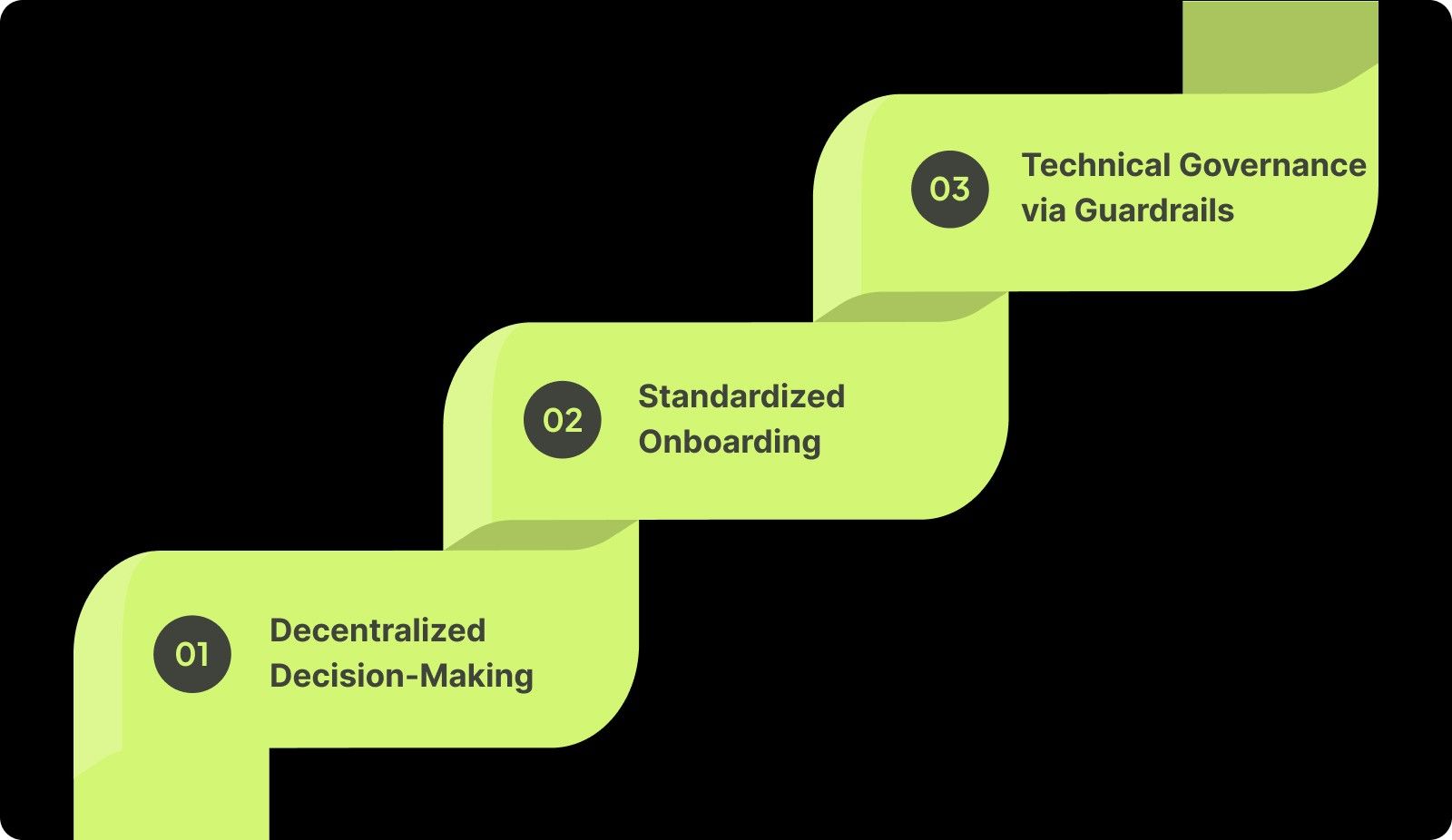
Here are the non-negotiable pillars you must establish:
Decentralized Decision-Making
You must push authority down to the team level rather than hoarding it at the executive level. This prevents the "bus factor" risk and allows squads to move fast without waiting for permission.
Standardized Onboarding and Culture
As new faces appear weekly, oral history and tribal knowledge become unreliable and exclusionary sources of truth. You need documented, automated onboarding processes that instill your engineering culture and coding standards from day one.
Technical Governance via Guardrails
Instead of acting as a gatekeeper who reviews every architectural decision, build automated guardrails into your platform. This approach ensures security and compliance standards are met programmatically without slowing down the development lifecycle.
These pillars provide the structural integrity needed to support the specific tactical strategies we will discuss next.
Also read: The Ultimate Guide to Engineering Project Collaboration
15 Critical Leadership Strategies for Scaling Engineering Teams
When teams grow, the processes that once provided freedom become bottlenecks that cause stagnation and frustration. The following strategies help you shift your focus from managing daily output to optimizing organizational systems for speed and quality:
Organizational Design and Accountability
These strategies define the structure of your teams and the boundaries of ownership, ensuring that independent units can move quickly without constant managerial oversight.
Implement the "Squad Model" with Clear Boundaries
This strategy involves breaking the organization into small, cross-functional teams that own a specific business capability from end to end. This prevents large monolithic teams from getting blocked by internal dependencies.
Action Plan: Reorganize into squads of 4-8 people, co-locating developers, Product Managers, and designers. Mandate that each squad define clear API contracts (technical and communication) for its services.
What to Expect: Teams will gain higher autonomy and velocity because they can deploy their own services independently. Accountability for service reliability will improve dramatically within the owning squad.
Create a Formal Dual-Track Career Ladder
You cannot afford to lose your best technical talent just because management is the only path to a higher salary band or prestige. Technical excellence must be valued and rewarded equally.
Action Plan: Design and publish a parallel career path for Individual Contributors (ICs), defining competencies for Staff and Principal Engineer roles that focus on mentorship and architectural influence. Ensure the compensation bands match those for the Engineering Manager and Director roles.
What to Expect: You will retain senior engineers who prefer deep technical work, providing necessary mentorship and stability to the younger teams. Morale improves when technical mastery is recognized as a specialty.
Define Clear Service Ownership (You Build It, You Run It)
Blurred ownership leads to slow incident response times and technical neglect. When a team owns a service fully, they become incentivized to build quality systems and reduce operational pain.
Action Plan: Assign every microservice, data pipeline, and repository to a single, clearly named team. Require that the owning team is responsible for on-call rotation, monitoring, alerting, and budget management for their service.
What to Expect: Mean Time to Restore (MTTR) will decrease dramatically because the team most familiar with the code is responding immediately. Code quality and documentation will improve naturally.
Create an Internal "Platform Team"
As the number of squads grows, so does the need for shared infrastructure, tooling, and standards. A dedicated Platform Team centralizes this effort to improve Developer Experience (DevEx).
Action Plan: Staff a team whose sole mission is to treat internal developers as customers. Their roadmap should focus on providing self-service tools for deployment, testing, and environment setup.
What to Expect: Feature squads can focus 100% on product delivery rather than solving complex infrastructure issues. Standardization of the tech environment reduces cognitive load across the entire organization.
Establish the "Team of Teams" Model
When the organization grows too large (beyond 100-150 people), a layer of alignment is necessary to coordinate related squads toward larger goals. This prevents communication fragmentation.
Action Plan: Group several related squads into a larger "Tribe" or "Group" led by a Director. Schedule regular monthly syncs for leaders within that group to share priorities and surface cross-cutting dependencies.
What to Expect: Knowledge sharing becomes formalized across related domains, preventing redundant work and ensuring product-wide consistency without forcing micro-level coordination.
Also read: Sprint Review Guide: Definition, Goals, and Tips
Streamlining Process and Flow
These strategies address the friction created by increased communication pathways and complex decision-making processes, ensuring speed is maintained.
Shift from Synchronous to Asynchronous Communication
In large teams, meetings become flow killers, disrupting the necessary concentration time for deep engineering work. You must formalize written communication as the primary medium for decision-making.
Action Plan: Implement a "No status updates in meetings" rule; require status to be pre-read. Require all significant decisions to be documented in a shared wiki or document before the final discussion.
What to Expect: Meeting time is converted back into decision-making and alignment, not information transfer. Engineers recover significant blocks of uninterrupted time for focused coding.
Implement a Mandatory Engineering RFC Process
Decision-making slows down when architecture changes are made ad hoc or through verbal consent. A Request for Comments (RFC) process standardizes how technical decisions are proposed, reviewed, and approved.
Action Plan: Create a lightweight RFC template outlining the problem, alternatives considered, and the proposed solution. Mandate that any architectural change impacting more than one team must go through this review process.
What to Expect: Consensus is built efficiently, reducing late-stage surprises and rework. New hires can review past RFCs to understand the why behind existing architectural choices quickly.
Enforce Small Batch Sizes and High Cadence
Scaling teams often default to large, risky releases, which increases the Change Failure Rate. Scaling successfully demands more frequent, smaller deployments to de-risk releases.
Action Plan: Set an organizational goal to reduce the maximum size of any Pull Request (PR) to under 250 lines of code. Prioritize continuous integration and continuous delivery (CI/CD) tooling to enable daily deployments.
What to Expect: Production failures are isolated to smaller changes, making them easier to diagnose and fix quickly. Velocity improves because code spends less time sitting in long-running branches.
Standardize Tech Stack Choices and Libraries
Allowing every new squad to choose a new database or framework introduces maintenance burden and complexity at scale. Standardization reduces the cognitive overhead for engineers moving between teams.
Action Plan: Establish an approved list of technologies and libraries (e.g., one database per type, one caching mechanism). Require any team proposing a deviation from the standard to write a formal exception request detailing the operational costs.
What to Expect: New teams become productive faster because core patterns are familiar. Centralized tooling teams can provide better support for a smaller range of approved technologies.
Automate the Onboarding Process
The cost and time needed to get a new hire productive (time-to-value) scales linearly with headcount unless automated. Manual onboarding pulls senior engineers away from high-value work.
Action Plan: Create a single repository or script that handles environment setup, required access, and dependency installation for new hires. Define a clear "First 30 Days" checklist focusing on shipping a small PR in week one.
What to Expect: New engineers contribute value faster, and the burden on existing staff for setup and mentorship is dramatically reduced.
Culture and Talent Management
These strategies focus on retaining top talent and ensuring your leadership mindset supports decentralized growth.
Invest Heavily in Developer Experience (DevEx)
DevEx is the sum of all friction points a developer faces, from local setup to production monitoring. Poor DevEx leads directly to burnout and attrition in large organizations.
Action Plan: Treat DevEx as a priority by assigning internal NPS scores to processes like build times and local environment reliability. Fund the Platform Team to address the lowest-scoring areas first.
What to Expect: Engineer satisfaction scores increase, directly correlating with improved retention. You will spend less money replacing senior talent.
Establish the Principle of High Context, Low Control
Micromanagement is the death of velocity in scaled teams. Leadership must provide high context (the strategic why) while granting teams low control (allowing them to define the how).
Action Plan: Ensure every Objective and Key Result (OKR) is linked directly to a company goal. Managers must explicitly trust the team's technical implementation choices unless they violate a codified architectural principle.
What to Expect: Teams become highly motivated and autonomous. Managers shift their time from auditing tasks to coaching and resource acquisition, focusing on system-level improvements.
Implement Bi-directional Feedback Channels
Leaders become isolated from the ground truth as the organization grows. Formalized feedback loops ensure pain points are captured before they lead to attrition or critical blockers.
Action Plan: Mandate regular, small-group skip-level meetings between senior leaders and individual contributors. Conduct quarterly anonymous surveys specifically targeting tooling, process friction, and cultural adherence.
What to Expect: You will catch signs of process decay and morale issues early, allowing for proactive, targeted organizational fixes.
Formalize the Architecture Review Board (ARB)
This board ensures that major changes are aligned with organizational strategy and security requirements, acting as a governance body without acting as a bottleneck for small changes.
Action Plan: Establish a small, senior group (Staff Engineers and Architects) responsible for reviewing all cross-team or high-risk RFCs. The ARB's role is to guide and challenge, not to dictate the final solution.
What to Expect: Architectural coherence is maintained across the organization, and significant spending decisions related to infrastructure are thoroughly vetted by technical experts.
Dedicate Budget to Eliminating Technical Debt
If technical debt is not formally budgeted and prioritized, feature pressure will always ensure it grows. You must assign real capacity to quality.
Action Plan: Mandate that all teams allocate a fixed percentage of sprint capacity (e.g., 20%) explicitly to debt repayment, refactoring, and stability work. Hold quarterly deep-dive sessions to review debt metrics.
What to Expect: Code quality improves predictably, reducing the frequency of critical incidents and ensuring long-term feature velocity is preserved.
These strategies require clear data to implement effectively. See how Entelligence AI provides the engineering intelligence to turn these frameworks into results. Book a demo.
Also read: How to Improve Software Engineering Management and Team Performance?
Essential Metrics for Engineering Velocity and Health
You cannot manage what you do not measure, but measuring the wrong things is dangerous. Avoid vanity metrics like lines of code and focus on metrics that indicate system health and velocity.
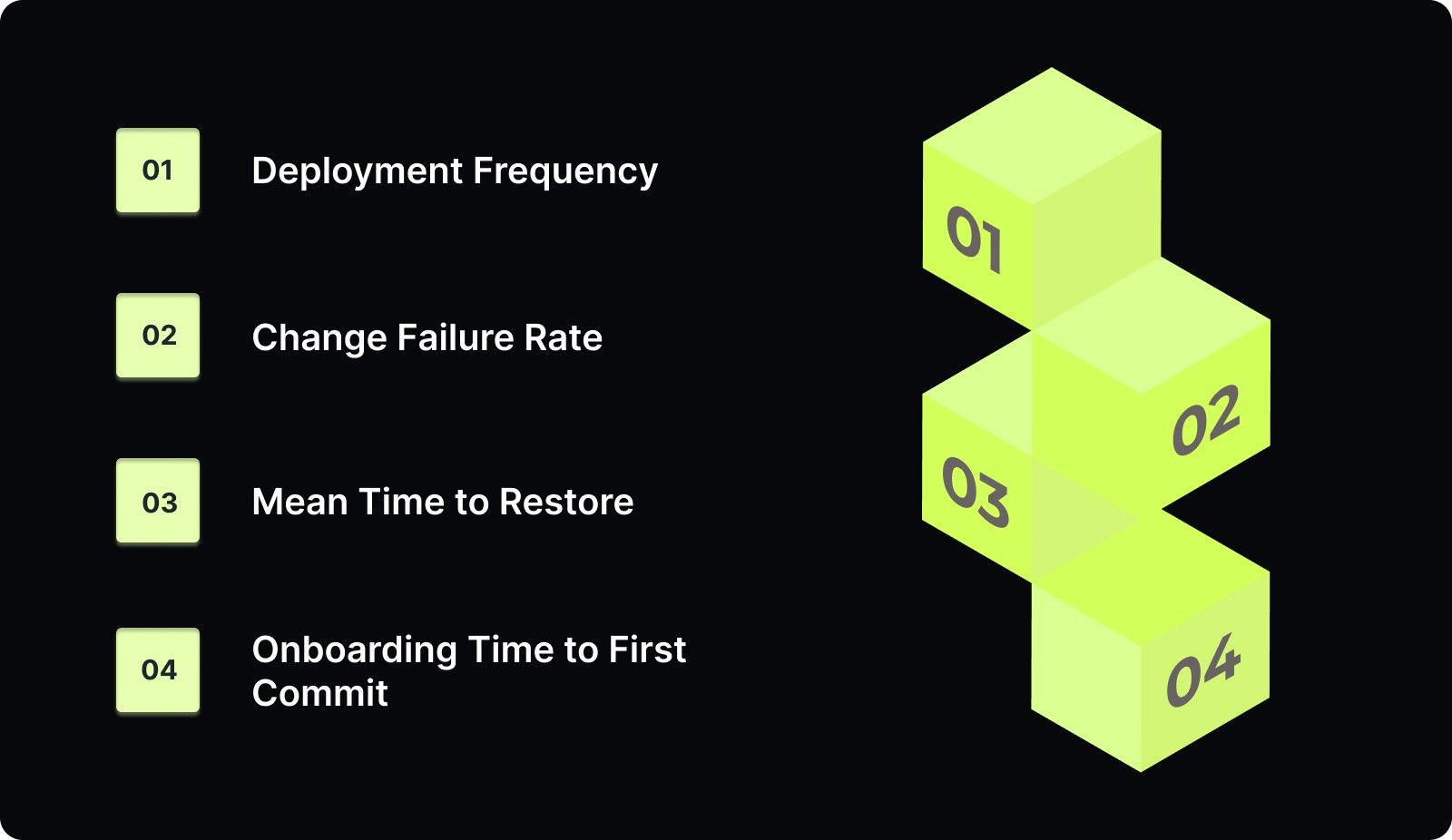
Here are the essential metrics beyond headcount and DORA to track:
Deployment Frequency (Speed): This measures how often your organization successfully releases code to production. High frequency indicates a healthy pipeline and small, manageable batch sizes.
Change Failure Rate (Quality): This is the percentage of deployments that cause a failure in production. It helps you understand if the team is sacrificing quality for speed.
Mean Time to Restore (Stability): When a failure occurs, this measures how quickly the team recovers service. It tests the team's incident response and collaboration under pressure.
Onboarding Time to First Commit (Efficiency): This metric tracks how long it takes a new engineer to merge code into production. It acts as a proxy for the health of your documentation and DevEx.
Metrics will highlight areas of concern, often revealing behavioral patterns that stifle growth.
Common Mistakes Engineering Leaders Make When Scaling
Even with the best intentions, leaders often fall into traps that stifle growth and frustrate their teams. Identifying these pitfalls early allows you to correct course before they become cultural norms.
Here are the mistakes to avoid:
Hiring Faster Than You Can Onboard
Bringing in too many people at once dilutes culture and overwhelms existing staff with mentorship duties.
Solution: Cap hiring based on your capacity to onboard effectively. Automate the onboarding checklist to reduce the burden on mentors.
Promoting the Best Coder to Manager
Technical skill does not translate to people management skill, often leading to team attrition.
Solution: Provide management training before promotion. Use the dual-track ladder to offer alternatives for technical growth.
Neglecting Technical Debt
In the rush to ship features, teams ignore debt until it grinds development to a halt.
Solution: Enforce a strict ratio of feature work to debt reduction (e.g., 80/20). Make debt pay-down a visible part of sprint planning.
Also read: Exploring PR Review AI Tools: Boost Code Quality Fast
Avoiding these pitfalls requires visibility that manual spreadsheets and ad-hoc reports simply cannot provide.
Entelligence AI: Unifying Productivity and Clarity for Scaled Teams
Clear leadership requires clear data, but it's scattered across GitHub, Jira, and Slack. Synthesizing this manually creates a major overhead and forces decisions based on gut feeling.
Entelligence AI is the engineering intelligence platform that solves this. We move beyond code review to unify your entire engineering workflow into one source of truth. We bridge the gap between code execution and the strategic clarity needed for effective scaling.
PR Dashboards for Flow: Our dashboards provide specific metrics on the state of your development pipeline, including Cycle Time, Pull Request Review Load per reviewer, and a list of Stuck PRs (stale or blocked) to ensure code keeps moving.
AI-Powered Sprint Health Checks: Automate retrospectives and planning with data. Entelligence analyzes sprint data to specifically track Planned vs. Completed Tasks, surface current Blockers and Bottlenecks, and generate data-backed reports for effective post-sprint review.
Leader/Org View Dashboards: Get strategic, cross-team clarity. See Trend Lines Across Teams for velocity, code quality, and security posture, enabling Engineering Leaders to identify systemic risks and make informed decisions on resource allocation.
Contextual Code Review Agent: Our AI ensures higher quality before merge. It provides suggestions aligned with architectural standards and flags critical issues directly in the IDE, drastically reducing back-and-forth review cycles.
Entelligence positions your engineering organization to stop guessing and start improving with data-backed clarity.
Conclusion
Mastering leadership strategies for scaling engineering teams requires a deliberate shift from ad-hoc management to systematic leadership. By decentralizing decision-making, investing in developer experience, and tracking the right metrics, you can build an organization that grows stronger as it gets bigger. The goal is to create a culture where speed and stability coexist naturally.
Entelligence AI acts as your partner in this journey, providing the insights and automation needed to measure what matters. From ensuring code quality to visualizing team velocity, we help you hit your targets with confidence.
Ready to gain total clarity over your engineering goals and accelerate your transformation? Book a demo today.
FAQs
Q. How does leadership change from a startup to a scaleup?
Startup leadership focuses on direct contribution and "doing it all." Scaleup leadership shifts to designing systems, hiring leaders, and removing blockers for others. You move from being the player to being the coach.
Q. What is the ideal ratio of engineering managers to engineers?
A common rule of thumb is one manager for every 6 to 8 engineers. This ratio allows the manager to provide adequate mentorship and career guidance without being overwhelmed by administrative overhead.
Q. How do we maintain culture while doubling the team size?
You must write down your values and repeat them constantly. Embed your cultural principles into your hiring rubrics, onboarding processes, and performance reviews to ensure they are practiced, not just preached.
Q. What tools are essential for scaling engineering teams?
Beyond standard CI/CD and project management tools, you need observability platforms and engineering intelligence tools like Entelligence. These provide the data needed to spot bottlenecks that human intuition might miss in a large organization.
Growing your engineering team is not just about adding more people. It's a complex leadership challenge. New hires struggle to onboard, communication slows down, and a once-sharp culture can quickly become diluted. You add developers, but your team's velocity plateaus.
According to recent research, developers report that "engineering system friction" is a primary cause of unproductive days, a problem that multiplies with scale. To scale successfully, you must evolve your leadership approach.
It requires shifting from hands-on management to building systems, empowering teams, and creating clarity from the ground up. You need strategies that maintain your team's core strengths while building new structures for growth.
In this guide, we break down actionable leadership strategies for scaling engineering teams. You will learn how to establish clear strategic pillars, implement day-to-day management tactics, measure the right outcomes, and avoid common pitfalls that derail growth.
At a Glance
According to recent research, developers report that "engineering system friction" is a primary cause of unproductive days, a problem that multiplies with scale.
Move decision-making power to the edges of the organization to prevent leadership bottlenecks.
Write down your values and operating principles to ensure consistency as new hires join.
Friction increases with size; prioritize tooling that automates environments and reduces administrative overhead.
Retain top technical talent by offering equal growth paths for individual contributors and managers.
Shift focus from "lines of code" to DORA metrics like deployment frequency and change failure rate.
Why Scaling Breaks Engineering Teams
Scaling an engineering team isn't just about hiring more people; it's about managing the exponential growth in complexity and communication overhead that comes with it. As your team size doubles, the number of potential communication pathways grows much faster. This leads to bottlenecks, fragmented ownership, and a significant drop in collective velocity.
The fundamental challenge is shifting from a startup-era leadership model, where everyone knows everything and decisions are informal, to a scaled leadership model that relies on strong, deliberate systems.
Here are the four key areas where engineering organizations typically break down during rapid scaling:
Communication Overhead: Every new person adds to the N-squared problem of team interactions. Decision-making slows down because more people must be consulted, leading to "meeting fatigue" and project stagnation.
Organizational Friction: Without clear boundaries, smaller, high-velocity teams get replaced by large, slow monolithic teams. This creates confusing dependencies, where one team can't ship without another team's approval, destroying autonomy.
Loss of Context and Quality: New hires lack deep historical knowledge, and technical debt accelerates because of rapid feature mandates. The focus shifts from architectural quality and maintainability to simply delivering output, leading to instability and developer frustration.
Leadership Drain: Existing leaders, often top technical contributors, get bogged down in recruiting, administrative tasks, and resolving inter-team conflicts. They are forced to shift from technical coaching to pure people management, stretching them thin and creating a bottleneck for strategic work.
Also read: Effective Strategies to Reduce Technical Debt
Scaling exposes cracks in your foundation, but the right strategic pillars can turn those weaknesses into strengths.
3 Strategic Pillars for Scaling Engineering Leadership
Scaling successfully requires a fundamental shift from "building the product" to "building the machine that builds the product." You must establish a foundation that supports rapid growth without requiring your constant intervention in every decision.

Here are the non-negotiable pillars you must establish:
Decentralized Decision-Making
You must push authority down to the team level rather than hoarding it at the executive level. This prevents the "bus factor" risk and allows squads to move fast without waiting for permission.
Standardized Onboarding and Culture
As new faces appear weekly, oral history and tribal knowledge become unreliable and exclusionary sources of truth. You need documented, automated onboarding processes that instill your engineering culture and coding standards from day one.
Technical Governance via Guardrails
Instead of acting as a gatekeeper who reviews every architectural decision, build automated guardrails into your platform. This approach ensures security and compliance standards are met programmatically without slowing down the development lifecycle.
These pillars provide the structural integrity needed to support the specific tactical strategies we will discuss next.

Also read: The Ultimate Guide to Engineering Project Collaboration
15 Critical Leadership Strategies for Scaling Engineering Teams
When teams grow, the processes that once provided freedom become bottlenecks that cause stagnation and frustration. The following strategies help you shift your focus from managing daily output to optimizing organizational systems for speed and quality:
Organizational Design and Accountability
These strategies define the structure of your teams and the boundaries of ownership, ensuring that independent units can move quickly without constant managerial oversight.
Implement the "Squad Model" with Clear Boundaries
This strategy involves breaking the organization into small, cross-functional teams that own a specific business capability from end to end. This prevents large monolithic teams from getting blocked by internal dependencies.
Action Plan: Reorganize into squads of 4-8 people, co-locating developers, Product Managers, and designers. Mandate that each squad define clear API contracts (technical and communication) for its services.
What to Expect: Teams will gain higher autonomy and velocity because they can deploy their own services independently. Accountability for service reliability will improve dramatically within the owning squad.
Create a Formal Dual-Track Career Ladder
You cannot afford to lose your best technical talent just because management is the only path to a higher salary band or prestige. Technical excellence must be valued and rewarded equally.
Action Plan: Design and publish a parallel career path for Individual Contributors (ICs), defining competencies for Staff and Principal Engineer roles that focus on mentorship and architectural influence. Ensure the compensation bands match those for the Engineering Manager and Director roles.
What to Expect: You will retain senior engineers who prefer deep technical work, providing necessary mentorship and stability to the younger teams. Morale improves when technical mastery is recognized as a specialty.
Define Clear Service Ownership (You Build It, You Run It)
Blurred ownership leads to slow incident response times and technical neglect. When a team owns a service fully, they become incentivized to build quality systems and reduce operational pain.
Action Plan: Assign every microservice, data pipeline, and repository to a single, clearly named team. Require that the owning team is responsible for on-call rotation, monitoring, alerting, and budget management for their service.
What to Expect: Mean Time to Restore (MTTR) will decrease dramatically because the team most familiar with the code is responding immediately. Code quality and documentation will improve naturally.
Create an Internal "Platform Team"
As the number of squads grows, so does the need for shared infrastructure, tooling, and standards. A dedicated Platform Team centralizes this effort to improve Developer Experience (DevEx).
Action Plan: Staff a team whose sole mission is to treat internal developers as customers. Their roadmap should focus on providing self-service tools for deployment, testing, and environment setup.
What to Expect: Feature squads can focus 100% on product delivery rather than solving complex infrastructure issues. Standardization of the tech environment reduces cognitive load across the entire organization.
Establish the "Team of Teams" Model
When the organization grows too large (beyond 100-150 people), a layer of alignment is necessary to coordinate related squads toward larger goals. This prevents communication fragmentation.
Action Plan: Group several related squads into a larger "Tribe" or "Group" led by a Director. Schedule regular monthly syncs for leaders within that group to share priorities and surface cross-cutting dependencies.
What to Expect: Knowledge sharing becomes formalized across related domains, preventing redundant work and ensuring product-wide consistency without forcing micro-level coordination.
Also read: Sprint Review Guide: Definition, Goals, and Tips
Streamlining Process and Flow
These strategies address the friction created by increased communication pathways and complex decision-making processes, ensuring speed is maintained.
Shift from Synchronous to Asynchronous Communication
In large teams, meetings become flow killers, disrupting the necessary concentration time for deep engineering work. You must formalize written communication as the primary medium for decision-making.
Action Plan: Implement a "No status updates in meetings" rule; require status to be pre-read. Require all significant decisions to be documented in a shared wiki or document before the final discussion.
What to Expect: Meeting time is converted back into decision-making and alignment, not information transfer. Engineers recover significant blocks of uninterrupted time for focused coding.
Implement a Mandatory Engineering RFC Process
Decision-making slows down when architecture changes are made ad hoc or through verbal consent. A Request for Comments (RFC) process standardizes how technical decisions are proposed, reviewed, and approved.
Action Plan: Create a lightweight RFC template outlining the problem, alternatives considered, and the proposed solution. Mandate that any architectural change impacting more than one team must go through this review process.
What to Expect: Consensus is built efficiently, reducing late-stage surprises and rework. New hires can review past RFCs to understand the why behind existing architectural choices quickly.
Enforce Small Batch Sizes and High Cadence
Scaling teams often default to large, risky releases, which increases the Change Failure Rate. Scaling successfully demands more frequent, smaller deployments to de-risk releases.
Action Plan: Set an organizational goal to reduce the maximum size of any Pull Request (PR) to under 250 lines of code. Prioritize continuous integration and continuous delivery (CI/CD) tooling to enable daily deployments.
What to Expect: Production failures are isolated to smaller changes, making them easier to diagnose and fix quickly. Velocity improves because code spends less time sitting in long-running branches.
Standardize Tech Stack Choices and Libraries
Allowing every new squad to choose a new database or framework introduces maintenance burden and complexity at scale. Standardization reduces the cognitive overhead for engineers moving between teams.
Action Plan: Establish an approved list of technologies and libraries (e.g., one database per type, one caching mechanism). Require any team proposing a deviation from the standard to write a formal exception request detailing the operational costs.
What to Expect: New teams become productive faster because core patterns are familiar. Centralized tooling teams can provide better support for a smaller range of approved technologies.
Automate the Onboarding Process
The cost and time needed to get a new hire productive (time-to-value) scales linearly with headcount unless automated. Manual onboarding pulls senior engineers away from high-value work.
Action Plan: Create a single repository or script that handles environment setup, required access, and dependency installation for new hires. Define a clear "First 30 Days" checklist focusing on shipping a small PR in week one.
What to Expect: New engineers contribute value faster, and the burden on existing staff for setup and mentorship is dramatically reduced.
Culture and Talent Management
These strategies focus on retaining top talent and ensuring your leadership mindset supports decentralized growth.
Invest Heavily in Developer Experience (DevEx)
DevEx is the sum of all friction points a developer faces, from local setup to production monitoring. Poor DevEx leads directly to burnout and attrition in large organizations.
Action Plan: Treat DevEx as a priority by assigning internal NPS scores to processes like build times and local environment reliability. Fund the Platform Team to address the lowest-scoring areas first.
What to Expect: Engineer satisfaction scores increase, directly correlating with improved retention. You will spend less money replacing senior talent.
Establish the Principle of High Context, Low Control
Micromanagement is the death of velocity in scaled teams. Leadership must provide high context (the strategic why) while granting teams low control (allowing them to define the how).
Action Plan: Ensure every Objective and Key Result (OKR) is linked directly to a company goal. Managers must explicitly trust the team's technical implementation choices unless they violate a codified architectural principle.
What to Expect: Teams become highly motivated and autonomous. Managers shift their time from auditing tasks to coaching and resource acquisition, focusing on system-level improvements.
Implement Bi-directional Feedback Channels
Leaders become isolated from the ground truth as the organization grows. Formalized feedback loops ensure pain points are captured before they lead to attrition or critical blockers.
Action Plan: Mandate regular, small-group skip-level meetings between senior leaders and individual contributors. Conduct quarterly anonymous surveys specifically targeting tooling, process friction, and cultural adherence.
What to Expect: You will catch signs of process decay and morale issues early, allowing for proactive, targeted organizational fixes.
Formalize the Architecture Review Board (ARB)
This board ensures that major changes are aligned with organizational strategy and security requirements, acting as a governance body without acting as a bottleneck for small changes.
Action Plan: Establish a small, senior group (Staff Engineers and Architects) responsible for reviewing all cross-team or high-risk RFCs. The ARB's role is to guide and challenge, not to dictate the final solution.
What to Expect: Architectural coherence is maintained across the organization, and significant spending decisions related to infrastructure are thoroughly vetted by technical experts.
Dedicate Budget to Eliminating Technical Debt
If technical debt is not formally budgeted and prioritized, feature pressure will always ensure it grows. You must assign real capacity to quality.
Action Plan: Mandate that all teams allocate a fixed percentage of sprint capacity (e.g., 20%) explicitly to debt repayment, refactoring, and stability work. Hold quarterly deep-dive sessions to review debt metrics.
What to Expect: Code quality improves predictably, reducing the frequency of critical incidents and ensuring long-term feature velocity is preserved.
These strategies require clear data to implement effectively. See how Entelligence AI provides the engineering intelligence to turn these frameworks into results. Book a demo.
Also read: How to Improve Software Engineering Management and Team Performance?
Essential Metrics for Engineering Velocity and Health
You cannot manage what you do not measure, but measuring the wrong things is dangerous. Avoid vanity metrics like lines of code and focus on metrics that indicate system health and velocity.

Here are the essential metrics beyond headcount and DORA to track:
Deployment Frequency (Speed): This measures how often your organization successfully releases code to production. High frequency indicates a healthy pipeline and small, manageable batch sizes.
Change Failure Rate (Quality): This is the percentage of deployments that cause a failure in production. It helps you understand if the team is sacrificing quality for speed.
Mean Time to Restore (Stability): When a failure occurs, this measures how quickly the team recovers service. It tests the team's incident response and collaboration under pressure.
Onboarding Time to First Commit (Efficiency): This metric tracks how long it takes a new engineer to merge code into production. It acts as a proxy for the health of your documentation and DevEx.
Metrics will highlight areas of concern, often revealing behavioral patterns that stifle growth.
Common Mistakes Engineering Leaders Make When Scaling
Even with the best intentions, leaders often fall into traps that stifle growth and frustrate their teams. Identifying these pitfalls early allows you to correct course before they become cultural norms.
Here are the mistakes to avoid:
Hiring Faster Than You Can Onboard
Bringing in too many people at once dilutes culture and overwhelms existing staff with mentorship duties.
Solution: Cap hiring based on your capacity to onboard effectively. Automate the onboarding checklist to reduce the burden on mentors.
Promoting the Best Coder to Manager
Technical skill does not translate to people management skill, often leading to team attrition.
Solution: Provide management training before promotion. Use the dual-track ladder to offer alternatives for technical growth.
Neglecting Technical Debt
In the rush to ship features, teams ignore debt until it grinds development to a halt.
Solution: Enforce a strict ratio of feature work to debt reduction (e.g., 80/20). Make debt pay-down a visible part of sprint planning.
Also read: Exploring PR Review AI Tools: Boost Code Quality Fast
Avoiding these pitfalls requires visibility that manual spreadsheets and ad-hoc reports simply cannot provide.
Entelligence AI: Unifying Productivity and Clarity for Scaled Teams
Clear leadership requires clear data, but it's scattered across GitHub, Jira, and Slack. Synthesizing this manually creates a major overhead and forces decisions based on gut feeling.
Entelligence AI is the engineering intelligence platform that solves this. We move beyond code review to unify your entire engineering workflow into one source of truth. We bridge the gap between code execution and the strategic clarity needed for effective scaling.
PR Dashboards for Flow: Our dashboards provide specific metrics on the state of your development pipeline, including Cycle Time, Pull Request Review Load per reviewer, and a list of Stuck PRs (stale or blocked) to ensure code keeps moving.
AI-Powered Sprint Health Checks: Automate retrospectives and planning with data. Entelligence analyzes sprint data to specifically track Planned vs. Completed Tasks, surface current Blockers and Bottlenecks, and generate data-backed reports for effective post-sprint review.
Leader/Org View Dashboards: Get strategic, cross-team clarity. See Trend Lines Across Teams for velocity, code quality, and security posture, enabling Engineering Leaders to identify systemic risks and make informed decisions on resource allocation.
Contextual Code Review Agent: Our AI ensures higher quality before merge. It provides suggestions aligned with architectural standards and flags critical issues directly in the IDE, drastically reducing back-and-forth review cycles.
Entelligence positions your engineering organization to stop guessing and start improving with data-backed clarity.
Conclusion
Mastering leadership strategies for scaling engineering teams requires a deliberate shift from ad-hoc management to systematic leadership. By decentralizing decision-making, investing in developer experience, and tracking the right metrics, you can build an organization that grows stronger as it gets bigger. The goal is to create a culture where speed and stability coexist naturally.
Entelligence AI acts as your partner in this journey, providing the insights and automation needed to measure what matters. From ensuring code quality to visualizing team velocity, we help you hit your targets with confidence.
Ready to gain total clarity over your engineering goals and accelerate your transformation? Book a demo today.
FAQs
Q. How does leadership change from a startup to a scaleup?
Startup leadership focuses on direct contribution and "doing it all." Scaleup leadership shifts to designing systems, hiring leaders, and removing blockers for others. You move from being the player to being the coach.
Q. What is the ideal ratio of engineering managers to engineers?
A common rule of thumb is one manager for every 6 to 8 engineers. This ratio allows the manager to provide adequate mentorship and career guidance without being overwhelmed by administrative overhead.
Q. How do we maintain culture while doubling the team size?
You must write down your values and repeat them constantly. Embed your cultural principles into your hiring rubrics, onboarding processes, and performance reviews to ensure they are practiced, not just preached.
Q. What tools are essential for scaling engineering teams?
Beyond standard CI/CD and project management tools, you need observability platforms and engineering intelligence tools like Entelligence. These provide the data needed to spot bottlenecks that human intuition might miss in a large organization.
Your questions,
Your questions,
Decoded
Decoded
What makes Entelligence different?
Unlike tools that just flag issues, Entelligence understands context — detecting, explaining, and fixing problems while aligning with product goals and team standards.
Does it replace human reviewers?
No. It amplifies them. Entelligence handles repetitive checks so engineers can focus on architecture, logic, and innovation.
What tools does it integrate with?
It fits right into your workflow — GitHub, GitLab, Jira, Linear, Slack, and more. No setup friction, no context switching.
How secure is my code?
Your code never leaves your environment. Entelligence uses encrypted processing and complies with top industry standards like SOC 2 and HIPAA.
Who is it built for?
Fast-growing engineering teams that want to scale quality, security, and velocity without adding more manual reviews or overhead.

What makes Entelligence different?
Does it replace human reviewers?
What tools does it integrate with?
How secure is my code?
Who is it built for?