10 Proven Best Practices for Managing Technical Debt in Distributed Teams
Dec 31, 2025
Dec 31, 2025
Nothing slows down a successful engineering team faster than the weight of unmanaged technical debt. That initial quick fix or postponed refactor compounds eventually, making simple changes excruciatingly difficult and risky. This problem is acutely felt in distributed teams, where a lack of physical proximity already strains communication and shared understanding of the codebase.
The solution is not just paying down debt, but strategically integrating debt management into your daily workflow and culture. It requires clear visibility, standardized processes, and dedicated time for cleanup.
In this guide, we will break down 10 proven best practices for managing technical debt in distributed teams, providing you with actionable strategies to maintain speed and quality as you scale.
Need To Know
Treat technical debt items as first-class citizens on your product backlog, just like new features.
Formally allocate 20% of all sprint capacity toward intentional debt repayment and quality tasks.
Track Change Failure Rate and Mean Time to Repair (MTTR), as they are direct indicators of technical debt health.
Implement automated code quality checks (linting, static analysis) that must pass before a Pull Request can be merged.
Document why a technical choice was made to prevent the same mistakes later or when contexts change.
Mandate that every developer leaves the code cleaner than they found it before checking in.
What is Technical Debt
Technical debt is the implied cost of additional rework caused by choosing an easier solution now instead of using a better approach that would take longer. It represents the future consequence of past technical shortcuts, outdated designs, or insufficient testing.
Like financial debt, it accrues interest in the form of slower development cycles, increased bugs, and higher maintenance costs over time.
Common Causes of Technical Debt:
Pressure to Ship: Rushing features to market often results in temporary, poorly structured code that is intended to be fixed later.
Lack of Standards: Distributed teams without a codified style guide or architectural principles create inconsistent, fragmented codebases.
Architectural Drift: As the business evolves, the original system design becomes unsuitable, forcing new features into an outdated structure.
Insufficient Testing: Skipping unit or integration tests saves time initially but guarantees future defects and painful refactoring.
Outdated Dependencies: Failure to update external libraries introduces security vulnerabilities and makes future major upgrades exponentially harder.
Codebases quickly become fragile if you do not actively address these issues.
Also read: Top 8 Developer Productivity Tools For Maximum Efficiency

The pervasive nature of technical debt impacts every aspect of a software organization, often silently eroding productivity until a critical failure occurs.
Impact of Technical Debt on Software Development Teams
Technical debt is more than just messy code; it fundamentally affects morale, velocity, and the organization's capacity for strategic execution. Understanding these downstream effects is essential for prioritizing cleanup work.
Here is how unmanaged technical debt affects your team:
Reduced Velocity and Predictability
When core system modules are fragile or poorly documented, changes take significantly longer than expected.
Developers spend an inordinate amount of time decoding spaghetti code before making a minor update.
The high risk of introducing new bugs forces teams to implement overly cautious testing processes, lengthening the sprint cycle.
Estimation accuracy plummets because the actual effort is masked by the time required to navigate legacy issues.
Higher Risk and Lower Quality
The reliance on quick fixes and the presence of older, unpatched code introduce security and stability concerns.
High technical debt directly correlates with a higher Change Failure Rate upon deployment, as small changes have wide, unpredictable side effects.
Older, unmaintained dependencies are vulnerable to published Common Vulnerabilities and Exposures (CVEs), exposing the system to security breaches.
The absence of adequate test coverage means critical business logic may contain hidden flaws that only appear in production.
Increased Cognitive Load and Attrition
Engineers find it frustrating and demoralizing to work in a codebase riddled with avoidable complexity and outdated patterns.
New hires face a steep, discouraging learning curve, struggling to grasp the system when documentation is nonexistent or misleading.
Senior developers, whose expertise is most valuable for refactoring, become frustrated by being perpetually relegated to firefighting minor bugs.
This sustained frustration significantly increases attrition risk, especially among high-performing, quality-focused engineers.
Architectural Fragility and Loss of Agility
Unpaid technical debt makes the system rigid, eliminating the flexibility required to respond to market changes or build modern features.
The system structure becomes so interdependent that touching one component risks breaking dozens of others, paralyzing new development.
Leaders cannot quickly pivot the product strategy because the cost of implementing a major architectural shift is deemed prohibitively expensive.
This eventually leads to a necessary, massive, and costly replatforming project instead of incremental, sustainable evolution.
Strain on Distributed Team Alignment
The lack of a shared, centralized understanding of the codebase is amplified when teams are geographically separated.
Developers cannot easily walk over to ask the original author for context, leading to time lost in asynchronous communication delays.
Siloed knowledge, where only one engineer understands a module, becomes a critical, untraceable single point of failure.
The strategic management of technical debt ensures you maintain velocity, quality, and team morale across multiple time zones.
Also read: Best Practices for Effective Sprint Planning Meetings
10 Best Practices for Technical Debt Management
These ten strategies provide a structured framework for identifying, prioritizing, and resolving technical debt, moving it from an abstract problem to a measurable asset management task.
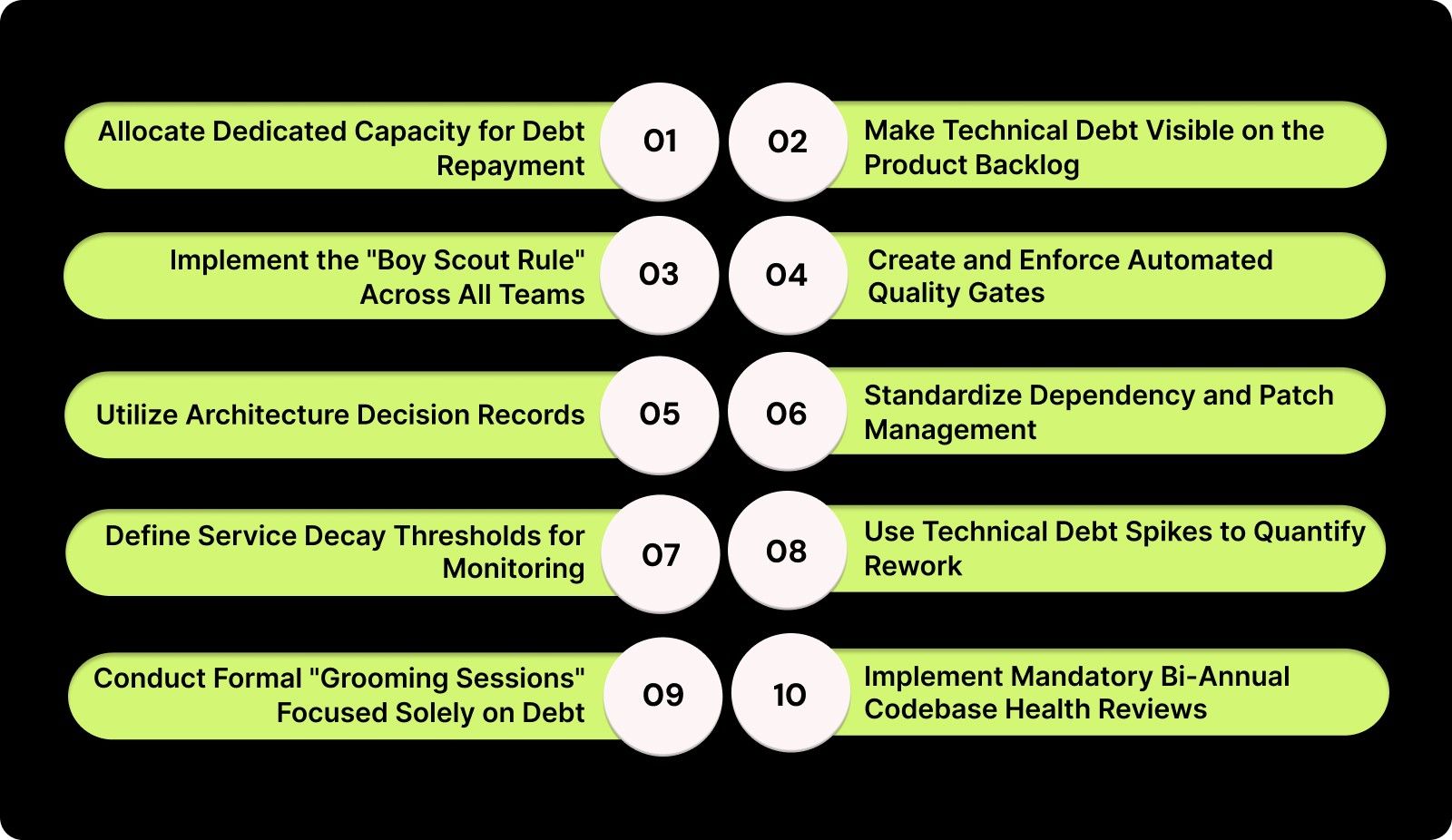
1. Allocate Dedicated Capacity for Debt Repayment
If debt work is not formally scheduled, feature pressure will always win, ensuring debt grows perpetually. You must make repayment a formal priority.
Action Steps:
Enforce a mandatory 80% feature to 20% debt/quality ratio for all sprint planning.
Create a "Tech Debt" swimlane on your sprint board, ensuring it is always populated with items.
Require Engineering Managers to justify any sprint that deviates from this allocation ratio.
Impact: Debt work receives predictable, consistent attention, preventing the formation of large, unmanageable debt piles. Quality becomes a measurable part of velocity.
2. Make Technical Debt Visible on the Product Backlog
Technical debt must compete with features on the basis of business risk and cost, not just engineering preference.
Action Steps:
Create explicit cards for debt items (e.g., "Refactor legacy payment gateway," "Update dependency X") within the product backlog.
Assign each debt item a Business Risk Score (high/medium/low) based on its likelihood of causing a customer-facing incident or delaying future features.
Require the Product Manager to be involved in prioritizing the debt backlog alongside the Engineering Manager.
Impact: Debt conversation moves from the engineering silo to the business planning table, enabling data-driven prioritization decisions.
3. Implement the "Boy Scout Rule" Across All Teams
This simple cultural practice ensures that small amounts of debt are paid down continuously and cheaply by every developer.
Action Steps:
Require developers to fix minor issues like code comments, variable names, or small linting problems in any file they touch.
Define "minor" as anything that takes less than 30 minutes to address during the feature implementation.
Include a mandatory checklist item in the PR template asking, "Did you leave the code cleaner than you found it?"
Impact: The codebase gradually improves over time without dedicated, expensive refactoring sprints, distributing cleanup effort throughout the organization.
4. Create and Enforce Automated Quality Gates
For distributed teams, consistency is non-negotiable. Quality must be enforced by systems, not solely by human code reviews.
Action Steps:
Integrate static analysis tools (e.g., SonarQube, linters) directly into the CI/CD pipeline.
Configure the CI/CD pipeline to automatically fail a build if code coverage drops below a set threshold (e.g., 70%).
Require 100% passing tests and zero critical warnings before allowing a Pull Request to merge into the main branch.
Impact: Quality is standardized across all teams and repos, eliminating technical debt at its source and reducing the burden on human reviewers.
Setting up these gates manually is complex. See how Entelligence AI automates code quality and security standards across all repos. Book a demo to see it in action.
5. Utilize Architecture Decision Records (ADRs)
Documenting the "why" behind technical choices is essential for distributed teams that lack historical context and may suffer from architectural drift.
Action Steps:
Mandate a simple ADR template (Context, Decision, Consequences) for any non-trivial technical choice.
Store all ADRs in a centralized, easily searchable repository (like a wiki or documentation tool).
Require new hires to review key architectural decisions during their onboarding process.
Impact: New team members quickly gain architectural context, preventing them from unknowingly violating established design patterns.
6. Standardize Dependency and Patch Management
Outdated dependencies are a common source of security and technical debt that grow exponentially if ignored.
Action Steps:
Implement an automated tool (e.g., Dependabot, Renovate) to automatically open PRs for minor dependency updates.
Assign a rotating "Dependency Czar" role to a team member to review and approve major, risky dependency updates once per sprint.
Set a firm policy of only supporting dependencies within two major versions of the latest release.
Impact: Security posture improves, and the risk of a massive, costly, all-at-once dependency upgrade is eliminated.
7. Define Service Decay Thresholds for Monitoring
You must define what constitutes an unacceptable level of technical debt for a production service and monitor it proactively.
Action Steps:
Establish system-level Service Level Objectives (SLOs) for debt, such as "Maximum 5 outstanding critical security alerts."
Instrument the codebase to track internal quality metrics like build time, code complexity, or test coverage trends.
Set up alerts to notify the owning team if a service breaches its predefined decay threshold for more than two weeks.
Impact: Teams are forced to address high-risk debt quickly, ensuring that operational quality standards are maintained even under pressure.
Also read: The Ultimate Guide to Engineering Project Collaboration
8. Use Technical Debt Spikes to Quantify Rework
Before committing to a large debt repayment item, you need to understand the true cost of the cleanup, especially for distributed teams lacking ground-level insight.
Action Steps:
Schedule a small, time-boxed spike (2-4 hours) to investigate the specific section of legacy code.
The spike's deliverable must be a detailed assessment that estimates the full refactoring effort and identifies any unexpected dependencies.
Use the spike findings to adjust the Business Risk Score and inform the final priority of the debt item on the backlog.
Impact: Technical debt prioritization becomes much more accurate, reducing the chance of committing to a massive, underestimated refactoring project.
9. Conduct Formal "Grooming Sessions" Focused Solely on Debt
Debt items need the same level of granular planning as feature work to be executed predictably by separated teams.
Action Steps:
Schedule a separate, dedicated weekly or bi-weekly Tech Debt Grooming meeting for the entire team (or department).
Use this session to break down large debt items into small, defined, and estimable tasks for the upcoming sprints.
Require the Lead Engineer to champion the session, ensuring clarity on the technical approach for the distributed team.
Impact: Debt work moves from being vaguely defined to being actionable, preventing developers from wasting time deciphering the necessary cleanup steps.
10. Implement Mandatory Bi-Annual Codebase Health Reviews
A comprehensive, top-down review provides strategic clarity and uncovers system-wide debt patterns that local teams may miss.
Action Steps:
Have a senior architect or principal engineer (or an external team) perform a thorough audit of a core system every six months.
The audit should focus on architecture, dependencies, and deployment health.
Share the results transparently with all Engineering Leaders and create department-level OKRs to address the findings.
Impact: Leaders gain necessary strategic clarity on where debt accumulation is systemic, enabling informed decisions about resource allocation and hiring.
These best practices create a debt management culture, but you need daily habits to keep your system clean.
Also read: Software Engineering Burnout: Prevention and Solutions Guide
Quick Tips to Reduce Technical Debt
Small, consistent habits executed daily by every member of a distributed team dramatically reduce the long-term compounding cost of technical debt. These tips are cultural reminders to keep quality high.
Here are quick, actionable steps you can implement today:
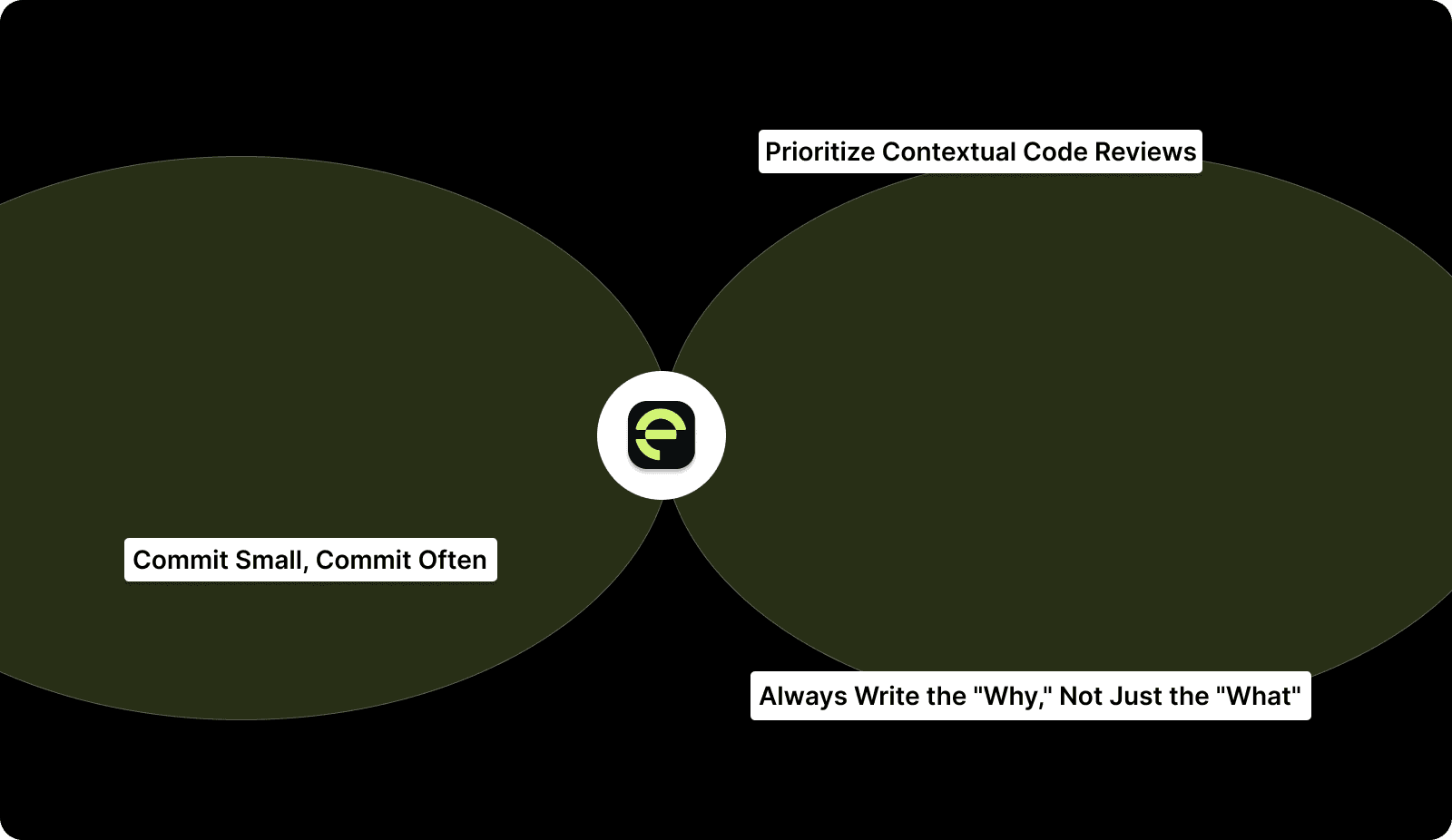
Commit Small, Commit Often
Large changes sit in development branches longer, making them prone to divergence from the main branch and increasing merge complexity.
Limit Pull Request sizes to under 250 lines of code to ensure quick, focused reviews.
Require developers to commit and push their changes daily to the main branch using feature flags for unfinished work.
Smaller batches of work reduce the risk associated with each deployment, improving quality and stability.
Prioritize Contextual Code Reviews
Effective code review is the last line of defense against poor design choices and simple debt items slipping into the main branch.
Shift your review focus from just finding bugs to actively checking for code consistency and architectural adherence.
Implement tooling that provides the reviewer with context on the affected architecture and dependencies, not just the lines changed.
Require new tests for any bug fix to ensure the debt is not just hidden but permanently prevented.
Always Write the "Why," Not Just the "What"
When writing code, especially in a distributed team where context is lost easily, you must document the intention behind non-obvious choices.
Add inline comments to explain complex or non-standard logic that might seem like technical debt to a future developer.
Ensure every new function or class has a descriptive docstring explaining its purpose, inputs, and outputs.
Documenting the initial constraints helps future developers avoid unnecessary refactoring because they understand the past context.
Addressing technical debt at scale requires organization-wide clarity and integrated tooling.
Also read: 25 Practical OKR Examples for Software Engineers
Entelligence AI: Unifying Productivity and Clarity
Managing technical debt at scale overwhelms distributed teams. Without centralized visibility, enforcing standards and spotting high-risk areas is nearly impossible. This hidden architectural debt eventually cripples your velocity.
Entelligence AI transforms this challenge. Our platform unifies code quality, security, and team performance into a single source of truth. This gives you the clarity to make smart, proactive decisions and manage debt strategically.
Our features include:
Contextual Code Reviews: Our AI flags architectural risks and code quality debt directly within the PR workflow.
Security Dashboard: Continuously scans dependencies and configuration for vulnerabilities, helping you prioritize high-risk security debt immediately.
Automated Documentation: AI-generated docs reduce "documentation debt," ensuring new hires and distributed teams always have accurate system context.
Individual & Team Insights: Provides quantitative analytics that correlate code quality trends with team performance, showing leaders where debt is actively slowing down velocity.
Entelligence AI bridges day-to-day code execution with the strategic clarity leaders need, making it a solution for your entire engineering organization.
Real-World Insight: Digibee
Digibee, an AI-native iPaaS platform, integrated Entelligence AI to automate code reviews across 20+ microservices, deploying multiple times daily. The solution provided automated line-level reviews, AI-generated documentation, and a Slack code-chat bot.
Over eight weeks, Entelligence AI inspected 191 merge requests, identified 164 real defects, and saved approximately 110 engineering hours with zero production incidents. This enabled Digibee's team to ship changes confidently multiple times daily while maintaining reliability.
Conclusion
Managing technical debt in distributed teams is not a project with an end date; it is an ongoing, essential discipline. By adopting 10 proven best practices for managing technical debt in distributed teams, such as allocating dedicated time, enforcing small batch sizes, you can ensure your system remains adaptable and maintainable.
This strategic focus on quality ensures that today's velocity does not become tomorrow's crippling maintenance burden. Entelligence AI is your trusted advisor, providing the comprehensive intelligence and automation required to keep your codebase healthy and your teams aligned.
We provide the clarity that allows you to manage debt strategically, not reactively.
Ready to transform technical debt from a blocker into a managed risk? Book a demo with Entelligence today.
FAQs
Q. How do I convince my Product Manager to prioritize technical debt?
You must translate the technical cost into business risk. Instead of saying "We need to refactor the database access layer," say, "We need to refactor the database layer to reduce our Change Failure Rate from 5% to 1%, which currently causes 2 major outages per month." Prioritizing based on the cost of inaction or the risk to future revenue moves the discussion from maintenance to strategic decision-making.
Q. What is the difference between technical debt and a bug?
A bug is a fault, error, or defect in the code that causes the program to fail or produce an incorrect result. Technical debt is a design choice or lack of standardization that makes the code harder to change in the future, even if it works correctly today. All bugs need fixing, but not all technical debt needs immediate refactoring; its repayment is prioritized based on the interest it is currently costing you.
Q. What is the "Snowflake Server" debt pattern?
A Snowflake Server refers to a production machine or environment that has been manually configured and customized so heavily that it is nearly impossible to replicate automatically. It is a critical form of infrastructure debt, as its failure guarantees a lengthy and manual recovery process. The best practice to eliminate this debt is to adopt Infrastructure as Code (IaC) principles.
Q. How can a distributed team track debt consistently?
The most consistent way is through tooling and standardization. Use a shared code quality dashboard that integrates with your Pull Request process to score technical debt automatically. This ensures every team, regardless of location, uses the same metrics (like complexity scores or test coverage) to judge code quality before it merges.
Nothing slows down a successful engineering team faster than the weight of unmanaged technical debt. That initial quick fix or postponed refactor compounds eventually, making simple changes excruciatingly difficult and risky. This problem is acutely felt in distributed teams, where a lack of physical proximity already strains communication and shared understanding of the codebase.
The solution is not just paying down debt, but strategically integrating debt management into your daily workflow and culture. It requires clear visibility, standardized processes, and dedicated time for cleanup.
In this guide, we will break down 10 proven best practices for managing technical debt in distributed teams, providing you with actionable strategies to maintain speed and quality as you scale.
Need To Know
Treat technical debt items as first-class citizens on your product backlog, just like new features.
Formally allocate 20% of all sprint capacity toward intentional debt repayment and quality tasks.
Track Change Failure Rate and Mean Time to Repair (MTTR), as they are direct indicators of technical debt health.
Implement automated code quality checks (linting, static analysis) that must pass before a Pull Request can be merged.
Document why a technical choice was made to prevent the same mistakes later or when contexts change.
Mandate that every developer leaves the code cleaner than they found it before checking in.
What is Technical Debt
Technical debt is the implied cost of additional rework caused by choosing an easier solution now instead of using a better approach that would take longer. It represents the future consequence of past technical shortcuts, outdated designs, or insufficient testing.
Like financial debt, it accrues interest in the form of slower development cycles, increased bugs, and higher maintenance costs over time.
Common Causes of Technical Debt:
Pressure to Ship: Rushing features to market often results in temporary, poorly structured code that is intended to be fixed later.
Lack of Standards: Distributed teams without a codified style guide or architectural principles create inconsistent, fragmented codebases.
Architectural Drift: As the business evolves, the original system design becomes unsuitable, forcing new features into an outdated structure.
Insufficient Testing: Skipping unit or integration tests saves time initially but guarantees future defects and painful refactoring.
Outdated Dependencies: Failure to update external libraries introduces security vulnerabilities and makes future major upgrades exponentially harder.
Codebases quickly become fragile if you do not actively address these issues.
Also read: Top 8 Developer Productivity Tools For Maximum Efficiency

The pervasive nature of technical debt impacts every aspect of a software organization, often silently eroding productivity until a critical failure occurs.
Impact of Technical Debt on Software Development Teams
Technical debt is more than just messy code; it fundamentally affects morale, velocity, and the organization's capacity for strategic execution. Understanding these downstream effects is essential for prioritizing cleanup work.
Here is how unmanaged technical debt affects your team:
Reduced Velocity and Predictability
When core system modules are fragile or poorly documented, changes take significantly longer than expected.
Developers spend an inordinate amount of time decoding spaghetti code before making a minor update.
The high risk of introducing new bugs forces teams to implement overly cautious testing processes, lengthening the sprint cycle.
Estimation accuracy plummets because the actual effort is masked by the time required to navigate legacy issues.
Higher Risk and Lower Quality
The reliance on quick fixes and the presence of older, unpatched code introduce security and stability concerns.
High technical debt directly correlates with a higher Change Failure Rate upon deployment, as small changes have wide, unpredictable side effects.
Older, unmaintained dependencies are vulnerable to published Common Vulnerabilities and Exposures (CVEs), exposing the system to security breaches.
The absence of adequate test coverage means critical business logic may contain hidden flaws that only appear in production.
Increased Cognitive Load and Attrition
Engineers find it frustrating and demoralizing to work in a codebase riddled with avoidable complexity and outdated patterns.
New hires face a steep, discouraging learning curve, struggling to grasp the system when documentation is nonexistent or misleading.
Senior developers, whose expertise is most valuable for refactoring, become frustrated by being perpetually relegated to firefighting minor bugs.
This sustained frustration significantly increases attrition risk, especially among high-performing, quality-focused engineers.
Architectural Fragility and Loss of Agility
Unpaid technical debt makes the system rigid, eliminating the flexibility required to respond to market changes or build modern features.
The system structure becomes so interdependent that touching one component risks breaking dozens of others, paralyzing new development.
Leaders cannot quickly pivot the product strategy because the cost of implementing a major architectural shift is deemed prohibitively expensive.
This eventually leads to a necessary, massive, and costly replatforming project instead of incremental, sustainable evolution.
Strain on Distributed Team Alignment
The lack of a shared, centralized understanding of the codebase is amplified when teams are geographically separated.
Developers cannot easily walk over to ask the original author for context, leading to time lost in asynchronous communication delays.
Siloed knowledge, where only one engineer understands a module, becomes a critical, untraceable single point of failure.
The strategic management of technical debt ensures you maintain velocity, quality, and team morale across multiple time zones.
Also read: Best Practices for Effective Sprint Planning Meetings
10 Best Practices for Technical Debt Management
These ten strategies provide a structured framework for identifying, prioritizing, and resolving technical debt, moving it from an abstract problem to a measurable asset management task.

1. Allocate Dedicated Capacity for Debt Repayment
If debt work is not formally scheduled, feature pressure will always win, ensuring debt grows perpetually. You must make repayment a formal priority.
Action Steps:
Enforce a mandatory 80% feature to 20% debt/quality ratio for all sprint planning.
Create a "Tech Debt" swimlane on your sprint board, ensuring it is always populated with items.
Require Engineering Managers to justify any sprint that deviates from this allocation ratio.
Impact: Debt work receives predictable, consistent attention, preventing the formation of large, unmanageable debt piles. Quality becomes a measurable part of velocity.
2. Make Technical Debt Visible on the Product Backlog
Technical debt must compete with features on the basis of business risk and cost, not just engineering preference.
Action Steps:
Create explicit cards for debt items (e.g., "Refactor legacy payment gateway," "Update dependency X") within the product backlog.
Assign each debt item a Business Risk Score (high/medium/low) based on its likelihood of causing a customer-facing incident or delaying future features.
Require the Product Manager to be involved in prioritizing the debt backlog alongside the Engineering Manager.
Impact: Debt conversation moves from the engineering silo to the business planning table, enabling data-driven prioritization decisions.
3. Implement the "Boy Scout Rule" Across All Teams
This simple cultural practice ensures that small amounts of debt are paid down continuously and cheaply by every developer.
Action Steps:
Require developers to fix minor issues like code comments, variable names, or small linting problems in any file they touch.
Define "minor" as anything that takes less than 30 minutes to address during the feature implementation.
Include a mandatory checklist item in the PR template asking, "Did you leave the code cleaner than you found it?"
Impact: The codebase gradually improves over time without dedicated, expensive refactoring sprints, distributing cleanup effort throughout the organization.
4. Create and Enforce Automated Quality Gates
For distributed teams, consistency is non-negotiable. Quality must be enforced by systems, not solely by human code reviews.
Action Steps:
Integrate static analysis tools (e.g., SonarQube, linters) directly into the CI/CD pipeline.
Configure the CI/CD pipeline to automatically fail a build if code coverage drops below a set threshold (e.g., 70%).
Require 100% passing tests and zero critical warnings before allowing a Pull Request to merge into the main branch.
Impact: Quality is standardized across all teams and repos, eliminating technical debt at its source and reducing the burden on human reviewers.
Setting up these gates manually is complex. See how Entelligence AI automates code quality and security standards across all repos. Book a demo to see it in action.
5. Utilize Architecture Decision Records (ADRs)
Documenting the "why" behind technical choices is essential for distributed teams that lack historical context and may suffer from architectural drift.
Action Steps:
Mandate a simple ADR template (Context, Decision, Consequences) for any non-trivial technical choice.
Store all ADRs in a centralized, easily searchable repository (like a wiki or documentation tool).
Require new hires to review key architectural decisions during their onboarding process.
Impact: New team members quickly gain architectural context, preventing them from unknowingly violating established design patterns.
6. Standardize Dependency and Patch Management
Outdated dependencies are a common source of security and technical debt that grow exponentially if ignored.
Action Steps:
Implement an automated tool (e.g., Dependabot, Renovate) to automatically open PRs for minor dependency updates.
Assign a rotating "Dependency Czar" role to a team member to review and approve major, risky dependency updates once per sprint.
Set a firm policy of only supporting dependencies within two major versions of the latest release.
Impact: Security posture improves, and the risk of a massive, costly, all-at-once dependency upgrade is eliminated.
7. Define Service Decay Thresholds for Monitoring
You must define what constitutes an unacceptable level of technical debt for a production service and monitor it proactively.
Action Steps:
Establish system-level Service Level Objectives (SLOs) for debt, such as "Maximum 5 outstanding critical security alerts."
Instrument the codebase to track internal quality metrics like build time, code complexity, or test coverage trends.
Set up alerts to notify the owning team if a service breaches its predefined decay threshold for more than two weeks.
Impact: Teams are forced to address high-risk debt quickly, ensuring that operational quality standards are maintained even under pressure.
Also read: The Ultimate Guide to Engineering Project Collaboration
8. Use Technical Debt Spikes to Quantify Rework
Before committing to a large debt repayment item, you need to understand the true cost of the cleanup, especially for distributed teams lacking ground-level insight.
Action Steps:
Schedule a small, time-boxed spike (2-4 hours) to investigate the specific section of legacy code.
The spike's deliverable must be a detailed assessment that estimates the full refactoring effort and identifies any unexpected dependencies.
Use the spike findings to adjust the Business Risk Score and inform the final priority of the debt item on the backlog.
Impact: Technical debt prioritization becomes much more accurate, reducing the chance of committing to a massive, underestimated refactoring project.
9. Conduct Formal "Grooming Sessions" Focused Solely on Debt
Debt items need the same level of granular planning as feature work to be executed predictably by separated teams.
Action Steps:
Schedule a separate, dedicated weekly or bi-weekly Tech Debt Grooming meeting for the entire team (or department).
Use this session to break down large debt items into small, defined, and estimable tasks for the upcoming sprints.
Require the Lead Engineer to champion the session, ensuring clarity on the technical approach for the distributed team.
Impact: Debt work moves from being vaguely defined to being actionable, preventing developers from wasting time deciphering the necessary cleanup steps.
10. Implement Mandatory Bi-Annual Codebase Health Reviews
A comprehensive, top-down review provides strategic clarity and uncovers system-wide debt patterns that local teams may miss.
Action Steps:
Have a senior architect or principal engineer (or an external team) perform a thorough audit of a core system every six months.
The audit should focus on architecture, dependencies, and deployment health.
Share the results transparently with all Engineering Leaders and create department-level OKRs to address the findings.
Impact: Leaders gain necessary strategic clarity on where debt accumulation is systemic, enabling informed decisions about resource allocation and hiring.
These best practices create a debt management culture, but you need daily habits to keep your system clean.
Also read: Software Engineering Burnout: Prevention and Solutions Guide
Quick Tips to Reduce Technical Debt
Small, consistent habits executed daily by every member of a distributed team dramatically reduce the long-term compounding cost of technical debt. These tips are cultural reminders to keep quality high.

Here are quick, actionable steps you can implement today:
Commit Small, Commit Often
Large changes sit in development branches longer, making them prone to divergence from the main branch and increasing merge complexity.
Limit Pull Request sizes to under 250 lines of code to ensure quick, focused reviews.
Require developers to commit and push their changes daily to the main branch using feature flags for unfinished work.
Smaller batches of work reduce the risk associated with each deployment, improving quality and stability.
Prioritize Contextual Code Reviews
Effective code review is the last line of defense against poor design choices and simple debt items slipping into the main branch.
Shift your review focus from just finding bugs to actively checking for code consistency and architectural adherence.
Implement tooling that provides the reviewer with context on the affected architecture and dependencies, not just the lines changed.
Require new tests for any bug fix to ensure the debt is not just hidden but permanently prevented.
Always Write the "Why," Not Just the "What"
When writing code, especially in a distributed team where context is lost easily, you must document the intention behind non-obvious choices.
Add inline comments to explain complex or non-standard logic that might seem like technical debt to a future developer.
Ensure every new function or class has a descriptive docstring explaining its purpose, inputs, and outputs.
Documenting the initial constraints helps future developers avoid unnecessary refactoring because they understand the past context.
Addressing technical debt at scale requires organization-wide clarity and integrated tooling.
Also read: 25 Practical OKR Examples for Software Engineers
Entelligence AI: Unifying Productivity and Clarity
Managing technical debt at scale overwhelms distributed teams. Without centralized visibility, enforcing standards and spotting high-risk areas is nearly impossible. This hidden architectural debt eventually cripples your velocity.
Entelligence AI transforms this challenge. Our platform unifies code quality, security, and team performance into a single source of truth. This gives you the clarity to make smart, proactive decisions and manage debt strategically.
Our features include:
Contextual Code Reviews: Our AI flags architectural risks and code quality debt directly within the PR workflow.
Security Dashboard: Continuously scans dependencies and configuration for vulnerabilities, helping you prioritize high-risk security debt immediately.
Automated Documentation: AI-generated docs reduce "documentation debt," ensuring new hires and distributed teams always have accurate system context.
Individual & Team Insights: Provides quantitative analytics that correlate code quality trends with team performance, showing leaders where debt is actively slowing down velocity.
Entelligence AI bridges day-to-day code execution with the strategic clarity leaders need, making it a solution for your entire engineering organization.
Real-World Insight: Digibee
Digibee, an AI-native iPaaS platform, integrated Entelligence AI to automate code reviews across 20+ microservices, deploying multiple times daily. The solution provided automated line-level reviews, AI-generated documentation, and a Slack code-chat bot.
Over eight weeks, Entelligence AI inspected 191 merge requests, identified 164 real defects, and saved approximately 110 engineering hours with zero production incidents. This enabled Digibee's team to ship changes confidently multiple times daily while maintaining reliability.
Conclusion
Managing technical debt in distributed teams is not a project with an end date; it is an ongoing, essential discipline. By adopting 10 proven best practices for managing technical debt in distributed teams, such as allocating dedicated time, enforcing small batch sizes, you can ensure your system remains adaptable and maintainable.
This strategic focus on quality ensures that today's velocity does not become tomorrow's crippling maintenance burden. Entelligence AI is your trusted advisor, providing the comprehensive intelligence and automation required to keep your codebase healthy and your teams aligned.
We provide the clarity that allows you to manage debt strategically, not reactively.
Ready to transform technical debt from a blocker into a managed risk? Book a demo with Entelligence today.
FAQs
Q. How do I convince my Product Manager to prioritize technical debt?
You must translate the technical cost into business risk. Instead of saying "We need to refactor the database access layer," say, "We need to refactor the database layer to reduce our Change Failure Rate from 5% to 1%, which currently causes 2 major outages per month." Prioritizing based on the cost of inaction or the risk to future revenue moves the discussion from maintenance to strategic decision-making.
Q. What is the difference between technical debt and a bug?
A bug is a fault, error, or defect in the code that causes the program to fail or produce an incorrect result. Technical debt is a design choice or lack of standardization that makes the code harder to change in the future, even if it works correctly today. All bugs need fixing, but not all technical debt needs immediate refactoring; its repayment is prioritized based on the interest it is currently costing you.
Q. What is the "Snowflake Server" debt pattern?
A Snowflake Server refers to a production machine or environment that has been manually configured and customized so heavily that it is nearly impossible to replicate automatically. It is a critical form of infrastructure debt, as its failure guarantees a lengthy and manual recovery process. The best practice to eliminate this debt is to adopt Infrastructure as Code (IaC) principles.
Q. How can a distributed team track debt consistently?
The most consistent way is through tooling and standardization. Use a shared code quality dashboard that integrates with your Pull Request process to score technical debt automatically. This ensures every team, regardless of location, uses the same metrics (like complexity scores or test coverage) to judge code quality before it merges.

Your questions,
Your questions,
Decoded
Decoded
What makes Entelligence different?
Unlike tools that just flag issues, Entelligence understands context — detecting, explaining, and fixing problems while aligning with product goals and team standards.
Does it replace human reviewers?
No. It amplifies them. Entelligence handles repetitive checks so engineers can focus on architecture, logic, and innovation.
What tools does it integrate with?
It fits right into your workflow — GitHub, GitLab, Jira, Linear, Slack, and more. No setup friction, no context switching.
How secure is my code?
Your code never leaves your environment. Entelligence uses encrypted processing and complies with top industry standards like SOC 2 and HIPAA.
Who is it built for?
Fast-growing engineering teams that want to scale quality, security, and velocity without adding more manual reviews or overhead.

What makes Entelligence different?
Does it replace human reviewers?
What tools does it integrate with?
How secure is my code?
Who is it built for?