Cycle Time Reduction: Implementation Steps, ROI Formulas, and Practical Frameworks
Jan 20, 2026
Jan 20, 2026
Engineering organizations often struggle with a "Black Box" problem where code disappears into a void after a developer finishes their local work. You might see a feature completed on Tuesday, yet it takes two weeks of waiting for reviews and deployments to reach production.
This delay creates deep frustration for stakeholders and product managers who constantly ask why simple updates are taking so long to ship. According to DORA Research, elite engineering performers maintain a cycle time of less than one day, while low performers take weeks.
Cycle time reduction is the most definitive metric for measuring your overall engineering health and the efficiency of your internal processes. By focusing on this metric, you move beyond guessing and start using data to identify exactly where your delivery pipeline is stalled.
In this article, you will learn the exact formulas and frameworks required to halve your cycle time and build a high-velocity culture.
Overview
The 4-Stage Breakdown: Learn to measure coding, pickup, review, and deployment times to pinpoint your specific team bottlenecks.
The "Small PR" Rule: Understand why PR size is the single biggest predictor of speed and how to enforce it.
WIP Cap Framework: Implement work-in-progress limits to ensure your team stops starting new tasks and starts finishing existing ones.
Automation ROI Formula: Use quantitative formulas to calculate your review efficiency and identify where manual overhead is draining resources.
AI Review Integration: See how automated, context-aware code reviews can eliminate the "Pickup Time" gap that stalls most organizations.
Cultural Shifts: Move from a "coding-first" mindset to a "review-first" culture to ensure work never sits idle in a queue.
What is Cycle Time in Engineering?
Cycle time reduction focuses on the total duration from the moment a developer makes their first commit to the moment code runs in production. It measures the velocity of your work once it has actually started, making it the best indicator of your internal process efficiency.
Metric | Definition | Focus |
Cycle Time | First commit to Production deployment | Process and handoff efficiency |
Lead Time | Ticket creation to Production deployment | Backlog management and prioritization |
Takt Time | Average time between completed features | Matching the rate of customer demand |
To improve this metric, you must first deconstruct it into its composite parts to find where time is actually lost.
Also read: Understanding Velocity in Agile Software Development
One of the largest contributors to high cycle time is the idle period spent waiting for manual peer reviews. Entelligence AI addresses this by providing context-aware feedback in the IDE, reducing handoff delays before the formal review process begins. Book a demo to see how this intelligence accelerates your delivery speed.
Why Cycle Time Reduction is Your North Star Metric?
Reducing cycle time transforms your engineering organization by aligning your daily work with actual business value. When your team ships faster, you create a virtuous cycle of high morale and predictable delivery that benefits every stakeholder.
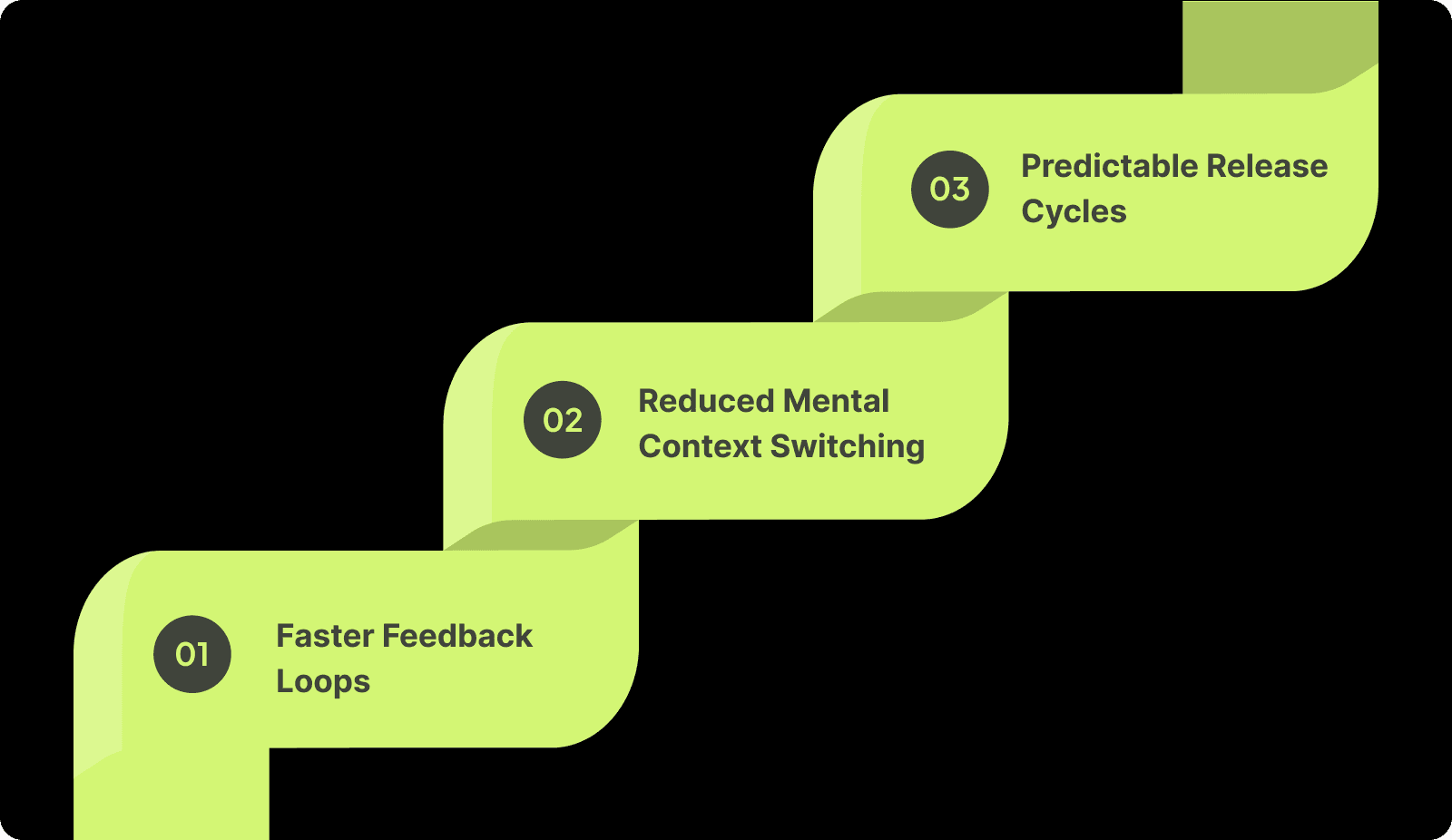
Reducing cycle time transforms your engineering organization in several key ways:
1. Faster Feedback Loops
Shipping code quickly allows your team to receive immediate feedback from users and automated monitoring systems in the production environment. This prevents developers from building complex features on top of buggy or misunderstood logic that was merged days ago.
Faster cycles mean you catch errors while the code is still fresh in the developer's mind, reducing the total cost of fixes.
2. Reduced Mental Context Switching
Long cycle times force developers to juggle multiple active tasks while they wait for reviews or deployments on their previous work. When you prioritize cycle time reduction, you allow engineers to finish one task completely before moving to the next.
This focus improves the quality of the code and reduces the cognitive load that typically leads to developer burnout.
3. Predictable Release Cycles
Stakeholders value predictability just as much as speed, and low cycle times make your roadmap dates much more accurate. When your process is efficient, you can estimate delivery times based on data rather than optimistic guesses.
This builds trust across the organization and allows product teams to plan marketing and sales activities with confidence.
Once you commit to these outcomes, you need to look at the individual stages where your time is being spent.
Also read: How to Measure Developer Productivity Effectively

Deconstructing the Cycle Time Framework
Cycle time is not a single number but a sequence of critical handoffs that each contain potential for delay.
To find your bottlenecks, you must measure these four specific phases:
1. Coding Time
Coding time measures the duration from the first commit made in a local branch to the moment a pull request is opened. High coding time often indicates that your tickets are too large or that your developers are struggling with unclear requirements.
By tracking this, you can see if your team needs better technical specifications before they start writing any code.
2. Pickup Time
Pickup time is the interval between when a PR is created and when a reviewer provides the first piece of feedback. This is often the most significant "Wait State" in the entire lifecycle, where code sits idle and provides zero value.
Reducing this phase usually requires a cultural shift toward prioritizing reviews over starting new feature work.
3. Review Time
Review time covers the back-and-forth communication, additional commits, and final approval needed to merge the code. If this phase is too long, it suggests that your reviews are either too pedantic or that the initial code quality was poor.
Automation can help by handling the routine checks so humans can focus on high-level architectural logic.
4. Deploy Time
Deploy time is the final stretch from the moment code is merged to when it is actually running in production. In a high-performing team, this should be automated and take only a few minutes through a continuous deployment pipeline.
Manual deployment windows or complex release approvals are the primary causes of delays in this final phase.
Transition: Identifying these phases allows you to implement a specific strategy for each area of your delivery pipeline.
4 Simple Steps to Achieve Cycle Time Reduction
This practical manual focuses on actionable workflows that your team can adopt to see immediate improvements in shipping speed.
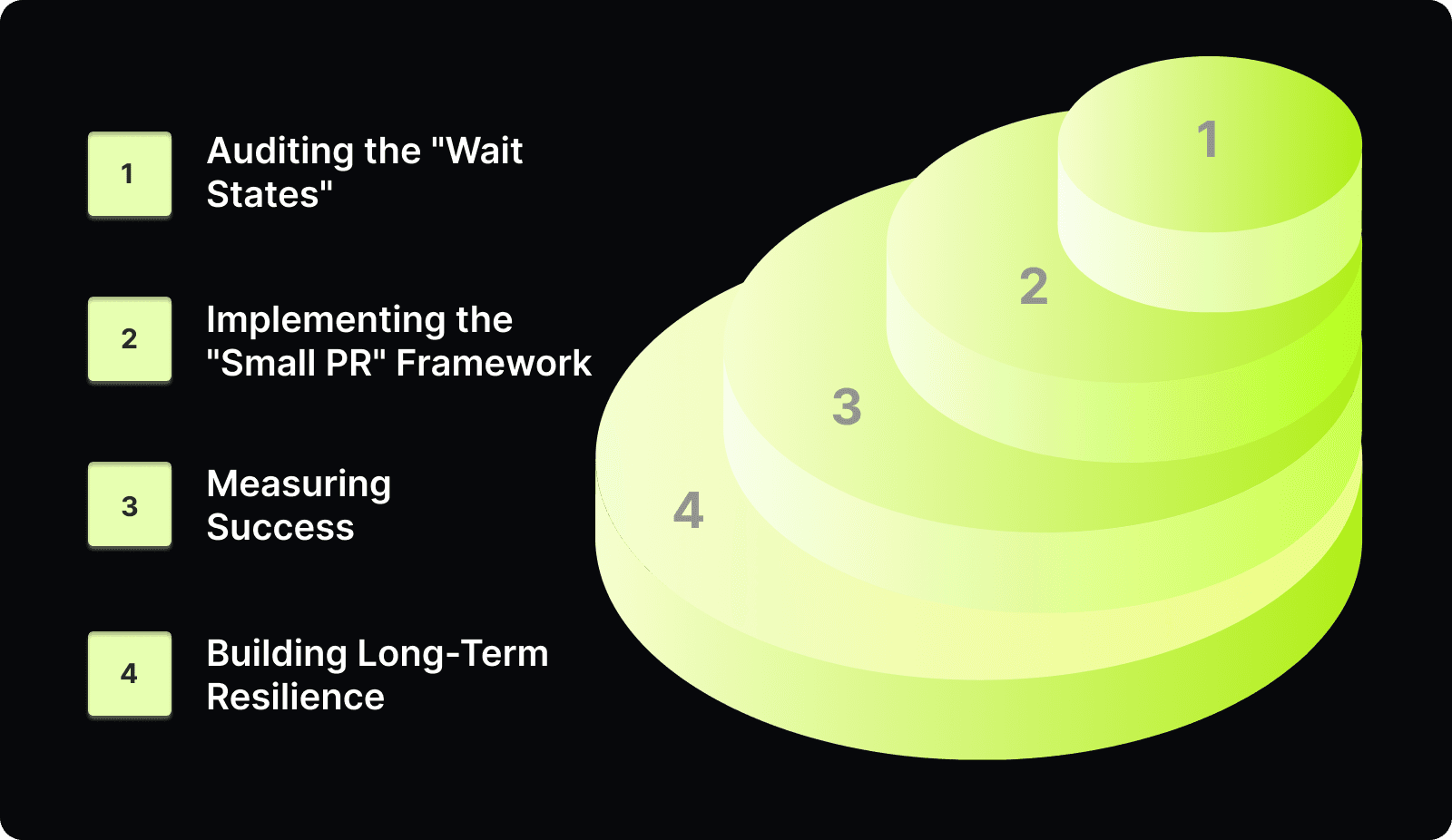
Step 1: Auditing the "Wait States"
You must identify exactly where code sits idle by analyzing the timestamps of your PR transitions over the last thirty days. Most teams find that code spends 60% of its life waiting for a human to look at it rather than being actively written.
Use this audit to find the specific phase where your cycle time is the highest and target it first.
Key actions to take:
Export PR data from GitHub or GitLab for the last month of activity.
Calculate the average time spent in the "Pickup" and "Review" statuses.
Identify which specific repositories have the highest deployment delays.
Find the "Single Points of Failure" where one reviewer is blocking multiple teams.
Share these findings with the team to build consensus on the need for change.
Step 2: Implementing the "Small PR" Framework
PR size is the number one predictor of cycle time because small changes are easier to review and less likely to contain bugs. You should encourage your team to break down large features into multiple PRs of less than 250 lines of code.
This practice ensures that reviewers can provide feedback in minutes rather than hours, keeping the work moving quickly.
Key actions to take:
Set a soft limit for PR size and flag any PR that exceeds 300 lines.
Encourage the use of feature flags to merge partial work into the main branch.
Train developers to use atomic commits that focus on one specific change.
Reward teams that maintain a high volume of small, high-quality PRs.
Provide templates for PR descriptions that make the context clear for reviewers.
Step 3: Measuring Success (The Formulas)
You cannot manage what you do not measure, so you must implement these formulas into your weekly engineering reports.
Cycle Time Formula: Use this to track your overall velocity.
Cycle Time = Deployment Timestamp - First Commit Timestamp
Review Efficiency Ratio: This formula helps you see if your reviews are becoming too conversational or inefficient.
Review Efficiency = Comments per PR \ Review Time
Key actions to take:
Automate the collection of these metrics using a unified engineering dashboard.
Set team-wide goals for reducing the average Pickup Time by 20% each quarter.
Track the correlation between PR size and total Cycle Time.
Review these metrics during every sprint retrospective to identify new blockers.
Avoid using these numbers to punish individuals; focus on improving the process.
Step 4: Building Long-Term Resilience
You must handle the "Massive Refactor" trap where essential architectural changes naturally take longer to complete. For these cases, use long-lived feature branches with frequent internal merges to prevent the "Integration Hell" that usually happens at the end.
Additionally, solve the "Reviewer Bottleneck" by empowering junior developers to perform initial reviews of style and documentation.
Key actions to take:
Create a separate track for "Epic" changes that do not skew your standard metrics.
Implement a "Reviewer Roulette" to distribute the load across the entire team.
Use AI to automate the initial review of linting and security patterns.
Establish a "Review-First" culture where PRs are cleared before new work starts.
Document your architectural standards so reviewers don't have to guess.
Sustainable reduction requires cultural shifts that go beyond simple tool changes.
Get your Cycle Time data in one click. Don't spend your weekends manually calculating timestamps from GitHub logs. Entelligence AI unifies your data to give you real-time visibility into your delivery speed. Book a demo to learn more.
Also read: Understanding Code Scanning for Vulnerabilities
3 Effective Best Practices for Sustainable Speed
Maintaining a fast cycle time requires consistent habits that prevent your delivery pipeline from becoming clogged with unfinished work.
1. Set a WIP (Work-in-Progress) Cap
You should implement a limit on how many active tasks a developer or a team can have at any given time. This "Stop starting, start finishing" mindset ensures that your team stays focused on moving code to the "Done" column.
When a developer reaches their WIP cap, their only priority should be helping a teammate unblock an existing PR.
Why it matters:
Prevents the accumulation of half-finished features that provide no value.
Forces the team to collaborate on resolving blockers in the review phase.
Reduces the mental stress of managing a large list of open tickets.
2. Automate Low-Value Review Tasks
You must use AI to handle the routine parts of a code review, such as checking for style violations, missing tests, and basic security flaws. This allows your human reviewers to focus their limited time on high-level architectural decisions and logic flaws.
By removing the noise from the review process, you make the entire phase faster and more impactful for the developer.
Why it matters:
Reduces the number of review cycles needed to reach an approval.
Ensures consistent quality standards across the entire engineering organization.
Frees up your senior engineers to focus on coaching and architectural strategy.
3. Normalize "Review-First" Culture
In a high-performing team, checking the PR queue should be the first thing a developer does when they start their day. By making peer reviews a top priority, you ensure that code never sits in the "Pickup" phase for more than a few hours.
This cultural shift aligns the entire team toward the goal of cycle time reduction rather than individual ticket counts.
Why it matters:
Drastically reduces the "Wait State" that stalls the delivery pipeline.
Promotes a sense of shared ownership over the codebase and its quality.
Ensures that feedback is provided while the context is still fresh for everyone.
Even with the best strategy, certain mistakes can turn your speed goals into a quality risk.
Common Mistakes When Reducing Cycle Time
Engineering leaders often fall into traps that prioritize the speed of the metric over the health of the actual system.
1. Sacrificing Quality for Velocity
Some teams try to hit their cycle time goals by skipping essential tests or rushing through peer reviews without deep thought. This leads to a surge in production bugs and technical debt that will eventually crash your velocity in the long run.
Tip: Use automated release gates to ensure that speed never comes at the cost of your non-negotiable quality standards.
2. Micromanaging Individual Speed
Using cycle time to track and punish individual developers is the fastest way to destroy team morale and encourage "metric gaming." Cycle time is a team process metric, and high numbers are usually the result of bad handoffs, not slow typing.
Tip: Focus your discussions on process bottlenecks and resource allocation rather than individual performance.
3. Ignoring the "Pickup" Gap
Teams often spend all their energy on making developers code faster while ignoring the three days that a PR sits waiting for a reviewer. Shaving ten minutes off a build time is useless if your code is destined to rot in a queue for seventy-two hours.
Tip: Prioritize the reduction of idle time in the "Pickup" phase before you try to optimize active coding speed.
To achieve true end-to-end efficiency, you need a platform that unifies your data and provides the clarity to act.
Also Read: High Velocity Engineering: Build Teams That Ship Faster

Entelligence AI: Visualizing and Accelerating Your Workflow
Engineering leaders lose quality control when data is scattered across Jira tickets, GitHub PRs, and Slack conversations. This fragmentation hides the "why" behind your bottlenecks, making it impossible to see where code is truly stalled or which teams are struggling.
Without a unified view, you cannot distinguish real progress from a team that is just running faster on a treadmill of technical debt. Entelligence AI unifies the entire engineering workflow by linking daily code execution directly to high-level performance and quality metrics.
Our platform provides the strategic clarity needed to manage the entire bug and feature lifecycle without chasing manual reports.
Key features:
Context-Aware PR Reviews: Our AI analyzes your specific codebase to suggest fixes and catch anti-patterns directly in the IDE, reducing review cycles.
Sprint Assessment Dashboards: Automatically track planned vs. completed work to surface blockers and delays before they impact your release dates.
Automated Blocker Alerts: Receive real-time notifications on stale PRs or high-frequency errors so you can intervene exactly when and where you are needed.
Entelligence AI gives you the clarity to move from guessing to knowing, ensuring your team ships faster with higher-quality code.
Also Read: Sprint Velocity in Scrum: How to Measure and Calculate It Right?
Conclusion
Cycle time reduction is the most effective way to improve your engineering throughput while building a healthier, more focused developer culture. By deconstructing your lifecycle into coding, pickup, and review phases, you can identify and eliminate the idle time that stalls your progress.
Implementing practical frameworks like WIP caps and small PRs ensures that your team maintains a consistent, high-velocity flow of value to your users.
Entelligence AI acts as the partner your engineering organization needs to scale productivity without losing strategic clarity. Our suite provides the context-aware insights required to turn your cycle time metrics into a driver for engineering excellence.
Ready to gain total clarity? Book a demo with Entelligence AI today.
FAQs
Q. What is a "good" cycle time for an enterprise team?
There's no universal number, but elite benchmarks provide a guide. According to DORA research, elite teams have a cycle time of less than one day. For many enterprise teams dealing with legacy systems and complexity, moving from a multi-week cycle to under one week is a massive, valuable win. Focus on improving your own baseline by 20-30% as a first goal.
Q. How do I reduce cycle time without increasing bug rates?
The key is automation and focus. Automate your quality gates (tests, security) so they are non-negotiable and fast. Focus human review time on logic and architecture by using AI for style and linting. This ensures speed is achieved through efficiency and consistency, not by cutting corners.
Q. Can AI actually speed up the review phase?
Absolutely, by addressing the two biggest review delays. First, AI provides instant, contextual feedback in the IDE, allowing developers to fix issues before the PR is even created. Second, it performs a thorough first-pass analysis, catching common bugs and style issues so human reviewers can focus on higher-value feedback, making their time more efficient.
Q. How do I explain the value of cycle time to non-technical stakeholders?
Frame it in business outcomes. Shorter cycle time means: Faster time-to-market for new features, quicker response to customer feedback and bugs, and reduced risk because changes are smaller and easier to manage. It's not about "developer speed"; it's about organizational agility and customer satisfaction.
Q. How often should we review our cycle time metrics?
Incorporate them into your regular rhythms. View real-time dashboards daily in stand-ups to catch blockers. Analyze trends and phase breakdowns in your bi-weekly sprint retrospectives to identify process improvements. This keeps the focus continuous and actionable.
Engineering organizations often struggle with a "Black Box" problem where code disappears into a void after a developer finishes their local work. You might see a feature completed on Tuesday, yet it takes two weeks of waiting for reviews and deployments to reach production.
This delay creates deep frustration for stakeholders and product managers who constantly ask why simple updates are taking so long to ship. According to DORA Research, elite engineering performers maintain a cycle time of less than one day, while low performers take weeks.
Cycle time reduction is the most definitive metric for measuring your overall engineering health and the efficiency of your internal processes. By focusing on this metric, you move beyond guessing and start using data to identify exactly where your delivery pipeline is stalled.
In this article, you will learn the exact formulas and frameworks required to halve your cycle time and build a high-velocity culture.
Overview
The 4-Stage Breakdown: Learn to measure coding, pickup, review, and deployment times to pinpoint your specific team bottlenecks.
The "Small PR" Rule: Understand why PR size is the single biggest predictor of speed and how to enforce it.
WIP Cap Framework: Implement work-in-progress limits to ensure your team stops starting new tasks and starts finishing existing ones.
Automation ROI Formula: Use quantitative formulas to calculate your review efficiency and identify where manual overhead is draining resources.
AI Review Integration: See how automated, context-aware code reviews can eliminate the "Pickup Time" gap that stalls most organizations.
Cultural Shifts: Move from a "coding-first" mindset to a "review-first" culture to ensure work never sits idle in a queue.
What is Cycle Time in Engineering?
Cycle time reduction focuses on the total duration from the moment a developer makes their first commit to the moment code runs in production. It measures the velocity of your work once it has actually started, making it the best indicator of your internal process efficiency.
Metric | Definition | Focus |
Cycle Time | First commit to Production deployment | Process and handoff efficiency |
Lead Time | Ticket creation to Production deployment | Backlog management and prioritization |
Takt Time | Average time between completed features | Matching the rate of customer demand |
To improve this metric, you must first deconstruct it into its composite parts to find where time is actually lost.
Also read: Understanding Velocity in Agile Software Development
One of the largest contributors to high cycle time is the idle period spent waiting for manual peer reviews. Entelligence AI addresses this by providing context-aware feedback in the IDE, reducing handoff delays before the formal review process begins. Book a demo to see how this intelligence accelerates your delivery speed.
Why Cycle Time Reduction is Your North Star Metric?
Reducing cycle time transforms your engineering organization by aligning your daily work with actual business value. When your team ships faster, you create a virtuous cycle of high morale and predictable delivery that benefits every stakeholder.

Reducing cycle time transforms your engineering organization in several key ways:
1. Faster Feedback Loops
Shipping code quickly allows your team to receive immediate feedback from users and automated monitoring systems in the production environment. This prevents developers from building complex features on top of buggy or misunderstood logic that was merged days ago.
Faster cycles mean you catch errors while the code is still fresh in the developer's mind, reducing the total cost of fixes.
2. Reduced Mental Context Switching
Long cycle times force developers to juggle multiple active tasks while they wait for reviews or deployments on their previous work. When you prioritize cycle time reduction, you allow engineers to finish one task completely before moving to the next.
This focus improves the quality of the code and reduces the cognitive load that typically leads to developer burnout.
3. Predictable Release Cycles
Stakeholders value predictability just as much as speed, and low cycle times make your roadmap dates much more accurate. When your process is efficient, you can estimate delivery times based on data rather than optimistic guesses.
This builds trust across the organization and allows product teams to plan marketing and sales activities with confidence.
Once you commit to these outcomes, you need to look at the individual stages where your time is being spent.
Also read: How to Measure Developer Productivity Effectively

Deconstructing the Cycle Time Framework
Cycle time is not a single number but a sequence of critical handoffs that each contain potential for delay.
To find your bottlenecks, you must measure these four specific phases:
1. Coding Time
Coding time measures the duration from the first commit made in a local branch to the moment a pull request is opened. High coding time often indicates that your tickets are too large or that your developers are struggling with unclear requirements.
By tracking this, you can see if your team needs better technical specifications before they start writing any code.
2. Pickup Time
Pickup time is the interval between when a PR is created and when a reviewer provides the first piece of feedback. This is often the most significant "Wait State" in the entire lifecycle, where code sits idle and provides zero value.
Reducing this phase usually requires a cultural shift toward prioritizing reviews over starting new feature work.
3. Review Time
Review time covers the back-and-forth communication, additional commits, and final approval needed to merge the code. If this phase is too long, it suggests that your reviews are either too pedantic or that the initial code quality was poor.
Automation can help by handling the routine checks so humans can focus on high-level architectural logic.
4. Deploy Time
Deploy time is the final stretch from the moment code is merged to when it is actually running in production. In a high-performing team, this should be automated and take only a few minutes through a continuous deployment pipeline.
Manual deployment windows or complex release approvals are the primary causes of delays in this final phase.
Transition: Identifying these phases allows you to implement a specific strategy for each area of your delivery pipeline.
4 Simple Steps to Achieve Cycle Time Reduction
This practical manual focuses on actionable workflows that your team can adopt to see immediate improvements in shipping speed.

Step 1: Auditing the "Wait States"
You must identify exactly where code sits idle by analyzing the timestamps of your PR transitions over the last thirty days. Most teams find that code spends 60% of its life waiting for a human to look at it rather than being actively written.
Use this audit to find the specific phase where your cycle time is the highest and target it first.
Key actions to take:
Export PR data from GitHub or GitLab for the last month of activity.
Calculate the average time spent in the "Pickup" and "Review" statuses.
Identify which specific repositories have the highest deployment delays.
Find the "Single Points of Failure" where one reviewer is blocking multiple teams.
Share these findings with the team to build consensus on the need for change.
Step 2: Implementing the "Small PR" Framework
PR size is the number one predictor of cycle time because small changes are easier to review and less likely to contain bugs. You should encourage your team to break down large features into multiple PRs of less than 250 lines of code.
This practice ensures that reviewers can provide feedback in minutes rather than hours, keeping the work moving quickly.
Key actions to take:
Set a soft limit for PR size and flag any PR that exceeds 300 lines.
Encourage the use of feature flags to merge partial work into the main branch.
Train developers to use atomic commits that focus on one specific change.
Reward teams that maintain a high volume of small, high-quality PRs.
Provide templates for PR descriptions that make the context clear for reviewers.
Step 3: Measuring Success (The Formulas)
You cannot manage what you do not measure, so you must implement these formulas into your weekly engineering reports.
Cycle Time Formula: Use this to track your overall velocity.
Cycle Time = Deployment Timestamp - First Commit Timestamp
Review Efficiency Ratio: This formula helps you see if your reviews are becoming too conversational or inefficient.
Review Efficiency = Comments per PR \ Review Time
Key actions to take:
Automate the collection of these metrics using a unified engineering dashboard.
Set team-wide goals for reducing the average Pickup Time by 20% each quarter.
Track the correlation between PR size and total Cycle Time.
Review these metrics during every sprint retrospective to identify new blockers.
Avoid using these numbers to punish individuals; focus on improving the process.
Step 4: Building Long-Term Resilience
You must handle the "Massive Refactor" trap where essential architectural changes naturally take longer to complete. For these cases, use long-lived feature branches with frequent internal merges to prevent the "Integration Hell" that usually happens at the end.
Additionally, solve the "Reviewer Bottleneck" by empowering junior developers to perform initial reviews of style and documentation.
Key actions to take:
Create a separate track for "Epic" changes that do not skew your standard metrics.
Implement a "Reviewer Roulette" to distribute the load across the entire team.
Use AI to automate the initial review of linting and security patterns.
Establish a "Review-First" culture where PRs are cleared before new work starts.
Document your architectural standards so reviewers don't have to guess.
Sustainable reduction requires cultural shifts that go beyond simple tool changes.
Get your Cycle Time data in one click. Don't spend your weekends manually calculating timestamps from GitHub logs. Entelligence AI unifies your data to give you real-time visibility into your delivery speed. Book a demo to learn more.
Also read: Understanding Code Scanning for Vulnerabilities
3 Effective Best Practices for Sustainable Speed
Maintaining a fast cycle time requires consistent habits that prevent your delivery pipeline from becoming clogged with unfinished work.
1. Set a WIP (Work-in-Progress) Cap
You should implement a limit on how many active tasks a developer or a team can have at any given time. This "Stop starting, start finishing" mindset ensures that your team stays focused on moving code to the "Done" column.
When a developer reaches their WIP cap, their only priority should be helping a teammate unblock an existing PR.
Why it matters:
Prevents the accumulation of half-finished features that provide no value.
Forces the team to collaborate on resolving blockers in the review phase.
Reduces the mental stress of managing a large list of open tickets.
2. Automate Low-Value Review Tasks
You must use AI to handle the routine parts of a code review, such as checking for style violations, missing tests, and basic security flaws. This allows your human reviewers to focus their limited time on high-level architectural decisions and logic flaws.
By removing the noise from the review process, you make the entire phase faster and more impactful for the developer.
Why it matters:
Reduces the number of review cycles needed to reach an approval.
Ensures consistent quality standards across the entire engineering organization.
Frees up your senior engineers to focus on coaching and architectural strategy.
3. Normalize "Review-First" Culture
In a high-performing team, checking the PR queue should be the first thing a developer does when they start their day. By making peer reviews a top priority, you ensure that code never sits in the "Pickup" phase for more than a few hours.
This cultural shift aligns the entire team toward the goal of cycle time reduction rather than individual ticket counts.
Why it matters:
Drastically reduces the "Wait State" that stalls the delivery pipeline.
Promotes a sense of shared ownership over the codebase and its quality.
Ensures that feedback is provided while the context is still fresh for everyone.
Even with the best strategy, certain mistakes can turn your speed goals into a quality risk.
Common Mistakes When Reducing Cycle Time
Engineering leaders often fall into traps that prioritize the speed of the metric over the health of the actual system.
1. Sacrificing Quality for Velocity
Some teams try to hit their cycle time goals by skipping essential tests or rushing through peer reviews without deep thought. This leads to a surge in production bugs and technical debt that will eventually crash your velocity in the long run.
Tip: Use automated release gates to ensure that speed never comes at the cost of your non-negotiable quality standards.
2. Micromanaging Individual Speed
Using cycle time to track and punish individual developers is the fastest way to destroy team morale and encourage "metric gaming." Cycle time is a team process metric, and high numbers are usually the result of bad handoffs, not slow typing.
Tip: Focus your discussions on process bottlenecks and resource allocation rather than individual performance.
3. Ignoring the "Pickup" Gap
Teams often spend all their energy on making developers code faster while ignoring the three days that a PR sits waiting for a reviewer. Shaving ten minutes off a build time is useless if your code is destined to rot in a queue for seventy-two hours.
Tip: Prioritize the reduction of idle time in the "Pickup" phase before you try to optimize active coding speed.
To achieve true end-to-end efficiency, you need a platform that unifies your data and provides the clarity to act.
Also Read: High Velocity Engineering: Build Teams That Ship Faster

Entelligence AI: Visualizing and Accelerating Your Workflow
Engineering leaders lose quality control when data is scattered across Jira tickets, GitHub PRs, and Slack conversations. This fragmentation hides the "why" behind your bottlenecks, making it impossible to see where code is truly stalled or which teams are struggling.
Without a unified view, you cannot distinguish real progress from a team that is just running faster on a treadmill of technical debt. Entelligence AI unifies the entire engineering workflow by linking daily code execution directly to high-level performance and quality metrics.
Our platform provides the strategic clarity needed to manage the entire bug and feature lifecycle without chasing manual reports.
Key features:
Context-Aware PR Reviews: Our AI analyzes your specific codebase to suggest fixes and catch anti-patterns directly in the IDE, reducing review cycles.
Sprint Assessment Dashboards: Automatically track planned vs. completed work to surface blockers and delays before they impact your release dates.
Automated Blocker Alerts: Receive real-time notifications on stale PRs or high-frequency errors so you can intervene exactly when and where you are needed.
Entelligence AI gives you the clarity to move from guessing to knowing, ensuring your team ships faster with higher-quality code.
Also Read: Sprint Velocity in Scrum: How to Measure and Calculate It Right?
Conclusion
Cycle time reduction is the most effective way to improve your engineering throughput while building a healthier, more focused developer culture. By deconstructing your lifecycle into coding, pickup, and review phases, you can identify and eliminate the idle time that stalls your progress.
Implementing practical frameworks like WIP caps and small PRs ensures that your team maintains a consistent, high-velocity flow of value to your users.
Entelligence AI acts as the partner your engineering organization needs to scale productivity without losing strategic clarity. Our suite provides the context-aware insights required to turn your cycle time metrics into a driver for engineering excellence.
Ready to gain total clarity? Book a demo with Entelligence AI today.
FAQs
Q. What is a "good" cycle time for an enterprise team?
There's no universal number, but elite benchmarks provide a guide. According to DORA research, elite teams have a cycle time of less than one day. For many enterprise teams dealing with legacy systems and complexity, moving from a multi-week cycle to under one week is a massive, valuable win. Focus on improving your own baseline by 20-30% as a first goal.
Q. How do I reduce cycle time without increasing bug rates?
The key is automation and focus. Automate your quality gates (tests, security) so they are non-negotiable and fast. Focus human review time on logic and architecture by using AI for style and linting. This ensures speed is achieved through efficiency and consistency, not by cutting corners.
Q. Can AI actually speed up the review phase?
Absolutely, by addressing the two biggest review delays. First, AI provides instant, contextual feedback in the IDE, allowing developers to fix issues before the PR is even created. Second, it performs a thorough first-pass analysis, catching common bugs and style issues so human reviewers can focus on higher-value feedback, making their time more efficient.
Q. How do I explain the value of cycle time to non-technical stakeholders?
Frame it in business outcomes. Shorter cycle time means: Faster time-to-market for new features, quicker response to customer feedback and bugs, and reduced risk because changes are smaller and easier to manage. It's not about "developer speed"; it's about organizational agility and customer satisfaction.
Q. How often should we review our cycle time metrics?
Incorporate them into your regular rhythms. View real-time dashboards daily in stand-ups to catch blockers. Analyze trends and phase breakdowns in your bi-weekly sprint retrospectives to identify process improvements. This keeps the focus continuous and actionable.
We raised $5M to run your Engineering team on Autopilot
Watch our launch video
Talk to Sales
Turn engineering signals into leadership decisions
Connect with our team to see how Entelliegnce helps engineering leaders with full visibility into sprint performance, Team insights & Product Delivery
Talk to Sales
Turn engineering signals into leadership decisions
Connect with our team to see how Entelliegnce helps engineering leaders with full visibility into sprint performance, Team insights & Product Delivery
Try Entelligence now