Agile Development Burnout: Causes, Warning Signs, and Recovery
Jan 20, 2026
Jan 20, 2026
Your engineering team was supposed to ship faster with Agile. Instead, you’re watching your best developers mentally check out by sprint five.
The promise was clear: shorter cycles, better collaboration, continuous delivery. But somewhere between daily standups, sprint commitments, and back-to-back reviews, that promise turned into a grind that’s wearing teams down.
According to the LeadDev Engineering Leadership Report, 22% of developers report experiencing critical levels of burnout, while another 24% say they’re moderately burned out. That means nearly half of engineering teams are operating under sustained exhaustion. In Agile environments, this pressure compounds sprint after sprint, with the pace never truly slowing and recovery rarely occurring.
If you’re seeing fatigue on your Agile team, it’s not a failure of the methodology itself. It’s a signal that how Agile is being implemented is unsustainable. In this article, you’ll learn why Agile development burnout happens, how to spot the warning signs before they erode delivery and morale, and the practical steps engineering leaders can take to restore team health without sacrificing outcomes.
Key Takeaways
System-level conditions primarily drive agile development burnout; it emerges when delivery pressure outpaces clarity.
Early burnout signals show up in flow, quality, and engagement patterns long before teams visibly slow down.
Sustainable Agile requires planning around real capacity, not optimistic assumptions or historical velocity alone.
Making invisible engineering work visible is critical to protecting quality, morale, and long-term delivery health.
Preventing agile development burnout depends on data-driven visibility, enabling leaders to act early instead of reacting late.
What Is Agile Development Burnout?
Agile development burnout is chronic physical and mental exhaustion that occurs when developers work under pressure to deliver software in short, sprint cycles without adequate recovery time.
This type of burnout is directly tied to how you implement Agile and Scrum practices. Agile development burnout shows up in three ways:
Chronic Exhaustion: Developers feel drained before the workday starts. The energy that once fueled their problem-solving has disappeared.
Declining Efficacy: Team members who took pride in their code now just want tickets closed. Work that used to excite them feels like an endless treadmill.
Emotional Detachment: Developers disconnect from the product, the team, and the company's mission. They show up and go through the motions, but the engagement that made them valuable contributors has evaporated.
What makes scrum developer burnout particularly dangerous is its gradual onset. Teams don't collapse after one intense sprint. They slowly degrade over multiple cycles until what was once a high-performing team becomes a group of people trying to survive until Friday.
Also read: Exploring PR Review AI Tools: Boost Code Quality Fast
Why Agile Teams Burn Out (The Real Causes)
The root causes of agile development burnout rarely appear in sprint metrics. They live in the gap between what gets planned and what developers actually experience every day.
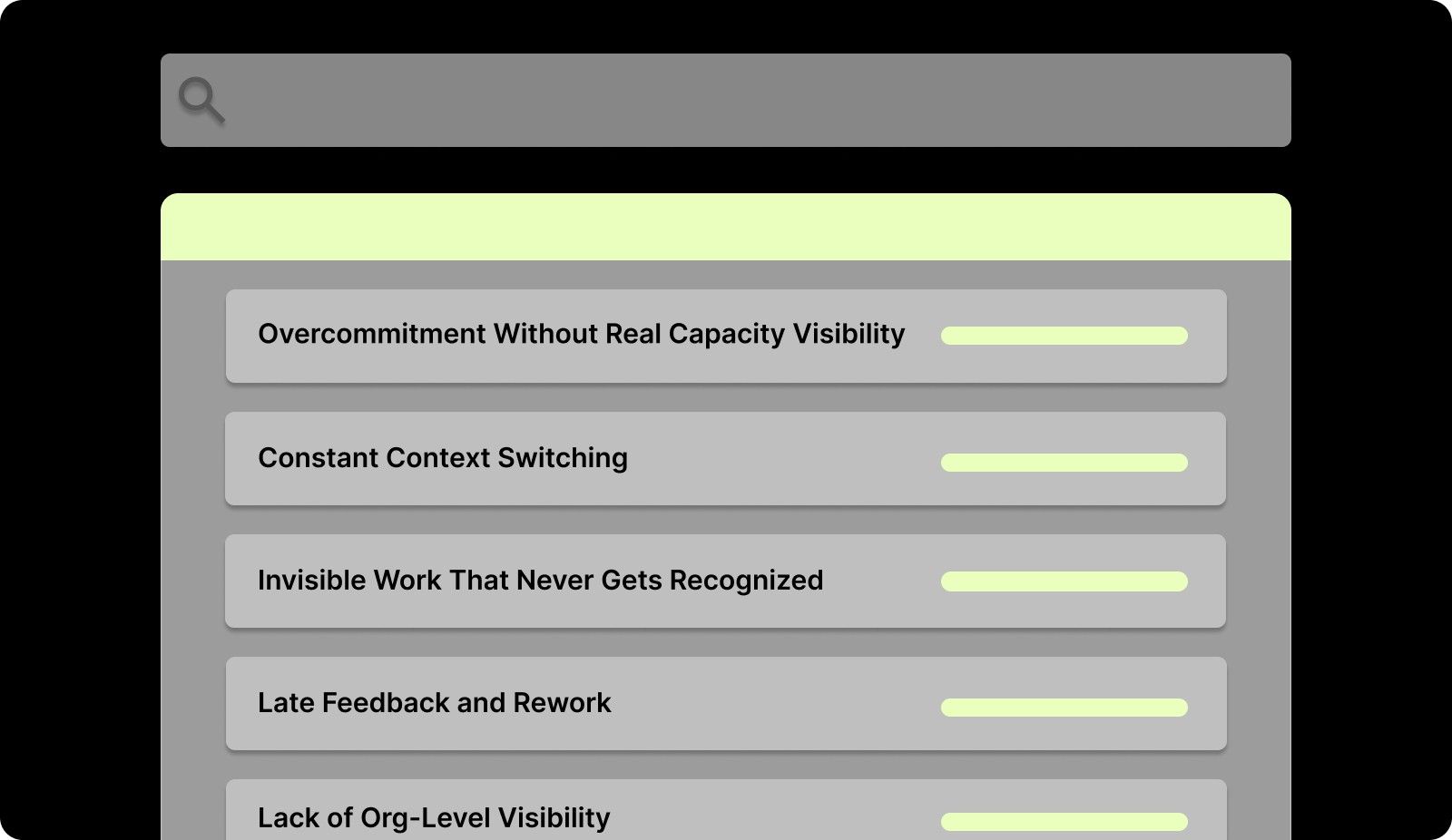
1. Overcommitment Without Real Capacity Visibility
Sprint planning often assumes full availability. Meetings, reviews, production issues, and time off rarely make it into the equation.
Most teams confuse availability with capacity. A full-time engineer does not have 40 hours of focused development time. In reality:
Meetings, reviews, and support work consume a large portion of the week.
Context switching quietly eats into focus.
Planned work gets squeezed into what’s left.
When sprints are planned at full capacity, teams start behind from day one. Developers stretch nights and weekends to meet commitments that were unrealistic to begin with. Repeated sprint after sprint, burnout becomes inevitable.
The problem compounds when velocity from a crunch-heavy sprint becomes the new baseline. Output achieved through exhaustion is unsustainable pressure disguised as productivity.
2. Constant Context Switching
Agile teams rarely work on one thing at a time. A typical day includes:
Sprint tasks.
Pull request reviews.
Slack and Teams interruptions.
Meetings across product, design, and planning.
Unplanned incidents or urgent fixes.
An eight-hour workday filled with interruptions often results in only a few hours of real focus. Agile ceremonies add to the load. Standups, planning, refinement, reviews, and retrospectives can consume a full day per sprint before development even begins.
When developers are expected to be “always available,” deep work becomes nearly impossible. Complex problems require uninterrupted thinking; constant switching slowly erodes it.
3. Invisible Work That Never Gets Recognized
Sprint boards show completed tickets. They don’t show:
Mentoring junior teammates.
Reviewing and improving others’ code.
Investigating issues that don’t lead to fixes.
Refactoring or improving test coverage.
This invisible work is essential to long-term health and quality. But when it isn’t tracked or acknowledged, developers internalize a simple message: only ticket completion matters.
When recognition and performance feedback revolve around velocity alone:
Foundational work gets postponed.
Technical debt accumulates.
Quality quietly degrades.
Over time, teams slow down under the weight of the work they were never “allowed” to prioritize.
4. Late Feedback and Rework
Teams often spend entire sprints building features, only to receive major feedback during demos or reviews. The result:
Carryover work.
Missed sprint goals.
A sense that effort was wasted.
Late feedback breaks momentum and morale. When requirements change without adjusting scope or timelines, teams are pushed into rework instead of progress.
With time, trust erodes. Developers stop assuming their work will land as intended, invest less care, and disengage emotionally.
5. Lack of Org-Level Visibility
Engineering teams may be working hard and meeting sprint goals, but outside the team, progress often appears slow or unclear.
Without visibility into:
Workload distribution.
Bottlenecks.
Constraints and tradeoffs.
Leaders struggle to advocate for realistic timelines. Pressure increases because there’s no shared understanding of what’s actually happening.
This visibility gap also hides impact. Critical contributions, stabilizing systems, reducing risk, improving performance, go unnoticed, accelerating burnout across teams.

Also read: How to Improve Software Engineering Management and Team Performance?
Early Warning Signs of Burnout in Agile Teams
Burnout in Agile teams doesn’t show up as a sudden breakdown. It usually appears as small changes in flow, quality, and engagement, the kind that are easy to dismiss if you’re only looking at delivery outcomes.
The goal here isn’t to label teams as “burnt out,” but to help you notice when the system is under strain early enough to respond.
Declining and Unpredictable Sprint Velocity
Velocity rarely collapses overnight. More often, it becomes inconsistent.
You might notice completed story points trending down over a few sprints, or delivery becoming harder to forecast even when scope and team size stay the same. Each sprint has a reasonable explanation, but the overall pattern points to rising cognitive load.
At this stage, teams are still working hard; they just need more time and more effort to reach the same outcomes.
Helpful signals to watch:
Completed story points across the last 8–10 sprints.
Percentage of planned work that carries over from sprint to sprint.
Gaps between committed and delivered scope are becoming routine.
Increased After-Hours Work and Weekend Commits
Occasional late nights happen. When they become predictable, they’re worth paying attention to.
If engineers regularly push commits late at night or over weekends, it often means work no longer fits comfortably within regular hours. This is a sign that the system is stretched.
Sustained after-hours work is one of the earliest indicators that a team is compensating rather than operating sustainably.
PR Review Times Expanding Significantly
Code reviews are one of the first workflows to slow down when mental bandwidth tightens.
PRs may sit longer before getting reviewed, or reviews may happen quickly but with less depth. Feedback becomes shorter, and more issues surface later in testing or production.
Watch for patterns like:
Longer time to first review.
Growing PR queues.
Shallow reviews followed by downstream bugs.
Rising Production Bugs and Quality Issues
Quality usually declines gradually, not dramatically.
Small issues start slipping through. Teams spend more time fixing regressions or hotfixes from earlier sprints. Refactoring gets postponed in favor of closing tickets.
These are often early tradeoffs teams make to maintain delivery, but they accumulate quickly.
Things to notice:
Bug creation rate per sprint.
Time spent on fixes versus new development.
Change failure rates after deployments.
Silent Retrospectives and Declining Team Engagement
One of the clearest and quietest signals is reduced participation.
Retrospectives still happen, but fewer insights surface. Discussions feel shorter or more procedural. Concerns don’t escalate, even when issues persist.
Silence here usually means people are conserving energy or aren’t confident that raising issues will lead to change.
Things to pay attention to:
Fewer actionable takeaways from retros.
Limited follow-through on improvement items.
Lower participation in team discussions.
Increased Sick Days and Unplanned Absences
Burnout often shows up physically before it’s acknowledged mentally.
You may see more unplanned time off, especially around intense delivery periods. Individuals who were previously consistent may start taking intermittent days away.
Helpful signals to watch:
Unplanned absence frequency.
Clusters of sick days around sprint deadlines.
Changes in attendance trends over time.
Loss of Technical Curiosity and Professional Growth
When teams are operating well, curiosity naturally arises.
When burnout begins, learning and experimentation are the first things to pause. Engineers focus on completing current work rather than improving systems or exploring new approaches.
Early signs include:
Less participation in knowledge sharing.
Reduced interest in improvement work.
Fewer technical discussions beyond immediate tasks.
None of these signals means something is “wrong.” They mean something is tight.
However, most early signs of agile development burnout don’t appear in Jira dashboards or sprint velocity charts. They live in PR cycles, workload imbalance, review delays, and invisible effort that leaders rarely see in one place.
Entelligence AI helps engineering leaders surface these patterns early by turning delivery flow, code review data, and team activity into clear, actionable insight, so you can rebalance work before burnout impacts morale or output. Book a free demo to see how it simplifies your work.
Also read: Sprint Review Guide: Definition, Goals, and Tips

Proven Strategies You Can Use to Avoid Agile Development Burnout
Recognizing burnout is only valuable if you follow it with action. The strategies below are specific interventions you can implement to protect your team's mental health and productivity.
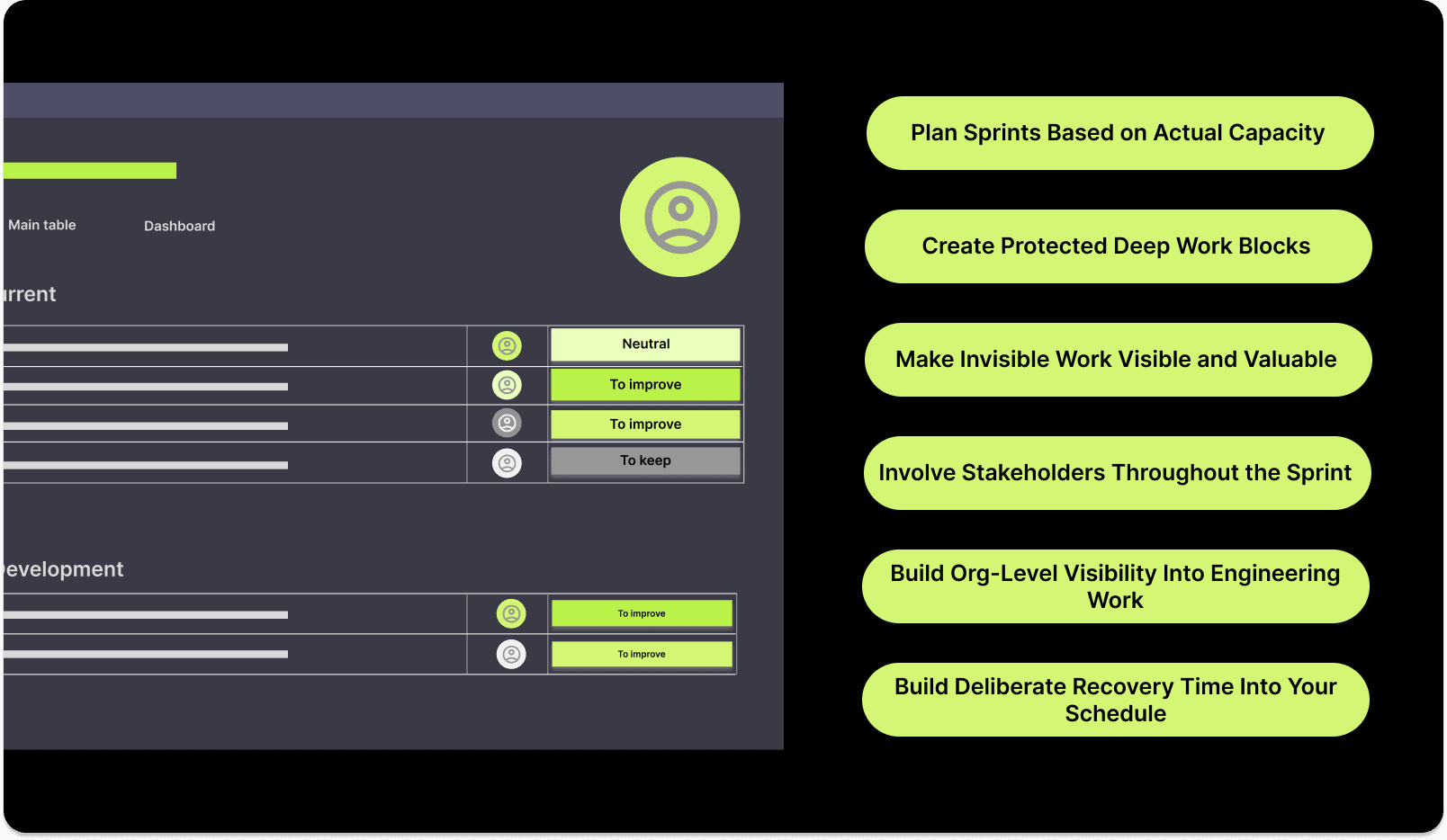
1. Plan Sprints Based on Actual Capacity
Most teams plan assuming 40 productive hours per week. This assumption is wrong. Meetings, code reviews, interruptions, and administrative tasks consume 30-40% of time before planned work begins.
How to implement it:
Calculate your team's real productive hours:
Track one typical week for your team.
Include all meetings, code reviews, interruptions, and admin tasks.
Establish a focus factor for sprint planning:
If your team averages 25 productive hours per week over a two-week sprint, that's 50 hours per person.
Build in a 20% buffer for unplanned work (production issues, urgent bugs, unexpected stakeholder requests always appear).
Make capacity visible during sprint planning, and show precisely how many hours are available after all fixed commitments.
Track utilization sprint over sprint:
If your team is consistently at 90%+ utilization, you're planning too tightly.
Aim for 70-80% utilization to allow breathing room.
It's important to note that velocity might initially appear to drop, but the work you deliver will be higher quality and require less rework.
2. Create Protected Deep Work Blocks
Constant interruptions destroy productivity and accelerate burnout. Developers need predictable blocks of uninterrupted time to solve complex problems.
How to implement it:
Designate no-meeting zones:
Block out specific half-days (e.g., Tuesday and Thursday afternoons) as completely meeting-free for all developers.
Protect this time in team calendars.
Batch Agile ceremonies:
Run standups, planning, reviews, and retrospectives on the same schedule (e.g., Mondays and Fridays).
Leave mid-week clear for focused development work.
Implement async standups:
Developers post updates in Slack or project management tools when it makes sense for their workflow.
Removes daily interruptions to focused work.
Set communication expectations:
Non-urgent Slack questions get answered within 4 hours.
Permit developers to batch their communication.
Reserve synchronous interruptions for genuine emergencies only.
Track and limit meeting time:
Monitor meeting hours per person per week.
Make this metric visible to leadership.
If someone spends 20+ hours in meetings, they can't do development work.
3. Make Invisible Work Visible and Valuable
Your sprint board only shows ticket completion. All the critical work that keeps your system healthy but doesn't move tickets forward becomes invisible and undervalued.
How to implement it:
Create explicit tickets for untracked work:
Code reviews (treat them as work items worth story points).
Mentoring and pairing sessions.
Production support and incident response.
Technical debt reduction.
Architecture planning and documentation.
Dependency updates and security patches.
Include health metrics in sprint reviews:
Show stakeholders the number of bugs prevented through code review.
Present performance improvements from refactoring.
Highlight test coverage increases.
Make quality work visible alongside feature demos.
Build quality time into every sprint:
Allocate 20-30% of sprint capacity to work that improves the system but doesn't ship customer-facing features.
Make this allocation explicit and non-negotiable.
4. Involve Stakeholders Throughout the Sprint
Late feedback kills morale and creates rework. By the time stakeholders see work at the sprint review, too much time has been invested to change direction easily.
How to implement it:
Schedule mid-sprint check-ins:
For any feature taking more than three days, show work-in-progress at 30-40% completion.
Get feedback when changes are still easy and cheap to make.
Use staging environments and feature flags:
Give stakeholders hands-on access to features before they're "done."
Written specs and mockups don't reveal misalignments the way working software does.
Record async demo videos:
When you finish significant portions of a feature, record a 2-3 minute demo.
Post in Slack or email to stakeholders.
Get feedback without waiting for formal meetings.
Make sprint boards visible to product owners:
When developers document decisions or raise questions in tickets, product owners can respond quickly.
Prevents developers from being blocked waiting for input.
Create a feedback SLA:
Product owners commit to reviewing in-progress work within 24 hours of notification.
This becomes a two-way agreement: developers show work early, product owners respond promptly.
5. Build Org-Level Visibility Into Engineering Work
Engineering leaders need data to advocate for their teams and make informed decisions. Without visibility, you can't push back on unrealistic timelines or identify systemic issues before they become crises.
How to implement it:
Create leadership dashboards:
Show sprint completion rates across teams.
Display PR review times and bottlenecks.
Track production incident frequency and resolution times.
Monitor developer utilization and capacity.
Generate automated sprint health reports:
Highlight blockers and capacity issues before they derail delivery.
Surface risks that need leadership attention.
Make systemic problems visible.
Track individual contributions beyond tickets:
Code review quality and volume.
Bug prevention and quality improvements.
Mentoring and knowledge sharing.
Technical improvements and debt reduction.
Connect engineering work to business outcomes:
Show how technical improvements directly impact customer metrics or revenue.
Make the value of quality work tangible to non-technical stakeholders.
6. Build Deliberate Recovery Time Into Your Schedule
Continuous sprints without breaks create unsustainable pressure. Your team needs time to recover, explore, and work on professional interests.
How to implement it:
End sprints with breathing room:
End sprints Thursday afternoon.
Use Friday mornings for sprint reviews and retrospectives.
Give teams Friday afternoons for personal projects, learning, or cleanup work.
Start the next sprint on Monday with fresh energy.
Schedule innovation sprints:
Every 6-8 sprints, dedicate one sprint to whatever interests your team professionally.
Let developers work on technical debt, learn new tools, or build internal improvements.
These breaks prevent monotony and re-engage creativity.
Implement true vacation policies:
Developers should completely disconnect without fear of returning to chaos.
Pair developers so someone in each area always knows enough to handle emergencies.
No "working vacations" or expectation of checking messages.
Create quarterly refactoring weeks:
Once per quarter, the only goal is to improve code quality.
Update dependencies, eliminate technical debt, and improve test coverage.
Make the time to fix things that have been nagging the team.
Also read: Effective Strategies to Reduce Technical Debt
How Entelligence AI Helps Prevent Agile Burnout?
The strategies above work. But they require visibility that most engineering teams don't have. You can't fix what you can't see. Traditional Agile tools show you tickets and velocity, not the underlying health of your team or the actual capacity they have to deliver.
Entelligence AI gives you that missing visibility layer.
Entelligence AI gives you the data you need to make smarter decisions about sprint planning, resource allocation, and team health, so burnout never has a chance to take root.
Here's exactly how Entelligence AI addresses the root causes of agile development burnout:
Here’s how that clarity shows up in practice:
Planning sprints around real capacity: Sprint commitments improve when teams plan based on how work actually flows. Entelligence’s Sprint Assessments use historical delivery patterns, review load, meetings, and unplanned work to reflect actual capacity, helping teams avoid chronic overcommitment.
Making invisible work visible and valued: Reviews, mentoring, refactors, and preventative fixes often disappear from sprint boards. With Individual and Team Insights, Entelligence surfaces these contributions alongside ticketed work, ensuring effort that protects quality and sustainability is recognized.
Identifying burnout risk before it escalates: Burnout rarely appears overnight. Changes in PR cycle times, uneven workload distribution, and repeated spillovers signal rising pressure early. Entelligence’s Individual Insights highlight these patterns so managers can rebalance work before exhaustion sets in.
Reducing rework through earlier feedback: Late feedback is one of the fastest paths to demoralization. Entelligence’s Contextual Code Reviews provide in-IDE feedback during development, helping teams catch issues early and avoid weeks of rework after sprint reviews.
Giving leaders clarity without micromanagement: When delivery feels unclear, pressure increases. Entelligence’s Leadership Dashboards provide real-time visibility into flow, bottlenecks, and constraints across teams, allowing leaders to set expectations and defend timelines using data rather than check-ins.
Entelligence AI doesn't push your developers to work harder. We give you the clarity you need to work smarter. We help you identify problems before they become crises, plan sprints based on reality, and create an engineering culture where sustainable pace is your actual practice.
Conclusion
Agile development burnout isn’t something you fix with better intentions or more effort. Once you’ve identified the patterns, the real work is making those insights actionable, consistently, and at scale.
Entelligence AI gives you the visibility that makes every strategy in this article implementable. It shows you the real health of your engineering organization, so you can make informed adjustments before burnout takes hold.
Stop managing by gut feeling and start leading with data. Book a demo with Entelligence AI to see exactly how your team is working, where bottlenecks are forming, and what specific changes will prevent agile development burnout before it starts.
FAQs
1. What is the 20–30–50 rule in Agile?
In Agile, the 20–30–50 rule is commonly used as a capacity allocation guideline. Teams allocate 50% to new feature development, 30% to technical debt or improvements, and 20% to bugs, support, or urgent work, helping prevent overload and burnout.
2. How long does it take to see improvement after fixing burnout signals?
Many teams see improved flow and predictability within two to three sprints once capacity planning, feedback timing, and workload visibility are corrected.
3. Should engineering leaders intervene at the team or org level first?
Leaders should start at the system level, fixing planning, visibility, and feedback loops before addressing individual teams or performance concerns.
4. Can remote or distributed Agile teams burn out faster?
Yes. Distributed teams face higher context switching, communication overhead, and longer feedback loops, which can accelerate burnout if visibility and alignment are weak.
5. How do you balance sustainability with aggressive business deadlines?
Sustainability comes from transparency. When leaders understand real capacity and constraints, deadlines become informed trade-offs rather than pressure-driven commitments.
Your engineering team was supposed to ship faster with Agile. Instead, you’re watching your best developers mentally check out by sprint five.
The promise was clear: shorter cycles, better collaboration, continuous delivery. But somewhere between daily standups, sprint commitments, and back-to-back reviews, that promise turned into a grind that’s wearing teams down.
According to the LeadDev Engineering Leadership Report, 22% of developers report experiencing critical levels of burnout, while another 24% say they’re moderately burned out. That means nearly half of engineering teams are operating under sustained exhaustion. In Agile environments, this pressure compounds sprint after sprint, with the pace never truly slowing and recovery rarely occurring.
If you’re seeing fatigue on your Agile team, it’s not a failure of the methodology itself. It’s a signal that how Agile is being implemented is unsustainable. In this article, you’ll learn why Agile development burnout happens, how to spot the warning signs before they erode delivery and morale, and the practical steps engineering leaders can take to restore team health without sacrificing outcomes.
Key Takeaways
System-level conditions primarily drive agile development burnout; it emerges when delivery pressure outpaces clarity.
Early burnout signals show up in flow, quality, and engagement patterns long before teams visibly slow down.
Sustainable Agile requires planning around real capacity, not optimistic assumptions or historical velocity alone.
Making invisible engineering work visible is critical to protecting quality, morale, and long-term delivery health.
Preventing agile development burnout depends on data-driven visibility, enabling leaders to act early instead of reacting late.
What Is Agile Development Burnout?
Agile development burnout is chronic physical and mental exhaustion that occurs when developers work under pressure to deliver software in short, sprint cycles without adequate recovery time.
This type of burnout is directly tied to how you implement Agile and Scrum practices. Agile development burnout shows up in three ways:
Chronic Exhaustion: Developers feel drained before the workday starts. The energy that once fueled their problem-solving has disappeared.
Declining Efficacy: Team members who took pride in their code now just want tickets closed. Work that used to excite them feels like an endless treadmill.
Emotional Detachment: Developers disconnect from the product, the team, and the company's mission. They show up and go through the motions, but the engagement that made them valuable contributors has evaporated.
What makes scrum developer burnout particularly dangerous is its gradual onset. Teams don't collapse after one intense sprint. They slowly degrade over multiple cycles until what was once a high-performing team becomes a group of people trying to survive until Friday.
Also read: Exploring PR Review AI Tools: Boost Code Quality Fast
Why Agile Teams Burn Out (The Real Causes)
The root causes of agile development burnout rarely appear in sprint metrics. They live in the gap between what gets planned and what developers actually experience every day.

1. Overcommitment Without Real Capacity Visibility
Sprint planning often assumes full availability. Meetings, reviews, production issues, and time off rarely make it into the equation.
Most teams confuse availability with capacity. A full-time engineer does not have 40 hours of focused development time. In reality:
Meetings, reviews, and support work consume a large portion of the week.
Context switching quietly eats into focus.
Planned work gets squeezed into what’s left.
When sprints are planned at full capacity, teams start behind from day one. Developers stretch nights and weekends to meet commitments that were unrealistic to begin with. Repeated sprint after sprint, burnout becomes inevitable.
The problem compounds when velocity from a crunch-heavy sprint becomes the new baseline. Output achieved through exhaustion is unsustainable pressure disguised as productivity.
2. Constant Context Switching
Agile teams rarely work on one thing at a time. A typical day includes:
Sprint tasks.
Pull request reviews.
Slack and Teams interruptions.
Meetings across product, design, and planning.
Unplanned incidents or urgent fixes.
An eight-hour workday filled with interruptions often results in only a few hours of real focus. Agile ceremonies add to the load. Standups, planning, refinement, reviews, and retrospectives can consume a full day per sprint before development even begins.
When developers are expected to be “always available,” deep work becomes nearly impossible. Complex problems require uninterrupted thinking; constant switching slowly erodes it.
3. Invisible Work That Never Gets Recognized
Sprint boards show completed tickets. They don’t show:
Mentoring junior teammates.
Reviewing and improving others’ code.
Investigating issues that don’t lead to fixes.
Refactoring or improving test coverage.
This invisible work is essential to long-term health and quality. But when it isn’t tracked or acknowledged, developers internalize a simple message: only ticket completion matters.
When recognition and performance feedback revolve around velocity alone:
Foundational work gets postponed.
Technical debt accumulates.
Quality quietly degrades.
Over time, teams slow down under the weight of the work they were never “allowed” to prioritize.
4. Late Feedback and Rework
Teams often spend entire sprints building features, only to receive major feedback during demos or reviews. The result:
Carryover work.
Missed sprint goals.
A sense that effort was wasted.
Late feedback breaks momentum and morale. When requirements change without adjusting scope or timelines, teams are pushed into rework instead of progress.
With time, trust erodes. Developers stop assuming their work will land as intended, invest less care, and disengage emotionally.
5. Lack of Org-Level Visibility
Engineering teams may be working hard and meeting sprint goals, but outside the team, progress often appears slow or unclear.
Without visibility into:
Workload distribution.
Bottlenecks.
Constraints and tradeoffs.
Leaders struggle to advocate for realistic timelines. Pressure increases because there’s no shared understanding of what’s actually happening.
This visibility gap also hides impact. Critical contributions, stabilizing systems, reducing risk, improving performance, go unnoticed, accelerating burnout across teams.

Also read: How to Improve Software Engineering Management and Team Performance?
Early Warning Signs of Burnout in Agile Teams
Burnout in Agile teams doesn’t show up as a sudden breakdown. It usually appears as small changes in flow, quality, and engagement, the kind that are easy to dismiss if you’re only looking at delivery outcomes.
The goal here isn’t to label teams as “burnt out,” but to help you notice when the system is under strain early enough to respond.
Declining and Unpredictable Sprint Velocity
Velocity rarely collapses overnight. More often, it becomes inconsistent.
You might notice completed story points trending down over a few sprints, or delivery becoming harder to forecast even when scope and team size stay the same. Each sprint has a reasonable explanation, but the overall pattern points to rising cognitive load.
At this stage, teams are still working hard; they just need more time and more effort to reach the same outcomes.
Helpful signals to watch:
Completed story points across the last 8–10 sprints.
Percentage of planned work that carries over from sprint to sprint.
Gaps between committed and delivered scope are becoming routine.
Increased After-Hours Work and Weekend Commits
Occasional late nights happen. When they become predictable, they’re worth paying attention to.
If engineers regularly push commits late at night or over weekends, it often means work no longer fits comfortably within regular hours. This is a sign that the system is stretched.
Sustained after-hours work is one of the earliest indicators that a team is compensating rather than operating sustainably.
PR Review Times Expanding Significantly
Code reviews are one of the first workflows to slow down when mental bandwidth tightens.
PRs may sit longer before getting reviewed, or reviews may happen quickly but with less depth. Feedback becomes shorter, and more issues surface later in testing or production.
Watch for patterns like:
Longer time to first review.
Growing PR queues.
Shallow reviews followed by downstream bugs.
Rising Production Bugs and Quality Issues
Quality usually declines gradually, not dramatically.
Small issues start slipping through. Teams spend more time fixing regressions or hotfixes from earlier sprints. Refactoring gets postponed in favor of closing tickets.
These are often early tradeoffs teams make to maintain delivery, but they accumulate quickly.
Things to notice:
Bug creation rate per sprint.
Time spent on fixes versus new development.
Change failure rates after deployments.
Silent Retrospectives and Declining Team Engagement
One of the clearest and quietest signals is reduced participation.
Retrospectives still happen, but fewer insights surface. Discussions feel shorter or more procedural. Concerns don’t escalate, even when issues persist.
Silence here usually means people are conserving energy or aren’t confident that raising issues will lead to change.
Things to pay attention to:
Fewer actionable takeaways from retros.
Limited follow-through on improvement items.
Lower participation in team discussions.
Increased Sick Days and Unplanned Absences
Burnout often shows up physically before it’s acknowledged mentally.
You may see more unplanned time off, especially around intense delivery periods. Individuals who were previously consistent may start taking intermittent days away.
Helpful signals to watch:
Unplanned absence frequency.
Clusters of sick days around sprint deadlines.
Changes in attendance trends over time.
Loss of Technical Curiosity and Professional Growth
When teams are operating well, curiosity naturally arises.
When burnout begins, learning and experimentation are the first things to pause. Engineers focus on completing current work rather than improving systems or exploring new approaches.
Early signs include:
Less participation in knowledge sharing.
Reduced interest in improvement work.
Fewer technical discussions beyond immediate tasks.
None of these signals means something is “wrong.” They mean something is tight.
However, most early signs of agile development burnout don’t appear in Jira dashboards or sprint velocity charts. They live in PR cycles, workload imbalance, review delays, and invisible effort that leaders rarely see in one place.
Entelligence AI helps engineering leaders surface these patterns early by turning delivery flow, code review data, and team activity into clear, actionable insight, so you can rebalance work before burnout impacts morale or output. Book a free demo to see how it simplifies your work.
Also read: Sprint Review Guide: Definition, Goals, and Tips

Proven Strategies You Can Use to Avoid Agile Development Burnout
Recognizing burnout is only valuable if you follow it with action. The strategies below are specific interventions you can implement to protect your team's mental health and productivity.

1. Plan Sprints Based on Actual Capacity
Most teams plan assuming 40 productive hours per week. This assumption is wrong. Meetings, code reviews, interruptions, and administrative tasks consume 30-40% of time before planned work begins.
How to implement it:
Calculate your team's real productive hours:
Track one typical week for your team.
Include all meetings, code reviews, interruptions, and admin tasks.
Establish a focus factor for sprint planning:
If your team averages 25 productive hours per week over a two-week sprint, that's 50 hours per person.
Build in a 20% buffer for unplanned work (production issues, urgent bugs, unexpected stakeholder requests always appear).
Make capacity visible during sprint planning, and show precisely how many hours are available after all fixed commitments.
Track utilization sprint over sprint:
If your team is consistently at 90%+ utilization, you're planning too tightly.
Aim for 70-80% utilization to allow breathing room.
It's important to note that velocity might initially appear to drop, but the work you deliver will be higher quality and require less rework.
2. Create Protected Deep Work Blocks
Constant interruptions destroy productivity and accelerate burnout. Developers need predictable blocks of uninterrupted time to solve complex problems.
How to implement it:
Designate no-meeting zones:
Block out specific half-days (e.g., Tuesday and Thursday afternoons) as completely meeting-free for all developers.
Protect this time in team calendars.
Batch Agile ceremonies:
Run standups, planning, reviews, and retrospectives on the same schedule (e.g., Mondays and Fridays).
Leave mid-week clear for focused development work.
Implement async standups:
Developers post updates in Slack or project management tools when it makes sense for their workflow.
Removes daily interruptions to focused work.
Set communication expectations:
Non-urgent Slack questions get answered within 4 hours.
Permit developers to batch their communication.
Reserve synchronous interruptions for genuine emergencies only.
Track and limit meeting time:
Monitor meeting hours per person per week.
Make this metric visible to leadership.
If someone spends 20+ hours in meetings, they can't do development work.
3. Make Invisible Work Visible and Valuable
Your sprint board only shows ticket completion. All the critical work that keeps your system healthy but doesn't move tickets forward becomes invisible and undervalued.
How to implement it:
Create explicit tickets for untracked work:
Code reviews (treat them as work items worth story points).
Mentoring and pairing sessions.
Production support and incident response.
Technical debt reduction.
Architecture planning and documentation.
Dependency updates and security patches.
Include health metrics in sprint reviews:
Show stakeholders the number of bugs prevented through code review.
Present performance improvements from refactoring.
Highlight test coverage increases.
Make quality work visible alongside feature demos.
Build quality time into every sprint:
Allocate 20-30% of sprint capacity to work that improves the system but doesn't ship customer-facing features.
Make this allocation explicit and non-negotiable.
4. Involve Stakeholders Throughout the Sprint
Late feedback kills morale and creates rework. By the time stakeholders see work at the sprint review, too much time has been invested to change direction easily.
How to implement it:
Schedule mid-sprint check-ins:
For any feature taking more than three days, show work-in-progress at 30-40% completion.
Get feedback when changes are still easy and cheap to make.
Use staging environments and feature flags:
Give stakeholders hands-on access to features before they're "done."
Written specs and mockups don't reveal misalignments the way working software does.
Record async demo videos:
When you finish significant portions of a feature, record a 2-3 minute demo.
Post in Slack or email to stakeholders.
Get feedback without waiting for formal meetings.
Make sprint boards visible to product owners:
When developers document decisions or raise questions in tickets, product owners can respond quickly.
Prevents developers from being blocked waiting for input.
Create a feedback SLA:
Product owners commit to reviewing in-progress work within 24 hours of notification.
This becomes a two-way agreement: developers show work early, product owners respond promptly.
5. Build Org-Level Visibility Into Engineering Work
Engineering leaders need data to advocate for their teams and make informed decisions. Without visibility, you can't push back on unrealistic timelines or identify systemic issues before they become crises.
How to implement it:
Create leadership dashboards:
Show sprint completion rates across teams.
Display PR review times and bottlenecks.
Track production incident frequency and resolution times.
Monitor developer utilization and capacity.
Generate automated sprint health reports:
Highlight blockers and capacity issues before they derail delivery.
Surface risks that need leadership attention.
Make systemic problems visible.
Track individual contributions beyond tickets:
Code review quality and volume.
Bug prevention and quality improvements.
Mentoring and knowledge sharing.
Technical improvements and debt reduction.
Connect engineering work to business outcomes:
Show how technical improvements directly impact customer metrics or revenue.
Make the value of quality work tangible to non-technical stakeholders.
6. Build Deliberate Recovery Time Into Your Schedule
Continuous sprints without breaks create unsustainable pressure. Your team needs time to recover, explore, and work on professional interests.
How to implement it:
End sprints with breathing room:
End sprints Thursday afternoon.
Use Friday mornings for sprint reviews and retrospectives.
Give teams Friday afternoons for personal projects, learning, or cleanup work.
Start the next sprint on Monday with fresh energy.
Schedule innovation sprints:
Every 6-8 sprints, dedicate one sprint to whatever interests your team professionally.
Let developers work on technical debt, learn new tools, or build internal improvements.
These breaks prevent monotony and re-engage creativity.
Implement true vacation policies:
Developers should completely disconnect without fear of returning to chaos.
Pair developers so someone in each area always knows enough to handle emergencies.
No "working vacations" or expectation of checking messages.
Create quarterly refactoring weeks:
Once per quarter, the only goal is to improve code quality.
Update dependencies, eliminate technical debt, and improve test coverage.
Make the time to fix things that have been nagging the team.
Also read: Effective Strategies to Reduce Technical Debt
How Entelligence AI Helps Prevent Agile Burnout?
The strategies above work. But they require visibility that most engineering teams don't have. You can't fix what you can't see. Traditional Agile tools show you tickets and velocity, not the underlying health of your team or the actual capacity they have to deliver.
Entelligence AI gives you that missing visibility layer.
Entelligence AI gives you the data you need to make smarter decisions about sprint planning, resource allocation, and team health, so burnout never has a chance to take root.
Here's exactly how Entelligence AI addresses the root causes of agile development burnout:
Here’s how that clarity shows up in practice:
Planning sprints around real capacity: Sprint commitments improve when teams plan based on how work actually flows. Entelligence’s Sprint Assessments use historical delivery patterns, review load, meetings, and unplanned work to reflect actual capacity, helping teams avoid chronic overcommitment.
Making invisible work visible and valued: Reviews, mentoring, refactors, and preventative fixes often disappear from sprint boards. With Individual and Team Insights, Entelligence surfaces these contributions alongside ticketed work, ensuring effort that protects quality and sustainability is recognized.
Identifying burnout risk before it escalates: Burnout rarely appears overnight. Changes in PR cycle times, uneven workload distribution, and repeated spillovers signal rising pressure early. Entelligence’s Individual Insights highlight these patterns so managers can rebalance work before exhaustion sets in.
Reducing rework through earlier feedback: Late feedback is one of the fastest paths to demoralization. Entelligence’s Contextual Code Reviews provide in-IDE feedback during development, helping teams catch issues early and avoid weeks of rework after sprint reviews.
Giving leaders clarity without micromanagement: When delivery feels unclear, pressure increases. Entelligence’s Leadership Dashboards provide real-time visibility into flow, bottlenecks, and constraints across teams, allowing leaders to set expectations and defend timelines using data rather than check-ins.
Entelligence AI doesn't push your developers to work harder. We give you the clarity you need to work smarter. We help you identify problems before they become crises, plan sprints based on reality, and create an engineering culture where sustainable pace is your actual practice.
Conclusion
Agile development burnout isn’t something you fix with better intentions or more effort. Once you’ve identified the patterns, the real work is making those insights actionable, consistently, and at scale.
Entelligence AI gives you the visibility that makes every strategy in this article implementable. It shows you the real health of your engineering organization, so you can make informed adjustments before burnout takes hold.
Stop managing by gut feeling and start leading with data. Book a demo with Entelligence AI to see exactly how your team is working, where bottlenecks are forming, and what specific changes will prevent agile development burnout before it starts.
FAQs
1. What is the 20–30–50 rule in Agile?
In Agile, the 20–30–50 rule is commonly used as a capacity allocation guideline. Teams allocate 50% to new feature development, 30% to technical debt or improvements, and 20% to bugs, support, or urgent work, helping prevent overload and burnout.
2. How long does it take to see improvement after fixing burnout signals?
Many teams see improved flow and predictability within two to three sprints once capacity planning, feedback timing, and workload visibility are corrected.
3. Should engineering leaders intervene at the team or org level first?
Leaders should start at the system level, fixing planning, visibility, and feedback loops before addressing individual teams or performance concerns.
4. Can remote or distributed Agile teams burn out faster?
Yes. Distributed teams face higher context switching, communication overhead, and longer feedback loops, which can accelerate burnout if visibility and alignment are weak.
5. How do you balance sustainability with aggressive business deadlines?
Sustainability comes from transparency. When leaders understand real capacity and constraints, deadlines become informed trade-offs rather than pressure-driven commitments.

We raised $5M to run your Engineering team on Autopilot
Watch our launch video
Talk to Sales
Turn engineering signals into leadership decisions
Connect with our team to see how Entelliegnce helps engineering leaders with full visibility into sprint performance, Team insights & Product Delivery
Talk to Sales
Turn engineering signals into leadership decisions
Connect with our team to see how Entelliegnce helps engineering leaders with full visibility into sprint performance, Team insights & Product Delivery
Try Entelligence now