An Ultimate Guide to Agile OKRs: Benefits, Importance and Examples

Dec 31, 2025

Dec 31, 2025

Your engineering teams work in rapid, iterative sprints, but your goal-setting process remains an annual, top-down mandate. This misalignment causes frustration. Teams struggle to connect daily tasks to vague annual objectives, while leaders lack visibility into real progress.

According to recent industry analysis, 84% of developers are using or planning to use AI tools in their workflow, signaling a shift toward more dynamic, data-driven ways of working.

The framework designed to solve this disconnect is agile OKRs. This method combines the adaptability of Agile with the clarity of Objectives and Key Results. It turns static goals into a living system that evolves with your product and team.

In this guide, we break down how to implement agile OKRs in your engineering organization. You will learn the core benefits, see actionable examples, and discover how to track success with precision.

An Overview

  • Agile OKRs measure the value delivered to the customer, not just the number of features shipped.

  • With 84% of developers using or planning to use AI, workflows are more dynamic and require data-driven goals to maintain alignment.

  • Connect daily standups and sprint planning directly to high-level company objectives to prevent siloed work.

  • Use objective metrics like DORA scores or bug rates to grade key results, removing subjectivity.

  • Adapt OKRs to shorter cycles to match the adaptability of Agile development.

What is Agile Methodology?

Agile is a project management approach that prioritizes iterative development and continuous feedback loops over rigid, linear planning. It empowers cross-functional teams to deliver software in small, consumable increments, allowing for rapid adaptation to changing customer needs.

Instead of waiting months for a "big bang" launch, you ship value frequently, learn from real user data, and adjust your course immediately to maximize impact.

Also read: 8 Top OKR Software for Engineering Teams in 2025

Now that you understand the agile foundation, let's see how goal-setting frameworks fit into this dynamic environment.

How OKRs and Agile Work Together

Agile provides the vehicle for execution, while OKRs (Objectives and Key Results) provide the navigational map for your destination. Agile helps you move quickly, and OKRs ensure you are moving in the right direction.
How OKRs and Agile Work Together

When combined, they connect high-level business strategy with daily engineering tasks, ensuring that every sprint backlog item contributes directly to a measurable organizational outcome.

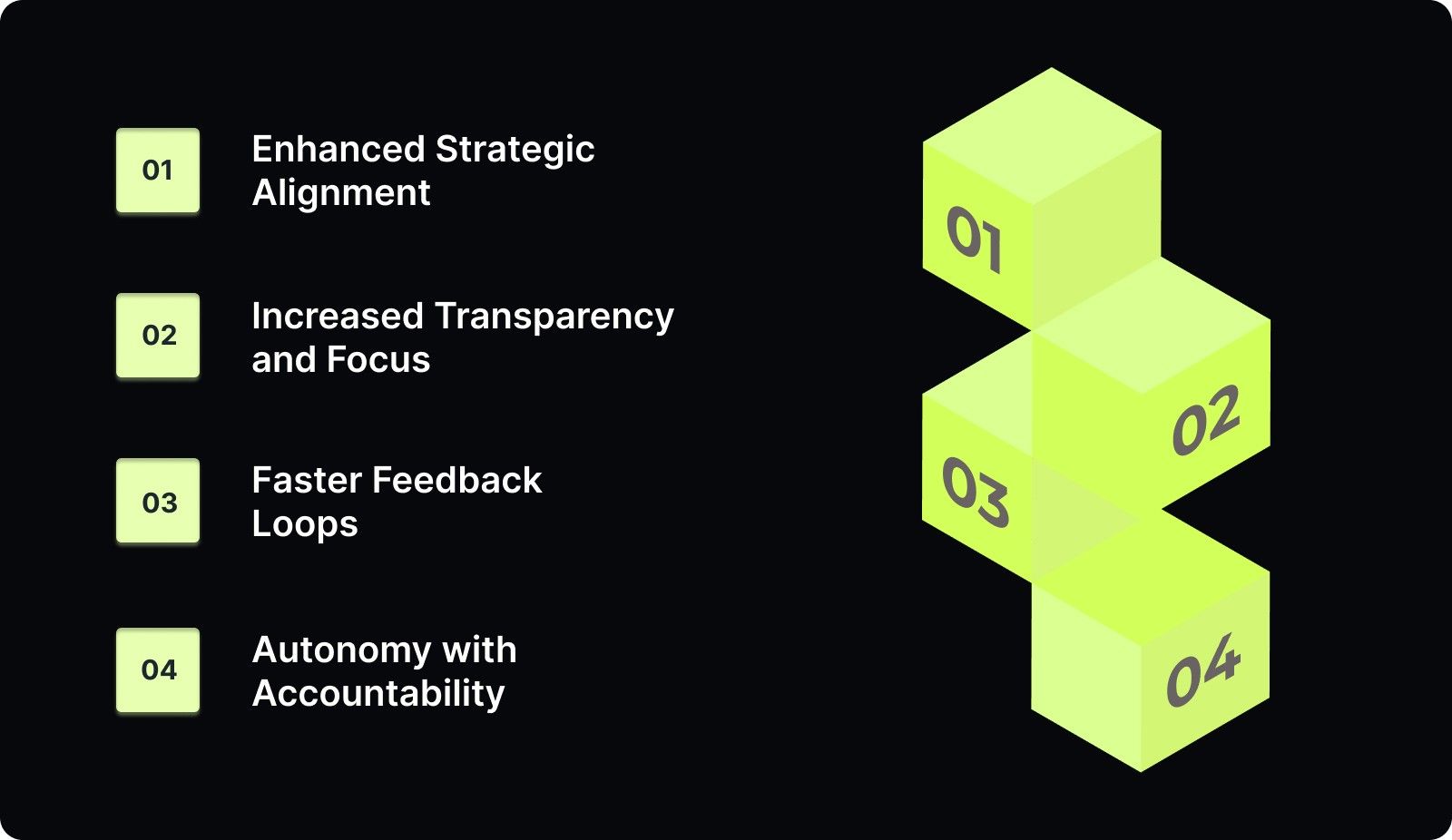
Here are the benefits of combining these powerful frameworks:

  1. Enhanced Strategic Alignment

Engineers often feel disconnected from the "why" behind their work, leading to lower engagement. Agile OKRs make the connection explicit by linking specific code changes to broader business goals like revenue or retention.

This clarity ensures everyone understands how their daily contributions impact the company's success.

  1. Increased Transparency and Focus

In a fast-paced environment, it is easy to get distracted by ad-hoc requests and technical rabbit holes. Clear Key Results act as a filter, helping teams say "no" to work that does not drive the objective.

This focus reduces context switching and keeps the team aligned on the most critical priorities.

  1. Faster Feedback Loops

Traditional goal setting often waits until the end of the year to assess success or failure. Agile OKRs encourage frequent check-ins, allowing teams to identify risks early and pivot strategies if a Key Result is off track.

This agility prevents teams from wasting months on initiatives that are not working.

  1. Autonomy with Accountability

Agile teams thrive when they have the freedom to decide how to solve a problem. OKRs define what needs to be achieved, leaving the implementation details to the engineering team. This autonomy fosters creativity while ensuring accountability for the final results.

Also read: Understanding Velocity in Agile Software Development
Understanding the benefits is the first step, but the real challenge lies in mapping these goals to your daily workflows.

Integrating OKRs with Agile Cadences

You should not treat OKR reviews as separate, burdensome meetings that clutter your calendar. Instead, you must embed them directly into your existing agile rituals to ensure they become part of the team's muscle memory.

Here is how to map OKRs to your existing rituals:

  1. Sprint Planning

During planning, do not just pull tickets from the backlog based on urgency or age. Evaluate every potential task against your active Key Results to ensure the sprint moves the needle on your quarterly goals. If a task does not support an OKR, question why it is in the sprint.

  1. Daily Standups

While standups focus on immediate blockers, briefly mentioning how current work ties to a Key Result keeps the big picture visible. This micro-alignment reminds the team that they are building towards a specific outcome, not just clearing a Jira board.

  1. Sprint Reviews

Use the sprint demo to show not just the features built, but the progress made on the Key Results. Instead of saying "we shipped the search bar," say "we shipped the search bar to reduce search latency by 20%." This shifts the conversation from output to outcome.

  1. Retrospectives

When discussing process improvements, analyze if your team's workflow supports your OKRs. If you missed a Key Result, use the retrospective to understand if it was an execution issue, a resource issue, or an unrealistic goal. Adjust your process for the next cycle based on these insights.

Also read: 25 Practical OKR Examples for Software Engineers

With the structure in place, let's look at concrete examples you can adapt for your specific engineering challenges.

15 Agile OKRs for a Powerful Transformation

Vague goals lead to vague results, so you must be specific when defining your objectives. Below are examples covering various aspects of engineering, from velocity to security, formatted to help you implement them immediately.

  1. Objectives Focused on Product Quality and Reliability:

Objective

Key Results

Objective 1: Significantly Increase Product Stability for Core Features

KR 1: Reduce P1 and P2 production incidents by 40%.

KR 2: Increase automated end-to-end test coverage from 60% to 85%.

KR 3: Decrease the average Mean Time to Restore (MTTR) a critical service from 45 minutes to 15 minutes.

Objective 2: Elevate Code Quality and Maintainability Across the Core Repository

KR 1: Decrease the average code review cycle time from 15 hours to under 8 hours.

KR 2: Achieve a static analysis defect density score of less than 0.5 per 1,000 lines of code.

KR 3: Have 95% of all new pull requests reviewed and approved by at least two distinct team members.

Objective 3: Harden Application Security Posture Against Known Vulnerabilities

KR 1: Reduce the number of critical and high-severity security vulnerabilities detected by 70%.

KR 2: Increase the percentage of dependencies with known vulnerabilities resolved within 7 days from 20% to 90%.

KR 3: Achieve 100% compliance with new automated security scanning integrated into the CI/CD pipeline.

  1. Objectives Focused on Engineering Velocity and Delivery:

Objective

Key Results

Objective 4: Accelerate Feature Delivery Time-to-Market

KR 1: Reduce the average Lead Time for Changes (from commit to production) from 4 days to 2 days.

KR 2: Increase the average deployment frequency from once per week to three times per week.

KR 3: Decrease the number of blocked pull requests due to dependencies by 50%.

Objective 5: Streamline and Simplify Onboarding for New Engineering Hires

KR 1: Reduce the time for a new developer to merge their first production-ready pull request from 3 days to 1 day.

KR 2: Increase the usage of AI-generated internal documentation by new hires from 10% to 75%.

KR 3: Achieve an average satisfaction score of 4.5/5 from new hires on the clarity of the onboarding process.

Objective 6: Reduce Technical Debt in High-Traffic Service

KR 1: Refactor 10,000 lines of code in Service X, reducing its cyclomatic complexity score by 25%.

KR 2: Eliminate all database queries marked as 'slow' in the performance monitoring tool.

KR 3: Migrate Service Y from the legacy framework to the modern architecture, achieving 100% migration completion.

Also read: Best Practices for an Efficient PR Review Process

  1. Objectives Focused on Team Health and Collaboration:

Objective

Key Results

Objective 7: Improve Code Review Participation and Efficiency

KR 1: Increase the percentage of code reviews completed within 4 hours of submission from 55% to 85%.

KR 2: Achieve a 'Reviewer Fairness Index' score of 0.95 or higher, indicating balanced review load.

KR 3: Increase the number of actionable, context-rich comments left per pull request from 3 to 6.

Objective 8: Enhance Team Autonomy and Ownership Over Services

KR 1: Increase the percentage of service-level alerts resolved by the owning team without escalation from 60% to 90%.

KR 2: Complete cross-training for five key engineers on two new critical services, documented by a certification quiz.

KR 3: Reduce external dependencies requiring another team’s code change by 30%.

Objective 9: Drive a Culture of Continuous Learning and Skill Growth

KR 1: Have 100% of developers complete the new security best practices training module.

KR 2: Host six internal knowledge-sharing sessions on topics like new technologies or architecture patterns.

KR 3: Increase the average monthly contribution to the internal engineering knowledge base by 50%.

Objective 10: Boost Documentation Accuracy and Accessibility

KR 1: Reduce the number of reported documentation errors by 60%.

KR 2: Increase the percentage of critical API endpoints with automatically generated and updated documentation to 95%.

KR 3: Achieve a 25% increase in weekly internal views of the 'Architecture' documentation section.

Objective 11: Improve Sprint Planning Accuracy and Predictability

KR 1: Increase the percentage of committed sprint stories completed by the end of the sprint from 75% to 90%.

KR 2: Reduce the average deviation between estimated and actual story points for completed work by 20%.

KR 3: Decrease the number of scope changes introduced mid-sprint by 40%.

Objective 12: Raise the Quality of Team Retrospectives

KR 1: Increase the number of actionable, data-backed improvement items generated per retrospective from 2 to 5.

KR 2: Achieve a 90% completion rate for all improvement items carried over from the previous retrospective.

KR 3: Increase the overall satisfaction score for retrospectives by 1 point, measured via a quick survey.

Objective 13: Increase Feature Adoption and Usability for Key Product Area

KR 1: Increase the weekly active users of Feature X from 5,000 to 15,000.

KR 2: Decrease the average time required for a new user to complete the core onboarding flow by 30 seconds.

KR 3: Achieve a Net Promoter Score (NPS) of +40 for the new product module.

Objective 14: Enhance Developer Workflow Experience and Tooling

KR 1: Reduce the average time spent on the build and deployment process from 15 minutes to under 5 minutes.

KR 2: Increase the adoption rate of the new integrated development environment (IDE) tools to 100% of the team.

KR 3: Decrease the average time spent on manual overhead tasks (e.g., documentation, boilerplate) by 2 hours per week per developer.

Objective 15: Drive Strategic Alignment with Product Roadmap

KR 1: Have 100% of engineering Epics clearly tagged to a Q3 Product Goal.

KR 2: Achieve a 90% correlation between engineering's perceived progress and product manager's perceived progress on key initiatives.

KR 3: Reduce stakeholder requests for status updates by 50% due to improved, transparent reporting.

Also read: How to Squash All Commits on a Git Branch?

Setting ambitious goals is important, but you must also have a reliable method to track your progress accurately.

Measuring Success: How to Score and Track Agile OKRs Step-by-Step

Simply setting OKRs is not enough; you must rigorously track and score them to drive accountability. A consistent scoring method removes ambiguity and helps teams understand true performance versus perceived effort.
Measuring Success: How to Score and Track Agile OKRs Step-by-Step

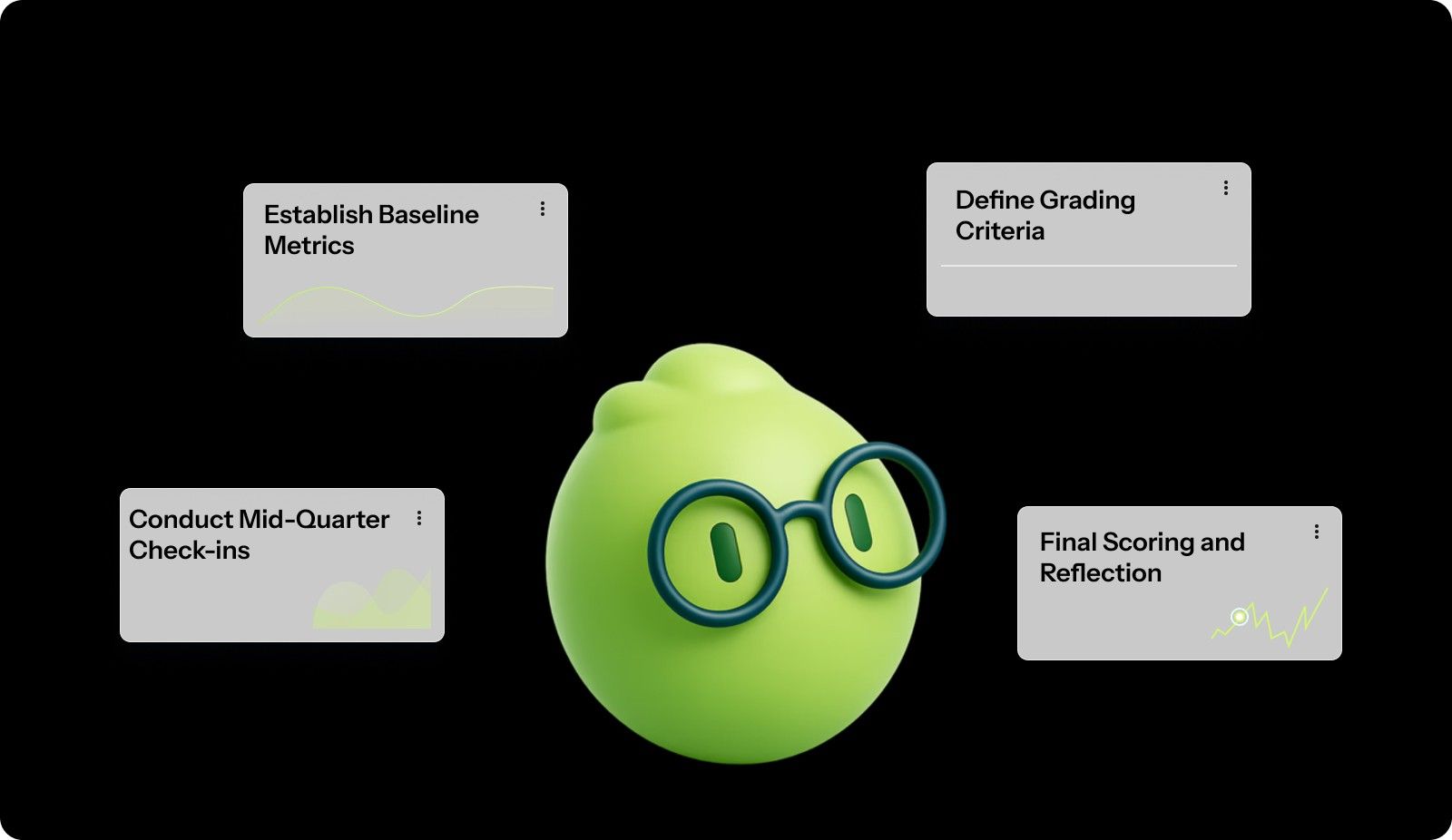
Here are the steps to effectively score your agile objectives:

  1. Establish Baseline Metrics

Before the quarter begins, you must know your starting point for every Key Result. If you want to "improve deployment frequency," you need to know exactly how often you deploy today. Use tools like Entelligence or your CI/CD logs to gather accurate historical data to serve as your baseline.

  1. Define Grading Criteria

Adopt a standardized scale, typically 0.0 to 1.0, where 0.7 (70%) is considered success for stretch goals. Define clearly what constitutes a 0.3, a 0.7, and a 1.0 for each Key Result. This prevents subjective grading at the end of the quarter and sets clear expectations.

  1. Conduct Mid-Quarter Check-ins

Do not wait until the quarter ends to look at the numbers; review them during sprint reviews. If a Key Result is tracking at 0.1 halfway through the quarter, the team needs to pivot immediately. These check-ins allow for course correction while there is still time to impact the outcome.

  1. Final Scoring and Reflection

At the end of the cycle, calculate the final score and discuss why you landed there. A low score is not a failure if the team learned a valuable lesson or if priorities shifted. Use the scoring process as a learning tool to set better, more realistic goals for the next cycle.

Stop Guessing. See Progress. Transform vague goals into real-time metrics with Entelligence AI. Book a demo now.

Tracking helps you see where you stand, but execution requires discipline and avoiding common implementation traps.

Do’s and Don’ts for Your Agile OKR Implementation

Successful implementation requires a cultural shift, not just a spreadsheet. You need to foster an environment where goals are challenging yet motivating, avoiding the trap of turning OKRs into a weapon for performance management.

Here are the best practices and common pitfalls to manage:

Do's

Don'ts

Do focus on outcomes (e.g., increase revenue) rather than outputs (e.g., ship feature X).

Don't set too many OKRs; stick to 3-5 objectives to avoid diluting the team's focus.

Do involve the engineering team in setting their own Key Results to ensure buy-in.

Don't dictate OKRs from the top down without consulting the people who do the work.

Do review progress frequently, ideally during sprint reviews or weekly check-ins.

Don't "set and forget" your OKRs until the end of the quarter.

Do make OKRs visible to the entire organization to promote transparency and alignment.

Don't keep goals hidden in private documents or disparate tools.

Do set "stretch goals" that encourage innovation and ambitious thinking.

Don't punish teams for not hitting 100% on ambitious stretch goals.

While frameworks provide the rules, maintaining visibility across all these metrics requires the right intelligence platform.

Also read: How to Conduct a Code Quality Audit: A Comprehensive Guide

Bringing Clarity to Engineering Productivity with Entelligence AI

Engineering leaders often struggle to track agile OKRs because the necessary data is scattered across GitHub, Jira, and various CI/CD tools. You cannot measure what you cannot see, and manual tracking leads to outdated spreadsheets and guesswork.

This lack of visibility makes it nearly impossible to know if you are truly on track to hit your Key Results. Entelligence AI serves as the end-to-end engineering productivity suite that bridges this gap.

We provide the intelligence layer that sits on top of your workflow, offering clarity from the first line of code to the final release. Below are our features:

  • Sprint Assessment Dashboards: Get automated health checks on delivery cycles, helping you track velocity and blockers against your delivery OKRs.

  • Contextual Code Reviews: Our AI catches bugs and anti-patterns early, directly impacting quality and stability key results.

  • Security Dashboard: We automatically track vulnerability remediation, making it easy to measure and achieve your security objectives.

  • Team Performance Insights: Understand how process changes impact velocity and quality, providing the data needed for accurate scoring.

Entelligence positions your organization to achieve your ambitious goals by turning raw engineering data into actionable strategy.

Conclusion

Adopting agile OKRs transforms engineering teams from feature factories into strategic partners that drive business growth. By aligning your sprints with measurable outcomes, you ensure that every line of code contributes to the company's success.

However, this framework requires discipline, transparency, and the right tools to track progress effectively. Entelligence AI acts as your partner in this journey, providing the insights and automation needed to measure what matters. From ensuring code quality to visualizing team velocity, we help you hit your targets with confidence.

Ready to gain total clarity over your engineering goals and accelerate your transformation? Book a demo with Entelligence AI today.

FAQs

Q. What is the difference between KPIs and OKRs?

KPIs (Key Performance Indicators) track the ongoing health of a system, such as site uptime or ticket volume. OKRs (Objectives and Key Results) are aggressive goals designed to change or improve that system, such as "Improve uptime from 99% to 99.9%." KPIs maintain the status quo; OKRs drive growth.

Q. How many OKRs should an agile team have?

A team should typically focus on 3 to 5 objectives per quarter, with 3 to 5 Key Results per objective. Having too many goals dilutes focus and makes it difficult to achieve significant progress on any single initiative.

Q. Can OKRs change during an agile sprint?

While Objectives should remain stable for the quarter, Key Results can be adjusted if new data proves they are no longer relevant or achievable. However, frequent changes should be avoided to maintain focus and stability for the team.

Q. How do we handle failed OKRs?

Failure is part of the process, especially with ambitious stretch goals. Conduct a blameless retrospective to understand why the goal was missed, whether it was due to resourcing, estimation errors, or external factors, and apply those learnings to the next cycle.

Your engineering teams work in rapid, iterative sprints, but your goal-setting process remains an annual, top-down mandate. This misalignment causes frustration. Teams struggle to connect daily tasks to vague annual objectives, while leaders lack visibility into real progress.

According to recent industry analysis, 84% of developers are using or planning to use AI tools in their workflow, signaling a shift toward more dynamic, data-driven ways of working.

The framework designed to solve this disconnect is agile OKRs. This method combines the adaptability of Agile with the clarity of Objectives and Key Results. It turns static goals into a living system that evolves with your product and team.

In this guide, we break down how to implement agile OKRs in your engineering organization. You will learn the core benefits, see actionable examples, and discover how to track success with precision.

An Overview

  • Agile OKRs measure the value delivered to the customer, not just the number of features shipped.

  • With 84% of developers using or planning to use AI, workflows are more dynamic and require data-driven goals to maintain alignment.

  • Connect daily standups and sprint planning directly to high-level company objectives to prevent siloed work.

  • Use objective metrics like DORA scores or bug rates to grade key results, removing subjectivity.

  • Adapt OKRs to shorter cycles to match the adaptability of Agile development.

What is Agile Methodology?

Agile is a project management approach that prioritizes iterative development and continuous feedback loops over rigid, linear planning. It empowers cross-functional teams to deliver software in small, consumable increments, allowing for rapid adaptation to changing customer needs.

Instead of waiting months for a "big bang" launch, you ship value frequently, learn from real user data, and adjust your course immediately to maximize impact.

Also read: 8 Top OKR Software for Engineering Teams in 2025

Now that you understand the agile foundation, let's see how goal-setting frameworks fit into this dynamic environment.

How OKRs and Agile Work Together

Agile provides the vehicle for execution, while OKRs (Objectives and Key Results) provide the navigational map for your destination. Agile helps you move quickly, and OKRs ensure you are moving in the right direction.

How OKRs and Agile Work Together

When combined, they connect high-level business strategy with daily engineering tasks, ensuring that every sprint backlog item contributes directly to a measurable organizational outcome.

Here are the benefits of combining these powerful frameworks:

  1. Enhanced Strategic Alignment

Engineers often feel disconnected from the "why" behind their work, leading to lower engagement. Agile OKRs make the connection explicit by linking specific code changes to broader business goals like revenue or retention.

This clarity ensures everyone understands how their daily contributions impact the company's success.

  1. Increased Transparency and Focus

In a fast-paced environment, it is easy to get distracted by ad-hoc requests and technical rabbit holes. Clear Key Results act as a filter, helping teams say "no" to work that does not drive the objective.

This focus reduces context switching and keeps the team aligned on the most critical priorities.

  1. Faster Feedback Loops

Traditional goal setting often waits until the end of the year to assess success or failure. Agile OKRs encourage frequent check-ins, allowing teams to identify risks early and pivot strategies if a Key Result is off track.

This agility prevents teams from wasting months on initiatives that are not working.

  1. Autonomy with Accountability

Agile teams thrive when they have the freedom to decide how to solve a problem. OKRs define what needs to be achieved, leaving the implementation details to the engineering team. This autonomy fosters creativity while ensuring accountability for the final results.

Also read: Understanding Velocity in Agile Software Development

Understanding the benefits is the first step, but the real challenge lies in mapping these goals to your daily workflows.

Integrating OKRs with Agile Cadences

You should not treat OKR reviews as separate, burdensome meetings that clutter your calendar. Instead, you must embed them directly into your existing agile rituals to ensure they become part of the team's muscle memory.

Here is how to map OKRs to your existing rituals:

  1. Sprint Planning

During planning, do not just pull tickets from the backlog based on urgency or age. Evaluate every potential task against your active Key Results to ensure the sprint moves the needle on your quarterly goals. If a task does not support an OKR, question why it is in the sprint.

  1. Daily Standups

While standups focus on immediate blockers, briefly mentioning how current work ties to a Key Result keeps the big picture visible. This micro-alignment reminds the team that they are building towards a specific outcome, not just clearing a Jira board.

  1. Sprint Reviews

Use the sprint demo to show not just the features built, but the progress made on the Key Results. Instead of saying "we shipped the search bar," say "we shipped the search bar to reduce search latency by 20%." This shifts the conversation from output to outcome.

  1. Retrospectives

When discussing process improvements, analyze if your team's workflow supports your OKRs. If you missed a Key Result, use the retrospective to understand if it was an execution issue, a resource issue, or an unrealistic goal. Adjust your process for the next cycle based on these insights.

Also read: 25 Practical OKR Examples for Software Engineers

With the structure in place, let's look at concrete examples you can adapt for your specific engineering challenges.

15 Agile OKRs for a Powerful Transformation

Vague goals lead to vague results, so you must be specific when defining your objectives. Below are examples covering various aspects of engineering, from velocity to security, formatted to help you implement them immediately.

  1. Objectives Focused on Product Quality and Reliability:

Objective

Key Results

Objective 1: Significantly Increase Product Stability for Core Features

KR 1: Reduce P1 and P2 production incidents by 40%.

KR 2: Increase automated end-to-end test coverage from 60% to 85%.

KR 3: Decrease the average Mean Time to Restore (MTTR) a critical service from 45 minutes to 15 minutes.

Objective 2: Elevate Code Quality and Maintainability Across the Core Repository

KR 1: Decrease the average code review cycle time from 15 hours to under 8 hours.

KR 2: Achieve a static analysis defect density score of less than 0.5 per 1,000 lines of code.

KR 3: Have 95% of all new pull requests reviewed and approved by at least two distinct team members.

Objective 3: Harden Application Security Posture Against Known Vulnerabilities

KR 1: Reduce the number of critical and high-severity security vulnerabilities detected by 70%.

KR 2: Increase the percentage of dependencies with known vulnerabilities resolved within 7 days from 20% to 90%.

KR 3: Achieve 100% compliance with new automated security scanning integrated into the CI/CD pipeline.

  1. Objectives Focused on Engineering Velocity and Delivery:

Objective

Key Results

Objective 4: Accelerate Feature Delivery Time-to-Market

KR 1: Reduce the average Lead Time for Changes (from commit to production) from 4 days to 2 days.

KR 2: Increase the average deployment frequency from once per week to three times per week.

KR 3: Decrease the number of blocked pull requests due to dependencies by 50%.

Objective 5: Streamline and Simplify Onboarding for New Engineering Hires

KR 1: Reduce the time for a new developer to merge their first production-ready pull request from 3 days to 1 day.

KR 2: Increase the usage of AI-generated internal documentation by new hires from 10% to 75%.

KR 3: Achieve an average satisfaction score of 4.5/5 from new hires on the clarity of the onboarding process.

Objective 6: Reduce Technical Debt in High-Traffic Service

KR 1: Refactor 10,000 lines of code in Service X, reducing its cyclomatic complexity score by 25%.

KR 2: Eliminate all database queries marked as 'slow' in the performance monitoring tool.

KR 3: Migrate Service Y from the legacy framework to the modern architecture, achieving 100% migration completion.

Also read: Best Practices for an Efficient PR Review Process

  1. Objectives Focused on Team Health and Collaboration:

Objective

Key Results

Objective 7: Improve Code Review Participation and Efficiency

KR 1: Increase the percentage of code reviews completed within 4 hours of submission from 55% to 85%.

KR 2: Achieve a 'Reviewer Fairness Index' score of 0.95 or higher, indicating balanced review load.

KR 3: Increase the number of actionable, context-rich comments left per pull request from 3 to 6.

Objective 8: Enhance Team Autonomy and Ownership Over Services

KR 1: Increase the percentage of service-level alerts resolved by the owning team without escalation from 60% to 90%.

KR 2: Complete cross-training for five key engineers on two new critical services, documented by a certification quiz.

KR 3: Reduce external dependencies requiring another team’s code change by 30%.

Objective 9: Drive a Culture of Continuous Learning and Skill Growth

KR 1: Have 100% of developers complete the new security best practices training module.

KR 2: Host six internal knowledge-sharing sessions on topics like new technologies or architecture patterns.

KR 3: Increase the average monthly contribution to the internal engineering knowledge base by 50%.

Objective 10: Boost Documentation Accuracy and Accessibility

KR 1: Reduce the number of reported documentation errors by 60%.

KR 2: Increase the percentage of critical API endpoints with automatically generated and updated documentation to 95%.

KR 3: Achieve a 25% increase in weekly internal views of the 'Architecture' documentation section.

Objective 11: Improve Sprint Planning Accuracy and Predictability

KR 1: Increase the percentage of committed sprint stories completed by the end of the sprint from 75% to 90%.

KR 2: Reduce the average deviation between estimated and actual story points for completed work by 20%.

KR 3: Decrease the number of scope changes introduced mid-sprint by 40%.

Objective 12: Raise the Quality of Team Retrospectives

KR 1: Increase the number of actionable, data-backed improvement items generated per retrospective from 2 to 5.

KR 2: Achieve a 90% completion rate for all improvement items carried over from the previous retrospective.

KR 3: Increase the overall satisfaction score for retrospectives by 1 point, measured via a quick survey.

Objective 13: Increase Feature Adoption and Usability for Key Product Area

KR 1: Increase the weekly active users of Feature X from 5,000 to 15,000.

KR 2: Decrease the average time required for a new user to complete the core onboarding flow by 30 seconds.

KR 3: Achieve a Net Promoter Score (NPS) of +40 for the new product module.

Objective 14: Enhance Developer Workflow Experience and Tooling

KR 1: Reduce the average time spent on the build and deployment process from 15 minutes to under 5 minutes.

KR 2: Increase the adoption rate of the new integrated development environment (IDE) tools to 100% of the team.

KR 3: Decrease the average time spent on manual overhead tasks (e.g., documentation, boilerplate) by 2 hours per week per developer.

Objective 15: Drive Strategic Alignment with Product Roadmap

KR 1: Have 100% of engineering Epics clearly tagged to a Q3 Product Goal.

KR 2: Achieve a 90% correlation between engineering's perceived progress and product manager's perceived progress on key initiatives.

KR 3: Reduce stakeholder requests for status updates by 50% due to improved, transparent reporting.

Also read: How to Squash All Commits on a Git Branch?

Setting ambitious goals is important, but you must also have a reliable method to track your progress accurately.

Measuring Success: How to Score and Track Agile OKRs Step-by-Step

Simply setting OKRs is not enough; you must rigorously track and score them to drive accountability. A consistent scoring method removes ambiguity and helps teams understand true performance versus perceived effort.

Measuring Success: How to Score and Track Agile OKRs Step-by-Step

Here are the steps to effectively score your agile objectives:

  1. Establish Baseline Metrics

Before the quarter begins, you must know your starting point for every Key Result. If you want to "improve deployment frequency," you need to know exactly how often you deploy today. Use tools like Entelligence or your CI/CD logs to gather accurate historical data to serve as your baseline.

  1. Define Grading Criteria

Adopt a standardized scale, typically 0.0 to 1.0, where 0.7 (70%) is considered success for stretch goals. Define clearly what constitutes a 0.3, a 0.7, and a 1.0 for each Key Result. This prevents subjective grading at the end of the quarter and sets clear expectations.

  1. Conduct Mid-Quarter Check-ins

Do not wait until the quarter ends to look at the numbers; review them during sprint reviews. If a Key Result is tracking at 0.1 halfway through the quarter, the team needs to pivot immediately. These check-ins allow for course correction while there is still time to impact the outcome.

  1. Final Scoring and Reflection

At the end of the cycle, calculate the final score and discuss why you landed there. A low score is not a failure if the team learned a valuable lesson or if priorities shifted. Use the scoring process as a learning tool to set better, more realistic goals for the next cycle.

Stop Guessing. See Progress. Transform vague goals into real-time metrics with Entelligence AI. Book a demo now.

Tracking helps you see where you stand, but execution requires discipline and avoiding common implementation traps.

Do’s and Don’ts for Your Agile OKR Implementation

Successful implementation requires a cultural shift, not just a spreadsheet. You need to foster an environment where goals are challenging yet motivating, avoiding the trap of turning OKRs into a weapon for performance management.

Here are the best practices and common pitfalls to manage:

Do's

Don'ts

Do focus on outcomes (e.g., increase revenue) rather than outputs (e.g., ship feature X).

Don't set too many OKRs; stick to 3-5 objectives to avoid diluting the team's focus.

Do involve the engineering team in setting their own Key Results to ensure buy-in.

Don't dictate OKRs from the top down without consulting the people who do the work.

Do review progress frequently, ideally during sprint reviews or weekly check-ins.

Don't "set and forget" your OKRs until the end of the quarter.

Do make OKRs visible to the entire organization to promote transparency and alignment.

Don't keep goals hidden in private documents or disparate tools.

Do set "stretch goals" that encourage innovation and ambitious thinking.

Don't punish teams for not hitting 100% on ambitious stretch goals.

While frameworks provide the rules, maintaining visibility across all these metrics requires the right intelligence platform.

Also read: How to Conduct a Code Quality Audit: A Comprehensive Guide

Bringing Clarity to Engineering Productivity with Entelligence AI

Engineering leaders often struggle to track agile OKRs because the necessary data is scattered across GitHub, Jira, and various CI/CD tools. You cannot measure what you cannot see, and manual tracking leads to outdated spreadsheets and guesswork.

This lack of visibility makes it nearly impossible to know if you are truly on track to hit your Key Results. Entelligence AI serves as the end-to-end engineering productivity suite that bridges this gap.

We provide the intelligence layer that sits on top of your workflow, offering clarity from the first line of code to the final release. Below are our features:

  • Sprint Assessment Dashboards: Get automated health checks on delivery cycles, helping you track velocity and blockers against your delivery OKRs.

  • Contextual Code Reviews: Our AI catches bugs and anti-patterns early, directly impacting quality and stability key results.

  • Security Dashboard: We automatically track vulnerability remediation, making it easy to measure and achieve your security objectives.

  • Team Performance Insights: Understand how process changes impact velocity and quality, providing the data needed for accurate scoring.

Entelligence positions your organization to achieve your ambitious goals by turning raw engineering data into actionable strategy.

Conclusion

Adopting agile OKRs transforms engineering teams from feature factories into strategic partners that drive business growth. By aligning your sprints with measurable outcomes, you ensure that every line of code contributes to the company's success.

However, this framework requires discipline, transparency, and the right tools to track progress effectively. Entelligence AI acts as your partner in this journey, providing the insights and automation needed to measure what matters. From ensuring code quality to visualizing team velocity, we help you hit your targets with confidence.

Ready to gain total clarity over your engineering goals and accelerate your transformation? Book a demo with Entelligence AI today.

FAQs

Q. What is the difference between KPIs and OKRs?

KPIs (Key Performance Indicators) track the ongoing health of a system, such as site uptime or ticket volume. OKRs (Objectives and Key Results) are aggressive goals designed to change or improve that system, such as "Improve uptime from 99% to 99.9%." KPIs maintain the status quo; OKRs drive growth.

Q. How many OKRs should an agile team have?

A team should typically focus on 3 to 5 objectives per quarter, with 3 to 5 Key Results per objective. Having too many goals dilutes focus and makes it difficult to achieve significant progress on any single initiative.

Q. Can OKRs change during an agile sprint?

While Objectives should remain stable for the quarter, Key Results can be adjusted if new data proves they are no longer relevant or achievable. However, frequent changes should be avoided to maintain focus and stability for the team.

Q. How do we handle failed OKRs?

Failure is part of the process, especially with ambitious stretch goals. Conduct a blameless retrospective to understand why the goal was missed, whether it was due to resourcing, estimation errors, or external factors, and apply those learnings to the next cycle.
Your questions,

Your questions,

Decoded

Decoded

What makes Entelligence different?

Unlike tools that just flag issues, Entelligence understands context — detecting, explaining, and fixing problems while aligning with product goals and team standards.

Does it replace human reviewers?

No. It amplifies them. Entelligence handles repetitive checks so engineers can focus on architecture, logic, and innovation.

What tools does it integrate with?

It fits right into your workflow — GitHub, GitLab, Jira, Linear, Slack, and more. No setup friction, no context switching.

How secure is my code?

Your code never leaves your environment. Entelligence uses encrypted processing and complies with top industry standards like SOC 2 and HIPAA.

Who is it built for?

Fast-growing engineering teams that want to scale quality, security, and velocity without adding more manual reviews or overhead.

What makes Entelligence different?
Does it replace human reviewers?
What tools does it integrate with?
How secure is my code?
Who is it built for?

Drop your details

We’ll reach out before your next deploy hits production.

We’ll reach out before your next deploy hits production.