What is Deployment Frequency? Benchmarks And Best Practices
Jan 19, 2026
Jan 19, 2026
Engineering leaders often face the "big bang" release problem, where shipping code feels like a high-risk event every single month. Infrequent deployments lead to massive merge conflicts and long feedback loops that eventually stall your entire product roadmap.
High-performing teams successfully reduce this friction by shipping small batches of code consistently to their production environments to minimize risk. According to the Google DORA 2025 report, elite engineering teams deploy on demand multiple times every day to stay competitive.
In this article, you will learn how to calculate and improve your deployment frequency to build a more resilient and productive engineering organization.
Quick Look
Elite Performance: Aim for on-demand deployments multiple times per day to minimize batch size and reduce the risk of failure.
Formula Basics: Calculate frequency by dividing the total number of successful production deployments by a specific time period, like one week.
Trunk-Based Development: Move away from long-lived feature branches to ensure your code is always in a state ready for immediate release.
Feature Flags: Separate code deployment from feature release to give your product team control over when users see new functional updates.
Automated Testing: Build a strong CI/CD pipeline that catches critical bugs early to prevent manual QA from becoming a permanent bottleneck.
Cultural Shift: Move from a blame-heavy culture to one that views every deployment as a non-event and a learning opportunity for everyone.
What is Deployment Frequency?
Deployment frequency measures how often an organization successfully releases code to a production environment or an app store for its end users.
This metric serves as a primary indicator of your team's overall agility and the efficiency of your automated delivery pipeline.
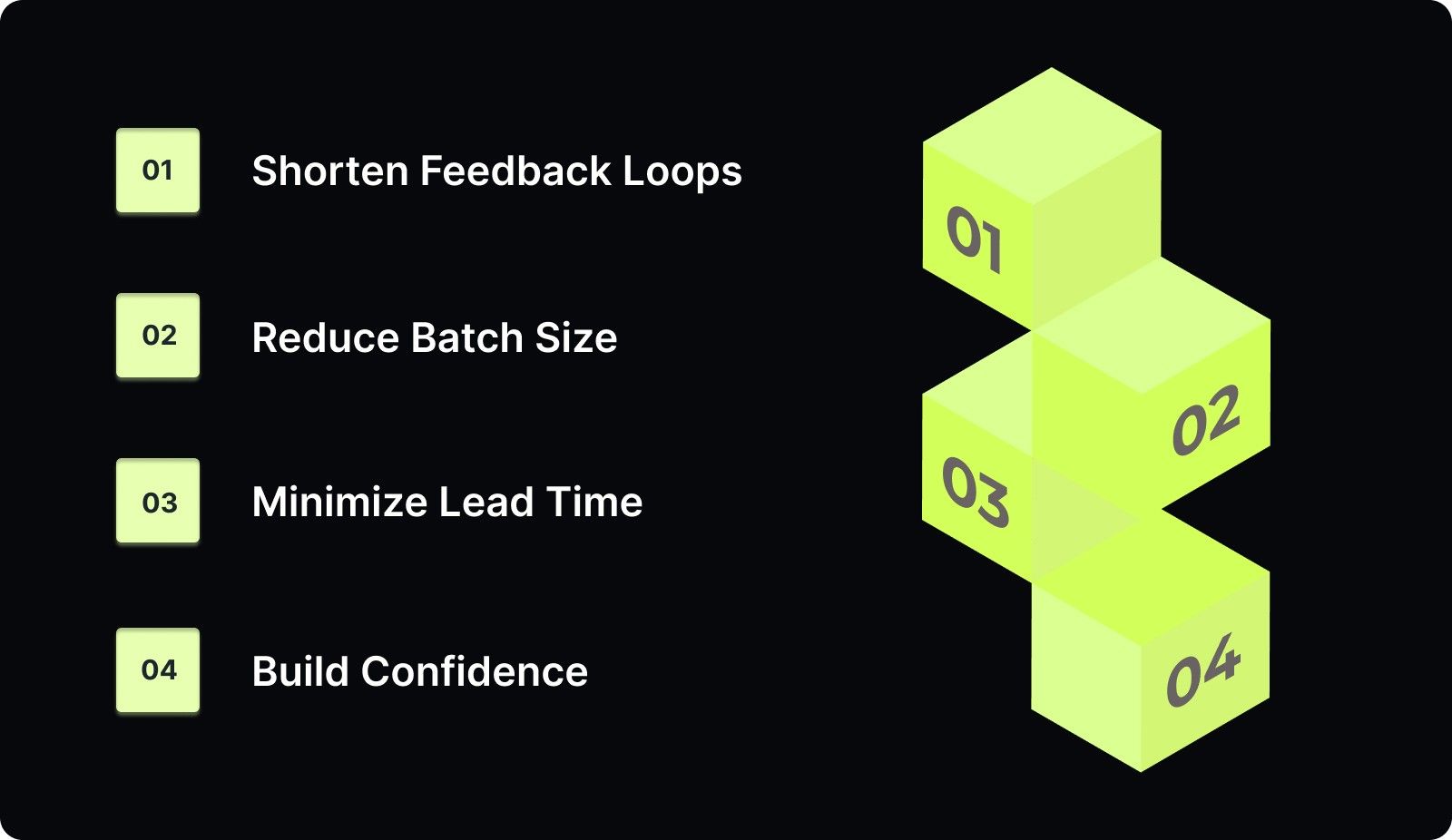
Shorten Feedback Loops: Get features in front of users faster to validate your product hypotheses before investing more development resources.
Reduce Batch Size: Shipping smaller increments makes it significantly easier to identify the root cause when a production error eventually occurs.
Minimize Lead Time: Decreasing the time between a code commit and a production deploy ensures your team delivers value without unnecessary delays.
Build Confidence: Frequent releases turn the deployment process into a routine activity rather than a stressful event that requires weekend work.
Improving this metric requires a combination of architectural changes and a mindset shift toward continuous delivery rather than scheduled batch releases.

Also read: AI Code Review Techniques and Top Tools
Benefits of Tracking Deployment Frequency
Tracking how often you ship code provides deep insights into the health of your engineering processes and the stability of your architecture. Monitoring this data allows you to identify invisible hurdles that prevent your developers from reaching their full productive potential every day.
You should monitor these specific outcomes to justify your investment in delivery automation:
1. Accelerated Feedback Loops
Shipping code daily allows your product teams to validate their hypotheses with real users in real-time rather than waiting for monthly cycles. This speed ensures that you are building the right features and can pivot quickly if a specific update does not resonate with users.
2. Reduced Risk Profile
There is a direct relationship between small batch sizes and lower change failure rates because smaller changes are easier to test and verify. When you deploy frequently, the scope of each change is limited, which makes troubleshooting and rolling back much faster for your on-call engineers.
3. Improved Developer Morale
Teams that ship often experience less "deployment anxiety" because the process is automated and predictable rather than a manual, high-stakes event. Developers feel a greater sense of accomplishment when they see their code reaching production hours after completion instead of weeks later.
Consistent measurement highlights where your delivery pipeline is failing so you can address those specific issues with targeted engineering improvements.
Also read: How to Measure Developer Productivity Effectively
Tracking these benefits manually shouldn't be another hurdle for your engineering team. Book a demo with Entelligence AI to see how our automated dashboards provide real-time visibility into your delivery pipeline and developer health. Start moving from anecdotal feedback to data-driven clarity today.
What is a Good Deployment Frequency?
A "good" target for your team depends on your industry and the complexity of the product you are currently building for your customers. While benchmarks provide a helpful starting point, you must align your goals with the specific needs of your business and users.
Consider these benchmarks when evaluating your current engineering performance:
1. The DORA Benchmarks
Elite teams deploy on demand multiple times per day, while high-performing teams typically ship between once per day and once per week. Low performers usually struggle to ship once per month and often rely on manual, error-prone processes that slow down the entire organization.
2. Contextual Targets
An "elite" target looks very different for a mobile app startup compared to a legacy banking system that requires strict regulatory compliance. You should aim for a frequency that allows you to remain competitive in your market without compromising the security of your user data.
3. Quality Over Quantity
You must ensure that increasing your speed does not come at the cost of significant technical debt or a rising change failure rate. A high frequency is only valuable if the code you ship is stable, secure, and provides actual value to your paying customers.
Your goal should be continuous improvement of your own historical baseline rather than chasing an arbitrary number that might not fit your context.
Also read: Understanding Velocity in Agile Software Development
What Causes Low Deployment Frequency?
Low frequency is usually a symptom of deeper technical or cultural issues that prevent your engineers from moving at a high velocity. Identifying these root causes is the first step toward building a more efficient and automated software delivery life cycle.
Look for these common obstacles within your current engineering organization:
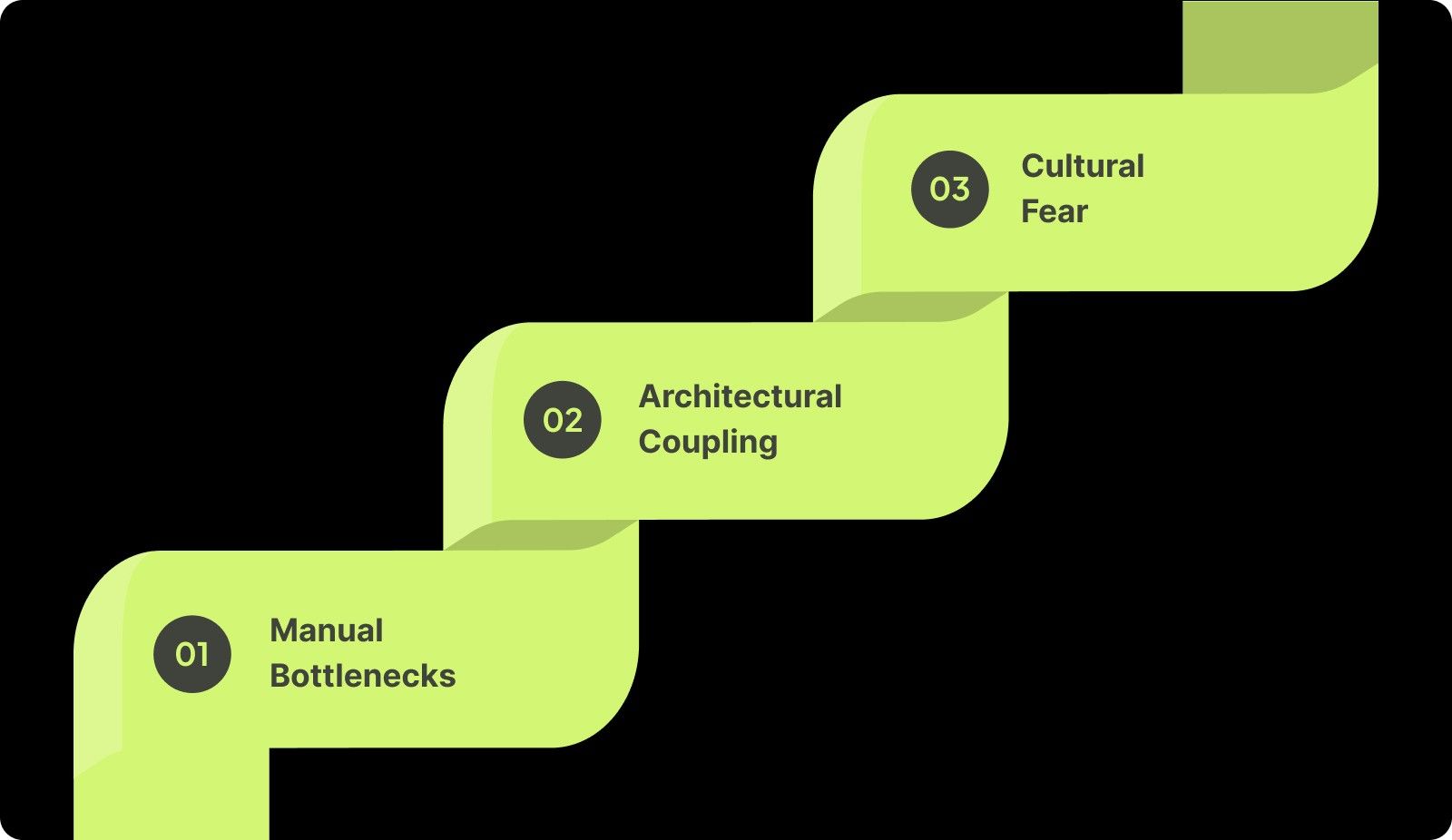
1. Manual Bottlenecks
The heavy impact of "manual QA" and manual change-approval gates creates long queues of unreleased code. These manual steps often introduce human error and make it impossible to reach the elite levels of on-demand deployment for your team.
2. Architectural Coupling
Monolithic structures and tight dependencies force your teams to coordinate massive, infrequent releases that require multiple departments to sign off simultaneously. This coupling means that a single bug in one area can block the entire release for every other part of the system.
3. Cultural Fear
A "blame culture" leads to oversized batches because developers become afraid of breaking production and choose to delay deployments for extra manual checking. This fear creates a vicious cycle where infrequent releases become larger, riskier, and more likely to fail when they finally happen.
Removing these barriers requires a strategic commitment from leadership to invest in automation and architectural decoupling over several sprint cycles.
Also read: Effective Strategies to Reduce Technical Debt
How to Calculate Deployment Frequency
Calculating your frequency accurately requires clear data from your version control system and your production deployment logs over a consistent time period. You need to distinguish between successful deployments and failed attempts to get an honest view of your team's actual delivery capability.
Use this standard formula to measure your performance:
DF = Total Successful Deployments/Time Period (Days)
For example, if your team successfully shipped 14 times to production over the last 7 days, your deployment frequency is 2.0 per day.
To implement this measurement step-by-step, you should:
Define what counts as a "deployment" (e.g., a successful merge to the production branch that passes all health checks).
Pull the timestamps of every successful production release from your CI/CD tool, like GitHub Actions or Jenkins, over a 30-day window.
Exclude any failed deployments that were rolled back immediately, as these do not contribute to the delivery of new value to users.
Visualize the trend over time to see if your frequency is increasing as you implement new automation tools and better engineering practices.
With a baseline measurement, you can begin implementing strategies to improve it systematically and sustainably.
10 Best Practices to Increase Deployment Frequency Without Breaking Production
Increasing your velocity requires a deliberate strategy that combines better tools with a more disciplined approach to how you write and review code. You must focus on reducing the friction at every stage of the delivery pipeline to make shipping a non-event.
Implement these strategies to improve your frequency while maintaining high quality:
1. Adopt Trunk-Based Development
Developers should merge small, frequent updates into a single "trunk" branch rather than maintaining long-lived feature branches for several weeks at a time.
Impact:
Reduces merge conflicts significantly.
Ensures the codebase is always ready for a release.
Encourages continuous integration of new code.
2. Implement Feature Flags
Use feature flags to decouple the technical act of deployment from the business act of releasing a feature to your end users.
Impact:
Allows for safer production testing.
Enables instant rollbacks without redeploying code.
Makes product managers control feature launch timing.
3. Automate the Testing Suite
Build a comprehensive set of unit, integration, and end-to-end tests that run automatically every time a developer pushes code to the repository.
Impact:
Catches regressions before they hit production.
Reduces the need for slow manual QA cycles.
Gives developers confidence to ship small changes.
4. Shift to Small Batch Sizes
Break down your product requirements into the smallest possible deployable units that still provide some level of value to the user or system.
Impact:
Simplifies the code review process.
Makes troubleshooting much faster after a failure.
Increases the total number of successful deploys.
5. Standardize CI/CD Pipelines
Create a reusable and automated pipeline that handles the build, test, and deployment steps identically for every microservice or application in your stack.
Impact:
Eliminates custom "snowflake" deployment scripts.
Makes the release process predictable and repeatable.
Simplifies onboarding for new engineering hires.

6. Use Containerization
Package your applications into containers to ensure they run exactly the same way in your local development environment as they do in production.
Impact:
Ends the "it works on my machine" problem.
Speeds up deployment times across environments.
Simplifies scaling and infrastructure management.
7. Automated Rollback Procedures
Configure your monitoring tools to automatically trigger a rollback if production error rates spike immediately after a new deployment is successfully completed.
Impact:
Protects the user experience during failures.
Reduces the stress of shipping new code.
Lowers the mean time to recovery (MTTR).
8. Streamline Peer Reviews
Use AI tools to handle the initial linting and documentation checks so human reviewers can focus on architectural logic and business requirements.
Impact:
Reduces the time code sits in the PR queue.
Improves the quality of feedback developers receive.
Accelerates the overall development cycle.
9. Infrastructure as Code (IaC)
Manage your servers and databases using code templates like Terraform or CloudFormation to ensure your infrastructure is versioned and easily reproducible.
Impact:
Eliminates manual configuration errors in production.
Allows for rapid environment creation and teardown.
Enhances the security and auditability of your stack.
10. Monitor Real-Time Health
Implement effective logging and observability tools that give you a clear view of how your application performs the second a new deploy goes live.
Impact:
Identifies performance bottlenecks early in the cycle.
Provides data-driven insights for the next sprint.
Increases accountability for code quality across teams.
As you implement these practices, beware of optimizing for the metric itself rather than the outcomes it represents.
Also read: 15 Software Engineering KPIs to Track in 2026

Common Pitfalls and How to Avoid Them
Simply shipping more often does not guarantee success if you are not also monitoring the quality and impact of those specific code changes. You must avoid gaming the metric and focus on the underlying health of your software delivery process and your engineering team.
Avoid these traps when optimizing your delivery speed:
1. Gaming the Metric
The danger of "Gaming the Metric" occurs when teams ship meaningless or tiny changes, such as documentation typos or minor CSS tweaks, just to hit their numerical targets. This behavior inflates your data without delivering any actual functional value to your product or customers.
How to fix:
Track Value-Added Changes: Link deployments directly to Jira tickets or GitHub issues to ensure every release corresponds to a legitimate task or bug fix.
Review Batch Content: Periodically audit the contents of your deployments to ensure the team is not artificially splitting single tasks into multiple micro-releases.
Focus on Outcomes: Shift the conversation in retrospectives from "how many times did we ship" to "how much of the sprint goal did we deliver."
2. Ignoring the Change Failure Rate
Focusing solely on speed while ignoring the Change Failure Rate will eventually lead to a brittle system and a loss of user trust. For example, if your frequency is high but 30% of those deployments require an immediate rollback, your velocity is actually causing more harm than good.
How to fix:
Monitor Parallel Metrics: Always view frequency alongside CFR and Mean Time to Recovery (MTTR) to ensure stability is keeping pace with speed.
Implement Quality Gates: Set a mandatory threshold where, if the failure rate exceeds a certain percentage, the team pauses to focus exclusively on testing and stability.
Automated Rollbacks: Reduce the impact of failures by ensuring your system can automatically revert to a stable state without manual intervention.
3. Regulated Industry Constraints
Handling frequency in highly regulated industries like healthcare or finance often leads to "compliance bottlenecks" where manual auditing slows down every release. Failing to integrate security and auditing into the automated flow will create a permanent barrier that prevents you from reaching elite velocity.
How to fix:
Compliance as Code: Use tools to automate security scanning, license checks, and audit logging directly within your CI/CD pipeline.
Pre-Approved Workflows: Work with your compliance and legal teams to create standardized deployment paths that are "pre-audited" if they pass all automated security gates.
Digital Audit Trails: Ensure every deployment automatically generates a report of what was changed, who approved it, and the test results to satisfy regulatory requirements instantly.
Achieving a healthy, high deployment frequency requires more than just process changes; it needs clear visibility into the entire system.
Entelligence AI: Unifying Engineering Velocity and Strategic Clarity
Measuring how often you ship is a great start, but high frequency becomes a major liability if your code quality is simultaneously declining. Engineering leaders need a way to see the context behind the numbers to understand if speed is actually translating into business value.
Entelligence AI helps you bridge the gap between raw deployment numbers and the actual performance of your individual developers and engineering teams. Our platform provides the visibility you need to optimize your deployment frequency without sacrificing the long-term health of your codebase.
Why choose us:
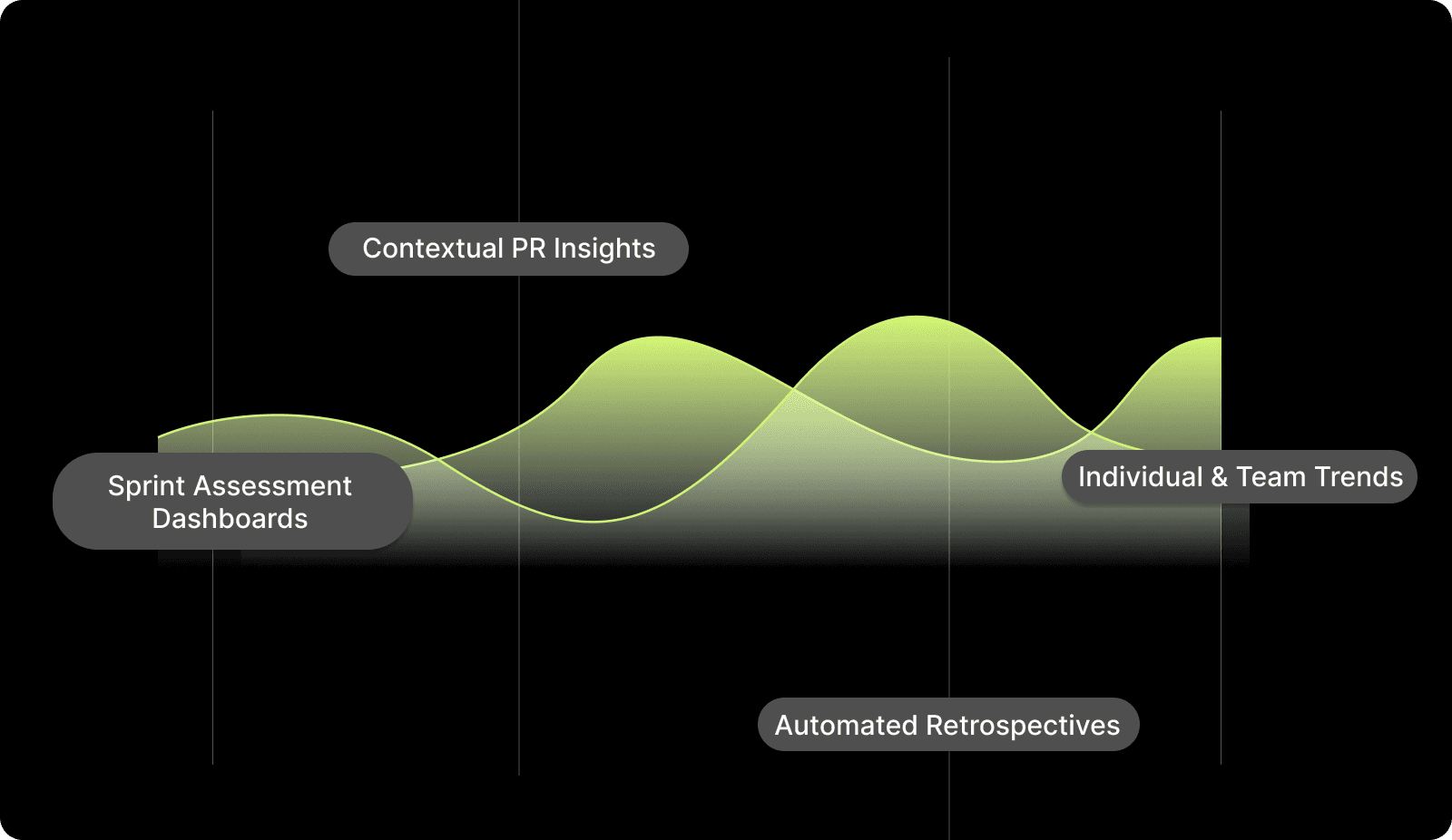
Sprint Assessment Dashboards: Automatically track your planned versus completed work to see if your shipping speed aligns with your strategic sprint goals.
Contextual PR Insights: Identify potential bugs and architectural risks within the IDE before they ever reach your production deployment pipeline.
Individual & Team Trends: Monitor productivity across different teams to identify who needs more support or where manual bottlenecks are still occurring.
Automated Retrospectives: Use real engineering data to lead better meetings that focus on improving velocity rather than just discussing anecdotal feedback.
Entelligence AI bridges day-to-day code execution with the strategic clarity leaders need to scale high-frequency deployments safely across the entire organization.
Also read: Understanding Code Coverage: Meaning, Metrics, and Measurement
Conclusion
Mastering your deployment frequency is a critical step toward becoming a high-performing engineering organization that can respond quickly to changing market demands. By implementing best practices like trunk-based development and automated testing, you reduce the risk of failure while increasing the value you deliver to users.
Entelligence AI empowers you to achieve this balance by providing deep insights into your code quality and team performance directly within your existing workflow. Our platform ensures that your pursuit of speed is always supported by the clarity and context needed for long-term technical success.
Ready to transform your engineering culture and increase your deployment frequency without sacrificing code quality? Start your free-trial with Entelligence AI today.
FAQs
Q. Does deployment frequency apply to frontend and backend teams equally?
Yes, the principle applies to any team that ships software to users. The implementation may differ; a frontend team might use feature flags and A/B testing platforms heavily, while a backend team focuses on API versioning and database migrations. The goal of small, frequent, low-risk updates is universal for modern software teams.
Q. How do we handle database schema changes with frequent deployments?
Use disciplined, backward-compatible migration strategies. Always make schema changes additive (new columns, new tables) in one deployment. Deploy the code that uses the new schema in a subsequent deployment. This allows for zero-downtime migrations and safe rollbacks, which are essential for frequent releases.
Q. Our stakeholders are used to major quarterly releases. How do we communicate the value of deploying daily?
Frame it in terms of risk reduction and value acceleration. Explain that daily deployments deliver small, safe increments of value continuously, allowing for quicker adjustments. Contrast this with the high risk of a single, massive quarterly release that could fail. Share data on lower change failure rates and faster user feedback cycles to build your case.
Q. Can we have high deployment frequency with a monolith?
It is challenging but possible with disciplined practices. Trunk-based development, extensive test automation, and feature flagging are absolutely critical. You must also modularize the codebase internally to limit the scope of changes. The ultimate goal for a monolith aiming for elite performance should be to break it into independently deployable services over time.
Q. What is the difference between deployment frequency and release frequency?
Deployment frequency is the technical act of putting new code into production. Release frequency is the business act of making new functionality available to users. With feature flags, you can deploy code multiple times a day (high deployment frequency) but only turn on new features once a week (lower release frequency). This separation is key to managing risk.
Engineering leaders often face the "big bang" release problem, where shipping code feels like a high-risk event every single month. Infrequent deployments lead to massive merge conflicts and long feedback loops that eventually stall your entire product roadmap.
High-performing teams successfully reduce this friction by shipping small batches of code consistently to their production environments to minimize risk. According to the Google DORA 2025 report, elite engineering teams deploy on demand multiple times every day to stay competitive.
In this article, you will learn how to calculate and improve your deployment frequency to build a more resilient and productive engineering organization.
Quick Look
Elite Performance: Aim for on-demand deployments multiple times per day to minimize batch size and reduce the risk of failure.
Formula Basics: Calculate frequency by dividing the total number of successful production deployments by a specific time period, like one week.
Trunk-Based Development: Move away from long-lived feature branches to ensure your code is always in a state ready for immediate release.
Feature Flags: Separate code deployment from feature release to give your product team control over when users see new functional updates.
Automated Testing: Build a strong CI/CD pipeline that catches critical bugs early to prevent manual QA from becoming a permanent bottleneck.
Cultural Shift: Move from a blame-heavy culture to one that views every deployment as a non-event and a learning opportunity for everyone.
What is Deployment Frequency?
Deployment frequency measures how often an organization successfully releases code to a production environment or an app store for its end users.

This metric serves as a primary indicator of your team's overall agility and the efficiency of your automated delivery pipeline.
Shorten Feedback Loops: Get features in front of users faster to validate your product hypotheses before investing more development resources.
Reduce Batch Size: Shipping smaller increments makes it significantly easier to identify the root cause when a production error eventually occurs.
Minimize Lead Time: Decreasing the time between a code commit and a production deploy ensures your team delivers value without unnecessary delays.
Build Confidence: Frequent releases turn the deployment process into a routine activity rather than a stressful event that requires weekend work.
Improving this metric requires a combination of architectural changes and a mindset shift toward continuous delivery rather than scheduled batch releases.

Also read: AI Code Review Techniques and Top Tools
Benefits of Tracking Deployment Frequency
Tracking how often you ship code provides deep insights into the health of your engineering processes and the stability of your architecture. Monitoring this data allows you to identify invisible hurdles that prevent your developers from reaching their full productive potential every day.
You should monitor these specific outcomes to justify your investment in delivery automation:
1. Accelerated Feedback Loops
Shipping code daily allows your product teams to validate their hypotheses with real users in real-time rather than waiting for monthly cycles. This speed ensures that you are building the right features and can pivot quickly if a specific update does not resonate with users.
2. Reduced Risk Profile
There is a direct relationship between small batch sizes and lower change failure rates because smaller changes are easier to test and verify. When you deploy frequently, the scope of each change is limited, which makes troubleshooting and rolling back much faster for your on-call engineers.
3. Improved Developer Morale
Teams that ship often experience less "deployment anxiety" because the process is automated and predictable rather than a manual, high-stakes event. Developers feel a greater sense of accomplishment when they see their code reaching production hours after completion instead of weeks later.
Consistent measurement highlights where your delivery pipeline is failing so you can address those specific issues with targeted engineering improvements.
Also read: How to Measure Developer Productivity Effectively
Tracking these benefits manually shouldn't be another hurdle for your engineering team. Book a demo with Entelligence AI to see how our automated dashboards provide real-time visibility into your delivery pipeline and developer health. Start moving from anecdotal feedback to data-driven clarity today.
What is a Good Deployment Frequency?
A "good" target for your team depends on your industry and the complexity of the product you are currently building for your customers. While benchmarks provide a helpful starting point, you must align your goals with the specific needs of your business and users.
Consider these benchmarks when evaluating your current engineering performance:
1. The DORA Benchmarks
Elite teams deploy on demand multiple times per day, while high-performing teams typically ship between once per day and once per week. Low performers usually struggle to ship once per month and often rely on manual, error-prone processes that slow down the entire organization.
2. Contextual Targets
An "elite" target looks very different for a mobile app startup compared to a legacy banking system that requires strict regulatory compliance. You should aim for a frequency that allows you to remain competitive in your market without compromising the security of your user data.
3. Quality Over Quantity
You must ensure that increasing your speed does not come at the cost of significant technical debt or a rising change failure rate. A high frequency is only valuable if the code you ship is stable, secure, and provides actual value to your paying customers.
Your goal should be continuous improvement of your own historical baseline rather than chasing an arbitrary number that might not fit your context.
Also read: Understanding Velocity in Agile Software Development
What Causes Low Deployment Frequency?
Low frequency is usually a symptom of deeper technical or cultural issues that prevent your engineers from moving at a high velocity. Identifying these root causes is the first step toward building a more efficient and automated software delivery life cycle.

Look for these common obstacles within your current engineering organization:
1. Manual Bottlenecks
The heavy impact of "manual QA" and manual change-approval gates creates long queues of unreleased code. These manual steps often introduce human error and make it impossible to reach the elite levels of on-demand deployment for your team.
2. Architectural Coupling
Monolithic structures and tight dependencies force your teams to coordinate massive, infrequent releases that require multiple departments to sign off simultaneously. This coupling means that a single bug in one area can block the entire release for every other part of the system.
3. Cultural Fear
A "blame culture" leads to oversized batches because developers become afraid of breaking production and choose to delay deployments for extra manual checking. This fear creates a vicious cycle where infrequent releases become larger, riskier, and more likely to fail when they finally happen.
Removing these barriers requires a strategic commitment from leadership to invest in automation and architectural decoupling over several sprint cycles.
Also read: Effective Strategies to Reduce Technical Debt
How to Calculate Deployment Frequency
Calculating your frequency accurately requires clear data from your version control system and your production deployment logs over a consistent time period. You need to distinguish between successful deployments and failed attempts to get an honest view of your team's actual delivery capability.
Use this standard formula to measure your performance:
DF = Total Successful Deployments/Time Period (Days)
For example, if your team successfully shipped 14 times to production over the last 7 days, your deployment frequency is 2.0 per day.
To implement this measurement step-by-step, you should:
Define what counts as a "deployment" (e.g., a successful merge to the production branch that passes all health checks).
Pull the timestamps of every successful production release from your CI/CD tool, like GitHub Actions or Jenkins, over a 30-day window.
Exclude any failed deployments that were rolled back immediately, as these do not contribute to the delivery of new value to users.
Visualize the trend over time to see if your frequency is increasing as you implement new automation tools and better engineering practices.
With a baseline measurement, you can begin implementing strategies to improve it systematically and sustainably.
10 Best Practices to Increase Deployment Frequency Without Breaking Production
Increasing your velocity requires a deliberate strategy that combines better tools with a more disciplined approach to how you write and review code. You must focus on reducing the friction at every stage of the delivery pipeline to make shipping a non-event.
Implement these strategies to improve your frequency while maintaining high quality:
1. Adopt Trunk-Based Development
Developers should merge small, frequent updates into a single "trunk" branch rather than maintaining long-lived feature branches for several weeks at a time.
Impact:
Reduces merge conflicts significantly.
Ensures the codebase is always ready for a release.
Encourages continuous integration of new code.
2. Implement Feature Flags
Use feature flags to decouple the technical act of deployment from the business act of releasing a feature to your end users.
Impact:
Allows for safer production testing.
Enables instant rollbacks without redeploying code.
Makes product managers control feature launch timing.
3. Automate the Testing Suite
Build a comprehensive set of unit, integration, and end-to-end tests that run automatically every time a developer pushes code to the repository.
Impact:
Catches regressions before they hit production.
Reduces the need for slow manual QA cycles.
Gives developers confidence to ship small changes.
4. Shift to Small Batch Sizes
Break down your product requirements into the smallest possible deployable units that still provide some level of value to the user or system.
Impact:
Simplifies the code review process.
Makes troubleshooting much faster after a failure.
Increases the total number of successful deploys.
5. Standardize CI/CD Pipelines
Create a reusable and automated pipeline that handles the build, test, and deployment steps identically for every microservice or application in your stack.
Impact:
Eliminates custom "snowflake" deployment scripts.
Makes the release process predictable and repeatable.
Simplifies onboarding for new engineering hires.

6. Use Containerization
Package your applications into containers to ensure they run exactly the same way in your local development environment as they do in production.
Impact:
Ends the "it works on my machine" problem.
Speeds up deployment times across environments.
Simplifies scaling and infrastructure management.
7. Automated Rollback Procedures
Configure your monitoring tools to automatically trigger a rollback if production error rates spike immediately after a new deployment is successfully completed.
Impact:
Protects the user experience during failures.
Reduces the stress of shipping new code.
Lowers the mean time to recovery (MTTR).
8. Streamline Peer Reviews
Use AI tools to handle the initial linting and documentation checks so human reviewers can focus on architectural logic and business requirements.
Impact:
Reduces the time code sits in the PR queue.
Improves the quality of feedback developers receive.
Accelerates the overall development cycle.
9. Infrastructure as Code (IaC)
Manage your servers and databases using code templates like Terraform or CloudFormation to ensure your infrastructure is versioned and easily reproducible.
Impact:
Eliminates manual configuration errors in production.
Allows for rapid environment creation and teardown.
Enhances the security and auditability of your stack.
10. Monitor Real-Time Health
Implement effective logging and observability tools that give you a clear view of how your application performs the second a new deploy goes live.
Impact:
Identifies performance bottlenecks early in the cycle.
Provides data-driven insights for the next sprint.
Increases accountability for code quality across teams.
As you implement these practices, beware of optimizing for the metric itself rather than the outcomes it represents.
Also read: 15 Software Engineering KPIs to Track in 2026

Common Pitfalls and How to Avoid Them
Simply shipping more often does not guarantee success if you are not also monitoring the quality and impact of those specific code changes. You must avoid gaming the metric and focus on the underlying health of your software delivery process and your engineering team.
Avoid these traps when optimizing your delivery speed:
1. Gaming the Metric
The danger of "Gaming the Metric" occurs when teams ship meaningless or tiny changes, such as documentation typos or minor CSS tweaks, just to hit their numerical targets. This behavior inflates your data without delivering any actual functional value to your product or customers.
How to fix:
Track Value-Added Changes: Link deployments directly to Jira tickets or GitHub issues to ensure every release corresponds to a legitimate task or bug fix.
Review Batch Content: Periodically audit the contents of your deployments to ensure the team is not artificially splitting single tasks into multiple micro-releases.
Focus on Outcomes: Shift the conversation in retrospectives from "how many times did we ship" to "how much of the sprint goal did we deliver."
2. Ignoring the Change Failure Rate
Focusing solely on speed while ignoring the Change Failure Rate will eventually lead to a brittle system and a loss of user trust. For example, if your frequency is high but 30% of those deployments require an immediate rollback, your velocity is actually causing more harm than good.
How to fix:
Monitor Parallel Metrics: Always view frequency alongside CFR and Mean Time to Recovery (MTTR) to ensure stability is keeping pace with speed.
Implement Quality Gates: Set a mandatory threshold where, if the failure rate exceeds a certain percentage, the team pauses to focus exclusively on testing and stability.
Automated Rollbacks: Reduce the impact of failures by ensuring your system can automatically revert to a stable state without manual intervention.
3. Regulated Industry Constraints
Handling frequency in highly regulated industries like healthcare or finance often leads to "compliance bottlenecks" where manual auditing slows down every release. Failing to integrate security and auditing into the automated flow will create a permanent barrier that prevents you from reaching elite velocity.
How to fix:
Compliance as Code: Use tools to automate security scanning, license checks, and audit logging directly within your CI/CD pipeline.
Pre-Approved Workflows: Work with your compliance and legal teams to create standardized deployment paths that are "pre-audited" if they pass all automated security gates.
Digital Audit Trails: Ensure every deployment automatically generates a report of what was changed, who approved it, and the test results to satisfy regulatory requirements instantly.
Achieving a healthy, high deployment frequency requires more than just process changes; it needs clear visibility into the entire system.
Entelligence AI: Unifying Engineering Velocity and Strategic Clarity
Measuring how often you ship is a great start, but high frequency becomes a major liability if your code quality is simultaneously declining. Engineering leaders need a way to see the context behind the numbers to understand if speed is actually translating into business value.

Entelligence AI helps you bridge the gap between raw deployment numbers and the actual performance of your individual developers and engineering teams. Our platform provides the visibility you need to optimize your deployment frequency without sacrificing the long-term health of your codebase.
Why choose us:
Sprint Assessment Dashboards: Automatically track your planned versus completed work to see if your shipping speed aligns with your strategic sprint goals.
Contextual PR Insights: Identify potential bugs and architectural risks within the IDE before they ever reach your production deployment pipeline.
Individual & Team Trends: Monitor productivity across different teams to identify who needs more support or where manual bottlenecks are still occurring.
Automated Retrospectives: Use real engineering data to lead better meetings that focus on improving velocity rather than just discussing anecdotal feedback.
Entelligence AI bridges day-to-day code execution with the strategic clarity leaders need to scale high-frequency deployments safely across the entire organization.
Also read: Understanding Code Coverage: Meaning, Metrics, and Measurement
Conclusion
Mastering your deployment frequency is a critical step toward becoming a high-performing engineering organization that can respond quickly to changing market demands. By implementing best practices like trunk-based development and automated testing, you reduce the risk of failure while increasing the value you deliver to users.
Entelligence AI empowers you to achieve this balance by providing deep insights into your code quality and team performance directly within your existing workflow. Our platform ensures that your pursuit of speed is always supported by the clarity and context needed for long-term technical success.
Ready to transform your engineering culture and increase your deployment frequency without sacrificing code quality? Start your free-trial with Entelligence AI today.
FAQs
Q. Does deployment frequency apply to frontend and backend teams equally?
Yes, the principle applies to any team that ships software to users. The implementation may differ; a frontend team might use feature flags and A/B testing platforms heavily, while a backend team focuses on API versioning and database migrations. The goal of small, frequent, low-risk updates is universal for modern software teams.
Q. How do we handle database schema changes with frequent deployments?
Use disciplined, backward-compatible migration strategies. Always make schema changes additive (new columns, new tables) in one deployment. Deploy the code that uses the new schema in a subsequent deployment. This allows for zero-downtime migrations and safe rollbacks, which are essential for frequent releases.
Q. Our stakeholders are used to major quarterly releases. How do we communicate the value of deploying daily?
Frame it in terms of risk reduction and value acceleration. Explain that daily deployments deliver small, safe increments of value continuously, allowing for quicker adjustments. Contrast this with the high risk of a single, massive quarterly release that could fail. Share data on lower change failure rates and faster user feedback cycles to build your case.
Q. Can we have high deployment frequency with a monolith?
It is challenging but possible with disciplined practices. Trunk-based development, extensive test automation, and feature flagging are absolutely critical. You must also modularize the codebase internally to limit the scope of changes. The ultimate goal for a monolith aiming for elite performance should be to break it into independently deployable services over time.
Q. What is the difference between deployment frequency and release frequency?
Deployment frequency is the technical act of putting new code into production. Release frequency is the business act of making new functionality available to users. With feature flags, you can deploy code multiple times a day (high deployment frequency) but only turn on new features once a week (lower release frequency). This separation is key to managing risk.
We raised $5M to run your Engineering team on Autopilot
Watch our launch video
Talk to Sales
Turn engineering signals into leadership decisions
Connect with our team to see how Entelliegnce helps engineering leaders with full visibility into sprint performance, Team insights & Product Delivery
Talk to Sales
Turn engineering signals into leadership decisions
Connect with our team to see how Entelliegnce helps engineering leaders with full visibility into sprint performance, Team insights & Product Delivery
Try Entelligence now