
7 Key Strategies to Reduce Accumulated Technical Debt Without Slowing Delivery

Jan 20, 2026

Jan 20, 2026

According to McKinsey, 30% of CIOs say that more than 20% of their technology budget intended for new products is instead spent addressing technical debt, and estimate that technical debt accounts for 20–40% of the value of their entire technology estate.

If your engineering velocity is slowing, releases take longer than they used to, and simple changes feel riskier every quarter, you’re likely experiencing the impact of accumulated technical debt. More time is spent maintaining fragile systems, leaving less time for building features that drive growth.

The good news is that this problem is solvable. Technical debt can be reduced systematically without stopping delivery or rewriting everything from scratch.

In this blog, you’ll find the key strategies for reducing accumulated technical debt, including how to identify where debt is hurting you most, prioritize fixes based on business impact, and reduce technical debt while keeping your team productive.

Key Takeaways

  • Accumulated technical debt quietly reduces engineering velocity, increases defects, and drives developer frustration over time.

  • The most effective strategies for reducing accumulated technical debt rely on visibility, prioritization, and shared ownership.

  • Technical debt is best addressed when it is planned alongside feature delivery, not postponed as optional maintenance.

  • Signals like declining velocity, rising bug rates, and slow onboarding show when accumulated technical debt is hurting teams.

  • Automation and workflow intelligence, supported by tools like Entelligence AI, help teams reduce technical debt without slowing delivery.

What Is Technical Debt?

Technical debt is the future cost of choosing faster or easier development solutions instead of stronger, longer-term ones. It represents the extra effort required later to maintain, fix, or improve code that was built with shortcuts.

When teams rush features, apply quick fixes, or delay refactoring, they create technical debt. Over time, this debt accumulates: dependencies grow, changes become riskier, and simple fixes take significantly longer than expected.

The term was introduced by Ward Cunningham, who compared shipping imperfect code to taking on financial debt, useful in the short term, but costly if left unpaid.

Common Types of Technical Debt

  • Code debt: Duplicated logic, workarounds, or inefficient implementations.

  • Architecture debt: Design decisions that limit scalability or flexibility.

  • Infrastructure debt: Outdated libraries, frameworks, or unsupported tools.

  • Documentation debt: Missing or unclear explanations of how systems work.

Not all technical debt is bad. Teams may intentionally take it on to ship faster or validate ideas. The real problem arises when debt isn’t tracked or addressed, allowing its cost to compound and slow development over time.

Why Does Technical Debt Accumulate Over Time?

Technical debt doesn’t show up all at once. It builds gradually through the decisions you and your team make to keep projects moving and meet delivery goals.

Here are the most common reasons technical debt accumulates over time:

  • You’re under constant delivery pressure: When deadlines are tight, you ship quick fixes instead of well-designed solutions. Tests get skipped, refactoring gets delayed, and documentation is pushed aside, all of which add to technical debt.

  • Your team is working with knowledge gaps: If you’re adopting new tools, frameworks, or domains, it’s easy to implement solutions that work now but don’t scale well. Junior developers may not even realize they’re creating debt.

  • Your product requirements keep changing: Code that worked perfectly six months ago can become a liability as new features, integrations, or scaling requirements emerge. These changes aren’t mistakes, but they do create debt you need to manage.

  • Your codebase isn’t actively maintained: Over time, dependencies fall behind, frameworks evolve, and best practices change. If you’re not revisiting older code, technical debt quietly piles up.

  • Your teams aren’t fully aligned: When product and engineering aren’t on the same page, incorrect assumptions lead to rework. Technical debt tasks also get deprioritized in favor of new feature delivery.

  • You’re constrained by time and resources: Limited budgets, small teams, or hiring gaps force tough tradeoffs. You focus on shipping now, even if it means creating problems you’ll have to fix later.

If you don’t address these issues early, they compound. Each shortcut makes future changes harder, slowing down development and increasing risk across your codebase.

How to Know If Technical Debt Is Actively Hurting Your Team?

Technical debt hides until it causes visible pain. You need concrete indicators to identify when debt crosses from manageable to damaging.
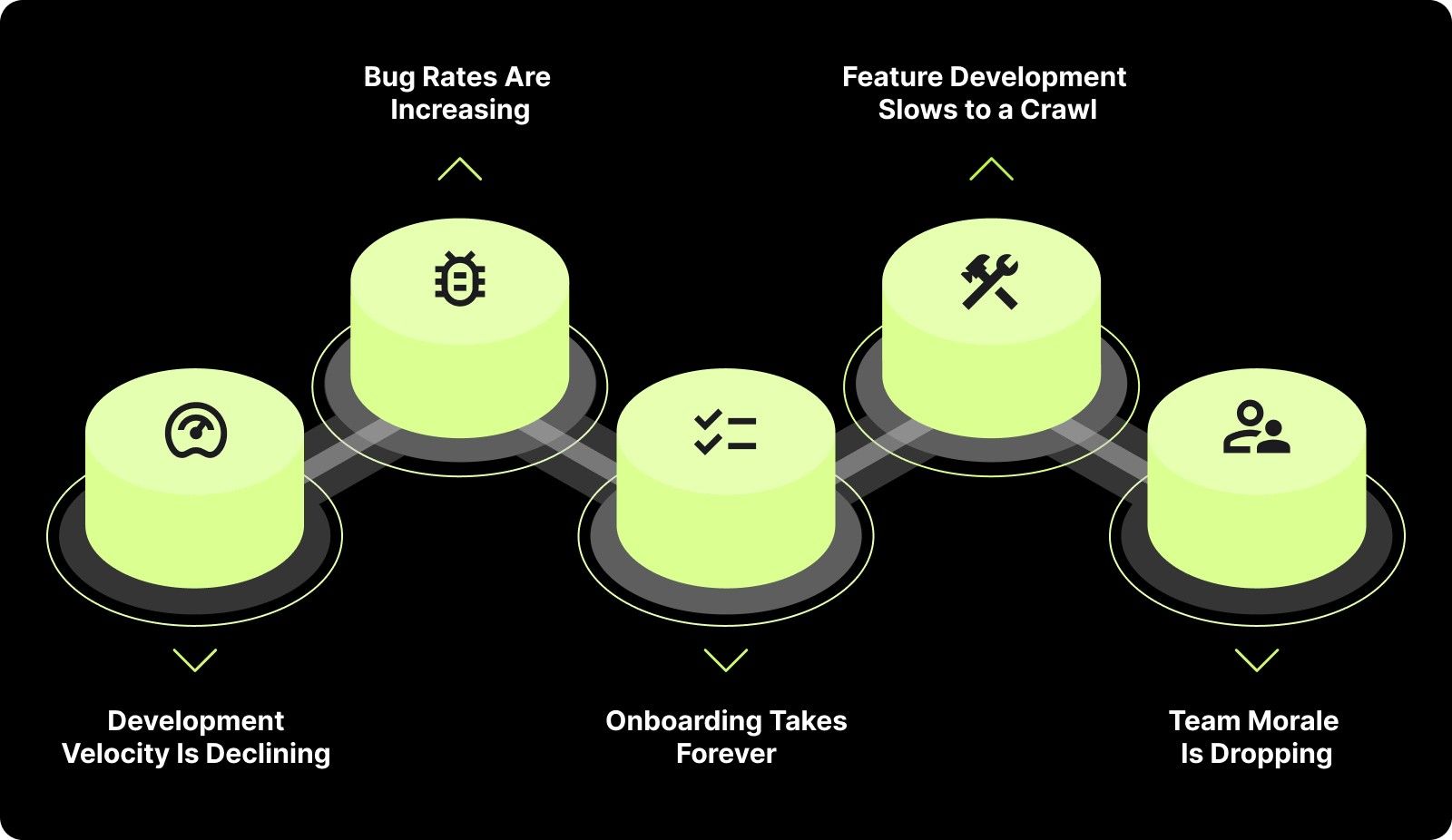
How to Know If Technical Debt Is Actively Hurting Your Team?

1. Development Velocity Is Declining

Track your team's velocity over time using sprint points completed or features shipped per month. If completing similar-sized features takes progressively longer each sprint, technical debt is likely the culprit.

Measure cycle time, the period from when a developer starts coding to when the change goes live. Calculate this by tracking:

  1. Time from the first commit to the creation of the pull request.

  2. Time from pull request to approval.

  3. Time from approval to deployment.

2. Bug Rates Are Increasing

Monitor your defect density by counting bugs per feature or per thousand lines of code. Track this monthly to identify trends.

Calculate defect ratio:

  • Formula: (New bugs discovered / Total lines of code) × 1000

  • Healthy benchmark: Under one defect per 1,000 lines of code

  • Red flag: Ratio increasing month over month

Track how often fixes for one issue cause new problems elsewhere. When your team plays maintenance whack-a-mole, fixing one bug only to create two more, you're dealing with architectural debt that makes the entire system unpredictable. Document these cascading failures.

3. Onboarding Takes Forever

Measure how long new engineers take to become productive using these milestones:

  • Days until first successful code contribution.

  • Days until independently completing a medium-sized feature.

  • Days until comfortable making architectural decisions.

If it takes months for competent developers to understand your codebase well enough to contribute confidently, you have significant documentation and architectural debt. 

4. Feature Development Slows to a Crawl

Compare the time required to add similar features across different quarters. If a feature that took two weeks last year now takes six weeks, calculate the difference. That's your debt tax.

Track these specific metrics:

  • Lead time: Time from feature request to production deployment.

  • Code churn: Percentage of code recently written that gets modified or deleted within weeks.

  • Pull request size: Average lines changed per PR (increasing size often indicates workarounds).

High code churn rates indicate developers are constantly reworking recent code because the foundation isn't solid. This rework consumes time that should be devoted to new features.

5. Team Morale Is Dropping

Technical debt destroys morale. Developers who constantly work around destructive code feel frustrated and devalued. Watch for these warning signs:

  • Increased complaints about "fighting the codebase" in standups.

  • Developers are expressing frustration that simple tasks take days.

  • Team members are avoiding certain parts of the codebase.

  • Rising turnover, especially among senior engineers who see the debt clearly.

Conduct quarterly anonymous surveys asking: "On a scale of 1-10, how much does our codebase quality affect your job satisfaction?" 

7 Key Strategies to Reduce Technical Debt

Reducing accumulated technical debt requires systematic approaches that balance immediate needs with long-term health. These key strategies for reducing accumulated technical debt have proven effective across organizations of all sizes.

Let’s look at them in detail:

1. Conduct a Comprehensive Technical Debt Audit

Before fixing technical debt, you need a clear view of what exists, where it lives, and how much it costs. A structured audit gives you that baseline.

Step 1: Inventory your debt

Use automated tooling to identify standard debt signals:

  • Run static analysis tools like Entelligence AI to surface code smells, high complexity, and duplication.

  • Review dependency scans to find outdated or vulnerable libraries.

  • Check test coverage reports to identify untested code paths.

Capture findings in a centralized debt register. For each item, record:

  • Code location

  • Debt type (code, architecture, infrastructure, documentation)

  • Estimated remediation effort (hours or story points)

  • Business impact if left unresolved

Step 2: Assess severity and business impact

Not all debt requires immediate action. Classify each item by risk and impact:

  • Critical — production failures, security vulnerabilities, or release blockers.

  • High — slows feature delivery or causes recurring defects.

  • Medium — manageable friction with workarounds.

  • Low — minimal business impact.

For critical and high-priority items, estimate the maintenance tax in terms of engineering hours lost per month.

Step 3: Prioritize by impact vs. effort

Use an effect, effort matrix to guide action:

  • High impact, low effort → Fix immediately.

  • High impact, high effort → Schedule dedicated refactoring.

  • Low impact, low effort → Address opportunistically.

  • Low impact, high effort → Defer or formally accept.

This audit becomes your technical debt roadmap. Share it with leadership to align remediation efforts with cost, risk, and delivery impact.

2. Implement Regular Refactoring Sprints

Refactoring improves the internal structure of code without changing its external behavior. Regular refactoring prevents debt from reaching critical mass.

Allocate dedicated time for refactoring.

  • Reserve 15-20% of each sprint for debt reduction work. For a two-week sprint, that's 1.5-2 days. 

  • Protect this time fiercely. When product pressures mount, teams often sacrifice refactoring time first. 

A 2024 Oliver Wyman report notes that while only a minority of companies follow the practice, earmarking 15-20% of their budget to manage technical debt is a proven strategy for maintaining long-term velocity.

Focus refactoring on high-traffic areas.

Refactor code that gets modified frequently. Apply the "Boy Scout Rule": leave the code better than you found it. When working on a feature that touches a debt-heavy module, spend extra time improving that module's structure.

Target refactoring based on change frequency:

  • Pull Git commit logs to identify the files that have been changed most often.

  • Refactor these high-churn files first since improvements here yield maximum benefit.

  • Skip rarely-touched code unless it's critical infrastructure.

Break extensive refactoring into incremental changes

Avoid massive rewrites that take months. Instead, refactor incrementally:

  1. Identify a specific improvement (extract duplicated code into a shared function)

  2. Make the change in one sprint.

  3. Test thoroughly to ensure behavior hasn't changed.

  4. Deploy to production.

  5. Move to the next improvement.

3. Establish and Enforce Coding Standards

Consistent coding standards prevent new debt from entering your codebase.

Define clear coding conventions.

Create a style guide covering:

  • Naming conventions for variables, functions, and classes.

  • Code formatting rules (indentation, line length, bracket placement).

  • Comment requirements and documentation expectations.

  • Approved design patterns and anti-patterns to avoid.

Make the guide accessible and specific. Avoid vague rules like "write clean code." Instead, specify: "Functions should not exceed 50 lines" or "All public APIs must have JSDoc comments."

Automate enforcement with linters and formatters

Manual code review can't catch every style violation. Automate enforcement:

  • Configure linters (ESLint for JavaScript, Pylint for Python) to match your style guide.

  • Set up auto-formatters (Prettier, Black) to standardize formatting automatically.

  • Integrate these tools into your CI/CD pipeline.

  • Fail builds that violate standards.

Conduct thorough code reviews.

Code reviews catch issues that automated tools miss. Establish review guidelines:

  • Every change requires approval from at least one senior developer.

  • Reviewers check for architectural concerns, not just syntax.

  • Teams discuss trade-offs when fast approaches might create debt.

  • Document decisions to take on intentional debt with a plan to repay it.

Make debt discussions explicit during reviews. When someone proposes a workaround, the team should discuss whether the long-term cost justifies the short-term speed. Entelligence AI fixes this by providing context-aware code quality and code security review suggestions directly in your IDE, helping catch potential debt before it enters the codebase.

4. Prioritize Automated Testing

Comprehensive test coverage prevents regressions and makes refactoring safer.

Build a strong test suite.

Aim for test coverage targets by layer:

  • Unit tests: 80% coverage of business logic.

  • Integration tests: Cover all API endpoints and database interactions.

  • End-to-end tests: Cover critical user journeys.

Measure current coverage using tools like Jest, pytest, or JUnit. Set incremental goals.

Write tests before refactoring.

Before changing legacy code, write tests that verify current behavior:

  1. Identify the function or module you plan to refactor.

  2. Write tests that confirm its current outputs for various inputs.

  3. Run tests to ensure they pass.

  4. Refactor the code.

  5. Rerun tests to confirm behavior hasn't changed.

This safety net lets you refactor confidently without breaking functionality.

Adopt test-driven development for new features.

For new code, write tests first:

  1. Write a failing test that describes the desired behavior.

  2. Write the minimum code needed to pass the test.

  3. Refactor to improve quality while keeping tests green

TDD prevents new debt by forcing you to think about design before implementation. It produces more testable, modular code.

5. Upgrade Dependencies and Modernize Technology

Outdated technologies accumulate debt through security vulnerabilities and incompatibility with modern tools.

Regularly update dependencies

Create a quarterly dependency review process:

  1. Run dependency audit tools (npm audit, pip-audit) to identify outdated packages.

  2. Check for security vulnerabilities in current versions.

  3. Review changelogs for major version updates to understand breaking changes.

  4. Update dependencies in a staging environment and run the full test suite.

  5. Deploy updates to production after validation.

Plan technology migrations carefully

When core technologies become obsolete, plan migrations strategically:

Phase 1: Assessment

  • Identify all systems using the legacy technology.

  • Estimate the effort required for migration.

  • Calculate the risk of staying versus migrating.

Phase 2: Pilot

  • Migrate one small, non-critical system first.

  • Document the process and lessons learned.

  • Measure performance and stability.

Phase 3: Incremental rollout

  • Migrate systems in order of business value.

  • Run old and new systems in parallel when possible.

  • Validate each migration before proceeding to the next.

Plan for 2-3 times longer than initial estimates. Technology migrations always uncover unexpected dependencies.

6. Improve Documentation Continuously

Documentation debt makes systems incomprehensible. Comprehensive documentation reduces onboarding time and prevents mistakes.

Document architectural decisions

Maintain an Architecture Decision Record (ADR) for significant technical decisions:

  • Context: What situation prompted this decision?

  • Decision: What approach did we choose?

  • Consequences: What are the implications of this choice?

  • Alternatives considered: What other options did we evaluate?

Update ADRs when circumstances change. If you reverse a decision, document why.

Keep API and code documentation current

For every public interface, maintain:

  • Purpose and intended use cases.

  • Parameters and return values.

  • Example usage.

  • Error conditions and how to handle them.

Create onboarding guides and runbooks.

New team members need fast paths to productivity. Document:

  • How to set up the development environment.

  • Architecture overview with system diagrams.

  • Common development workflows.

  • How to run tests and deploy changes.

  • Troubleshooting guides for frequent issues.

Platforms that automate documentation, like Entelligence AI, can automatically generate and maintain API documentation and architecture diagrams as code changes occur, eliminating the manual burden of keeping docs in sync with code.

7. Track Technical Debt Metrics Over Time

You can't manage what you don't measure. Establish metrics to track debt levels and progress toward debt reduction.

Calculate Technical Debt Ratio (TDR)

TDR measures the cost to fix debt versus the cost to build the system.

  • Formula: TDR = (Remediation effort in hours / Total development effort in hours) × 100

  • Healthy benchmark: TDR below 5% Warning zone: TDR between 5-10% Critical: TDR above 10%

Calculate TDR quarterly. Track the trend. Is debt growing or shrinking? A rising TDR means you're accumulating debt faster than you're paying it down.

Monitor velocity and cycle time.

Track sprint velocity (story points completed per sprint) and cycle time (days from code start to production). These indicate whether debt is slowing your team.

Create a dashboard showing:

  • Sprint velocity over the past six months.

  • Average cycle time trend.

  • Defect ratio trend.

  • Test coverage percentage.

Review these metrics monthly with leadership. When velocity drops or cycle time increases, investigate whether debt is the cause.

Use code quality metrics.

Track automated code quality metrics:

  • Cyclomatic complexity: Number of independent paths through code (lower is better, aim for under 10 per function).

  • Code duplication: Percentage of code that's duplicated (aim for under 5%).

  • Maintainability index: Composite score based on complexity and volume (aim for above 65).

Set targets and track progress. Celebrate improvements. If duplicated code drops from 15% to 8%, that's real progress worth recognizing.

How to Prevent and Manage Technical Debt Over Time?

Technical debt is unavoidable, but letting it grow unchecked isn’t. The teams that stay productive over time focus on two things: preventing new debt from entering the codebase and managing existing debt alongside feature delivery.

Prevent New Technical Debt at the Code Level

Preventing technical debt starts with everyday engineering habits that maintain high quality as you ship.

To reduce new debt, you should:

  • Enforce clear coding standards to ensure code remains consistent, readable, and maintainable across the team.

  • Rely on automated testing to catch issues early and make refactoring safer.

  • Use code reviews intentionally to spot risky shortcuts and discuss long-term tradeoffs before they reach production.

  • Keep dependencies up to date to avoid security risks and compatibility issues that become harder to fix later.

These practices act as guardrails, helping your team move fast without creating problems you’ll have to clean up later.

Balance Technical Debt with Feature Delivery

Even with strong prevention practices, some technical debt is inevitable. The challenge is to ensure it doesn’t get permanently deprioritized as feature pressure increases.

To manage debt alongside feature work:

  • Plan technical debt into your sprints instead of treating it as optional cleanup work.

  • Keep technical debt visible in your backlog so it’s discussed during planning, not ignored.

  • Fix debt by building new features to prevent fragile areas from getting worse.

  • Avoid extensive, all-or-nothing rewrites by improving systems incrementally while continuing to deliver value.

  • Frame technical debt in business terms, such as delivery speed, reliability, and risk, when discussing priorities with stakeholders.

When technical debt is planned, visible, and tied to outcomes, it stops competing with feature delivery and starts supporting it.

Technical Debt Checklist to Catch Problems Early

Use this checklist regularly to spot technical debt before it starts slowing your team down. If you find yourself checking “No” too often, technical debt is likely pulling your velocity down.
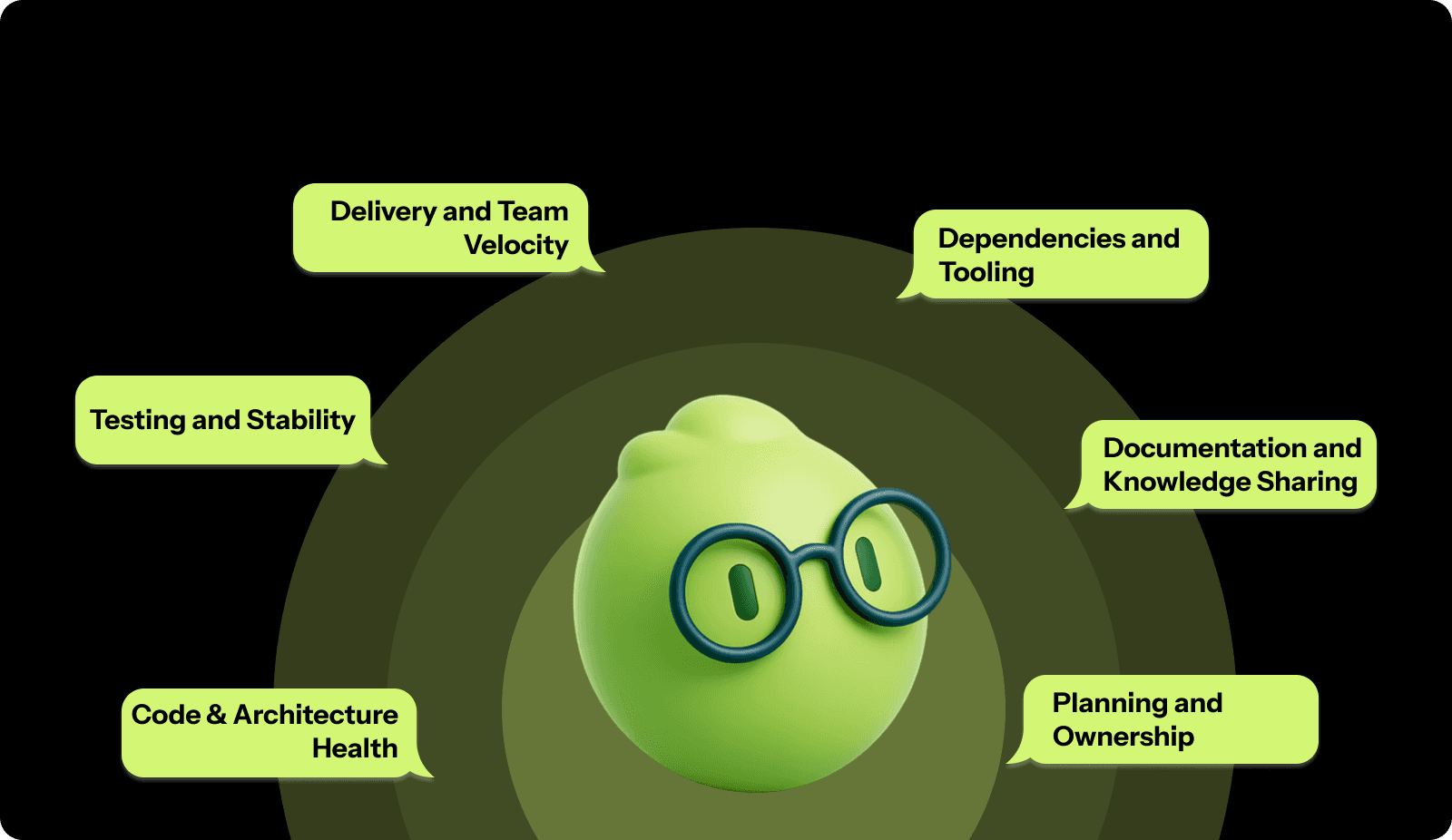
Technical Debt Checklist to Catch Problems Early

Code and Architecture Health

☐ Can you safely change frequently touched code without breaking unrelated features?

☐ Is duplicated or workaround-heavy logic minimal?

☐ Are core modules easy to understand and modify?

☐ Do architectural decisions still support your current scale and use cases?

Testing and Stability

☐ Do critical business flows have reliable automated test coverage?

☐ Can you refactor code confidently without fear of regressions?

☐ Are test failures treated as signals, not ignored?

☐ Are production issues trending downward or staying stable?

Delivery and Team Velocity

☐ Are sprint estimates mostly accurate?

☐ Is your cycle time stable or improving over time?

☐ Do releases happen without last-minute firefighting?

☐ Are engineers spending more time building than fixing past issues?

Dependencies and Tooling

☐ Are dependencies reviewed and updated regularly?

☐ Are you avoiding unsupported or end-of-life libraries and frameworks?

☐ Do your tools still fit your current team size and system complexity?

☐ Are security issues addressed proactively rather than reactively?

Documentation and Knowledge Sharing

☐ Can new engineers be onboarded without constant hand-holding?

☐ Are important architectural decisions documented and easy to find?

☐ Does documentation reflect how the system actually works today?

☐ Can your team understand why past technical tradeoffs were made?

Planning and Ownership

☐ Is technical debt visible in your backlog alongside feature work?

☐ Do you consistently allocate time to reduce technical debt?

☐ Can engineers raise concerns about risky shortcuts without pushback?

☐ Are technical debt decisions aligned with business priorities?

How to Use This Checklist

  • Review it monthly or quarterly with engineering leads.

  • Look for patterns, not perfection.

  • Focus first on sections where most answers are “No.”

If technical debt appears across multiple areas, it’s a signal that prevention and planning need attention.

How Entelligence AI Helps Reduce Technical Debt?

Technical debt reduction demands continuous effort, visibility, and intelligent automation. Manual tracking and fixing can't keep pace with the modern development velocity. You need AI-powered tools that surface problems before they compound and automate the grunt work of code quality.

Entelligence AI provides an end-to-end engineering productivity suite that helps teams systematically identify, track, and eliminate technical debt. It embeds quality and visibility into every stage of your development workflow.

Here’s how it helps: 

  • Context-aware code reviews prevent new technical debt: Entelligence AI analyzes code changes directly in the IDE and flags code smells, duplication, and risky shortcuts before they are merged. Developers get immediate, relevant feedback while context is fresh, reducing long-term maintenance burden.

  • Automated documentation eliminates documentation debt: Architecture diagrams, system context, and API documentation stay automatically in sync with the codebase. As code evolves, documentation updates automatically, removing one of the most common sources of technical debt.

  • Continuous security and dependency scanning reduces risk: It detects vulnerable or outdated dependencies early and provides actionable remediation guidance, helping teams address security and infrastructure debt before it reaches production.

  • Sprint and codebase insights expose high-impact debt: Built-in analytics reveal where technical debt slows velocity, increases bugs, or causes repeated rework, allowing teams to prioritize fixes based on real delivery impact.

  • PR visibility highlights recurring debt hotspots: Pull request dashboards surface review bottlenecks and patterns that signal underlying debt, making issues visible before they spread across the codebase.

  • Team-level insights connect debt to developer productivity: The platform shows where engineers spend disproportionate time navigating legacy issues instead of building features, enabling data-driven refactoring decisions.

By embedding these capabilities directly into your development workflow, Entelligence AI helps you apply the key strategies to reduce accumulated technical debt. You get the automation, visibility, and intelligent assistance needed to keep debt manageable while maintaining high velocity.

Conclusion

Reducing accumulated technical debt requires discipline, visibility, and consistent follow-through across the entire engineering lifecycle. One-time cleanup efforts rarely work because debt returns when quality is not built into daily workflows. Long-term success comes from making technical health a continuous priority, not an occasional initiative.

Key strategies for reducing accumulated technical debt work best when supported by intelligent tooling. Entelligence AI embeds visibility, code quality, and insights directly into everyday engineering work. This allows teams to identify risk earlier and focus effort where it creates the most impact.

Start a free trial with Entelligence AI today. See how AI-powered engineering insights help you stay ahead of technical debt and protect long-term velocity.

FAQ’s 

1. What are the four quadrants of technical debt?

The four quadrants are deliberate prudent, deliberate reckless, inadvertent prudent, and inadvertent reckless, classifying debt by intent and understanding at the time decisions were made.

2. What is the 80/20 rule for tech debt?

The 80/20 rule suggests that 20 percent of the codebase typically accounts for 80 percent of maintenance costs, bugs, and slowdowns, making focused fixes more effective.

3. How to manage technical debt in Agile?

Manage technical debt in Agile by planning debt tasks into sprints, keeping debt visible in the backlog, prioritizing by impact, and continuously refactoring alongside feature delivery.

4. What are the two major causes of the team's technical debt?

The two major causes are delivery pressure that encourages shortcuts and a lack of shared technical understanding, which leads to poor design decisions and inconsistent implementation practices.

5. How do you handle technical debt in a long-term project?

Handle technical debt by tracking it continuously, reviewing priorities regularly, allocating recurring capacity for reduction, modernizing incrementally, and aligning remediation decisions with long-term business goals.

According to McKinsey, 30% of CIOs say that more than 20% of their technology budget intended for new products is instead spent addressing technical debt, and estimate that technical debt accounts for 20–40% of the value of their entire technology estate.

If your engineering velocity is slowing, releases take longer than they used to, and simple changes feel riskier every quarter, you’re likely experiencing the impact of accumulated technical debt. More time is spent maintaining fragile systems, leaving less time for building features that drive growth.

The good news is that this problem is solvable. Technical debt can be reduced systematically without stopping delivery or rewriting everything from scratch.

In this blog, you’ll find the key strategies for reducing accumulated technical debt, including how to identify where debt is hurting you most, prioritize fixes based on business impact, and reduce technical debt while keeping your team productive.

Key Takeaways

  • Accumulated technical debt quietly reduces engineering velocity, increases defects, and drives developer frustration over time.

  • The most effective strategies for reducing accumulated technical debt rely on visibility, prioritization, and shared ownership.

  • Technical debt is best addressed when it is planned alongside feature delivery, not postponed as optional maintenance.

  • Signals like declining velocity, rising bug rates, and slow onboarding show when accumulated technical debt is hurting teams.

  • Automation and workflow intelligence, supported by tools like Entelligence AI, help teams reduce technical debt without slowing delivery.

What Is Technical Debt?

Technical debt is the future cost of choosing faster or easier development solutions instead of stronger, longer-term ones. It represents the extra effort required later to maintain, fix, or improve code that was built with shortcuts.

When teams rush features, apply quick fixes, or delay refactoring, they create technical debt. Over time, this debt accumulates: dependencies grow, changes become riskier, and simple fixes take significantly longer than expected.

The term was introduced by Ward Cunningham, who compared shipping imperfect code to taking on financial debt, useful in the short term, but costly if left unpaid.

Common Types of Technical Debt

  • Code debt: Duplicated logic, workarounds, or inefficient implementations.

  • Architecture debt: Design decisions that limit scalability or flexibility.

  • Infrastructure debt: Outdated libraries, frameworks, or unsupported tools.

  • Documentation debt: Missing or unclear explanations of how systems work.

Not all technical debt is bad. Teams may intentionally take it on to ship faster or validate ideas. The real problem arises when debt isn’t tracked or addressed, allowing its cost to compound and slow development over time.

Why Does Technical Debt Accumulate Over Time?

Technical debt doesn’t show up all at once. It builds gradually through the decisions you and your team make to keep projects moving and meet delivery goals.

Here are the most common reasons technical debt accumulates over time:

  • You’re under constant delivery pressure: When deadlines are tight, you ship quick fixes instead of well-designed solutions. Tests get skipped, refactoring gets delayed, and documentation is pushed aside, all of which add to technical debt.

  • Your team is working with knowledge gaps: If you’re adopting new tools, frameworks, or domains, it’s easy to implement solutions that work now but don’t scale well. Junior developers may not even realize they’re creating debt.

  • Your product requirements keep changing: Code that worked perfectly six months ago can become a liability as new features, integrations, or scaling requirements emerge. These changes aren’t mistakes, but they do create debt you need to manage.

  • Your codebase isn’t actively maintained: Over time, dependencies fall behind, frameworks evolve, and best practices change. If you’re not revisiting older code, technical debt quietly piles up.

  • Your teams aren’t fully aligned: When product and engineering aren’t on the same page, incorrect assumptions lead to rework. Technical debt tasks also get deprioritized in favor of new feature delivery.

  • You’re constrained by time and resources: Limited budgets, small teams, or hiring gaps force tough tradeoffs. You focus on shipping now, even if it means creating problems you’ll have to fix later.

If you don’t address these issues early, they compound. Each shortcut makes future changes harder, slowing down development and increasing risk across your codebase.

How to Know If Technical Debt Is Actively Hurting Your Team?

Technical debt hides until it causes visible pain. You need concrete indicators to identify when debt crosses from manageable to damaging.

How to Know If Technical Debt Is Actively Hurting Your Team?

1. Development Velocity Is Declining

Track your team's velocity over time using sprint points completed or features shipped per month. If completing similar-sized features takes progressively longer each sprint, technical debt is likely the culprit.

Measure cycle time, the period from when a developer starts coding to when the change goes live. Calculate this by tracking:

  1. Time from the first commit to the creation of the pull request.

  2. Time from pull request to approval.

  3. Time from approval to deployment.

2. Bug Rates Are Increasing

Monitor your defect density by counting bugs per feature or per thousand lines of code. Track this monthly to identify trends.

Calculate defect ratio:

  • Formula: (New bugs discovered / Total lines of code) × 1000

  • Healthy benchmark: Under one defect per 1,000 lines of code

  • Red flag: Ratio increasing month over month

Track how often fixes for one issue cause new problems elsewhere. When your team plays maintenance whack-a-mole, fixing one bug only to create two more, you're dealing with architectural debt that makes the entire system unpredictable. Document these cascading failures.

3. Onboarding Takes Forever

Measure how long new engineers take to become productive using these milestones:

  • Days until first successful code contribution.

  • Days until independently completing a medium-sized feature.

  • Days until comfortable making architectural decisions.

If it takes months for competent developers to understand your codebase well enough to contribute confidently, you have significant documentation and architectural debt. 

4. Feature Development Slows to a Crawl

Compare the time required to add similar features across different quarters. If a feature that took two weeks last year now takes six weeks, calculate the difference. That's your debt tax.

Track these specific metrics:

  • Lead time: Time from feature request to production deployment.

  • Code churn: Percentage of code recently written that gets modified or deleted within weeks.

  • Pull request size: Average lines changed per PR (increasing size often indicates workarounds).

High code churn rates indicate developers are constantly reworking recent code because the foundation isn't solid. This rework consumes time that should be devoted to new features.

5. Team Morale Is Dropping

Technical debt destroys morale. Developers who constantly work around destructive code feel frustrated and devalued. Watch for these warning signs:

  • Increased complaints about "fighting the codebase" in standups.

  • Developers are expressing frustration that simple tasks take days.

  • Team members are avoiding certain parts of the codebase.

  • Rising turnover, especially among senior engineers who see the debt clearly.

Conduct quarterly anonymous surveys asking: "On a scale of 1-10, how much does our codebase quality affect your job satisfaction?" 

7 Key Strategies to Reduce Technical Debt

Reducing accumulated technical debt requires systematic approaches that balance immediate needs with long-term health. These key strategies for reducing accumulated technical debt have proven effective across organizations of all sizes.

Let’s look at them in detail:

1. Conduct a Comprehensive Technical Debt Audit

Before fixing technical debt, you need a clear view of what exists, where it lives, and how much it costs. A structured audit gives you that baseline.

Step 1: Inventory your debt

Use automated tooling to identify standard debt signals:

  • Run static analysis tools like Entelligence AI to surface code smells, high complexity, and duplication.

  • Review dependency scans to find outdated or vulnerable libraries.

  • Check test coverage reports to identify untested code paths.

Capture findings in a centralized debt register. For each item, record:

  • Code location

  • Debt type (code, architecture, infrastructure, documentation)

  • Estimated remediation effort (hours or story points)

  • Business impact if left unresolved

Step 2: Assess severity and business impact

Not all debt requires immediate action. Classify each item by risk and impact:

  • Critical — production failures, security vulnerabilities, or release blockers.

  • High — slows feature delivery or causes recurring defects.

  • Medium — manageable friction with workarounds.

  • Low — minimal business impact.

For critical and high-priority items, estimate the maintenance tax in terms of engineering hours lost per month.

Step 3: Prioritize by impact vs. effort

Use an effect, effort matrix to guide action:

  • High impact, low effort → Fix immediately.

  • High impact, high effort → Schedule dedicated refactoring.

  • Low impact, low effort → Address opportunistically.

  • Low impact, high effort → Defer or formally accept.

This audit becomes your technical debt roadmap. Share it with leadership to align remediation efforts with cost, risk, and delivery impact.

2. Implement Regular Refactoring Sprints

Refactoring improves the internal structure of code without changing its external behavior. Regular refactoring prevents debt from reaching critical mass.

Allocate dedicated time for refactoring.

  • Reserve 15-20% of each sprint for debt reduction work. For a two-week sprint, that's 1.5-2 days. 

  • Protect this time fiercely. When product pressures mount, teams often sacrifice refactoring time first. 

A 2024 Oliver Wyman report notes that while only a minority of companies follow the practice, earmarking 15-20% of their budget to manage technical debt is a proven strategy for maintaining long-term velocity.

Focus refactoring on high-traffic areas.

Refactor code that gets modified frequently. Apply the "Boy Scout Rule": leave the code better than you found it. When working on a feature that touches a debt-heavy module, spend extra time improving that module's structure.

Target refactoring based on change frequency:

  • Pull Git commit logs to identify the files that have been changed most often.

  • Refactor these high-churn files first since improvements here yield maximum benefit.

  • Skip rarely-touched code unless it's critical infrastructure.

Break extensive refactoring into incremental changes

Avoid massive rewrites that take months. Instead, refactor incrementally:

  1. Identify a specific improvement (extract duplicated code into a shared function)

  2. Make the change in one sprint.

  3. Test thoroughly to ensure behavior hasn't changed.

  4. Deploy to production.

  5. Move to the next improvement.

3. Establish and Enforce Coding Standards

Consistent coding standards prevent new debt from entering your codebase.

Define clear coding conventions.

Create a style guide covering:

  • Naming conventions for variables, functions, and classes.

  • Code formatting rules (indentation, line length, bracket placement).

  • Comment requirements and documentation expectations.

  • Approved design patterns and anti-patterns to avoid.

Make the guide accessible and specific. Avoid vague rules like "write clean code." Instead, specify: "Functions should not exceed 50 lines" or "All public APIs must have JSDoc comments."

Automate enforcement with linters and formatters

Manual code review can't catch every style violation. Automate enforcement:

  • Configure linters (ESLint for JavaScript, Pylint for Python) to match your style guide.

  • Set up auto-formatters (Prettier, Black) to standardize formatting automatically.

  • Integrate these tools into your CI/CD pipeline.

  • Fail builds that violate standards.

Conduct thorough code reviews.

Code reviews catch issues that automated tools miss. Establish review guidelines:

  • Every change requires approval from at least one senior developer.

  • Reviewers check for architectural concerns, not just syntax.

  • Teams discuss trade-offs when fast approaches might create debt.

  • Document decisions to take on intentional debt with a plan to repay it.

Make debt discussions explicit during reviews. When someone proposes a workaround, the team should discuss whether the long-term cost justifies the short-term speed. Entelligence AI fixes this by providing context-aware code quality and code security review suggestions directly in your IDE, helping catch potential debt before it enters the codebase.

4. Prioritize Automated Testing

Comprehensive test coverage prevents regressions and makes refactoring safer.

Build a strong test suite.

Aim for test coverage targets by layer:

  • Unit tests: 80% coverage of business logic.

  • Integration tests: Cover all API endpoints and database interactions.

  • End-to-end tests: Cover critical user journeys.

Measure current coverage using tools like Jest, pytest, or JUnit. Set incremental goals.

Write tests before refactoring.

Before changing legacy code, write tests that verify current behavior:

  1. Identify the function or module you plan to refactor.

  2. Write tests that confirm its current outputs for various inputs.

  3. Run tests to ensure they pass.

  4. Refactor the code.

  5. Rerun tests to confirm behavior hasn't changed.

This safety net lets you refactor confidently without breaking functionality.

Adopt test-driven development for new features.

For new code, write tests first:

  1. Write a failing test that describes the desired behavior.

  2. Write the minimum code needed to pass the test.

  3. Refactor to improve quality while keeping tests green

TDD prevents new debt by forcing you to think about design before implementation. It produces more testable, modular code.

5. Upgrade Dependencies and Modernize Technology

Outdated technologies accumulate debt through security vulnerabilities and incompatibility with modern tools.

Regularly update dependencies

Create a quarterly dependency review process:

  1. Run dependency audit tools (npm audit, pip-audit) to identify outdated packages.

  2. Check for security vulnerabilities in current versions.

  3. Review changelogs for major version updates to understand breaking changes.

  4. Update dependencies in a staging environment and run the full test suite.

  5. Deploy updates to production after validation.

Plan technology migrations carefully

When core technologies become obsolete, plan migrations strategically:

Phase 1: Assessment

  • Identify all systems using the legacy technology.

  • Estimate the effort required for migration.

  • Calculate the risk of staying versus migrating.

Phase 2: Pilot

  • Migrate one small, non-critical system first.

  • Document the process and lessons learned.

  • Measure performance and stability.

Phase 3: Incremental rollout

  • Migrate systems in order of business value.

  • Run old and new systems in parallel when possible.

  • Validate each migration before proceeding to the next.

Plan for 2-3 times longer than initial estimates. Technology migrations always uncover unexpected dependencies.

6. Improve Documentation Continuously

Documentation debt makes systems incomprehensible. Comprehensive documentation reduces onboarding time and prevents mistakes.

Document architectural decisions

Maintain an Architecture Decision Record (ADR) for significant technical decisions:

  • Context: What situation prompted this decision?

  • Decision: What approach did we choose?

  • Consequences: What are the implications of this choice?

  • Alternatives considered: What other options did we evaluate?

Update ADRs when circumstances change. If you reverse a decision, document why.

Keep API and code documentation current

For every public interface, maintain:

  • Purpose and intended use cases.

  • Parameters and return values.

  • Example usage.

  • Error conditions and how to handle them.

Create onboarding guides and runbooks.

New team members need fast paths to productivity. Document:

  • How to set up the development environment.

  • Architecture overview with system diagrams.

  • Common development workflows.

  • How to run tests and deploy changes.

  • Troubleshooting guides for frequent issues.

Platforms that automate documentation, like Entelligence AI, can automatically generate and maintain API documentation and architecture diagrams as code changes occur, eliminating the manual burden of keeping docs in sync with code.

7. Track Technical Debt Metrics Over Time

You can't manage what you don't measure. Establish metrics to track debt levels and progress toward debt reduction.

Calculate Technical Debt Ratio (TDR)

TDR measures the cost to fix debt versus the cost to build the system.

  • Formula: TDR = (Remediation effort in hours / Total development effort in hours) × 100

  • Healthy benchmark: TDR below 5% Warning zone: TDR between 5-10% Critical: TDR above 10%

Calculate TDR quarterly. Track the trend. Is debt growing or shrinking? A rising TDR means you're accumulating debt faster than you're paying it down.

Monitor velocity and cycle time.

Track sprint velocity (story points completed per sprint) and cycle time (days from code start to production). These indicate whether debt is slowing your team.

Create a dashboard showing:

  • Sprint velocity over the past six months.

  • Average cycle time trend.

  • Defect ratio trend.

  • Test coverage percentage.

Review these metrics monthly with leadership. When velocity drops or cycle time increases, investigate whether debt is the cause.

Use code quality metrics.

Track automated code quality metrics:

  • Cyclomatic complexity: Number of independent paths through code (lower is better, aim for under 10 per function).

  • Code duplication: Percentage of code that's duplicated (aim for under 5%).

  • Maintainability index: Composite score based on complexity and volume (aim for above 65).

Set targets and track progress. Celebrate improvements. If duplicated code drops from 15% to 8%, that's real progress worth recognizing.

How to Prevent and Manage Technical Debt Over Time?

Technical debt is unavoidable, but letting it grow unchecked isn’t. The teams that stay productive over time focus on two things: preventing new debt from entering the codebase and managing existing debt alongside feature delivery.

Prevent New Technical Debt at the Code Level

Preventing technical debt starts with everyday engineering habits that maintain high quality as you ship.

To reduce new debt, you should:

  • Enforce clear coding standards to ensure code remains consistent, readable, and maintainable across the team.

  • Rely on automated testing to catch issues early and make refactoring safer.

  • Use code reviews intentionally to spot risky shortcuts and discuss long-term tradeoffs before they reach production.

  • Keep dependencies up to date to avoid security risks and compatibility issues that become harder to fix later.

These practices act as guardrails, helping your team move fast without creating problems you’ll have to clean up later.

Balance Technical Debt with Feature Delivery

Even with strong prevention practices, some technical debt is inevitable. The challenge is to ensure it doesn’t get permanently deprioritized as feature pressure increases.

To manage debt alongside feature work:

  • Plan technical debt into your sprints instead of treating it as optional cleanup work.

  • Keep technical debt visible in your backlog so it’s discussed during planning, not ignored.

  • Fix debt by building new features to prevent fragile areas from getting worse.

  • Avoid extensive, all-or-nothing rewrites by improving systems incrementally while continuing to deliver value.

  • Frame technical debt in business terms, such as delivery speed, reliability, and risk, when discussing priorities with stakeholders.

When technical debt is planned, visible, and tied to outcomes, it stops competing with feature delivery and starts supporting it.

Technical Debt Checklist to Catch Problems Early

Use this checklist regularly to spot technical debt before it starts slowing your team down. If you find yourself checking “No” too often, technical debt is likely pulling your velocity down.

Technical Debt Checklist to Catch Problems Early

Code and Architecture Health

☐ Can you safely change frequently touched code without breaking unrelated features?

☐ Is duplicated or workaround-heavy logic minimal?

☐ Are core modules easy to understand and modify?

☐ Do architectural decisions still support your current scale and use cases?

Testing and Stability

☐ Do critical business flows have reliable automated test coverage?

☐ Can you refactor code confidently without fear of regressions?

☐ Are test failures treated as signals, not ignored?

☐ Are production issues trending downward or staying stable?

Delivery and Team Velocity

☐ Are sprint estimates mostly accurate?

☐ Is your cycle time stable or improving over time?

☐ Do releases happen without last-minute firefighting?

☐ Are engineers spending more time building than fixing past issues?

Dependencies and Tooling

☐ Are dependencies reviewed and updated regularly?

☐ Are you avoiding unsupported or end-of-life libraries and frameworks?

☐ Do your tools still fit your current team size and system complexity?

☐ Are security issues addressed proactively rather than reactively?

Documentation and Knowledge Sharing

☐ Can new engineers be onboarded without constant hand-holding?

☐ Are important architectural decisions documented and easy to find?

☐ Does documentation reflect how the system actually works today?

☐ Can your team understand why past technical tradeoffs were made?

Planning and Ownership

☐ Is technical debt visible in your backlog alongside feature work?

☐ Do you consistently allocate time to reduce technical debt?

☐ Can engineers raise concerns about risky shortcuts without pushback?

☐ Are technical debt decisions aligned with business priorities?

How to Use This Checklist

  • Review it monthly or quarterly with engineering leads.

  • Look for patterns, not perfection.

  • Focus first on sections where most answers are “No.”

If technical debt appears across multiple areas, it’s a signal that prevention and planning need attention.

How Entelligence AI Helps Reduce Technical Debt?

Technical debt reduction demands continuous effort, visibility, and intelligent automation. Manual tracking and fixing can't keep pace with the modern development velocity. You need AI-powered tools that surface problems before they compound and automate the grunt work of code quality.

Entelligence AI provides an end-to-end engineering productivity suite that helps teams systematically identify, track, and eliminate technical debt. It embeds quality and visibility into every stage of your development workflow.

Here’s how it helps: 

  • Context-aware code reviews prevent new technical debt: Entelligence AI analyzes code changes directly in the IDE and flags code smells, duplication, and risky shortcuts before they are merged. Developers get immediate, relevant feedback while context is fresh, reducing long-term maintenance burden.

  • Automated documentation eliminates documentation debt: Architecture diagrams, system context, and API documentation stay automatically in sync with the codebase. As code evolves, documentation updates automatically, removing one of the most common sources of technical debt.

  • Continuous security and dependency scanning reduces risk: It detects vulnerable or outdated dependencies early and provides actionable remediation guidance, helping teams address security and infrastructure debt before it reaches production.

  • Sprint and codebase insights expose high-impact debt: Built-in analytics reveal where technical debt slows velocity, increases bugs, or causes repeated rework, allowing teams to prioritize fixes based on real delivery impact.

  • PR visibility highlights recurring debt hotspots: Pull request dashboards surface review bottlenecks and patterns that signal underlying debt, making issues visible before they spread across the codebase.

  • Team-level insights connect debt to developer productivity: The platform shows where engineers spend disproportionate time navigating legacy issues instead of building features, enabling data-driven refactoring decisions.

By embedding these capabilities directly into your development workflow, Entelligence AI helps you apply the key strategies to reduce accumulated technical debt. You get the automation, visibility, and intelligent assistance needed to keep debt manageable while maintaining high velocity.

Conclusion

Reducing accumulated technical debt requires discipline, visibility, and consistent follow-through across the entire engineering lifecycle. One-time cleanup efforts rarely work because debt returns when quality is not built into daily workflows. Long-term success comes from making technical health a continuous priority, not an occasional initiative.

Key strategies for reducing accumulated technical debt work best when supported by intelligent tooling. Entelligence AI embeds visibility, code quality, and insights directly into everyday engineering work. This allows teams to identify risk earlier and focus effort where it creates the most impact.

Start a free trial with Entelligence AI today. See how AI-powered engineering insights help you stay ahead of technical debt and protect long-term velocity.

FAQ’s 

1. What are the four quadrants of technical debt?

The four quadrants are deliberate prudent, deliberate reckless, inadvertent prudent, and inadvertent reckless, classifying debt by intent and understanding at the time decisions were made.

2. What is the 80/20 rule for tech debt?

The 80/20 rule suggests that 20 percent of the codebase typically accounts for 80 percent of maintenance costs, bugs, and slowdowns, making focused fixes more effective.

3. How to manage technical debt in Agile?

Manage technical debt in Agile by planning debt tasks into sprints, keeping debt visible in the backlog, prioritizing by impact, and continuously refactoring alongside feature delivery.

4. What are the two major causes of the team's technical debt?

The two major causes are delivery pressure that encourages shortcuts and a lack of shared technical understanding, which leads to poor design decisions and inconsistent implementation practices.

5. How do you handle technical debt in a long-term project?

Handle technical debt by tracking it continuously, reviewing priorities regularly, allocating recurring capacity for reduction, modernizing incrementally, and aligning remediation decisions with long-term business goals.

We raised $5M to run your Engineering team on Autopilot

We raised $5M to run your Engineering team on Autopilot

Watch our launch video

Talk to Sales

Turn engineering signals into leadership decisions

Connect with our team to see how Entelliegnce helps engineering leaders with full visibility into sprint performance, Team insights & Product Delivery

Talk to Sales

Turn engineering signals into leadership decisions

Connect with our team to see how Entelliegnce helps engineering leaders with full visibility into sprint performance, Team insights & Product Delivery

Try Entelligence now