Engineering Velocity: A Complete Guide to High-Output Teams
Jan 19, 2026
Jan 19, 2026
Your team works hard, sprint after sprint, but the product roadmap keeps slipping. You track story points, but they feel disconnected from the actual shipped value. This gap between effort and outcome creates frustration for leaders and developers alike.
Improving your engineering velocity is the answer. It moves beyond counting tasks to measuring the reliable, high-quality flow of value from idea to production. It is the key to predictable delivery and sustainable team performance.
In this guide, we break down engineering velocity into its core components. You will learn how to calculate it, identify bottlenecks, and implement 10 actionable best practices to increase your team's throughput.
Key Takeaways
Speed with Direction: Velocity is not just about raw coding speed but the consistent delivery of business value over specific time periods.
Team over Individual: Measuring individual developer speed creates toxic competition while team-based metrics encourage collaborative problem-solving.
WIP Limits: Reducing the number of active tasks per developer prevents context switching and ensures that features actually reach the finish line.
The Debt Tax: Unaddressed technical debt acts as a high-interest loan that eventually consumes your team's entire capacity for new feature work.
Automation is Mandatory: Manual documentation and repetitive PR checks are the primary killers of engineering momentum.
Data-Driven Retrospectives: Use objective engineering data rather than anecdotal evidence to identify which parts of your workflow need optimization.
What is Engineering Velocity?
Engineering velocity is a measure of how much functional work an engineering team can complete within a specific timeframe, like a two-week sprint. It serves as a compass rather than a speedometer by providing the necessary data to predict future delivery dates and identify internal process friction.
The 3 Pillars of Velocity: Predictability, Quality, and Throughput
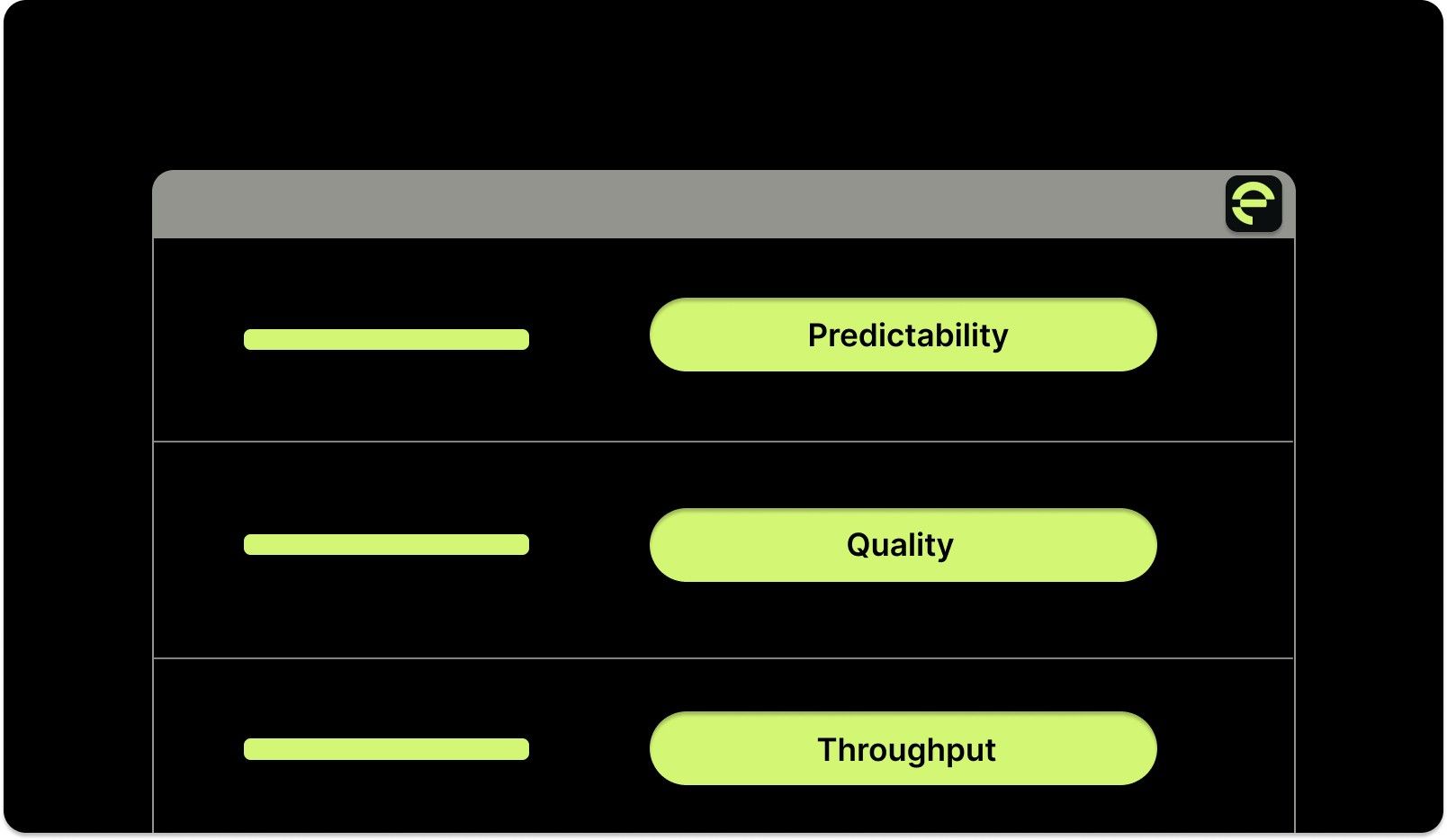
Predictability: This metric measures the consistency of your team's output across multiple sprints to help product managers plan roadmaps with a high degree of confidence.
Quality: High velocity is meaningless if the code is buggy. You must track your change failure rate to ensure that speed is not compromising stability.
Throughput: This represents the raw volume of work units, such as pull requests or tickets, that your team successfully moves to a completed state every week.
Why velocity is a "team metric," not an "individual metric"
Engineering velocity should always be measured at the team level because individual metrics fail to account for the collaborative nature of modern software development. When you track individuals, you discourage senior developers from mentoring juniors or performing deep architectural reviews that benefit the entire organization.
A team-centric approach fosters shared accountability and ensures that the total output remains stable even if a single developer is away or blocked.

Understanding your current team's performance allows you to make more informed decisions about your future product roadmap and resource requirements.
Also Read: High Velocity Engineering: Build Teams That Ship Faster
Benefits of Measuring Engineering Velocity
Measuring your velocity provides a transparent view of how your engineering department operates and where your resources are actually going. It moves the conversation from vague feelings about "busyness" to objective discussions about the actual flow of work through your delivery system.
Monitoring these key areas will help you justify strategic changes to your engineering processes:
1. Predictable Roadmap Planning
Historical velocity data allows you to forecast when specific features will be ready for release with a much higher degree of accuracy. This predictability builds trust with sales and marketing teams who rely on these timelines to coordinate product launches.
2. Identifying Process Bottlenecks
Significant drops in velocity often act as early warning signs for friction in your code review process or your automated testing suites. By spotting these trends early, you can address the root cause of the slowdown before it results in a missed project deadline.
3. Resource Allocation Clarity
Velocity data helps leaders decide whether they need to hire more developers or simply optimize existing workflows to increase capacity. It provides the objective evidence needed to prove that adding more people to a project might actually slow it down further.
A clear understanding of your team's delivery capabilities is the first step toward improving the overall efficiency of your engineering organization.
Also Read: Understanding Development Velocity in Software Engineering
How to Calculate Engineering Velocity: Step-by-Step Process
Calculating velocity requires a consistent method of tracking work to ensure that your data remains accurate and comparable over several months. You should choose a calculation method that aligns with your specific development methodology.
1. The Agile Approach: Calculating Average Story Points
Most teams using Scrum calculate velocity by totaling the story points of all "Done" tickets at the end of every two-week sprint.
Formula: Velocity = Total Story Points Completed/Sprint Period
Tip: Never include partially completed tickets in your calculation as this artificially inflates your perceived progress.
2. The Throughput Approach
If your team does not use story points, you can measure velocity by tracking the raw number of completed tasks or resolved pull requests.
Formula: Throughput = Total Completed Tasks / Time Period (weeks/months)
3. The DORA Integration
To get a holistic view of your engineering health, you must weight your velocity against your Lead Time for Changes. A team that completes 50 points but takes three weeks to deploy them is less agile than a team completing 30 points in three days.
Step-by-Step Implementation
Set a Baseline: Monitor your team's output for at least three consecutive sprints without making any major changes.
Calculate the Rolling Average: Use the average of your last three sprints to account for fluctuations caused by holidays or technical debt.
Define "Done": Ensure your team follows a strict "Definition of Done" that includes code review, testing, and successful deployment.
Refining your calculation methods will help you identify the specific obstacles that are currently preventing your team from reaching its maximum potential.
Also Read: Sprint Velocity in Scrum: How to Measure and Calculate It Right?
What Causes Low Engineering Velocity?
Low velocity is often a symptom of underlying technical debt or architectural issues that create unnecessary friction for your developers every day. Identifying these root causes allows you to stop treating the symptoms and start fixing the actual problems.
Look for these common velocity killers in your current development environment:
1. Technical Debt Accumulation
"Quick fixes" from six months ago often create complex dependencies that force developers to spend more time navigating old code than building new features. This debt acts as a constant drag on your velocity and makes every new task take significantly longer.
2. The "Context Switching" Tax
The hidden cost of constant interruptions prevents developers from entering a state of deep focus. Frequent context switching can reduce a developer's cognitive capacity and lead to a higher frequency of bugs and architectural mistakes.
3. Manual Feedback Loops
Waiting for manual human approval is one of the fastest ways to kill your engineering momentum. If your developers are waiting days for a code review or a manual QA sign-off, your overall throughput will remain low regardless of team size.
Overcoming these challenges requires a commitment to modernizing your workflows and adopting tools that automate repetitive tasks.
Identifying these bottlenecks manually shouldn't be another burden on your engineering leadership team. Book a demo with Entelligence AI to see how our automated sprint health dashboards instantly surface blockers and hidden friction in your development cycle.
Also Read: Understanding Velocity in Agile Software Development
10 Best Practices to Increase Engineering Velocity Without Burnout
Increasing your output does not mean asking your developers to work longer hours or sacrifice their well-being. True velocity comes from removing the obstacles that prevent your team from doing its best work in a sustainable way.
Implement these ten strategies to build a high-velocity engineering culture:
1. Adopt Trunk-Based Development
Encourage developers to merge small, frequent updates into the main branch instead of maintaining long-lived feature branches.
Action Steps:
Set a policy that branches must be merged back to the trunk within 24 hours.
Use feature flags to hide incomplete work from users.
Train the team on how to break large features into smaller units.
2. Implement WIP Limits
Restrict the number of active tasks each developer can work on simultaneously to ensure that work actually gets finished.
Action Steps:
Set a limit of two active tickets per developer in your project tool.
Use daily standups to identify who is over their limit.
Focus the team on "swarming" high-priority tickets.
3. Automate Documentation
Use AI tools to generate architecture diagrams and code explanations automatically so developers can spend more time writing logic.
Action Steps:
Integrate a tool like Entelligence AI to sync code changes with your documentation.
Require documentation updates as part of the automated CI/CD pipeline.
Use AI agents to handle boilerplate setup for new services.
4. Streamline Code Reviews
Adopt an "asynchronous-first" review culture where reviews are prioritized to reduce idle time for developers.
Action Steps:
Implement automated linting to catch basic issues before human review.
Set an "SLA" for code reviews (e.g., maximum four hours).
Use AI-powered contextual reviews to provide initial feedback.
5. Reduce PR Sizes
Smaller pull requests are significantly easier to review and much less likely to contain hidden bugs.
Action Steps:
Encourage developers to keep pull requests under 200 lines of code.
Highlight "mega-PRs" in retrospectives to discuss breakdown strategies.
Measure the correlation between PR size and review time.

6. Decouple Deployment from Release
Use feature flags to ship code frequently without necessarily making the features visible to all users immediately.
Action Steps:
Implement a feature flagging tool to give product managers release control.
Practice "dark launching" where new code is exercised with real traffic.
Use flags to perform "canary releases" for a subset of users.
7. Standardize Environments
Ensure that every developer is using a containerized environment that perfectly mirrors the production setup.
Action Steps:
Provide standardized Docker configurations for every service.
Automate the local environment setup for new hires.
Use infrastructure-as-code to manage staging and production identically.
8. Prioritize Technical Debt
Dedicate a specific percentage of every sprint to addressing technical debt and refactoring old code.
Action Steps:
Allocate 20% of team capacity in every sprint for maintenance.
Create a "Technical Debt Backlog" for future attention.
Use velocity drops as evidence for why a refactor is necessary.
9. Shift to Async Communication
Reduce the number of mandatory meetings and encourage the use of recorded demos or detailed PR comments.
Action Steps:
Implement "No Meeting Wednesdays" for uninterrupted deep work.
Use recorded video walkthroughs instead of live meetings for feature demos.
Document major decisions in an Architecture Decision Record (ADR).
10. Use Data-Driven Retrospectives
Stop relying on anecdotal feelings and start using actual engineering data to identify what truly slowed the team down.
Action Steps:
Review your "Say-Do Ratio" at every retrospective.
Use automated dashboards to visualize where tickets were blocked.
Focus on one specific process improvement per sprint.
Also Read: What Is Vibe Coding and How AI Tools Are Changing Development?
While implementing these practices, it's critical to avoid common traps that can undermine your efforts and harm your team.
Common Pitfalls and How To Avoid Them
Simply pushing for higher engineering velocity without considering the consequences can lead to a toxic culture and a fragile product. You must monitor these pitfalls to ensure that your pursuit of speed remains sustainable.
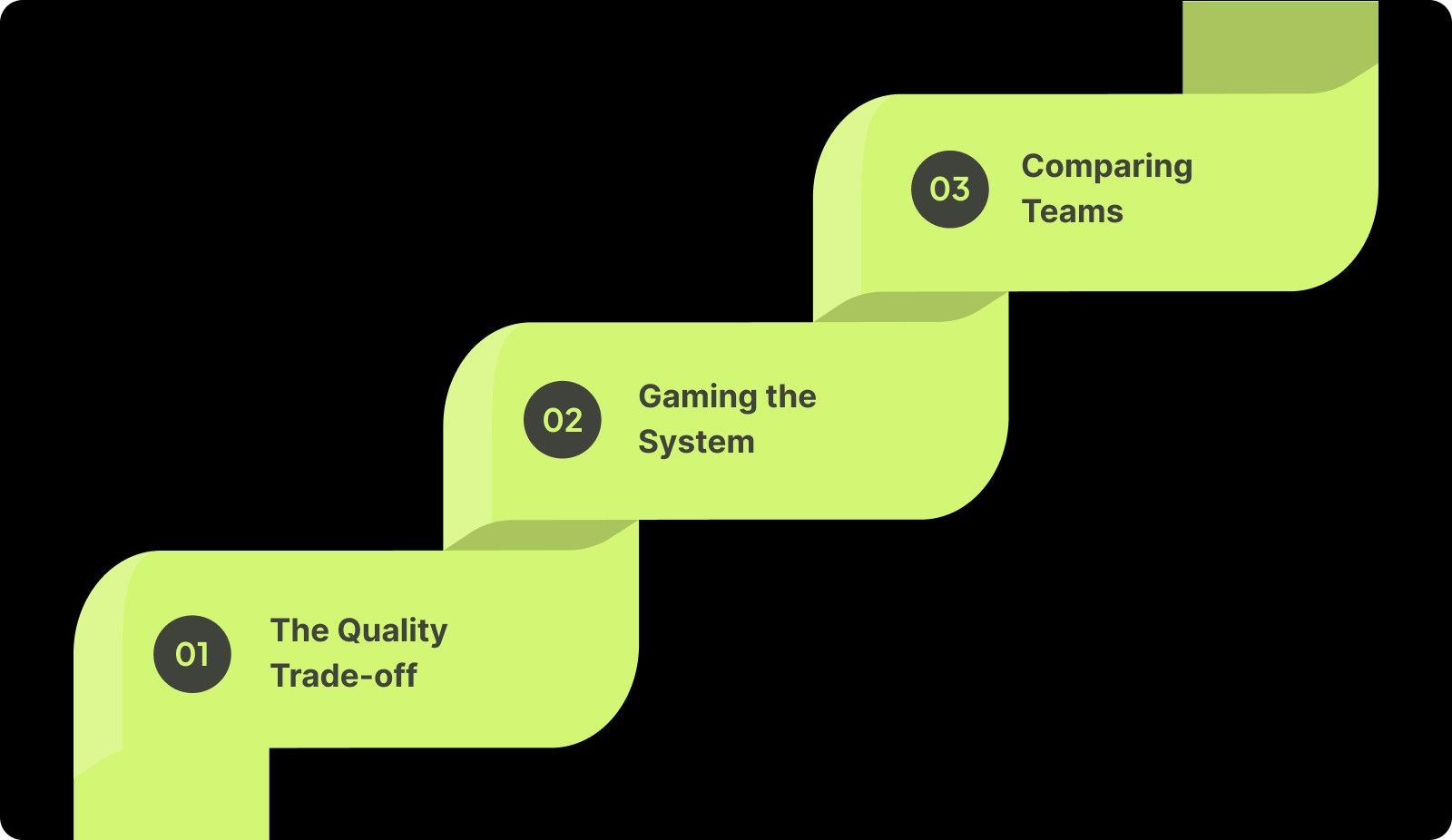
Avoid these common traps by implementing these strategic solutions:
1. The Quality Trade-off
When high velocity leads to a spike in your Change Failure Rate, you are not actually moving faster; you are just creating more rework.
The Solution: Link velocity directly to quality metrics. If the failure rate increases, prioritize stability over new features until the system recovers.
2. Gaming the System
Teams often start "padding" story points to appear more productive if velocity is used as a weapon by management.
The Solution: Never compare the velocity of different teams. Treat it as an internal diagnostic tool for the team itself to improve predictability.
3. Comparing Teams
Every team’s velocity is a unique fingerprint that depends on its specific tech stack and experience level.
The Solution: Focus on each team's growth relative to their own historical baseline. Use org-wide metrics like Deployment Frequency to compare department health instead.
Also read: Static Code Analysis: A Complete Guide to Improving Your Code
To navigate these pitfalls and implement best practices effectively, leaders need more than just output numbers. They need context.
Entelligence AI: Moving from Raw Speed to Strategic Throughput
Knowing that a team is "fast" is completely useless if they are shipping bugs or building the wrong features. To truly lead an engineering organization, you need the strategic clarity to understand exactly what is happening inside your delivery pipeline at every level.
Entelligence AI provides the necessary context behind your engineering velocity to ensure that speed stays high while quality remains consistent. Our platform automates the data-gathering phase so you can spend your time on meaningful leadership conversations instead of manual status tracking.
Automated Sprint Assessments: We provide a real-time health check of every sprint by tracking planned versus completed work and highlighting invisible blockers.
PR Bottleneck Alerts: Identify exactly where your code is getting stuck in the review process and receive suggestions on how to rebalance the workload.
Individual Contribution Clarity: Gain a qualitative and quantitative understanding of team performance without micromanaging your developers.
Entelligence AI provides the shared source of truth that turns velocity from a retrospective measure into a proactive tool for coaching and system-level optimization.

Conclusion
Engineering velocity is the most powerful tool in your leadership arsenal when it is measured with context and used to drive genuine process improvement. By focusing on team output rather than individual metrics, you create a culture of transparency and accountability that leads to better product outcomes for your users.
Entelligence AI supports this transition by providing the end-to-end intelligence needed to unify your delivery pipeline with your strategic business goals. Our platform ensures that every role in your organization has the clarity they need to succeed in a fast-paced software environment.
Ready to stop guessing and start growing your engineering velocity with objective data? Start your Entelligence AI free trial to see your team's true potential.
FAQs
Q. What is the difference between engineering velocity and productivity?
Engineering velocity specifically measures the volume of work completed over a set time period, while productivity is a broader concept that includes the efficiency and value of that work. You can have high velocity while producing very little business value if you are focusing on the wrong tasks.
Q. How do you explain a sudden drop in velocity to non-technical stakeholders?
Identify the specific systemic bottlenecks that occurred, such as a major increase in technical debt or a failure in the testing environment. Avoid blaming individuals and instead frame the conversation around the "process friction" that prevented the team from reaching their usual output level.
Q. Should I include bug fixes in my velocity calculation?
Most high-performing teams do not include bug fixes because bugs represent a failure to deliver quality work in a previous cycle. Including bugs can artificially inflate your engineering velocity and hide the fact that your team is spending too much time on rework. By excluding bugs, you get a clearer picture of your team's "feature capacity."
Q. How often should we adjust our team's velocity targets?
Velocity is not a target to be "hit" but a historical average to be observed for better planning and predictability. You should review your velocity every three to four sprints to see if your rolling average has changed due to process improvements. If your velocity remains stagnant despite making process changes, it is a sign that you have not yet addressed the primary bottleneck.
Q. Does increasing velocity always lead to higher developer burnout?
Increasing velocity through better automation and fewer meetings actually reduces burnout by removing the frustrating manual tasks that lead to developer fatigue. Burnout is caused by high-pressure environments with poor processes, not by the speed of shipping code itself.

Your team works hard, sprint after sprint, but the product roadmap keeps slipping. You track story points, but they feel disconnected from the actual shipped value. This gap between effort and outcome creates frustration for leaders and developers alike.
Improving your engineering velocity is the answer. It moves beyond counting tasks to measuring the reliable, high-quality flow of value from idea to production. It is the key to predictable delivery and sustainable team performance.
In this guide, we break down engineering velocity into its core components. You will learn how to calculate it, identify bottlenecks, and implement 10 actionable best practices to increase your team's throughput.
Key Takeaways
Speed with Direction: Velocity is not just about raw coding speed but the consistent delivery of business value over specific time periods.
Team over Individual: Measuring individual developer speed creates toxic competition while team-based metrics encourage collaborative problem-solving.
WIP Limits: Reducing the number of active tasks per developer prevents context switching and ensures that features actually reach the finish line.
The Debt Tax: Unaddressed technical debt acts as a high-interest loan that eventually consumes your team's entire capacity for new feature work.
Automation is Mandatory: Manual documentation and repetitive PR checks are the primary killers of engineering momentum.
Data-Driven Retrospectives: Use objective engineering data rather than anecdotal evidence to identify which parts of your workflow need optimization.
What is Engineering Velocity?
Engineering velocity is a measure of how much functional work an engineering team can complete within a specific timeframe, like a two-week sprint. It serves as a compass rather than a speedometer by providing the necessary data to predict future delivery dates and identify internal process friction.
The 3 Pillars of Velocity: Predictability, Quality, and Throughput

Predictability: This metric measures the consistency of your team's output across multiple sprints to help product managers plan roadmaps with a high degree of confidence.
Quality: High velocity is meaningless if the code is buggy. You must track your change failure rate to ensure that speed is not compromising stability.
Throughput: This represents the raw volume of work units, such as pull requests or tickets, that your team successfully moves to a completed state every week.
Why velocity is a "team metric," not an "individual metric"
Engineering velocity should always be measured at the team level because individual metrics fail to account for the collaborative nature of modern software development. When you track individuals, you discourage senior developers from mentoring juniors or performing deep architectural reviews that benefit the entire organization.
A team-centric approach fosters shared accountability and ensures that the total output remains stable even if a single developer is away or blocked.

Understanding your current team's performance allows you to make more informed decisions about your future product roadmap and resource requirements.
Also Read: High Velocity Engineering: Build Teams That Ship Faster
Benefits of Measuring Engineering Velocity
Measuring your velocity provides a transparent view of how your engineering department operates and where your resources are actually going. It moves the conversation from vague feelings about "busyness" to objective discussions about the actual flow of work through your delivery system.
Monitoring these key areas will help you justify strategic changes to your engineering processes:
1. Predictable Roadmap Planning
Historical velocity data allows you to forecast when specific features will be ready for release with a much higher degree of accuracy. This predictability builds trust with sales and marketing teams who rely on these timelines to coordinate product launches.
2. Identifying Process Bottlenecks
Significant drops in velocity often act as early warning signs for friction in your code review process or your automated testing suites. By spotting these trends early, you can address the root cause of the slowdown before it results in a missed project deadline.
3. Resource Allocation Clarity
Velocity data helps leaders decide whether they need to hire more developers or simply optimize existing workflows to increase capacity. It provides the objective evidence needed to prove that adding more people to a project might actually slow it down further.
A clear understanding of your team's delivery capabilities is the first step toward improving the overall efficiency of your engineering organization.
Also Read: Understanding Development Velocity in Software Engineering
How to Calculate Engineering Velocity: Step-by-Step Process
Calculating velocity requires a consistent method of tracking work to ensure that your data remains accurate and comparable over several months. You should choose a calculation method that aligns with your specific development methodology.

1. The Agile Approach: Calculating Average Story Points
Most teams using Scrum calculate velocity by totaling the story points of all "Done" tickets at the end of every two-week sprint.
Formula: Velocity = Total Story Points Completed/Sprint Period
Tip: Never include partially completed tickets in your calculation as this artificially inflates your perceived progress.
2. The Throughput Approach
If your team does not use story points, you can measure velocity by tracking the raw number of completed tasks or resolved pull requests.
Formula: Throughput = Total Completed Tasks / Time Period (weeks/months)
3. The DORA Integration
To get a holistic view of your engineering health, you must weight your velocity against your Lead Time for Changes. A team that completes 50 points but takes three weeks to deploy them is less agile than a team completing 30 points in three days.
Step-by-Step Implementation
Set a Baseline: Monitor your team's output for at least three consecutive sprints without making any major changes.
Calculate the Rolling Average: Use the average of your last three sprints to account for fluctuations caused by holidays or technical debt.
Define "Done": Ensure your team follows a strict "Definition of Done" that includes code review, testing, and successful deployment.
Refining your calculation methods will help you identify the specific obstacles that are currently preventing your team from reaching its maximum potential.
Also Read: Sprint Velocity in Scrum: How to Measure and Calculate It Right?
What Causes Low Engineering Velocity?
Low velocity is often a symptom of underlying technical debt or architectural issues that create unnecessary friction for your developers every day. Identifying these root causes allows you to stop treating the symptoms and start fixing the actual problems.
Look for these common velocity killers in your current development environment:
1. Technical Debt Accumulation
"Quick fixes" from six months ago often create complex dependencies that force developers to spend more time navigating old code than building new features. This debt acts as a constant drag on your velocity and makes every new task take significantly longer.
2. The "Context Switching" Tax
The hidden cost of constant interruptions prevents developers from entering a state of deep focus. Frequent context switching can reduce a developer's cognitive capacity and lead to a higher frequency of bugs and architectural mistakes.
3. Manual Feedback Loops
Waiting for manual human approval is one of the fastest ways to kill your engineering momentum. If your developers are waiting days for a code review or a manual QA sign-off, your overall throughput will remain low regardless of team size.
Overcoming these challenges requires a commitment to modernizing your workflows and adopting tools that automate repetitive tasks.
Identifying these bottlenecks manually shouldn't be another burden on your engineering leadership team. Book a demo with Entelligence AI to see how our automated sprint health dashboards instantly surface blockers and hidden friction in your development cycle.
Also Read: Understanding Velocity in Agile Software Development
10 Best Practices to Increase Engineering Velocity Without Burnout
Increasing your output does not mean asking your developers to work longer hours or sacrifice their well-being. True velocity comes from removing the obstacles that prevent your team from doing its best work in a sustainable way.
Implement these ten strategies to build a high-velocity engineering culture:
1. Adopt Trunk-Based Development
Encourage developers to merge small, frequent updates into the main branch instead of maintaining long-lived feature branches.
Action Steps:
Set a policy that branches must be merged back to the trunk within 24 hours.
Use feature flags to hide incomplete work from users.
Train the team on how to break large features into smaller units.
2. Implement WIP Limits
Restrict the number of active tasks each developer can work on simultaneously to ensure that work actually gets finished.
Action Steps:
Set a limit of two active tickets per developer in your project tool.
Use daily standups to identify who is over their limit.
Focus the team on "swarming" high-priority tickets.
3. Automate Documentation
Use AI tools to generate architecture diagrams and code explanations automatically so developers can spend more time writing logic.
Action Steps:
Integrate a tool like Entelligence AI to sync code changes with your documentation.
Require documentation updates as part of the automated CI/CD pipeline.
Use AI agents to handle boilerplate setup for new services.
4. Streamline Code Reviews
Adopt an "asynchronous-first" review culture where reviews are prioritized to reduce idle time for developers.
Action Steps:
Implement automated linting to catch basic issues before human review.
Set an "SLA" for code reviews (e.g., maximum four hours).
Use AI-powered contextual reviews to provide initial feedback.
5. Reduce PR Sizes
Smaller pull requests are significantly easier to review and much less likely to contain hidden bugs.
Action Steps:
Encourage developers to keep pull requests under 200 lines of code.
Highlight "mega-PRs" in retrospectives to discuss breakdown strategies.
Measure the correlation between PR size and review time.

6. Decouple Deployment from Release
Use feature flags to ship code frequently without necessarily making the features visible to all users immediately.
Action Steps:
Implement a feature flagging tool to give product managers release control.
Practice "dark launching" where new code is exercised with real traffic.
Use flags to perform "canary releases" for a subset of users.
7. Standardize Environments
Ensure that every developer is using a containerized environment that perfectly mirrors the production setup.
Action Steps:
Provide standardized Docker configurations for every service.
Automate the local environment setup for new hires.
Use infrastructure-as-code to manage staging and production identically.
8. Prioritize Technical Debt
Dedicate a specific percentage of every sprint to addressing technical debt and refactoring old code.
Action Steps:
Allocate 20% of team capacity in every sprint for maintenance.
Create a "Technical Debt Backlog" for future attention.
Use velocity drops as evidence for why a refactor is necessary.
9. Shift to Async Communication
Reduce the number of mandatory meetings and encourage the use of recorded demos or detailed PR comments.
Action Steps:
Implement "No Meeting Wednesdays" for uninterrupted deep work.
Use recorded video walkthroughs instead of live meetings for feature demos.
Document major decisions in an Architecture Decision Record (ADR).
10. Use Data-Driven Retrospectives
Stop relying on anecdotal feelings and start using actual engineering data to identify what truly slowed the team down.
Action Steps:
Review your "Say-Do Ratio" at every retrospective.
Use automated dashboards to visualize where tickets were blocked.
Focus on one specific process improvement per sprint.
Also Read: What Is Vibe Coding and How AI Tools Are Changing Development?
While implementing these practices, it's critical to avoid common traps that can undermine your efforts and harm your team.
Common Pitfalls and How To Avoid Them
Simply pushing for higher engineering velocity without considering the consequences can lead to a toxic culture and a fragile product. You must monitor these pitfalls to ensure that your pursuit of speed remains sustainable.

Avoid these common traps by implementing these strategic solutions:
1. The Quality Trade-off
When high velocity leads to a spike in your Change Failure Rate, you are not actually moving faster; you are just creating more rework.
The Solution: Link velocity directly to quality metrics. If the failure rate increases, prioritize stability over new features until the system recovers.
2. Gaming the System
Teams often start "padding" story points to appear more productive if velocity is used as a weapon by management.
The Solution: Never compare the velocity of different teams. Treat it as an internal diagnostic tool for the team itself to improve predictability.
3. Comparing Teams
Every team’s velocity is a unique fingerprint that depends on its specific tech stack and experience level.
The Solution: Focus on each team's growth relative to their own historical baseline. Use org-wide metrics like Deployment Frequency to compare department health instead.
Also read: Static Code Analysis: A Complete Guide to Improving Your Code
To navigate these pitfalls and implement best practices effectively, leaders need more than just output numbers. They need context.
Entelligence AI: Moving from Raw Speed to Strategic Throughput
Knowing that a team is "fast" is completely useless if they are shipping bugs or building the wrong features. To truly lead an engineering organization, you need the strategic clarity to understand exactly what is happening inside your delivery pipeline at every level.
Entelligence AI provides the necessary context behind your engineering velocity to ensure that speed stays high while quality remains consistent. Our platform automates the data-gathering phase so you can spend your time on meaningful leadership conversations instead of manual status tracking.
Automated Sprint Assessments: We provide a real-time health check of every sprint by tracking planned versus completed work and highlighting invisible blockers.
PR Bottleneck Alerts: Identify exactly where your code is getting stuck in the review process and receive suggestions on how to rebalance the workload.
Individual Contribution Clarity: Gain a qualitative and quantitative understanding of team performance without micromanaging your developers.
Entelligence AI provides the shared source of truth that turns velocity from a retrospective measure into a proactive tool for coaching and system-level optimization.

Conclusion
Engineering velocity is the most powerful tool in your leadership arsenal when it is measured with context and used to drive genuine process improvement. By focusing on team output rather than individual metrics, you create a culture of transparency and accountability that leads to better product outcomes for your users.
Entelligence AI supports this transition by providing the end-to-end intelligence needed to unify your delivery pipeline with your strategic business goals. Our platform ensures that every role in your organization has the clarity they need to succeed in a fast-paced software environment.
Ready to stop guessing and start growing your engineering velocity with objective data? Start your Entelligence AI free trial to see your team's true potential.
FAQs
Q. What is the difference between engineering velocity and productivity?
Engineering velocity specifically measures the volume of work completed over a set time period, while productivity is a broader concept that includes the efficiency and value of that work. You can have high velocity while producing very little business value if you are focusing on the wrong tasks.
Q. How do you explain a sudden drop in velocity to non-technical stakeholders?
Identify the specific systemic bottlenecks that occurred, such as a major increase in technical debt or a failure in the testing environment. Avoid blaming individuals and instead frame the conversation around the "process friction" that prevented the team from reaching their usual output level.
Q. Should I include bug fixes in my velocity calculation?
Most high-performing teams do not include bug fixes because bugs represent a failure to deliver quality work in a previous cycle. Including bugs can artificially inflate your engineering velocity and hide the fact that your team is spending too much time on rework. By excluding bugs, you get a clearer picture of your team's "feature capacity."
Q. How often should we adjust our team's velocity targets?
Velocity is not a target to be "hit" but a historical average to be observed for better planning and predictability. You should review your velocity every three to four sprints to see if your rolling average has changed due to process improvements. If your velocity remains stagnant despite making process changes, it is a sign that you have not yet addressed the primary bottleneck.
Q. Does increasing velocity always lead to higher developer burnout?
Increasing velocity through better automation and fewer meetings actually reduces burnout by removing the frustrating manual tasks that lead to developer fatigue. Burnout is caused by high-pressure environments with poor processes, not by the speed of shipping code itself.
We raised $5M to run your Engineering team on Autopilot
Watch our launch video
Talk to Sales
Turn engineering signals into leadership decisions
Connect with our team to see how Entelliegnce helps engineering leaders with full visibility into sprint performance, Team insights & Product Delivery
Talk to Sales
Turn engineering signals into leadership decisions
Connect with our team to see how Entelliegnce helps engineering leaders with full visibility into sprint performance, Team insights & Product Delivery
Try Entelligence now