
Software Metrics That Drive Engineering Productivity in 2026
Jan 20, 2026
Jan 20, 2026
Behind every successful software team is a clear understanding of what’s actually happening in their code, workflows, and delivery process. Without visibility, teams rely on assumptions about productivity, quality, and progress, which often leads to delays, rework, and missed expectations.
This is where software metrics step in. As engineering teams scale, the need to measure performance, reliability, and efficiency becomes essential. The growing focus on developer productivity reflects this shift, with the global developer productivity analytics market projected to reach $11.9 billion by 2033.
In this blog, we will discuss how software metrics help teams gain clarity, improve outcomes, and make better engineering decisions across the development lifecycle.
Overview
Software metrics give you clear visibility into developer output, team performance, and code quality, helping you make informed, actionable decisions across every stage of engineering.
High-impact metrics are actionable, context-rich, role-specific, and timely, allowing teams to optimize workflows, reduce bottlenecks, and improve sprint predictability without creating unnecessary noise.
Categorizing metrics into product, process, and project types ensures you track code quality, workflow efficiency, and project outcomes for both tactical and strategic engineering decisions.
Focusing on developer productivity, sprint performance, code reliability, security, and collaboration metrics helps teams identify issues, balance workloads, and deliver high-quality software consistently.
Implementing metrics effectively requires alignment with team goals, actionable tracking, trend analysis, and iterative improvements, while avoiding data overload, misalignment, or inconsistent measurement practices.
What Is Software Measurement & Why It Matters?
Software measurement is the process of tracking the metrics that truly reveal engineering productivity, from individual code quality and pull requests to sprint progress and team collaboration. Think of it as a health check-up for your development workflow. Without it, it’s impossible to know what’s slowing your team down, where bugs are hiding, or which processes waste time.
Why it matters: engineering teams that track actionable, context-rich metrics can:
Deliver features faster
Reduce rework and production issues
Improve code quality consistently
Make data-driven decisions instead of relying on guesswork
The right metrics provide clarity across developers, teams, and the org, enabling focus on what actually drives engineering impact and better product outcomes.
Also Read: Top 34 Continuous Integration Metrics Every Engineering Team Should Track
Principles of Effective Software Measurement
To get real engineering productivity, software metrics must be actionable. It must be tied to measurable developer output, sprint performance, and team efficiency, providing clarity without unnecessary overhead.
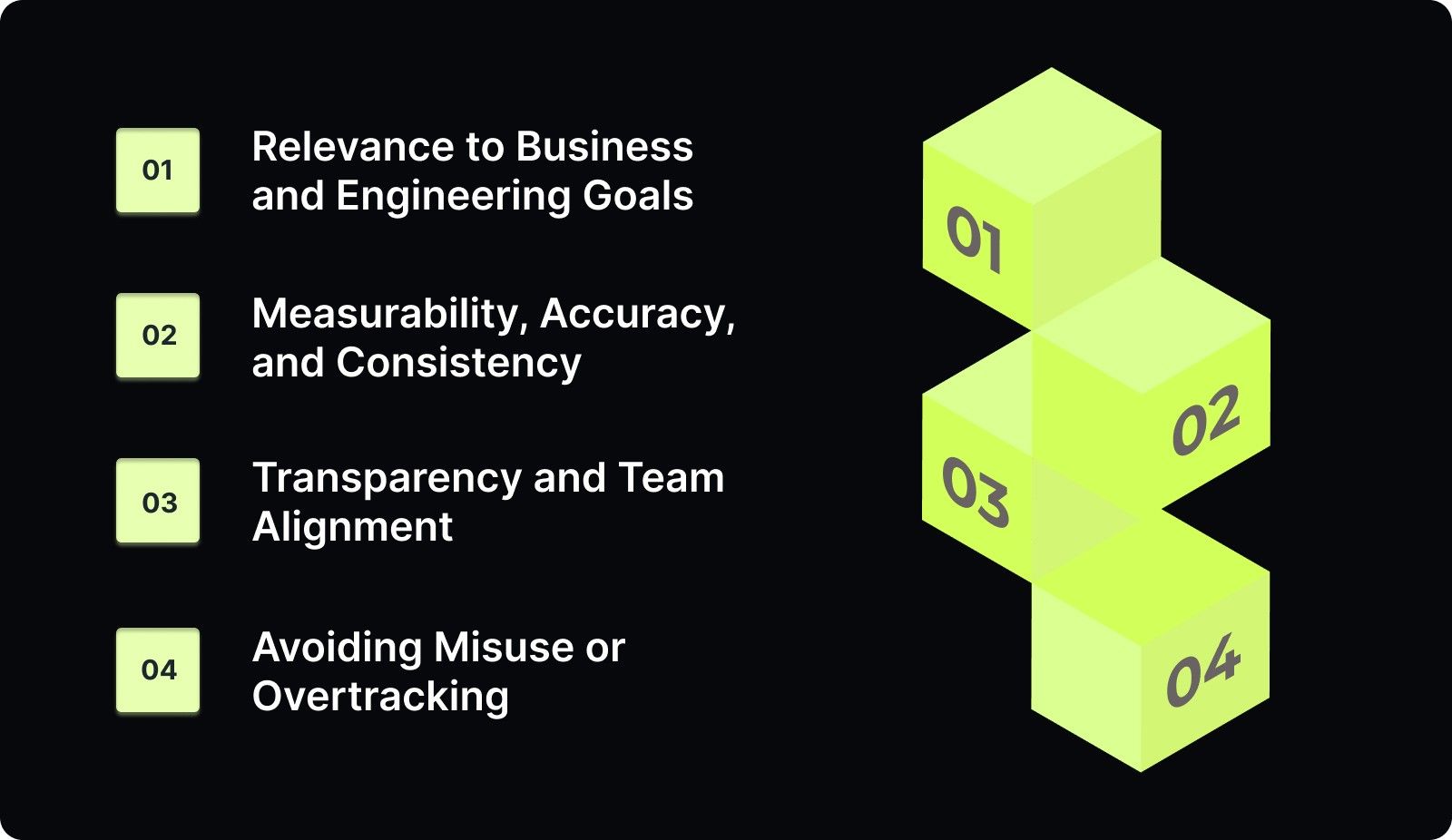
1. Relevance to Business and Engineering Goals
Metrics should directly track pull request throughput, sprint completion, bug resolution rates, and feature delivery, connecting day-to-day developer output to business impact and strategic engineering objectives.
2. Measurability, Accuracy, and Consistency
Every metric must be clearly defined, consistently measurable, and reliable, allowing you to spot trends in velocity, code quality, and defect resolution without ambiguity.
3. Transparency and Team Alignment
Metrics must be visible across dashboards, ensuring developers, managers, and leaders understand sprint progress, code health, blockers, and overall team performance for coordinated action.
4. Avoiding Misuse or Overtracking
Track only metrics that influence productivity, like MTTR, code churn, and escaped defects, avoiding vanity numbers like total commits or LOC that don’t drive actionable improvements.
By following these principles, you and your team can measure what matters most. Now, let’s dive into the characteristics of high-impact software metrics that move developer productivity and team performance.

Characteristics of High-Impact Metrics
Not all metrics drive engineering productivity. High-impact metrics provide actionable insights, context-rich visibility, and role-specific clarity, helping you optimize workflow, reduce bottlenecks, and improve delivery quality. The characteristics must be:
Actionable: Directly informs decisions and actions, highlighting which PRs, bugs, or tasks need immediate attention. It must ensure measurement gets tangible productivity improvements.
Context-Rich, Not Just Numbers: Provides project stage, team load, or code dependencies, revealing meaningful workflow insights rather than raw counts and improving developer understanding.
Role-Specific Relevance: Tailored for developers, managers, and leaders. Developers see code health and PR throughput, managers track sprint velocity and blockers, and leaders monitor org-wide productivity trends.
Timely and Repeatable: Available in real time and consistently tracked across sprints, enabling rapid responses, pattern spotting, and continuous improvement of team performance.
With high-impact metrics in place, you and your entire team can measure effectively and act decisively. Up next, let’s explore the types of software quality metrics that ensure code, processes, and teams perform at their best.
Types of Software Quality Metrics
To improve engineering productivity, it’s essential to categorize software metrics by what they measure and who benefits from them. Each type highlights actionable insights for developers, managers, and leaders.
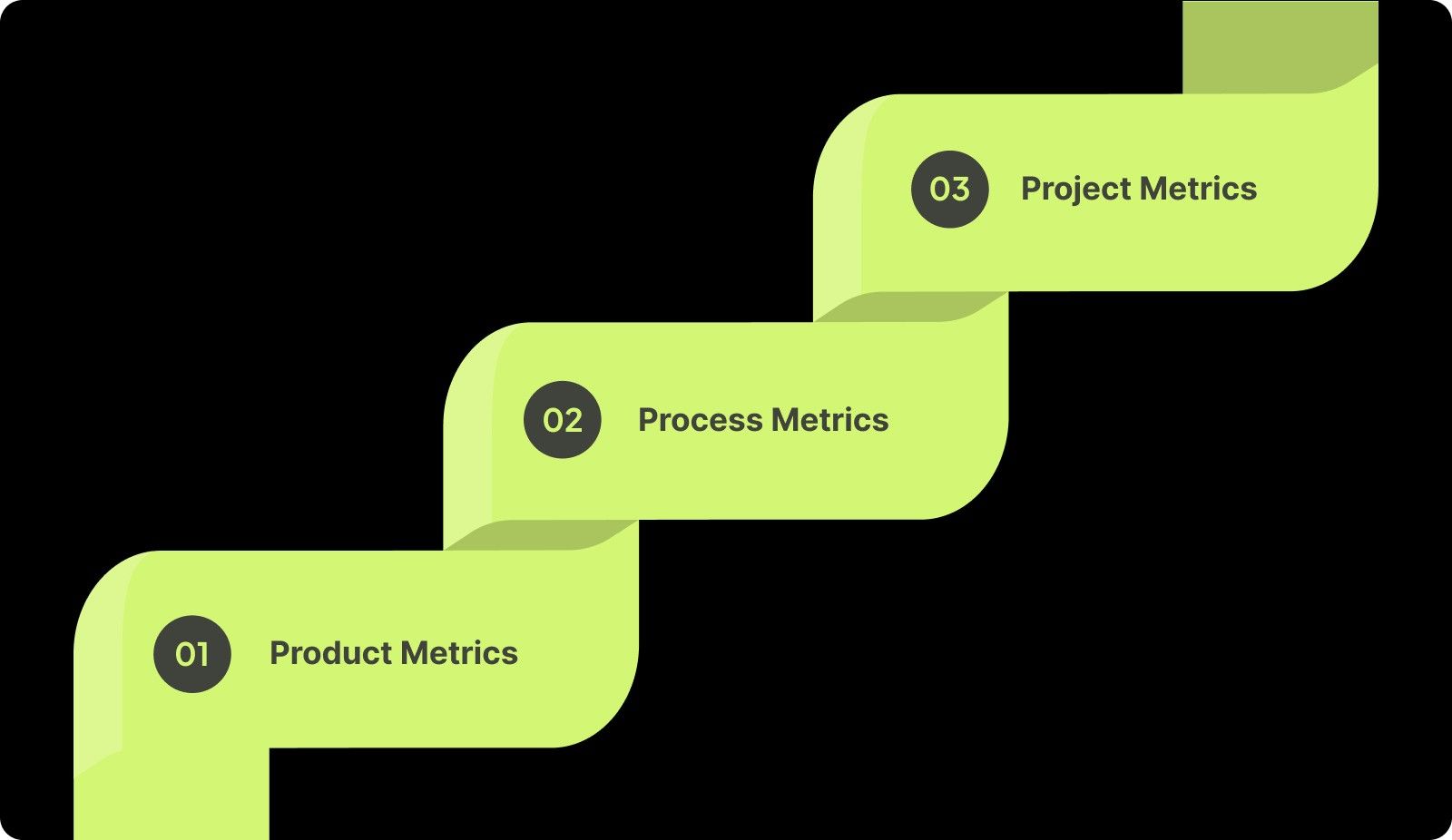
1. Product Metrics
Measure the quality, maintainability, and reliability of the software itself, including code health, defect density, test coverage, escaped bugs, and system uptime. Product metrics help developers deliver stable, production-ready features faster.
2. Process Metrics
Track how engineering work is executed, including PR throughput, sprint velocity, cycle time, code churn, and bottlenecks. They give managers actionable insights to optimize workflows and remove obstacles efficiently.
3. Project Metrics
Focus on project-level performance and delivery outcomes, such as feature completion rates, release frequency, lead time for changes, and alignment with product goals. This enables leaders to make data-driven strategic decisions.
Having categorized these metrics, let’s now explore the specific software metrics that actually push developer productivity, team performance, and engineering outcomes.
Key Software Metrics in Software Engineering
To manage real engineering productivity, you need to focus on the metrics that give you visibility into developer output and operational reliability across every stage of development. Below are the key metrics that help you do exactly that.
1. Developer Productivity Metrics
Developer productivity metrics directly impact developer productivity, code quality, and day-to-day workflow clarity. These metrics include:
Contextual Code Reviews & PR Metrics: You can track PR throughput and code feedback to know which changes need attention, resolve issues faster, and maintain high-quality code without unnecessary back-and-forth.
Automated Documentation & Knowledge Maintenance: Keep your docs and diagrams always up-to-date so your team has context at their fingertips, new members can be onboarded quickly, and no one wastes time searching for answers.
Code Churn & Commit Risk: Monitor frequent rewrites or risky commits to identify unstable areas early, allowing your team to maintain a healthier, more maintainable codebase.
Active Days & Workload Trends: Observe productive coding days and task patterns to spot bottlenecks, balance workloads, and plan sprints that consistently deliver on time.
2. Team & Sprint Performance Metrics
To ensure your team consistently delivers, you need metrics that give visibility into sprint progress, highlight obstacles, and show how efficiently work moves from planning to completion. The following metrics can help you do that:
Sprint Completion vs Planned Work: Track how much work your team completes versus what was planned, so you can identify gaps, adjust priorities, and keep sprints on track.
Bottlenecks & Blockers Analysis: Monitor recurring blockers or slowdowns in workflows to uncover hidden inefficiencies, remove obstacles quickly, and prevent delays from affecting delivery.
Agile Metrics: Cycle Time, Team Focus, Story Points Accuracy: Measure how long tasks take, how focused your team remains, and how accurately you estimate effort to refine planning and improve predictability.
Velocity & Throughput: Keep an eye on overall team output and task completion rates to assess capacity, balance workloads, and continuously improve sprint performance.
3. Software Quality & Reliability Metrics
To keep your codebase robust and your releases predictable, focus on the following metrics that ensure quality, minimize defects, and maintain smooth operations across your engineering workflow:
Code Health & Maintainability: Monitor code complexity, modularity, and technical debt so you can keep your codebase clean, easier to update, and faster to extend without slowing your team down.
Defect Density & Escaped Bugs: Track the number of bugs per lines of code and those that escape to production, so you can prioritize fixes and prevent recurring issues.
Test Coverage & Effectiveness: Measure how much of your code is tested and how well tests catch issues, helping you reduce failures and improve confidence in every release.
MTBF & MTTR: Keep an eye on the time between failures and the speed of recovery, so you can minimize downtime and maintain seamless service for users.
Lead Time for Changes: Track the time it takes to move code from development to production, helping you optimize processes and deliver features faster.
Release Frequency & Deployment Stability: Monitor how often you deploy and how stable releases are, so your team can iterate quickly without introducing new risks.
System Uptime & Reliability: Ensure your applications remain consistently available and performant, providing a stable foundation for both your team and your users.

4. Security & Risk Metrics
To protect your code and maintain trust, focus on metrics that highlight vulnerabilities, track remediation, and ensure compliance without slowing down your development workflow. These metrics include:
Vulnerability Density & Critical Risks: Monitor the number and severity of vulnerabilities in your code so you can prioritize fixes and reduce the likelihood of high-impact security incidents.
Patch & Remediation Times: Track how quickly issues are resolved from detection to deployment, helping your team respond efficiently and minimize exposure to risks.
Compliance & Audit Metrics: Keep an eye on adherence to standards, policies, and regulatory requirements, ensuring your engineering practices remain secure, auditable, and aligned with organizational guidelines.
5. Collaboration & Communication Metrics
Collaboration and communication metrics help team alignment and productivity. Focus on the following metrics to improve communication, manage reviews, and ensure collaboration flows smoothly across all tools and teams:
Code Review Feedback Time: Track how quickly your team provides review feedback so you can reduce delays, prevent issues, and keep development moving efficiently.
PR Acceptance Rate: Monitor the rate at which pull requests are approved, helping you identify areas where processes, code quality, or communication can be improved.
Cross-team Collaboration Metrics (Slack/Notion/IDE integration insights): Observe how effectively your team communicates and shares knowledge across tools, ensuring collaboration doesn’t break down and context stays accessible.
Once you understand which metrics matter, the next step is learning how to implement them effectively. Doing so can help your team to turn data into actionable insights and real productivity gains.
Also Read: How to Manage an Engineering Team: 10 Steps and Expert Tips
How to Implement Metrics Effectively?
To get real value from your metrics, you need to implement them in a way that helps you make decisions faster. Follow the steps below to learn how to implement metrics effectively:
1. Align Metrics with OKRs and Team Goals
You should focus only on metrics that directly connect your daily engineering work to team objectives and business outcomes. This ensures every measurement brings faster delivery, higher code quality, and tangible impact.
2. Prioritize Metrics that Are Actionable and Easy to Measure
Pick metrics you can track consistently and act on immediately. This avoids data that clutters dashboards or distracts your team from solving the issues that truly slow development.
3. Track Trends and Patterns Over Time
You need to observe patterns across sprints and releases, not just snapshots, so you can identify recurring bottlenecks, optimize processes, and continuously improve your team’s performance predictably.
4. Use Metrics to Drive Iterative Improvements (Agile & DevOps Context)
Use your metrics to guide incremental changes in Agile or DevOps workflows. This helps you reduce blockers, boost delivery, and refine processes for higher-quality code and faster releases.
After learning how to implement metrics successfully, it’s time to recognize the obstacles that can prevent your team from gaining real insights.
Challenges in Tracking Software Metrics
Even with the right metrics, you can run into obstacles that prevent your team from gaining real output and improving engineering productivity. Common challenges include:
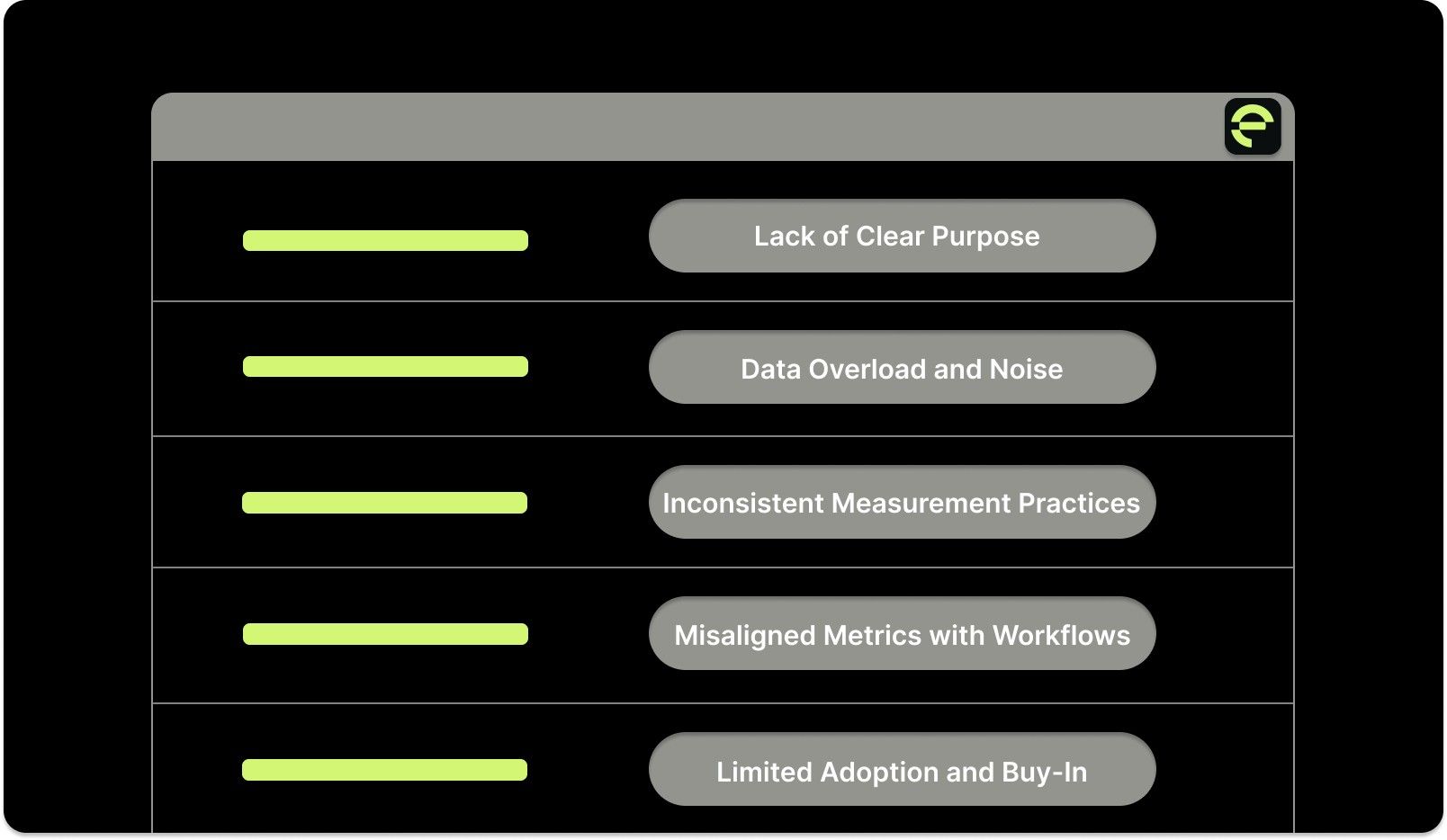
1. Lack of Clear Purpose
You may struggle if your team isn’t aligned on why metrics matter. Without a clear goal, data collection can feel like busywork rather than a tool for faster delivery and higher-quality code.
2. Data Overload and Noise
Tracking too many metrics or irrelevant data can overwhelm you, making it hard to focus on what truly affects developer productivity, sprint outcomes, and code quality.
3. Inconsistent Measurement Practices
If metrics aren’t measured consistently across teams or sprints, you can’t compare performance meaningfully, spot trends, or make confident, data-driven decisions.
4. Misaligned Metrics with Workflows
Metrics that don’t reflect your actual engineering process can mislead you, causing wasted effort, unnecessary reporting, and decisions that slow down delivery instead of improving it.
5. Limited Adoption and Buy-In
Even well-chosen metrics fail if your team or leadership doesn’t actively use them. Without adoption, insights won’t translate into actionable changes, and productivity gains remain theoretical.
After understanding the common obstacles in tracking meaningful software metrics, it’s time to see how a unified platform like Entelligence AI can help you gain clarity and improve engineering productivity.
Also Read: An Ultimate Guide to Agile OKRs: Benefits, Importance and Examples
How Entelligence AI Helps You Overcome Metrics Challenges?
Tracking meaningful software metrics can be challenging. You might face inconsistent measurement, data overload, or limited visibility into team performance, making it hard to improve code quality and engineering productivity.
Entelligence AI provides a unified platform that connects code quality, security, and team performance, so you can track actionable metrics, gain clarity across sprints, and understand how your engineering organization is performing.
Key Features of Entelligence AI:
Contextual Code Reviews & PR Insights: Get in-IDE feedback to focus on critical issues, resolve pull requests efficiently, and maintain higher-quality code.
Team & Sprint Analytics: Track sprint completion, velocity, bottlenecks, and Agile metrics to gain a clear view of team progress.
Software Quality & Reliability Dashboards: Monitor code health, defect trends, test coverage, and release stability to maintain a more predictable development workflow.
Collaboration Metrics & Leaderboards: Gain visibility into review cycles, PR acceptance, and team collaboration across tools.
With Entelligence AI, you get a single platform that centralizes essential engineering metrics, helping your team reduce manual tracking and improve overall delivery clarity.

Conclusion
Tracking the right software metrics is essential to boosting developer productivity, maintaining high code quality, and ensuring predictable team performance. By focusing on actionable, context-rich metrics across code, sprints, and collaboration, you can identify bottlenecks, optimize workflows, and make data-driven decisions that directly improve engineering outcomes.
Entelligence AI helps you overcome these challenges by providing a single platform for contextual code reviews, PR insights, team and sprint analytics, and software quality dashboards. With real-time visibility into defect trends, sprint progress, and code health, you can align your engineering team around measurable productivity goals.
Ready to see how Entelligence can simplify your engineering metrics, improve team productivity, and deliver high-quality software faster? Book a demo with us today to experience it in action!
FAQs
1. What are the benefits of Software Metrics?
Software metrics give you visibility into developer productivity, code quality, sprint progress, and team performance. They help prioritize work, identify bottlenecks, reduce defects, optimize workflows, and enable data-driven decisions that improve engineering efficiency and delivery predictability.
2. What are the 4 key flow metrics?
The four key flow metrics are: Lead Time (time from work start to delivery), Cycle Time (time to complete tasks), Throughput (tasks completed in a period), and Work in Progress (WIP), all revealing process efficiency.
3. What are the best practices of Software Metrics?
Focus on actionable, context-rich metrics aligned with business and engineering goals. Track consistently, ensure transparency, avoid excessive metrics, review trends periodically, and use insights to improve workflows, code quality, sprint planning, and organizational productivity.
4. What are some of the disadvantages of Software Metrics?
Excessive or irrelevant metrics can create noise, demotivate teams, and mislead decision-making. Poorly defined metrics may encourage vanity measurements, waste resources, or obscure actionable insights, reducing engineering productivity instead of improving it.

Behind every successful software team is a clear understanding of what’s actually happening in their code, workflows, and delivery process. Without visibility, teams rely on assumptions about productivity, quality, and progress, which often leads to delays, rework, and missed expectations.
This is where software metrics step in. As engineering teams scale, the need to measure performance, reliability, and efficiency becomes essential. The growing focus on developer productivity reflects this shift, with the global developer productivity analytics market projected to reach $11.9 billion by 2033.
In this blog, we will discuss how software metrics help teams gain clarity, improve outcomes, and make better engineering decisions across the development lifecycle.
Overview
Software metrics give you clear visibility into developer output, team performance, and code quality, helping you make informed, actionable decisions across every stage of engineering.
High-impact metrics are actionable, context-rich, role-specific, and timely, allowing teams to optimize workflows, reduce bottlenecks, and improve sprint predictability without creating unnecessary noise.
Categorizing metrics into product, process, and project types ensures you track code quality, workflow efficiency, and project outcomes for both tactical and strategic engineering decisions.
Focusing on developer productivity, sprint performance, code reliability, security, and collaboration metrics helps teams identify issues, balance workloads, and deliver high-quality software consistently.
Implementing metrics effectively requires alignment with team goals, actionable tracking, trend analysis, and iterative improvements, while avoiding data overload, misalignment, or inconsistent measurement practices.
What Is Software Measurement & Why It Matters?
Software measurement is the process of tracking the metrics that truly reveal engineering productivity, from individual code quality and pull requests to sprint progress and team collaboration. Think of it as a health check-up for your development workflow. Without it, it’s impossible to know what’s slowing your team down, where bugs are hiding, or which processes waste time.
Why it matters: engineering teams that track actionable, context-rich metrics can:
Deliver features faster
Reduce rework and production issues
Improve code quality consistently
Make data-driven decisions instead of relying on guesswork
The right metrics provide clarity across developers, teams, and the org, enabling focus on what actually drives engineering impact and better product outcomes.
Also Read: Top 34 Continuous Integration Metrics Every Engineering Team Should Track
Principles of Effective Software Measurement
To get real engineering productivity, software metrics must be actionable. It must be tied to measurable developer output, sprint performance, and team efficiency, providing clarity without unnecessary overhead.

1. Relevance to Business and Engineering Goals
Metrics should directly track pull request throughput, sprint completion, bug resolution rates, and feature delivery, connecting day-to-day developer output to business impact and strategic engineering objectives.
2. Measurability, Accuracy, and Consistency
Every metric must be clearly defined, consistently measurable, and reliable, allowing you to spot trends in velocity, code quality, and defect resolution without ambiguity.
3. Transparency and Team Alignment
Metrics must be visible across dashboards, ensuring developers, managers, and leaders understand sprint progress, code health, blockers, and overall team performance for coordinated action.
4. Avoiding Misuse or Overtracking
Track only metrics that influence productivity, like MTTR, code churn, and escaped defects, avoiding vanity numbers like total commits or LOC that don’t drive actionable improvements.
By following these principles, you and your team can measure what matters most. Now, let’s dive into the characteristics of high-impact software metrics that move developer productivity and team performance.

Characteristics of High-Impact Metrics
Not all metrics drive engineering productivity. High-impact metrics provide actionable insights, context-rich visibility, and role-specific clarity, helping you optimize workflow, reduce bottlenecks, and improve delivery quality. The characteristics must be:
Actionable: Directly informs decisions and actions, highlighting which PRs, bugs, or tasks need immediate attention. It must ensure measurement gets tangible productivity improvements.
Context-Rich, Not Just Numbers: Provides project stage, team load, or code dependencies, revealing meaningful workflow insights rather than raw counts and improving developer understanding.
Role-Specific Relevance: Tailored for developers, managers, and leaders. Developers see code health and PR throughput, managers track sprint velocity and blockers, and leaders monitor org-wide productivity trends.
Timely and Repeatable: Available in real time and consistently tracked across sprints, enabling rapid responses, pattern spotting, and continuous improvement of team performance.
With high-impact metrics in place, you and your entire team can measure effectively and act decisively. Up next, let’s explore the types of software quality metrics that ensure code, processes, and teams perform at their best.
Types of Software Quality Metrics
To improve engineering productivity, it’s essential to categorize software metrics by what they measure and who benefits from them. Each type highlights actionable insights for developers, managers, and leaders.

1. Product Metrics
Measure the quality, maintainability, and reliability of the software itself, including code health, defect density, test coverage, escaped bugs, and system uptime. Product metrics help developers deliver stable, production-ready features faster.
2. Process Metrics
Track how engineering work is executed, including PR throughput, sprint velocity, cycle time, code churn, and bottlenecks. They give managers actionable insights to optimize workflows and remove obstacles efficiently.
3. Project Metrics
Focus on project-level performance and delivery outcomes, such as feature completion rates, release frequency, lead time for changes, and alignment with product goals. This enables leaders to make data-driven strategic decisions.
Having categorized these metrics, let’s now explore the specific software metrics that actually push developer productivity, team performance, and engineering outcomes.
Key Software Metrics in Software Engineering
To manage real engineering productivity, you need to focus on the metrics that give you visibility into developer output and operational reliability across every stage of development. Below are the key metrics that help you do exactly that.
1. Developer Productivity Metrics
Developer productivity metrics directly impact developer productivity, code quality, and day-to-day workflow clarity. These metrics include:
Contextual Code Reviews & PR Metrics: You can track PR throughput and code feedback to know which changes need attention, resolve issues faster, and maintain high-quality code without unnecessary back-and-forth.
Automated Documentation & Knowledge Maintenance: Keep your docs and diagrams always up-to-date so your team has context at their fingertips, new members can be onboarded quickly, and no one wastes time searching for answers.
Code Churn & Commit Risk: Monitor frequent rewrites or risky commits to identify unstable areas early, allowing your team to maintain a healthier, more maintainable codebase.
Active Days & Workload Trends: Observe productive coding days and task patterns to spot bottlenecks, balance workloads, and plan sprints that consistently deliver on time.
2. Team & Sprint Performance Metrics
To ensure your team consistently delivers, you need metrics that give visibility into sprint progress, highlight obstacles, and show how efficiently work moves from planning to completion. The following metrics can help you do that:
Sprint Completion vs Planned Work: Track how much work your team completes versus what was planned, so you can identify gaps, adjust priorities, and keep sprints on track.
Bottlenecks & Blockers Analysis: Monitor recurring blockers or slowdowns in workflows to uncover hidden inefficiencies, remove obstacles quickly, and prevent delays from affecting delivery.
Agile Metrics: Cycle Time, Team Focus, Story Points Accuracy: Measure how long tasks take, how focused your team remains, and how accurately you estimate effort to refine planning and improve predictability.
Velocity & Throughput: Keep an eye on overall team output and task completion rates to assess capacity, balance workloads, and continuously improve sprint performance.
3. Software Quality & Reliability Metrics
To keep your codebase robust and your releases predictable, focus on the following metrics that ensure quality, minimize defects, and maintain smooth operations across your engineering workflow:
Code Health & Maintainability: Monitor code complexity, modularity, and technical debt so you can keep your codebase clean, easier to update, and faster to extend without slowing your team down.
Defect Density & Escaped Bugs: Track the number of bugs per lines of code and those that escape to production, so you can prioritize fixes and prevent recurring issues.
Test Coverage & Effectiveness: Measure how much of your code is tested and how well tests catch issues, helping you reduce failures and improve confidence in every release.
MTBF & MTTR: Keep an eye on the time between failures and the speed of recovery, so you can minimize downtime and maintain seamless service for users.
Lead Time for Changes: Track the time it takes to move code from development to production, helping you optimize processes and deliver features faster.
Release Frequency & Deployment Stability: Monitor how often you deploy and how stable releases are, so your team can iterate quickly without introducing new risks.
System Uptime & Reliability: Ensure your applications remain consistently available and performant, providing a stable foundation for both your team and your users.

4. Security & Risk Metrics
To protect your code and maintain trust, focus on metrics that highlight vulnerabilities, track remediation, and ensure compliance without slowing down your development workflow. These metrics include:
Vulnerability Density & Critical Risks: Monitor the number and severity of vulnerabilities in your code so you can prioritize fixes and reduce the likelihood of high-impact security incidents.
Patch & Remediation Times: Track how quickly issues are resolved from detection to deployment, helping your team respond efficiently and minimize exposure to risks.
Compliance & Audit Metrics: Keep an eye on adherence to standards, policies, and regulatory requirements, ensuring your engineering practices remain secure, auditable, and aligned with organizational guidelines.
5. Collaboration & Communication Metrics
Collaboration and communication metrics help team alignment and productivity. Focus on the following metrics to improve communication, manage reviews, and ensure collaboration flows smoothly across all tools and teams:
Code Review Feedback Time: Track how quickly your team provides review feedback so you can reduce delays, prevent issues, and keep development moving efficiently.
PR Acceptance Rate: Monitor the rate at which pull requests are approved, helping you identify areas where processes, code quality, or communication can be improved.
Cross-team Collaboration Metrics (Slack/Notion/IDE integration insights): Observe how effectively your team communicates and shares knowledge across tools, ensuring collaboration doesn’t break down and context stays accessible.
Once you understand which metrics matter, the next step is learning how to implement them effectively. Doing so can help your team to turn data into actionable insights and real productivity gains.
Also Read: How to Manage an Engineering Team: 10 Steps and Expert Tips
How to Implement Metrics Effectively?
To get real value from your metrics, you need to implement them in a way that helps you make decisions faster. Follow the steps below to learn how to implement metrics effectively:
1. Align Metrics with OKRs and Team Goals
You should focus only on metrics that directly connect your daily engineering work to team objectives and business outcomes. This ensures every measurement brings faster delivery, higher code quality, and tangible impact.
2. Prioritize Metrics that Are Actionable and Easy to Measure
Pick metrics you can track consistently and act on immediately. This avoids data that clutters dashboards or distracts your team from solving the issues that truly slow development.
3. Track Trends and Patterns Over Time
You need to observe patterns across sprints and releases, not just snapshots, so you can identify recurring bottlenecks, optimize processes, and continuously improve your team’s performance predictably.
4. Use Metrics to Drive Iterative Improvements (Agile & DevOps Context)
Use your metrics to guide incremental changes in Agile or DevOps workflows. This helps you reduce blockers, boost delivery, and refine processes for higher-quality code and faster releases.
After learning how to implement metrics successfully, it’s time to recognize the obstacles that can prevent your team from gaining real insights.
Challenges in Tracking Software Metrics
Even with the right metrics, you can run into obstacles that prevent your team from gaining real output and improving engineering productivity. Common challenges include:

1. Lack of Clear Purpose
You may struggle if your team isn’t aligned on why metrics matter. Without a clear goal, data collection can feel like busywork rather than a tool for faster delivery and higher-quality code.
2. Data Overload and Noise
Tracking too many metrics or irrelevant data can overwhelm you, making it hard to focus on what truly affects developer productivity, sprint outcomes, and code quality.
3. Inconsistent Measurement Practices
If metrics aren’t measured consistently across teams or sprints, you can’t compare performance meaningfully, spot trends, or make confident, data-driven decisions.
4. Misaligned Metrics with Workflows
Metrics that don’t reflect your actual engineering process can mislead you, causing wasted effort, unnecessary reporting, and decisions that slow down delivery instead of improving it.
5. Limited Adoption and Buy-In
Even well-chosen metrics fail if your team or leadership doesn’t actively use them. Without adoption, insights won’t translate into actionable changes, and productivity gains remain theoretical.
After understanding the common obstacles in tracking meaningful software metrics, it’s time to see how a unified platform like Entelligence AI can help you gain clarity and improve engineering productivity.
Also Read: An Ultimate Guide to Agile OKRs: Benefits, Importance and Examples
How Entelligence AI Helps You Overcome Metrics Challenges?
Tracking meaningful software metrics can be challenging. You might face inconsistent measurement, data overload, or limited visibility into team performance, making it hard to improve code quality and engineering productivity.
Entelligence AI provides a unified platform that connects code quality, security, and team performance, so you can track actionable metrics, gain clarity across sprints, and understand how your engineering organization is performing.
Key Features of Entelligence AI:
Contextual Code Reviews & PR Insights: Get in-IDE feedback to focus on critical issues, resolve pull requests efficiently, and maintain higher-quality code.
Team & Sprint Analytics: Track sprint completion, velocity, bottlenecks, and Agile metrics to gain a clear view of team progress.
Software Quality & Reliability Dashboards: Monitor code health, defect trends, test coverage, and release stability to maintain a more predictable development workflow.
Collaboration Metrics & Leaderboards: Gain visibility into review cycles, PR acceptance, and team collaboration across tools.
With Entelligence AI, you get a single platform that centralizes essential engineering metrics, helping your team reduce manual tracking and improve overall delivery clarity.

Conclusion
Tracking the right software metrics is essential to boosting developer productivity, maintaining high code quality, and ensuring predictable team performance. By focusing on actionable, context-rich metrics across code, sprints, and collaboration, you can identify bottlenecks, optimize workflows, and make data-driven decisions that directly improve engineering outcomes.
Entelligence AI helps you overcome these challenges by providing a single platform for contextual code reviews, PR insights, team and sprint analytics, and software quality dashboards. With real-time visibility into defect trends, sprint progress, and code health, you can align your engineering team around measurable productivity goals.
Ready to see how Entelligence can simplify your engineering metrics, improve team productivity, and deliver high-quality software faster? Book a demo with us today to experience it in action!
FAQs
1. What are the benefits of Software Metrics?
Software metrics give you visibility into developer productivity, code quality, sprint progress, and team performance. They help prioritize work, identify bottlenecks, reduce defects, optimize workflows, and enable data-driven decisions that improve engineering efficiency and delivery predictability.
2. What are the 4 key flow metrics?
The four key flow metrics are: Lead Time (time from work start to delivery), Cycle Time (time to complete tasks), Throughput (tasks completed in a period), and Work in Progress (WIP), all revealing process efficiency.
3. What are the best practices of Software Metrics?
Focus on actionable, context-rich metrics aligned with business and engineering goals. Track consistently, ensure transparency, avoid excessive metrics, review trends periodically, and use insights to improve workflows, code quality, sprint planning, and organizational productivity.
4. What are some of the disadvantages of Software Metrics?
Excessive or irrelevant metrics can create noise, demotivate teams, and mislead decision-making. Poorly defined metrics may encourage vanity measurements, waste resources, or obscure actionable insights, reducing engineering productivity instead of improving it.
We raised $5M to run your Engineering team on Autopilot
Watch our launch video
Talk to Sales
Turn engineering signals into leadership decisions
Connect with our team to see how Entelliegnce helps engineering leaders with full visibility into sprint performance, Team insights & Product Delivery
Talk to Sales
Turn engineering signals into leadership decisions
Connect with our team to see how Entelliegnce helps engineering leaders with full visibility into sprint performance, Team insights & Product Delivery
Try Entelligence now